
Career Growth

Interview Questions For A Full Stack Developer
Introduction
Full stack interviews have a reputation problem: candidates prepare for a hundred trivia questions and then get evaluated on something else entirely.
The best interview questions for a full stack developer don't test whether you've memorized what REST stands for. They test whether you can carry a feature from database schema to browser render, explain your trade-offs, and, increasingly in 2026, prove you understand code that AI tools helped you write.
That last part is new and worth taking seriously. With most developers now working alongside tools like GitHub Copilot and Cursor, interviewers have started asking candidates to reason through code without AI assistance. Hiring managers have grown blunt about it: fluency you can't explain is fluency you don't have.
This guide organizes the questions you'll actually face by interview round, covers what strong answers sound like, and flags what interviewers are really listening for at each stage. Whether you're the candidate or the person running the loop, the list works both ways.
TL;DR
- Full stack interviews typically run four rounds: a screening call, a frontend/backend technical deep dive, a system design round, and a behavioral round, with live coding woven in.
- Interviewers weight depth over breadth: one stack explained well (React + Node + PostgreSQL, for instance) beats surface familiarity with five frameworks.
- The 2026 twist is AI fluency: expect questions like "explain what this function does without AI context" and "when did an AI tool actually save you time?"
- System design carries the most weight for mid and senior roles; practice designing one complete feature end to end, including caching, auth, and failure handling.
- Demand stays strong: the Bureau of Labor Statistics projects roughly 16% growth for web developer roles through 2034, several times the average across all occupations.
How full stack interviews are structured
Most companies run a version of the same loop. Knowing the structure tells you where to spend your preparation hours:
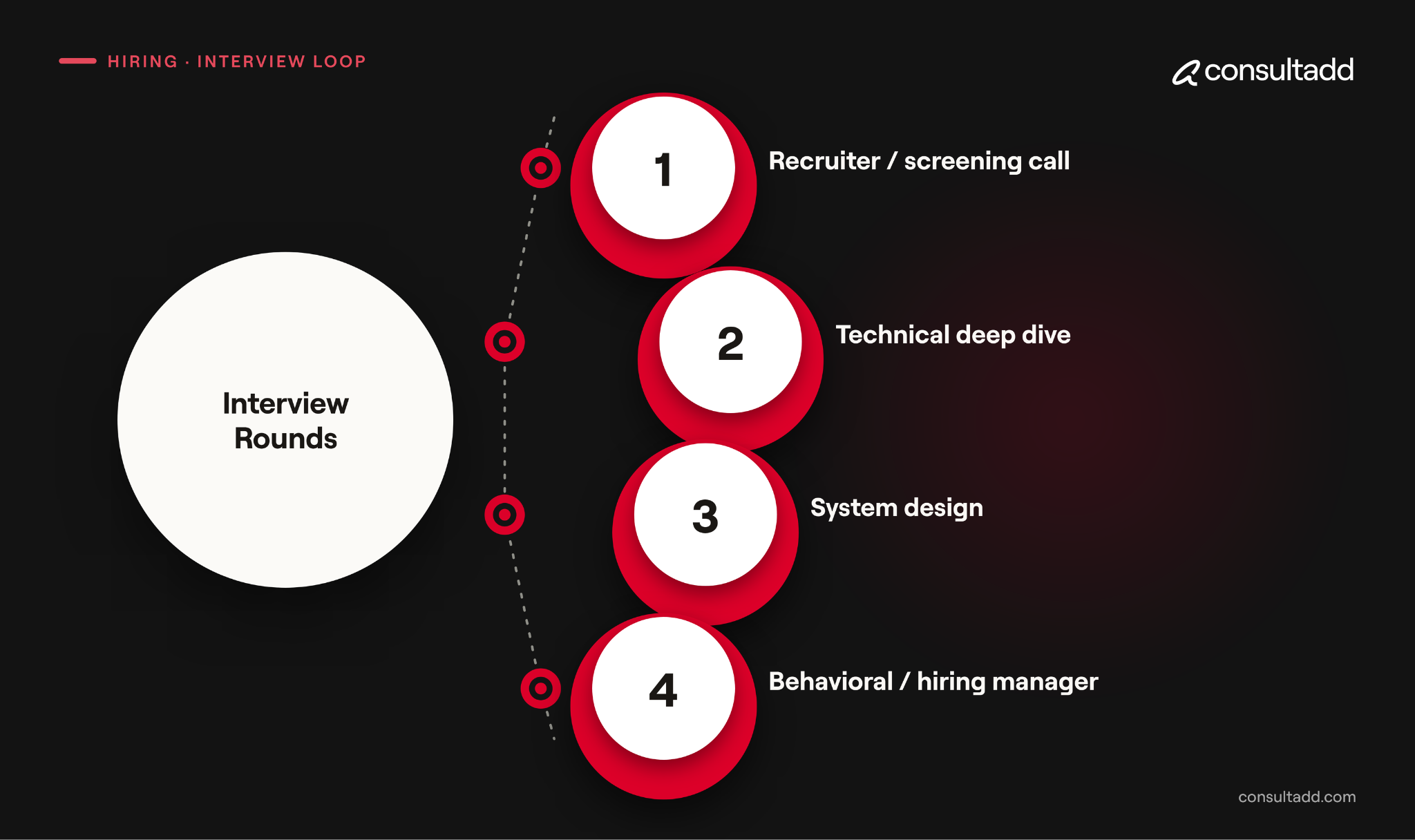
Two structural notes:
- First, "full stack" doesn't mean equal depth everywhere; interviewers expect a center of gravity (frontend-leaning or backend-leaning) with working competence on the other side. Say which one you are early; it sets fair expectations.
- Second, seniority shifts the weight: junior loops emphasize the technical deep dive, senior loops live and die in system design.
The general preparation principles from our coding interview playbook apply throughout, so I'll keep this guide focused on the full stack specific material.
Frontend interview questions
The frontend round in 2026 is overwhelmingly React and TypeScript territory, with the occasional Vue or Angular shop. Expect questions like:
1. What's the difference between state and props, and when does lifting state up become a problem?
Strong answers go past definitions into prop drilling, context, and when to reach for external state management rather than defaulting to it.
2. Explain how React re-renders. What actually triggers one, and how do you prevent unnecessary renders?
Interviewers listen for reconciliation, keys, memoization (React.memo, useMemo, useCallback), and, crucially, when memoizing is premature.
3. What are React Server Components, and what problem do they solve?
This one separates candidates who've worked in modern Next.js from those who stopped learning in 2022.
4. How does the browser go from HTML to pixels?
The rendering pipeline: parsing, DOM/CSSOM, layout, paint, composite. It underlies every performance question that follows.
5. A page is slow. Walk me through your diagnosis.
The expected shape: measure first (Lighthouse, DevTools performance tab), identify whether it's network, render, or JavaScript execution, then fix and re-measure. Jumping straight to "I'd lazy-load images" without measuring is the junior tell.
6. How do you handle forms and validation in a large app?
Controlled vs uncontrolled inputs, client vs server validation, and why you always validate on the server anyway.
7. Explain CORS in plain terms.
A perennial. If you can explain why the browser blocks the request and what the server must do about it, you understand the web's security model better than most.
Backend and API interview questions
Node.js dominates full stack backend interviews, with Python (Django/FastAPI) and Java (Spring Boot) close behind. The questions probe production thinking, not syntax:
1. Design a REST API for a resource, say, orders. What do your endpoints, status codes, and error responses look like?
Interviewers watch for consistent naming, correct verbs, pagination, versioning, and meaningful errors rather than 200-with-an-error-body.
2. REST vs GraphQL: when would you choose each?
The answer they want is a trade-off analysis (over-fetching vs caching complexity), not a tribal preference.
3. How do you handle authentication? Compare sessions and JWTs.
Expect follow-ups on token storage, expiry, refresh flows, and why localStorage for tokens makes security reviewers wince.
4. What happens, in as much detail as you can give, when a user submits a form on your site?
The classic end-to-end question, and arguably the single best full stack filter ever devised: DNS, TLS, request, middleware, validation, database write, response, re-render. Depth here correlates with real experience almost perfectly.
5. How do you make an endpoint idempotent, and why does it matter?
Payment and retry scenarios. If a candidate has never thought about duplicate requests, they haven't run anything important in production.
6. How would you rate-limit an API?
Token bucket vs fixed window, where the limiter lives, and what the client experience of a 429 should be.
7. How does the Node.js event loop work, and what happens when you block it?
The single most asked Node question. Strong answers cover the phases, why CPU-heavy work starves other requests, and remedies (worker threads, queues, offloading).
Database interview questions
Weak SQL sinks more full stack candidates than weak JavaScript, and interviewers in 2026 know it:
1. SQL vs NoSQL: how do you actually choose?
Consistency needs, query patterns, and schema flexibility, with a concrete example from your own work.
2. What is an index, how does it work, and when does adding one hurt?
B-trees at a conceptual level, faster reads, slower writes, and the discipline of indexing based on query patterns rather than vibes.
3. Write a query joining two tables with an aggregate, then optimize it.
Live SQL is back in fashion. Practice GROUP BY, HAVING, and reading an EXPLAIN plan.
4. Explain a transaction and the ACID properties with a real scenario.
The money-transfer example is fine; bonus points for discussing isolation levels and what a dirty read looks like in practice.
5. What's the N+1 query problem and how have you fixed it?
Every ORM user has hit this. Interviewers love it because the answer proves hands-on experience: eager loading, joins, batching with a dataloader.
6. How would you handle a schema migration on a live production table with millions of rows?
Backwards-compatible steps, deploy-then-migrate ordering, and never locking a hot table at noon.
System design and DevOps questions
For mid-level and senior roles, this round decides the offer. The prompts are open-ended by design:
1. Design a URL shortener / notification service / file upload feature end to end.
The evaluation isn't the final architecture; it's whether you clarify requirements first, reason about scale honestly, and name your trade-offs out loud.
2. Where would you add caching in a typical web app, and what can go wrong?
Browser, CDN, application (Redis), database. The "what can go wrong" half, invalidation, stale reads, stampedes, is where senior candidates separate.
3. How do you deploy your code today, and how would you improve it?
CI/CD literacy is now table stakes; a full stack developer who can't ship their own code reads as half the role. GitHub Actions, containers, environment promotion, rollback strategy.
4. A production endpoint's latency doubled overnight. Walk me through your investigation.
Logs, metrics, traces, recent deploys, database slow queries. Structured debugging under pressure is exactly what the job is.
5. How do you secure a full stack application?
OWASP basics: injection, XSS, CSRF, secrets management, dependency auditing. Nobody expects a security engineer; everyone expects awareness.
AI-era and behavioral questions
The newest question category, and the one candidates prepare for least. With AI assistants now writing a large share of production code, interviewers probe whether you're directing the tool or the tool is directing you:
1. Here's a function. Explain what it does, without any AI context.
Increasingly common at SaaS companies. It exists because hiring managers have been burned by candidates who couldn't explain their own GitHub history.
2. Tell me about a time an AI coding tool genuinely saved you significant time, and a time it led you astray.
The strong answer is specific and strategic (scaffolding tests, migrating patterns across files) rather than "it autocompletes my boilerplate."
3. How do you verify AI-generated code before shipping it?
Reading it fully, testing edge cases, checking licenses and security patterns. "I trust it for simple stuff" is the wrong answer.
The behavioral round then follows familiar lines: a project you owned end to end, a production incident and what changed afterward, a disagreement about technical direction, a deadline that forced scope cuts. Use a structure (situation, action, result), keep it honest, and pick stories where you can discuss the technical detail if pushed, because good interviewers always push.
Common mistakes and how to prepare
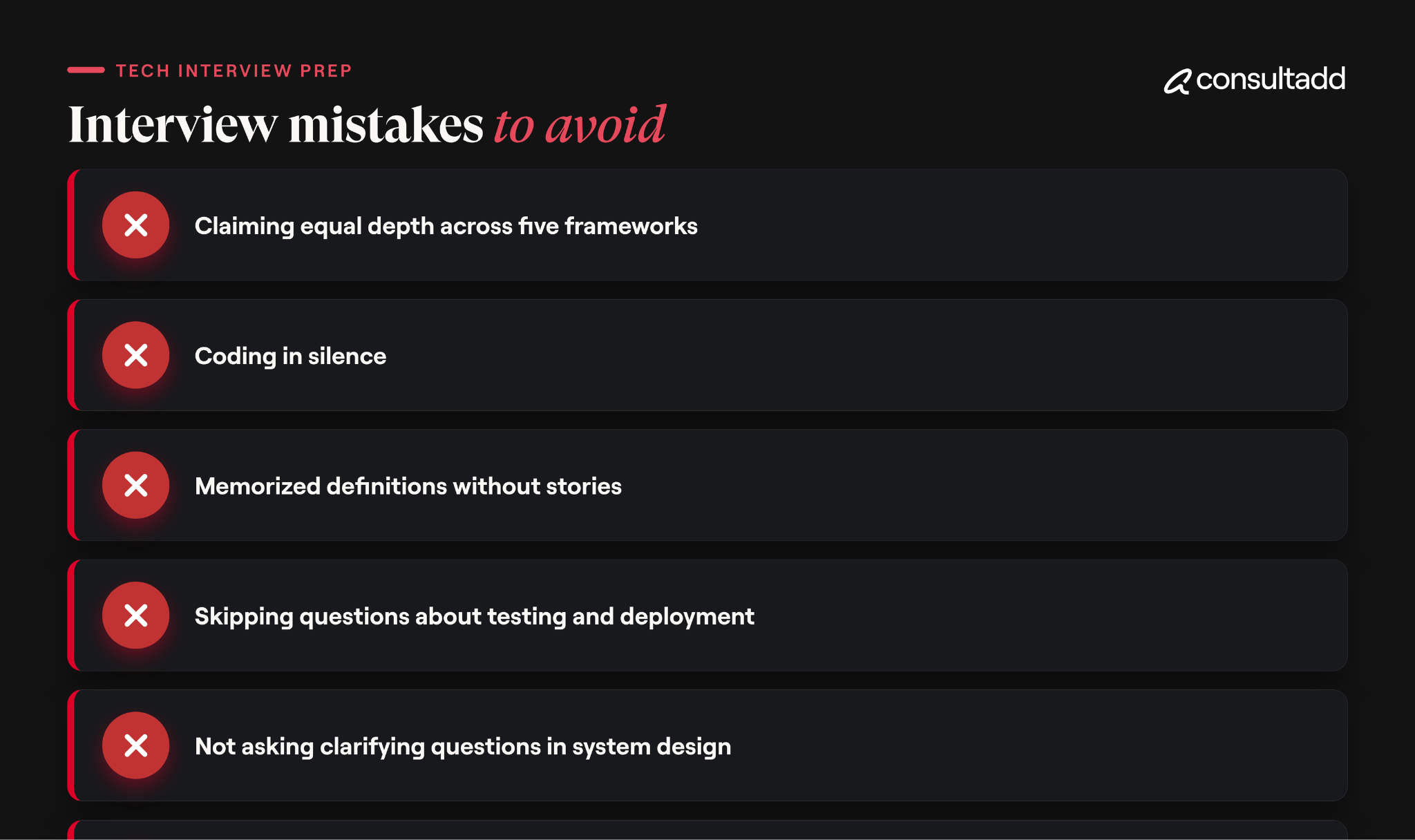
From the hiring side of the table, the same failure patterns repeat across loops:
Preparation that actually works: build or refactor one real project across the full stack and be ready to defend every decision in it, drill live SQL and one end-to-end system design prompt per week, and rehearse explaining code aloud without an editor's help.
The market rewards the effort; median pay for the BLS web developer category was $92,750 as of the latest published data, aggregator ranges for full stack roles run far higher with growth around 16% through 2034.
And if you're on the hiring side, the questions above only work inside a disciplined process: structured scorecards, consistent rubrics, and fast feedback loops.
Slow, improvised loops lose exactly the candidates you want, a pattern we've unpacked in our reviews of what's broken in IT recruitment and the hiring strategies that actually work in 2026
Start Strong With Consultadd
With 15 years in business and 5,000+ successful staffing engagements, we don't just fill roles, we build reliability into your process. We've supported 65 staffing companies in the past year alone and maintain MSAs with industry leaders like Robert Half and TEKsystems.
Here's what working with Consultadd looks like:
- Talent sourced in under 24 hours
- Ready-to-deploy candidates, vetted for experience and compliance
- Lower turnover risk: we match long-term goals, not just short-term needs
- Seamless compliance: visa, documentation, onboarding? Handled.
- Dedicated 1:1 account managers for responsive, personalized support
- Top 100 candidate matches delivered in the past year
- Strong partnerships with universities to tap into fresh, committed talent
- Post-placement support so your investment grows beyond day one
For candidates, your next opportunity is more than just a job title, it's a chance to build skills, gain experience, and move your career forward. At Consultadd, we connect technology professionals with projects and employers that align with their goals, whether they're looking for contract, contract-to-hire, or long-term opportunities.
The tech job market moves fast, but the right guidance can make all the difference. Ready to take the next step in your career journey? Explore Opportunities >>
Key takeaways
- Interview questions for a full stack developer cluster into five areas: frontend (React, rendering, performance), backend (APIs, auth, the event loop), databases (SQL, indexing, N+1), system design, and behavioral.
- Depth beats breadth: interviewers reward one well-explained stack with production stories over surface familiarity with many.
- The "what happens when a user submits a form" end-to-end question remains the single best full stack filter; rehearse it until your answer spans DNS to database and back.
- AI fluency questions are now standard: be ready to explain code without assistance and to describe strategically, not vaguely, how AI tools fit your workflow.
- System design decides mid and senior offers; practice one complete feature design weekly, clarifying requirements first and naming trade-offs out loud.
FAQs
What are the most common interview questions for a full stack developer?
The staples: explain what happens when a user submits a form (end to end), state vs props and re-rendering in React, how the Node.js event loop works, sessions vs JWTs for authentication, SQL joins with optimization, the N+1 query problem, and one open-ended system design prompt such as designing a URL shortener.
How do I prepare for a full stack developer interview?
Pick one primary stack and go deep: build or refactor a real project across frontend, backend, and database, and be ready to defend every decision in it. Drill live SQL, practice one system design prompt weekly, rehearse explaining code aloud, and prepare specific stories about production incidents and AI tool usage.
What technical skills do interviewers test for full stack roles in 2026?
React with TypeScript on the frontend, Node.js (or Python/Java) API design on the backend, SQL fluency including indexing and query optimization, CI/CD and cloud deployment basics, security fundamentals, and increasingly the ability to work with and verify AI-generated code.
How many interview rounds do full stack developers go through?
Typically three to four: a recruiter screen, a technical deep dive with live coding, a system design round, and a behavioral round with the hiring manager. Some companies add a take-home project or pair-programming session. Senior roles weight system design most heavily.
What is the hardest part of a full stack interview?
For most candidates, system design, because it's open-ended and tests judgment rather than recall. The most common failure isn't a wrong architecture but skipping requirements clarification and designing the wrong thing confidently. Database depth is the second most common gap.
Do interviewers care if I use AI coding tools?
They care how you use them. Expect questions asking you to explain code without AI assistance and to describe when a tool genuinely helped versus misled you. Candidates who treat AI as a strategic accelerator, and can verify its output, score well; candidates who can't explain their own code do not.

Java Full Stack Developer Skills: The Complete List
Introduction
Ask ten companies what a full stack developer should know, and you will get ten slightly different answers. But when the backend runs on Java, a clear pattern shows up.
The java full stack developer skills that actually get people hired sit across four areas: server-side Java, a frontend framework, databases, and the cloud tooling that ships it all to production.
This guide lays out each one, with the tools that matter and a checklist by experience level. Whether you are building toward the role or trying to hire for it, you will know exactly what "full stack Java" should mean by the end.
TL;DR
- A Java full stack developer builds both the server side (Java) and the client side (a JavaScript framework) of an application.
- Backend skills center on Core Java, Spring Boot, REST APIs, and a data access layer like Hibernate.
- Frontend skills mean HTML, CSS, modern JavaScript, and usually React or Angular.
- Databases (SQL and NoSQL) plus DevOps tooling (Git, Docker, CI/CD, a cloud platform) round out the role.
- Demand stays strong: the BLS projects software developer jobs to grow much faster than average through 2034.
What a Java full stack developer does
A Java full stack developer builds an application from end to end.
- On the server, they write business logic, design APIs, and handle data using Java and its frameworks.
- On the client, they build the interface users actually touch, usually with a JavaScript framework. Then they help package and deploy the whole thing.
The demand behind the role is real, not hype.
The U.S. Bureau of Labor Statistics projects software developer employment to grow 15% from 2024 to 2034, far above the average for all jobs, with a median wage of about $133,080 as of 2024.
Java sits at the center of a lot of that work, especially in banking, enterprise systems, and large-scale cloud platforms.
Here is the honest part: Nobody is equally expert at all of it. A strong full stack developer is deep in a couple of areas and competent across the rest. That mix is exactly what makes them useful.
The core Java full stack developer skills at a glance
Before the deep dive, here is the whole picture in one view. Think of these as the four layers you need to cover.
Each layer builds on the one before it. You cannot design a clean API without solid Java, and you cannot deploy a service well without understanding what it does. Let's take them in order.
Backend skills every Java full stack developer needs
This is the heart of the role and where Java earns its keep. If your backend is shaky, no amount of frontend polish saves the project.
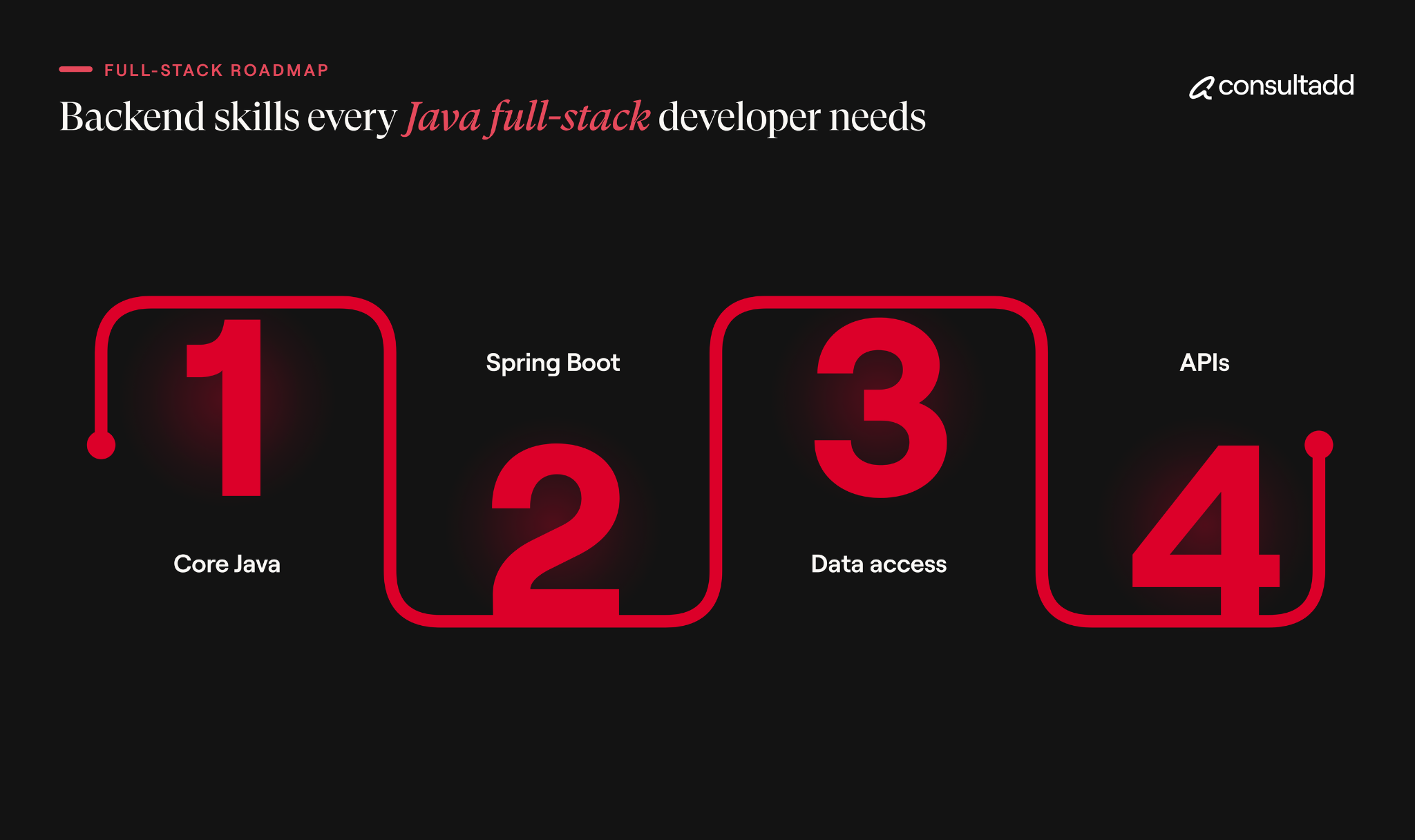
Core Java fundamentals
- Start here, always. That means object-oriented design, collections, exception handling, and generics, plus the modern features that show up in every codebase now: streams, lambdas, and the functional style.
- Concurrency and multithreading matter too, since real applications rarely do one thing at a time.
- Aim for a recent long-term support release. Java 17 or 21 is a safe target, and the fundamentals carry forward no matter which version your employer runs.
- Oracle keeps the official Java documentation and downloads current if you want the canonical reference.
Spring and Spring Boot
- If Core Java is the language, Spring Boot is how you actually build with it at work. It handles the wiring so you can focus on features.
- You will want dependency injection, Spring MVC for web layers, Spring Security for authentication, and Spring Data for the database side.
- The Spring Boot project site is the best starting point for what the framework covers and how its pieces fit.
Databases and data access
- Every application stores data, so you need to speak both dialects.
- Relational databases like PostgreSQL and MySQL cover structured, transactional data. NoSQL options like MongoDB handle flexible or high-volume cases.
- On the Java side, an ORM like Hibernate, usually through Spring Data JPA, maps your objects to tables without writing raw SQL for everything.
- You still need to read and write SQL well, though. Do not skip it.
APIs and microservices
- Modern Java systems are rarely one giant program.
- They are a set of services that talk over REST APIs. So you need to design clean endpoints, use HTTP methods and status codes correctly, and structure JSON responses that a frontend can actually consume.
- Microservice patterns, like splitting a monolith into independent services, are increasingly expected once you move past junior roles.
Frontend skills that round out the stack
The "full" in full stack lives here. You do not need to be a design specialist, but you do need to build a working interface and connect it to your APIs.
The practical advice:
- Get comfortable with HTML, CSS, and modern JavaScript first, then commit to one framework.
- React and Angular both dominate enterprise work, and knowing one well beats knowing both poorly.
- Since your backend already speaks REST, your job on the frontend is to call those APIs and turn the responses into something people can use.
DevOps, cloud, and tooling skills
Writing code is half the job. Shipping it is the other half. This layer is what turns a developer into someone who can own a feature all the way to production.
- Version control with Git, including branching and pull requests, since every team uses it.
- Build tools like Maven or Gradle to manage dependencies and package your app.
- Containers with Docker, and often orchestration with Kubernetes for larger systems.
- CI/CD pipelines (Jenkins, GitHub Actions) that test and deploy automatically.
- A cloud platform, most commonly AWS, for hosting, databases, and scaling.
- Testing with JUnit and Mockito, because untested code is a liability, not a feature.
You will not master all of these on day one, and that is fine. Git and basic testing are entry-level expectations. Docker, CI/CD, and cloud deployment tend to separate mid-level developers from juniors.
Soft skills that separate good from great
Technical range gets you in the door. These keep you in the room. Communication matters because you will explain trade-offs to people who do not code.
Problem-solving matters because most real bugs are not in any tutorial. And the willingness to keep learning matters because the stack you master this year will shift by the next.
Hiring managers notice this fast.
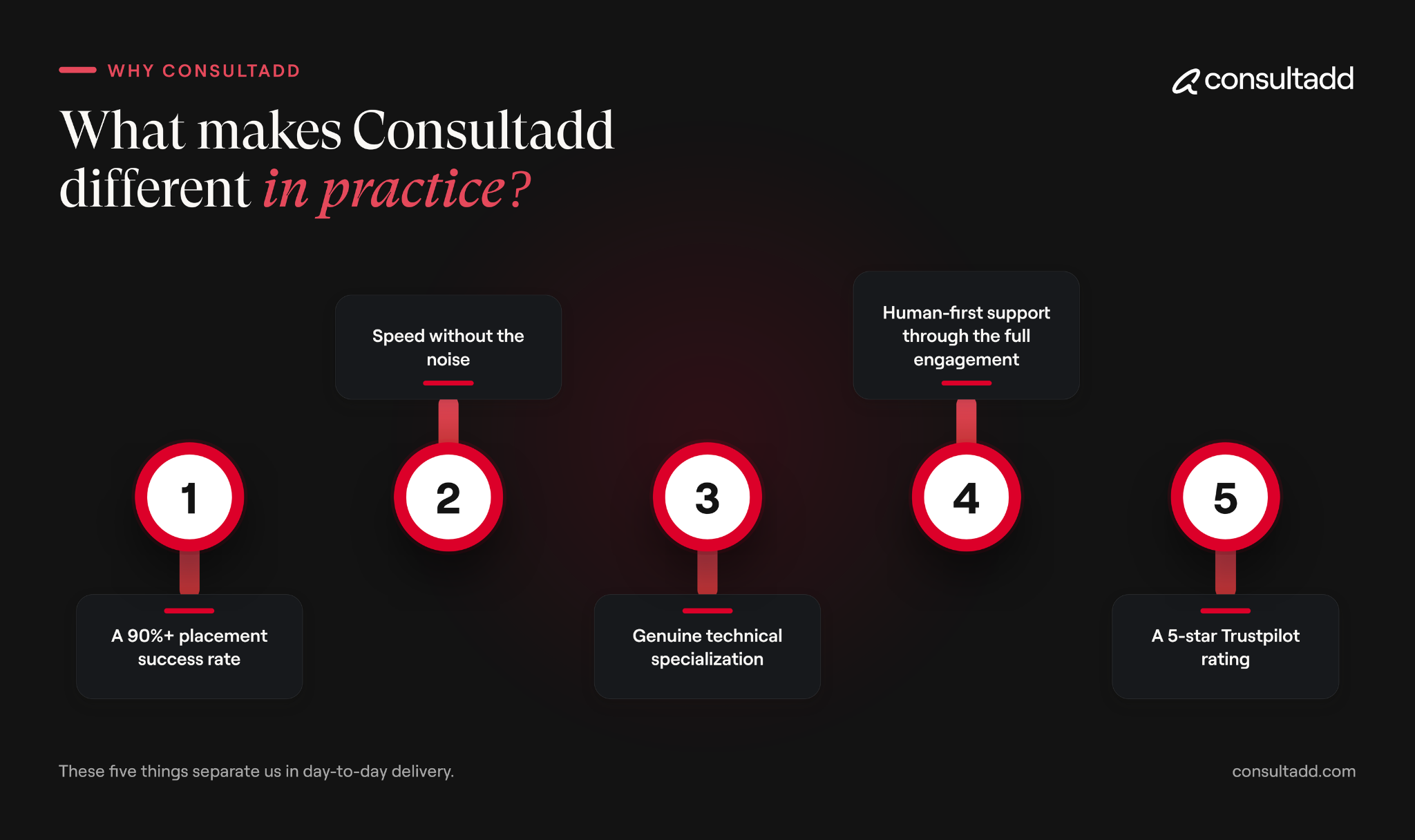
In fact, when Consultadd breaks down how to hire the best software engineers, the recurring theme is that technical brilliance means little if a developer cannot collaborate or adapt.
Skills checklist by experience level
Not every role needs every skill on day one. Here is a rough map of what tends to be expected as you move up.
For a deeper look at scoping technical roles accurately, Consultadd's guide to technical recruitment is worth a read.
The bottom line
The list of java full stack developer skills is long, but the shape is simple: be strong in backend Java and one frontend framework, competent with databases and cloud tooling, and easy to work with. Get those right and you cover what most teams actually need. The rest you pick up on the job, because in this field, you never really stop learning.
Start strong with Consultadd
With 15 years in business and 5,000+ successful staffing engagements, we don't just fill roles, we build reliability into your process. We've supported 65 staffing companies in the past year alone and maintain MSAs with industry leaders like Robert Half and TEKsystems.
Here's what working with Consultadd looks like:
- Talent sourced in under 24 hours
- Ready-to-deploy candidates, vetted for experience and compliance
- Lower turnover risk: we match long-term goals, not just short-term needs
- Seamless compliance: visa, documentation, onboarding? Handled.
- Dedicated 1:1 account managers for responsive, personalized support
- Top 100 candidate matches delivered in the past year
- Strong partnerships with universities to tap into fresh, committed talent
- Post-placement support so your investment grows beyond day one
For candidates, your next opportunity is more than just a job title, it's a chance to build skills, gain experience, and move your career forward. At Consultadd, we connect technology professionals with projects and employers that align with their goals, whether they're looking for contract, contract-to-hire, or long-term opportunities.
The tech job market moves fast, but the right guidance can make all the difference. Ready to take the next step in your career journey? Explore Opportunities >>
Key takeaways
- Java full stack developer skills span four layers: backend Java, frontend, databases, and DevOps or cloud.
- Core Java plus Spring Boot is the backbone, with REST APIs and a data access layer close behind.
- On the frontend, master HTML, CSS, and modern JavaScript, then go deep on React or Angular.
- Git, Docker, CI/CD, testing, and a cloud platform like AWS turn a coder into a shipping developer.
- Demand stays high, so both learners and hiring teams benefit from a clear, level-appropriate skills list.
FAQs
What skills does a Java full stack developer need?
A Java full stack developer needs backend skills (Core Java, Spring Boot, REST APIs, and a data layer like Hibernate), frontend skills (HTML, CSS, JavaScript, and React or Angular), database knowledge across SQL and NoSQL, and DevOps tooling such as Git, Docker, CI/CD, and a cloud platform.
Is Java good for full stack development in 2026?
Yes. Java remains a top choice for enterprise backends, banking systems, and cloud platforms because it is stable, secure, and scales well. Paired with a modern frontend framework, it supports building complete, production-ready applications.
Do I need to know both React and Angular?
No. Most employers want depth in one, not shallow knowledge of both. Pick the framework that matches your target jobs, learn it well, and you can pick up the other later if a role requires it.
How long does it take to become a Java full stack developer?
With consistent, project-based learning, many people reach a job-ready level in six to twelve months. The timeline depends on prior programming experience and how much you build. Real projects and a public portfolio speed things up more than courses alone.
What is the difference between a Java backend developer and a full stack developer?
A backend developer focuses on server-side logic, APIs, and databases in Java. A full stack developer does that plus the frontend, building the user interface and connecting it to the backend. Full stack roles trade some depth for broader coverage.
Which database should a Java full stack developer learn first?
Start with a relational database like PostgreSQL or MySQL, since most enterprise applications rely on structured, transactional data. Once you are comfortable with SQL and an ORM like Hibernate, add a NoSQL option such as MongoDB for flexible or high-volume use cases.
Mastering The Coding Interview: Your 2026 Playbook
Introduction
Most people prepare for coding interviews by grinding problems until their eyes blur, then freeze the moment an interviewer is watching. The grind isn't wrong. It's just not the whole game.
Mastering the coding interview means more than solving hard problems alone at midnight. It means recognizing patterns fast, explaining your thinking out loud, staying calm when you're stuck, and, in 2026, knowing how to work with AI tools when a company hands them to you. Those are learnable skills, not talents you're born with.
This playbook walks through the whole thing: how the process actually works, the fundamentals worth your time, the patterns that unlock most problems, and how to practice so the real interview feels familiar instead of terrifying.
TL;DR
- Mastering the coding interview is about pattern recognition and clear communication, not memorizing hundreds of solutions.
- Build a foundation in data structures and algorithms first, then learn the recurring patterns that solve most problems.
- Practice out loud and under time pressure, because a silent correct answer often scores worse than a well-explained partial one.
- Interviews in 2026 increasingly test how you work with AI, so learn to review and question generated code, not just produce it.
- Consistency beats cramming. A steady plan over weeks works better than a panicked weekend.
What mastering the coding interview really takes
Here's the reframe that helps most people. Interviewers aren't grading whether you can produce perfect code from memory. They're watching how you think.
That means three things matter as much as the final answer. Can you break an unfamiliar problem into steps? Can you talk through your reasoning so someone can follow it? And can you keep moving when the first idea doesn't work?
A candidate who explains a clean approach and gets most of the way there often beats one who silently types a correct solution. The silent solver leaves the interviewer guessing about whether they understood the problem or got lucky.
So mastery isn't a bigger pile of solved problems. It's a repeatable process you can run on a problem you've never seen, while narrating it clearly. Everything below builds toward that.
How the coding interview process works
Before you prepare, it helps to know what you're preparing for. Most tech companies run a multi-stage process, and each stage tests something different.
The coding rounds get the most attention, but the behavioral round sinks more candidates than people expect. Prepare a handful of real stories about projects, conflicts, and failures, and structure them clearly. Understanding how tech hiring actually works from the inside can take some of the mystery out of the loop.
Build your foundation in data structures and algorithms
You can't shortcut this part. Patterns and tricks only work if you understand the tools underneath them.
Focus your energy on the structures that show up again and again: arrays and strings, hash maps, linked lists, stacks and queues, trees, graphs, and heaps. For algorithms, get comfortable with sorting, binary search, recursion, breadth-first and depth-first search, and the basics of dynamic programming.
Alongside the structures, learn to reason about time and space complexity. When an interviewer asks "can you make this faster," they want to hear you think in Big O, not guess. Being able to say why an approach is O(n log n) and what would push it to O(n) is often the difference between a lean and a strong signal.
Don't try to learn everything at once. Pick one structure, understand how it works and when to reach for it, solve a few problems with it, then move on. Depth beats breadth here.
Learn the patterns, not just the problems
This is the single biggest shift that separates people who plateau from people who improve. There are thousands of coding problems, but they cluster into a much smaller set of recurring patterns. Learn the patterns, and unfamiliar problems start looking familiar.
The Grokking the Coding Interview approach popularized this idea, and it holds up. Once you can recognize that a problem is really a sliding window or a two-pointer problem in disguise, you're halfway to the solution before you write a line.
You don't need every pattern on day one. Start with two pointers and sliding window, since they show up constantly and build confidence quickly. Add the rest as you go.
The goal is recognition speed. When you can look at a fresh problem and name the pattern within a minute, you've built the instinct interview reward.
Practice like it's the real interview
Solving problems on paper in silence trains the wrong muscle. Interviews are performances under pressure, so your practice should be too.
Three habits make the difference.
- First, talk out loud the entire time, even when you're alone, so narrating your thinking becomes automatic.
- Second, use a timer, because the clock changes how your brain works and you want that pressure to feel normal.
- Third, do real mock interviews with another person or an AI tool that asks follow-up questions and pushes back.
When you practice, attempt the problem yourself before looking at any hint. The struggle is where the learning happens. If you jump to the solution, you're building recognition of that specific problem, not the ability to solve new ones.
And plan for getting stuck, because you will. Have a routine: restate the problem, work through a small example by hand, think about a brute-force approach first, then look for the pattern that improves it. An interviewer who sees a calm, structured recovery learns more about you than one who sees a fast answer.
The AI-aware interview: what changed in 2026
The biggest recent shift is that many companies stopped pretending AI doesn't exist. Since any engineer can now generate a textbook algorithm in seconds, some employers, including names like Meta, Google, and Microsoft, have started running interviews that let you use AI tools and watch how you do it. This guide to AI-assisted coding interviews tracks how the formats are evolving.
The evaluation changes with the format. Instead of only asking whether you can implement a solution, these interviews look at your judgment: can you write a clear prompt, read generated code critically, spot the subtle bug it introduced, and explain the trade-offs of your design? The skill on display is working with AI without switching your brain off.
A few things worth knowing. The format is still evolving, and companies are experimenting, so don't assume every interview allows AI. Many still forbid it, and using it when it isn't permitted can cost you the offer. When it is allowed, treat it as a collaborator you supervise, not an oracle you trust blindly.
None of this replaces fundamentals. If anything, it raises the bar on them, because you can't judge AI-generated code you don't understand. Strong basics plus good judgment about the tools is the combination companies want.
A study plan that actually sticks
Consistency beats intensity. An hour a day for six weeks does more than a frantic weekend before the interview. Here's a simple structure you can adapt to your timeline.
Track what you get wrong, not just what you solve. A short log of the problems that stumped you, and why, is more useful than a count of completed questions. Revisit those weak spots instead of piling on new problems you can already handle.
If you're aiming at contract or contract-to-hire tech roles, the interview loop can move faster and lean harder on practical skills. ConsultAdd's breakdown of the contract-to-hire path is worth a look if that's the route you're considering.
The through-line is simple. Build the base, learn the patterns, practice out loud, and stay steady. Do that, and the interview stops being a test you dread and becomes a conversation you're ready for.
Start Strong With Consultadd
With 15 years in business and 5,000+ successful staffing engagements, we don't just fill roles, we build reliability into your process. We've supported 65 staffing companies in the past year alone and maintain MSAs with industry leaders like Robert Half and TEKsystems.
Here's what working with Consultadd looks like:
- Talent sourced in under 24 hours
- Ready-to-deploy candidates, vetted for experience and compliance
- Lower turnover risk: we match long-term goals, not just short-term needs
- Seamless compliance: visa, documentation, onboarding? Handled.
- Dedicated 1:1 account managers for responsive, personalized support
- Top 100 candidate matches delivered in the past year
- Strong partnerships with universities to tap into fresh, committed talent
- Post-placement support so your investment grows beyond day one
For candidates, your next opportunity is more than just a job title, it's a chance to build skills, gain experience, and move your career forward. At Consultadd, we connect technology professionals with projects and employers that align with their goals, whether they're looking for contract, contract-to-hire, or long-term opportunities.
The tech job market moves fast, but the right guidance can make all the difference. Ready to take the next step in your career journey? Explore Opportunities >>
Key takeaways
- Mastering the coding interview comes down to pattern recognition and clear communication, not memorizing a huge stack of solutions.
- Build a solid foundation in data structures, algorithms, and Big O before chasing tricks.
- Learn recurring patterns like two pointers and sliding windows so unfamiliar problems start to look familiar.
- Practice out loud and on a timer, and have a calm routine ready for when you get stuck.
- Interviews in 2026 increasingly test judgment with AI tools, so understand the code well enough to question it.
FAQs
How long does it take to prepare for a coding interview?
For most people, six to eight weeks of steady daily practice is enough to feel ready, though it depends on your starting point and the company. Someone rusty on fundamentals may need longer. Consistency matters more than total hours, so an hour a day beats occasional marathon sessions.
Is LeetCode enough to master the coding interview?
It's a great problem bank, but volume alone won't get you there. Pair it with learning the underlying patterns and practicing out loud, since interviews test communication and reasoning, not just correct answers. Use LeetCode to drill, not as your entire strategy.
Can I use AI during a coding interview?
Only when the company explicitly allows it. Some employers now run AI-assisted interviews and watch how you use the tools, while many still forbid them entirely. Using AI when it isn't permitted can cost you the offer, so always confirm the rules before you start.
What programming language should I use in a coding interview?
Use the language you know best, as long as the company allows it. Python is popular for its concise syntax, but Java, C++, and JavaScript are all common and accepted. Fluency matters more than the specific language, since you don't want to fight the syntax while solving the problem.
How many LeetCode problems should I solve?
There's no magic number, and quality beats quantity. Solving 150 problems across the main patterns, with real understanding, is far more useful than rushing through 500. Track the ones you get wrong and revisit them rather than chasing a total.
What should I do if I get stuck during a coding interview?
Stay calm and think out loud. Restate the problem, try a small example by hand, and start with a brute-force approach before optimizing. Interviewers often value a structured recovery from being stuck more than a fast answer, so showing your process helps you even when the solution doesn't come immediately.

How To Not Be Nervous For An Interview
Introduction
Picture this: You’re moments away from the interview for your dream job. Your heart is racing, your palms are sweaty, and a whirlwind of "what ifs" floods your mind. Sound familiar? You're not alone.
Interview anxiety is the uninvited guest at nearly every job seeker's table. But what if you could turn the tables on anxiety and transform those nerves into your most potent ally?
This comprehensive guide doesn't just skim the surface; it dives deep into proven strategies, enriched with expert insights, psychological theories, and practical steps to ensure you walk into your next interview armed with confidence and poise.
TL;DR
- Interview anxiety is normal and can be managed with the right preparation techniques.
- Visualization builds confidence by mentally rehearsing a successful interview before the big day.
- A consistent pre-interview routine helps reduce stress and keeps you focused.
- Controlled breathing and confident posture improve both your mindset and how you present yourself.
- Mindful listening leads to stronger answers by helping you stay engaged and respond thoughtfully.
The Science Behind the Stress
Understanding the beast is half the battle won. Let's delve into the psychological underpinnings of interview anxiety. It's your body's natural response to a perceived high-stakes situation. Your brain signals a state of alert, triggering symptoms like a pounding heart or trembling hands.
Studies in sports psychology, like Dr. Richard Suinn’s work on mental rehearsal with Olympic athletes, show that the mind can be trained to enhance performance under pressure, paving the way for strategies like visualization and routine development.
Visualization: Seeing is Achieving
Picture success and your mind will work towards it. Visualization is more than mere daydreaming; it's a focused strategy where you vividly imagine navigating through each part of the interview with confidence.
Psychologist Dr. Richard Suinn found that athletes who visualized their performance showed significant improvement, a principle that's equally applicable to interview preparation.
Make it Work for You:
- Detailed Imagery: Envision the interview room, the panel's encouraging nods, and your calm responses. The more detailed your mental imagery, the better prepared you'll feel.
- Repetition is Key: Regularly practice visualization, especially in the days leading up to your interview. It's like muscle memory for your brain.
Routine Development: The Comfort of Ritual
Like athletes with pre-game rituals, your pre-interview routine can set the stage for a stellar performance. This ritual could be a series of steps that help you transition into a focused, calm state, providing a sense of control in an unpredictable situation.
Make it Work for You:
- Consistency is Comfort: Whether it’s a special breakfast or a particular playlist, keep certain elements consistent to foster a sense of familiarity.
- Mind-Body Balance: Include activities like yoga or meditation in your routine to keep anxiety at bay and maintain a clear, focused mind.
Breath Control: The Anchor of Calm
Mastering your breath is like finding a direct dial to calm. Controlled breathing techniques, used by singers and athletes alike, can dramatically reduce physical symptoms of anxiety and ensure your voice remains steady and confident during the interview.
Make it Work for You:
- Learn and Practice: Understand the mechanics of diaphragmatic breathing and integrate it into your daily routine.
- On-the-Spot Techniques: Master quick, on-the-spot breathing exercises like the 4-7-8 technique to calm sudden surges of anxiety.
Posture and Presence: Projecting Confidence
Your body speaks before you do. Adopting a confident posture not only sends a positive signal to your interviewers but also reinforces your self-confidence. Social psychologist Amy Cuddy's research on power posing reveals that our body language can significantly impact our mindset and performance.
Make it Work for You:
- Practice Power Posing: Find privacy before your interview to practice power poses. This can lead to hormonal changes that boost confidence.
- Mirror and Improve: Rehearse your answers in front of a mirror, paying close attention to your posture, gestures, and facial expressions.
Mindful Listening: The Art of Engagement
Engagement starts with listening. Mindful listening keeps you present during the interview, ensuring your responses are thoughtful and relevant. It’s a powerful tool to demonstrate your interest and build a rapport with your interviewer.
Make it Work for You:
- Active Participation: Show engagement through eye contact, nodding, and reacting appropriately to the interviewer's comments.
- Pause and Reflect: Allow yourself a moment to process the question fully before answering, ensuring your responses are well-considered.
Start Strong With Consultadd
With 15 years in business and 5,000+ successful staffing engagements, we don't just fill roles, we build reliability into your process. We've supported 65 staffing companies in the past year alone and maintain MSAs with industry leaders like Robert Half and TEKsystems.
Here's what working with Consultadd looks like:
- Talent sourced in under 24 hours
- Ready-to-deploy candidates, vetted for experience and compliance
- Lower turnover risk: we match long-term goals, not just short-term needs
- Seamless compliance: visa, documentation, onboarding? Handled.
- Dedicated 1:1 account managers for responsive, personalized support
- Top 100 candidate matches delivered in the past year
- Strong partnerships with universities to tap into fresh, committed talent
- Post-placement support so your investment grows beyond day one
For candidates, your next opportunity is more than just a job title, it's a chance to build skills, gain experience, and move your career forward. At Consultadd, we connect technology professionals with projects and employers that align with their goals, whether they're looking for contract, contract-to-hire, or long-term opportunities.
The tech job market moves fast, but the right guidance can make all the difference. Ready to take the next step in your career journey? Explore Opportunities >>
Key Takeaways
- Understand your anxiety instead of fighting it—it’s your body preparing to perform.
- Visualize success daily to reduce fear and improve confidence.
- Create a calming routine that helps you feel prepared before every interview.
- Use breathing techniques and positive body language to stay composed under pressure.
- Listen carefully before answering to give clear, relevant, and confident responses.
FAQs
1. Why do I feel nervous before an interview?
Interview anxiety is a natural stress response to a high-pressure situation. Proper preparation and confidence-building techniques can significantly reduce it.
2. Does visualization really improve interview performance?
Yes. Mentally rehearsing a successful interview can increase confidence, reduce anxiety, and help you communicate more effectively.
3. What is the best breathing exercise before an interview?
Diaphragmatic breathing or the 4-7-8 breathing technique can quickly calm your nervous system and steady your voice.
4. How can I appear more confident during an interview?
Maintain good posture, make eye contact, smile naturally, and speak at a steady pace. Confident body language positively influences first impressions.
5. What should I do if I panic during an interview?
Pause, take a slow breath, and ask the interviewer to repeat or clarify the question if needed. A brief pause is completely acceptable and helps you respond more thoughtfully.

Flourishing In The Us Workplace As An Immigrant It Professional
Introduction
The US workplace is a melting pot of diverse cultures, backgrounds, and perspectives. It is characterized by having a strong work ethic, being competitive, and having an attitude that is results-oriented. Communication in the usual workplace in the United States is straightforward and unequivocal.
Conversations are judged favorably based on their clarity, brevity, and effectiveness. They do not shy away from challenging ideas, asking questions, or expressing their thoughts and views. It is essential to keep in mind, however, that modes of communication may vary greatly not just based on geographic location and kind of business but also on the personalities of the people involved.
TL;DR
- Understand US work culture by communicating clearly, being proactive, and focusing on results.
- Respect cultural differences to build stronger relationships and collaborate effectively.
- Practice workplace professionalism through punctuality, respectful communication, and appropriate workplace etiquette.
- Develop emotional intelligence to improve teamwork, conflict resolution, and leadership skills.
- Use critical thinking to solve problems objectively and make informed decisions.
Tips for Effective Cross-Cultural Collaboration
Cooperation between people of different cultures is essential in the US workplace. The following are some pointers that can help you traverse this terrain effectively:
- Embrace Diversity- Acknowledge and appreciate the many cultures, backgrounds, and points of view that are represented on your team. This may lead to ideas that are richer, solutions that are more imaginative, and a work climate that is more inclusive.
- Communicate Clearly- In all of your communication, strive to be crystal clear, succinct, and specific. It's best to steer clear of slang, idioms, and cultural allusions that not everyone will be familiar with.
- Be Open and Adaptable- Maintain an open mind when it comes to other ways of thinking and doing. Develop a level of adaptability and flexibility in your approach to work in order to suit the norms and expectations of a variety of cultural contexts.
- Build Relationships- Spend some of your time cultivating connections with the people who work with you. This may assist to create trust, increase communication, and promote a climate at work that is more conducive to collaborative work.
Overcoming Cultural Barriers in the Workplace
In the workplace, people who come from different cultural backgrounds might provide considerable obstacles. Nevertheless, with enough soft skills, self-awareness, comprehension, and effort, you can prevail over them. Here are several strategies:
- Cultural Intelligence- You may increase your cultural intelligence by acquiring knowledge about a variety of cultures, being conscious of your own cultural prejudices, and changing your behavior in order to accept and accommodate the variations that exist across cultures.
- Language Skills- Putting in the effort to improve your English language abilities is time well spent if English is not your native language. You will be able to speak more confidently and successfully on the job as a result of this.
- Seek Support- If you are having trouble navigating cultural differences, don't be afraid to seek assistance. Your boss, HR, mentor, or even a professional coach or counselor might provide you with this kind of feedback.
Workplace Etiquette and Professionalism in the USA
Etiquette on the job and maintaining a professional demeanor are both highly valued in the US workplace. The following are some important considerations to bear in mind:
- Punctuality - Punctuality is highly valued in American culture. It is a show of professionalism and respect for the time of others if you are on time for scheduled events like meetings, deadlines, and appointments.
- Communication- Always maintain a level of professionalism, respect, and courtesy in all of your interactions, regardless of whether you are speaking in person, over the phone, or over email.
- Dress Code- Dress properly for the environment in which you will be working. If you are confused about the appropriate level of formality for an event, it is preferable to err on the side of overdressing rather than underdressing.
- Respect for privacy- Remember to be respectful of the personal space of others, particularly in public work settings. Avoid having private phone calls or talks in public places where they might be overheard by other people.
How to use Emotional Intelligence in the US Workplace?
The importance of emotional intelligence (also known as EQ) in the business world cannot be overstated. It is the skill of being able to sense, understand, display, regulate, analyze, and utilize one's emotions in a manner that is both productive and successful in communication. Several important features are as follows:
- Identifying and Describing Emotions- Employees that have a high emotional intelligence are able to recognize and articulate the emotions that others are experiencing, which results in improved interpersonal connections.
- Self-awareness- Emotional intelligence helps people become more self-aware, both of their own capabilities and limits, as well as more self-confident and self-accepting. Having this level of self-awareness may help one become better at making decisions and finding solutions to problems.
- Empathy- A high level of emotional intelligence is characterized by a strong feeling of empathy and care for other people. This has the potential to result in a workplace that is more peaceful and cooperative.
- Managing Emotions in Difficult Situations- A high emotional intelligence enables people to successfully regulate their emotions in tough circumstances, which in turn reduces conflict in the workplace and promotes a pleasant work environment.
- Accepting Criticism and Responsibility- Being able to take criticism and responsibility is a key component of emotional intelligence. This ability, in turn, may lead to increased personal development and higher performance.
How to use Critical Thinking in the US Workplace?
The ability to think critically is another one of those skills that is prevalent in the US workplace. It necessitates the capacity for clear and reasonable thought, as well as an awareness of the logical connections between various concepts. Several important features are as follows:
- Objective Analysis- Critical thinkers are able to conduct an objective analysis of a subject or problem, during which they can recognize several arguments and assess the value and relevance of each.
- Identifying Inconsistencies and Errors- People that are capable of critical thinking are able to see contradictions and fallacies in reasoning, which results in more precise decision-making and problem-solving.
- Systematic Problem Solving- Critical thinkers address issues in a manner that is both consistent and methodical, which ultimately results in more efficient solutions.
- Reflecting on Assumptions, Beliefs, and Values- Mirroring the explanation of one's own assumptions, beliefs, and values as part of critical thinking leads to better-informed decision-making and action-taking.
- Foresight- Critical thinking requires taking into account the possible consequences of choices and actions, which paves the way for improved planning and more effective risk management.
Start Strong With Consultadd
With 15 years in business and 5,000+ successful staffing engagements, we don't just fill roles, we build reliability into your process. We've supported 65 staffing companies in the past year alone and maintain MSAs with industry leaders like Robert Half and TEKsystems.
Here's what working with Consultadd looks like:
- Talent sourced in under 24 hours
- Ready-to-deploy candidates, vetted for experience and compliance
- Lower turnover risk: we match long-term goals, not just short-term needs
- Seamless compliance: visa, documentation, onboarding? Handled.
- Dedicated 1:1 account managers for responsive, personalized support
- Top 100 candidate matches delivered in the past year
- Strong partnerships with universities to tap into fresh, committed talent
- Post-placement support so your investment grows beyond day one
For candidates, your next opportunity is more than just a job title, it's a chance to build skills, gain experience, and move your career forward. At Consultadd, we connect technology professionals with projects and employers that align with their goals, whether they're looking for contract, contract-to-hire, or long-term opportunities.
The tech job market moves fast, but the right guidance can make all the difference. Ready to take the next step in your career journey? Explore Opportunities >>
Key Takeaways
- Embrace workplace diversity and learn from different perspectives.
- Communicate clearly and professionally in meetings, emails, and daily interactions.
- Build emotional intelligence through empathy, self-awareness, and emotional control.
- Strengthen critical thinking to analyze challenges and make better decisions.
- Adapt to US workplace expectations by staying punctual, respectful, and open to feedback.
FAQs
1. What defines US workplace culture?
US workplace culture emphasizes clear communication, accountability, collaboration, innovation, and delivering measurable results.
2. How can immigrants adapt to the US workplace?
Learn workplace norms, improve communication skills, respect cultural differences, seek feedback, and stay open to learning.
3. Why is emotional intelligence important at work?
Emotional intelligence helps you communicate effectively, manage conflicts, build trust, and maintain positive professional relationships.
4. How does critical thinking benefit professionals?
Critical thinking enables you to evaluate information objectively, solve complex problems, and make well-informed decisions.
5. What workplace etiquette is most important in the USA?
Being punctual, communicating respectfully, dressing appropriately, meeting deadlines, and respecting others' time and privacy are key professional expectations.

Job Interview Preparation Tips: The Ultimate Guide
Introduction
Job interview preparation can be both exciting and nerve-wracking. It is the crucial moment that determines whether you land your dream job or not. To ensure you're well-prepared and confident, follow this ultimate job interview preparation guide that will guide you through the entire process. From pre-interview research to acing the interview itself, we've got you covered.
TL;DR
- Research the company, role, and interviewer before your interview.
- Practice common, behavioral, and technical interview questions.
- Prepare STAR-based examples that highlight your achievements.
- Dress professionally, communicate confidently, and ask thoughtful questions.
- Follow up with a personalized thank-you email within 24 hours.
Pre-Interview Preparation
1. Research the Company and the Role
Before stepping into the interview room, immerse yourself in the company's culture, values, and history. Understand their products or services and their position in the market. Customize your answers to demonstrate how your skills align with the company's goals. Research the role you are applying for to show a genuine interest in the position and how it contributes to the company's success.
2. Dress the Part
First impressions matter, and what you wear can influence how you're perceived. Dress professionally and ensure your attire aligns with the company's dress code. It's always better to be slightly overdressed than underdressed when in doubt. Remember, dressing the part will boost your confidence and show that you take the interview seriously.
3. Highlight Your Unique Selling Points
During the interview, emphasize your unique selling points (USPs). Identify the qualities that set you apart from other candidates and how they add value to the company. Showcase your accomplishments and experiences that demonstrate your skills and abilities, particularly those that align with the role you're applying for.
4. Master the Art of Storytelling
Humans are wired for stories. Weaving your experiences into compelling narratives can leave a lasting impression on the interviewer. Craft stories that showcase your soft skills, problem-solving abilities, teamwork skills, and ability to overcome challenges. Engaging storytelling will make you more memorable and relatable.
5. Showcase Your Adaptability
In today's fast-paced work environment, adaptability is highly valued. Be prepared to discuss instances where you had to adapt to change, whether it was in a previous role or in your personal life. Employers seek candidates who can thrive in various situations and contribute positively to the team, even during uncertain times.
6. Demonstrate Your Passion
Passion is contagious, and when you demonstrate genuine enthusiasm for the company and the role, it can leave a lasting impression on the interviewer. Share your excitement for the industry and your eagerness to contribute to the company's growth and success. Let your passion shine through in your words and body language.
7. Prepare Thoughtful Questions
At the end of the interview, you'll likely be asked if you have any questions. Take this opportunity to ask thoughtful and relevant questions about the company, team dynamics, or the challenges and opportunities associated with the role. Asking questions not only shows your interest but also gives you valuable insights into whether the company is the right fit for you.
8. Follow Up with a Thank-You Note
After the interview, don't forget to send a personalized thank-you note to the interviewer or interview panel. Express gratitude for the opportunity and reiterate your interest in the role. A thoughtful thank-you note can leave a positive impression and set you apart from other candidates.
Technical Assessments and Coding Interviews
For technical roles, you might encounter technical assessments and coding interviews. These assessments gauge your problem-solving abilities, coding skills, and approach to real-world challenges.
To excel in technical interviews:
1. Practice Coding Problems: Regularly practice coding problems from various online platforms to enhance your coding proficiency and problem-solving skills.
2. Review Data Structures and Algorithms: Brush up on fundamental data structures and algorithms, as they form the core of many technical interviews.
3. Ask Clarifying Questions: During the interview, ask clarifying questions to ensure a clear understanding of the problem before attempting to solve it.
4. Explain Your Thought Process: Walk the interviewer through your thought process as you tackle the problem. Clear communication is vital.
Behavioral Interview Techniques and Strategies
Behavioral interviews assess your soft skills, work habits, and how you handle various workplace scenarios.
To excel in a behavioral interview:
1. Use the STAR Method: Structure your responses using the Situation, Task, Action, and Result (STAR) method to provide comprehensive answers.
2. Highlight Teamwork and Collaboration: Showcase instances where you successfully collaborated with others to achieve common goals.
3. Demonstrate Problem-Solving: Narrate situations where you identified challenges and proactively implemented solutions.
4. Display Adaptability: Emphasize your ability to adapt to changing situations and demonstrate a willingness to learn and grow.
Preparing for Virtual and In-Person Interviews
In today's job market, both virtual and in-person interviews are prevalent. Preparing for each type of interview can significantly impact your success.
Virtual Interviews
Test Technology in Advance: Ensure your internet connection, webcam, and microphone are working correctly before the interview.
Choose a Quiet Location: Select a distraction-free environment to conduct the interview without interruptions.
Dress Professionally: Dress as you would for an in-person interview to demonstrate professionalism.
In-Person Interviews
Plan Your Route: Know the interview location and plan your travel to avoid delays on the day.
Dress Appropriately: Dress in professional attire to make a positive first impression.
Bring Necessary Documents: Carry multiple copies of your resume, cover letter, and any other relevant documents.
Common Interview Questions and How to Answer Them
The job interview preparation can be both exciting and nerve-wracking. To increase your chances of success, it's crucial to be well-prepared for common interview questions.
Employers often ask questions like:
Tell me about yourself: This question allows you to provide a brief overview of your professional background, highlighting your relevant experiences and achievements.
What are your strengths and weaknesses: Focus on your strengths and showcase how they align with the job requirements. When discussing weaknesses, highlight areas where you've actively worked to improve.
Why do you want to work here: Research the company and align your answer with its values, mission, and culture to demonstrate genuine interest.
Where do you see yourself in five years: Showcase your ambition and commitment to growth while aligning your future goals with the company's trajectory.
Start Strong With Consultadd
With 15 years in business and 5,000+ successful staffing engagements, we don't just fill roles, we build reliability into your process. We've supported 65 staffing companies in the past year alone and maintain MSAs with industry leaders like Robert Half and TEKsystems.
Here's what working with Consultadd looks like:
- Talent sourced in under 24 hours
- Ready-to-deploy candidates, vetted for experience and compliance
- Lower turnover risk: we match long-term goals, not just short-term needs
- Seamless compliance: visa, documentation, onboarding? Handled.
- Dedicated 1:1 account managers for responsive, personalized support
- Top 100 candidate matches delivered in the past year
- Strong partnerships with universities to tap into fresh, committed talent
- Post-placement support so your investment grows beyond day one
For candidates, your next opportunity is more than just a job title, it's a chance to build skills, gain experience, and move your career forward. At Consultadd, we connect technology professionals with projects and employers that align with their goals, whether they're looking for contract, contract-to-hire, or long-term opportunities.
The tech job market moves fast, but the right guidance can make all the difference. Ready to take the next step in your career journey? Explore Opportunities >>
Key Takeaways
- Preparation builds confidence and improves interview performance.
- Tailor your answers to match the company's needs and job requirements.
- Strong communication and storytelling make your experience memorable.
- Technical and behavioral interviews require different preparation strategies.
- Professionalism before, during, and after the interview leaves a lasting impression.
FAQs
1. How should I prepare for a job interview?
Research the company, review the job description, practice common interview questions, and prepare examples of your accomplishments using the STAR method.
2. What should I wear to a job interview?
Choose professional attire that matches the company's culture. When unsure, it's better to be slightly overdressed than underdressed.
3. How can I answer behavioral interview questions effectively?
Use the STAR (Situation, Task, Action, Result) framework to give clear, structured, and impactful answers.
4. What should I do after an interview?
Send a personalized thank-you email within 24 hours to express appreciation, reinforce your interest, and leave a positive final impression.
5. How can I succeed in a virtual interview?
Test your technology beforehand, choose a quiet and well-lit space, maintain eye contact with the camera, and minimize distractions during the interview.