
Contracts

F-1 Visa Duration Of Status Change
Introduction
The F-1 visa duration of status change is now final. DHS published the rule in the Federal Register on July 17, 2026, and it takes effect on September 15, 2026. If you study in the U.S. on an F-1 visa, the biggest thing to understand is this: your permission to stay will no longer last as long as you keep studying.
It will end on a fixed date printed on your Form I-94, capped at four years, and staying past that date without an approved extension starts a clock you really don't want running.
That's the whole story in one paragraph. The rest of this article breaks down the rule, who it affects most, what overstaying now costs, and the specific steps to take before the effective date.
TL;DR
- Duration of status (D/S) is going away for F-1, J-1, and I visa holders. Admission will now end on a fixed date on your Form I-94, capped at four years for F and J.
- The rule was published July 17, 2026, and becomes effective September 15, 2026, after which new arrivals get a fixed end date instead of "D/S."
- Need more time to finish your program? You must file a formal Form I-539 extension with USCIS. A DSO can no longer just update SEVIS to give you more time.
- The post-completion grace period for F-1 drops from 60 days to 30 days, and overstaying your I-94 date now triggers automatic unlawful presence plus possible 3-year or 10-year reentry bars.
- Current students keep their status through their I-20 end date, capped at four years from the effective date, so PhD candidates, medical trainees, and OPT/STEM OPT workers should map their dates immediately.
What the F-1 visa duration of status change actually does
For about three decades, F-1 students were admitted for "duration of status." Your I-94 said D/S, not a calendar date. You could stay as long as you kept enrolled, followed the rules, and kept your I-20 current. A four-year bachelor's, a six-year PhD, a long medical program, all of it ran on continued enrollment rather than a countdown.
The new rule ends that. Every F-1 student admitted under it gets a specific "admit until" date on Form I-94. That date matches your program end date on the I-20, and it can't exceed four years. J-1 exchange visitors work the same way. English language training tops out at 24 months. Foreign media on I visas get up to 240 days.
DHS says the point is oversight. The agency framed the change around ending what it called "forever students," and lists goals like cutting overstays, improving compliance, and tightening national security. Whatever you think of the reasoning, the practical result is simple: your stay is now tied to a date, not to your enrollment.
The old rule vs the new rule
Here's the side-by-side so you can see exactly what shifts.
The two columns describe two different mental models. The old one was "stay enrolled, stay legal." The new one is "watch your I-94 date, file on time, or lose status."
Who gets hit hardest by the duration of status change
Almost every new F-1 and J-1 arrival is affected. But some groups carry far more risk because their programs or work periods routinely run past four years.
Doctoral and research students
PhD programs regularly run five, six, or seven years. Medical residencies and fellowships often stretch well beyond four. Long research appointments and dual-degree tracks do too. If your program crosses the four-year cap, you'll need at least one Form I-539 extension mid-program, with the cost, paperwork, and processing wait that comes with it.
OPT and STEM OPT workers
This is the one that surprises people. Filing for OPT or STEM OPT no longer extends your period of admission. If your I-94 date is approaching, you may need two filings on two clocks: Form I-765 for the work card and Form I-539 for the stay. There's one transition cushion here, discussed below, but plan for both. Staffing, consulting, and other employers with large OPT populations face real workforce-continuity risk, so this matters for hiring decisions too.
Our overview of OPT and STEM OPT work authorization for employers walks through how that plays out on a team.
Students relying on Day-1 CPT or same-level pivots
The rule closes a common bridge. F-1 students can no longer switch to a program at the same or lower academic level, which was the mechanic behind the "Day-1 CPT" move people used after missing the H-1B lottery. Graduate students also can't change majors or transfer schools mid-program without narrow SEVP authorization.
If your plan B depended on that pivot, it's time for a new plan B. If your goal is a work visa, compare paths in our guide to H-1B cap-gap timing and alternatives.
What happens if you overstay: unlawful presence and reentry bars
This is the part worth reading twice, because the consequence changed in a way that's easy to miss.
Under D/S, you generally started building "unlawful presence" only after a formal finding by USCIS or an immigration judge. Under the new rule, unlawful presence starts on its own, the day after your fixed admission date passes, if you haven't filed for an extension. No notice. No hearing. Just the calendar.
Why that's a big deal: accruing more than 180 days of unlawful presence triggers a 3-year bar on reentering the U.S. Accruing more than one year triggers a 10-year bar. A timely-filed extension pauses the clock while it's pending, which is exactly why filing early is the whole game now.
If an extension is denied, there's no grace period. You and any F-2 dependents are expected to leave.
Transition rules if you're already in the US
Good news for current students: you don't get kicked onto a four-year clock overnight, and you don't have to rush to file the day the rule takes effect.
If you're already here on D/S, you keep your status through your I-20 or DS-2019 program end date, capped at four years from the effective date. So a student with two years left generally has those two years, subject to the rule's specifics.
There's also a transition cushion for work authorization. From the effective date through roughly mid-March 2027, a timely-filed Form I-765 on its own protects your period of stay. After that window, the I-765 and I-539 split into two separate filings again. Because these provisions are fact-specific, confirm how they apply to your exact record with your DSO or an immigration attorney before you rely on them.
What to do right now: your action checklist
You asked for direct steps, so here they are.
Before September 15, 2026

If your program runs past four years
Start the extension conversation early. Form I-539 needs a real justification, like a documented academic delay or a medical reason. Academic probation does not count.
Build in months, not days, for processing, and avoid international travel near your admission expiry date since it complicates reentry. If you're weighing longer-term options, it's reasonable to look at categories that stand on their own, such as O-1A or an employment green card, well before your student status runs short.
One honest caveat: the rule is classified as a major rule subject to congressional review, so some details could still shift. That's not a reason to wait. The smart move is to prepare as if the September 15 date holds, because it very likely will.
For the official text and forms, go straight to the source: the DHS final rule in the Federal Register, the DHS announcement, and the USCIS Form I-539 page for extension filings.
Start Strong With Consultadd
With 15 years in business and 5,000+ successful staffing engagements, we don't just fill roles, we build reliability into your process. We've supported 65 staffing companies in the past year alone and maintain MSAs with industry leaders like Robert Half and TEKsystems.
Here's what working with Consultadd looks like:
- Talent sourced in under 24 hours
- Ready-to-deploy candidates, vetted for experience and compliance
- Lower turnover risk: we match long-term goals, not just short-term needs
- Seamless compliance: visa, documentation, onboarding? Handled.
- Dedicated 1:1 account managers for responsive, personalized support
- Top 100 candidate matches delivered in the past year
- Strong partnerships with universities to tap into fresh, committed talent
- Post-placement support so your investment grows beyond day one
For candidates, your next opportunity is more than just a job title, it's a chance to build skills, gain experience, and move your career forward. At Consultadd, we connect technology professionals with projects and employers that align with their goals, whether they're looking for contract, contract-to-hire, or long-term opportunities.
The tech job market moves fast, but the right guidance can make all the difference. Ready to take the next step in your career journey? Explore Opportunities >>
Key takeaways
- The F-1 visa duration of status change replaces open-ended stays with a fixed I-94 end date, capped at four years, effective September 15, 2026.
- More time now means a formal Form I-539 filing with USCIS, not a quiet SEVIS update from your DSO.
- Overstaying your fixed date starts unlawful presence automatically, and crossing 180 days or one year triggers 3-year or 10-year reentry bars.
- Doctoral students, medical trainees, and OPT/STEM OPT workers face the most exposure because their timelines often exceed four years.
- Current students keep status through their I-20 end date, capped at four years from the effective date, so check your dates and talk to your DSO now.
FAQs
When does the F-1 duration of status change take effect?
The final rule was published in the Federal Register on July 17, 2026, and takes effect 60 days later, on September 15, 2026. Students entering the U.S. on or after that date should expect a fixed admission date on their I-94 rather than the old "D/S" notation.
Does the new rule apply to students already in the U.S.?
Yes, but with a transition path. Current D/S holders keep their status through their I-20 or DS-2019 program end date, capped at four years from the effective date. You won't be forced to file an extension the moment the rule starts, but you should confirm your own dates with your DSO.
How do I extend my stay if my program runs long?
You file Form I-539, Application to Extend/Change Nonimmigrant Status, with USCIS, along with a documented reason such as an academic delay or medical issue. This is a real adjudication with a processing wait, so file well before your I-94 date, not at the last minute.
What happened to the F-1 grace period?
The post-completion grace period for F-1 students dropped from 60 days to 30 days. The J-1 grace period stays at 30 days. If an extension is denied, no grace period applies and you're expected to depart.
Do OPT and STEM OPT filings still protect my stay?
Not automatically anymore. Filing Form I-765 for work authorization no longer extends your admission period, so you may need a separate Form I-539 to keep lawful status. During a transition window running from the effective date through about mid-March 2027, a timely I-765 does independently protect your stay, after which the two filings separate again.
What are the penalties for staying past my I-94 date?
Unlawful presence now begins automatically the day after your fixed admission date if you haven't filed to extend. More than 180 days of unlawful presence brings a 3-year reentry bar, and more than one year brings a 10-year bar, which is why timely filing matters so much.

What Is C2C Employment? Explained Simply
Introduction
If you've spent any time in US contract staffing, especially in IT, you've seen the phrase "C2C only" on job postings.
So what is C2C employment? C2C stands for corp-to-corp, an arrangement where a company pays another business entity for a worker's services instead of paying the worker directly. Your corporation bills their corporation. Hence the name.
That single structural change ripples into everything: how you're taxed, what benefits you get, who carries the liability, and even whether the arrangement is legal for your visa status.
Recruiters throw around C2C, W2, and 1099 like everyone was born knowing the difference, and honestly, the confusion costs people money on both sides of the table.
This guide breaks down how C2C works, how it compares to W2 and 1099, the compliance traps, and who it actually makes sense for.
TL;DR
- C2C (corp-to-corp) means the hiring company contracts with the worker's registered business entity, such as an LLC or S-corp, not with the worker as an individual.
- The contractor's corporation handles all taxes, including the full 15.3% for Social Security and Medicare, plus its own insurance and benefits.
- C2C rates run higher than W2 rates because no benefits, payroll taxes, or protections come from the client. The gross number isn't the take-home number.
- A registered entity alone doesn't guarantee compliance. The IRS and Department of Labor look at the actual working relationship, not the paperwork.
- Most H-1B professionals work "C2C" through an employer, like a consulting firm, that holds their visa. Independent solo C2C generally isn't an option on H-1B.
What is C2C employment and how does it work?
In a standard job, a company hires you, withholds your taxes, and sends you a W-2 each January.
In a C2C arrangement, the company never hires you at all. It signs a services contract with your business entity, and your entity is the one that employs you, invoices the client, and gets paid.
For that to work, the contractor side needs a real registered business: an LLC, an S-corporation, or a C-corporation. A sole proprietorship doesn't count. Many clients also require the entity to carry general liability insurance, and some ask for professional liability coverage on top.
The parties involved
A typical C2C chain in IT staffing looks like this:
- An end client needs a software engineer for a nine-month project.
- A prime vendor or staffing agency holds the contract with that client.
- The contractor's corporation (or a consulting firm that employs the contractor) signs a corp-to-corp agreement with the staffing agency.
- The contractor does the work. Their corporation invoices the agency, the agency bills the client, and money flows back down the chain.
Sometimes there are more layers than that, which is where the phrase "C2C" gets its slightly complicated reputation in tech staffing.
We covered how these layered contract models actually function in our piece on IT contract staffing as a business strategy.
What the contractor's corporation is responsible for
Once the money lands in the corporation's account, everything else is the corporation's job:
- All payroll and self-employment taxes, including both the employer and employee halves of Social Security and Medicare (15.3% combined)
- Health insurance, retirement contributions, and paid time off, if any
- Business liability insurance
- Invoicing, bookkeeping, quarterly estimated tax payments, and state filings
None of it comes from the client. That's the trade: a higher rate in exchange for carrying the full administrative and financial load yourself.
C2C vs W2 vs 1099: the real differences
These three terms describe who gets paid and who handles the obligations. Here's the side-by-side:
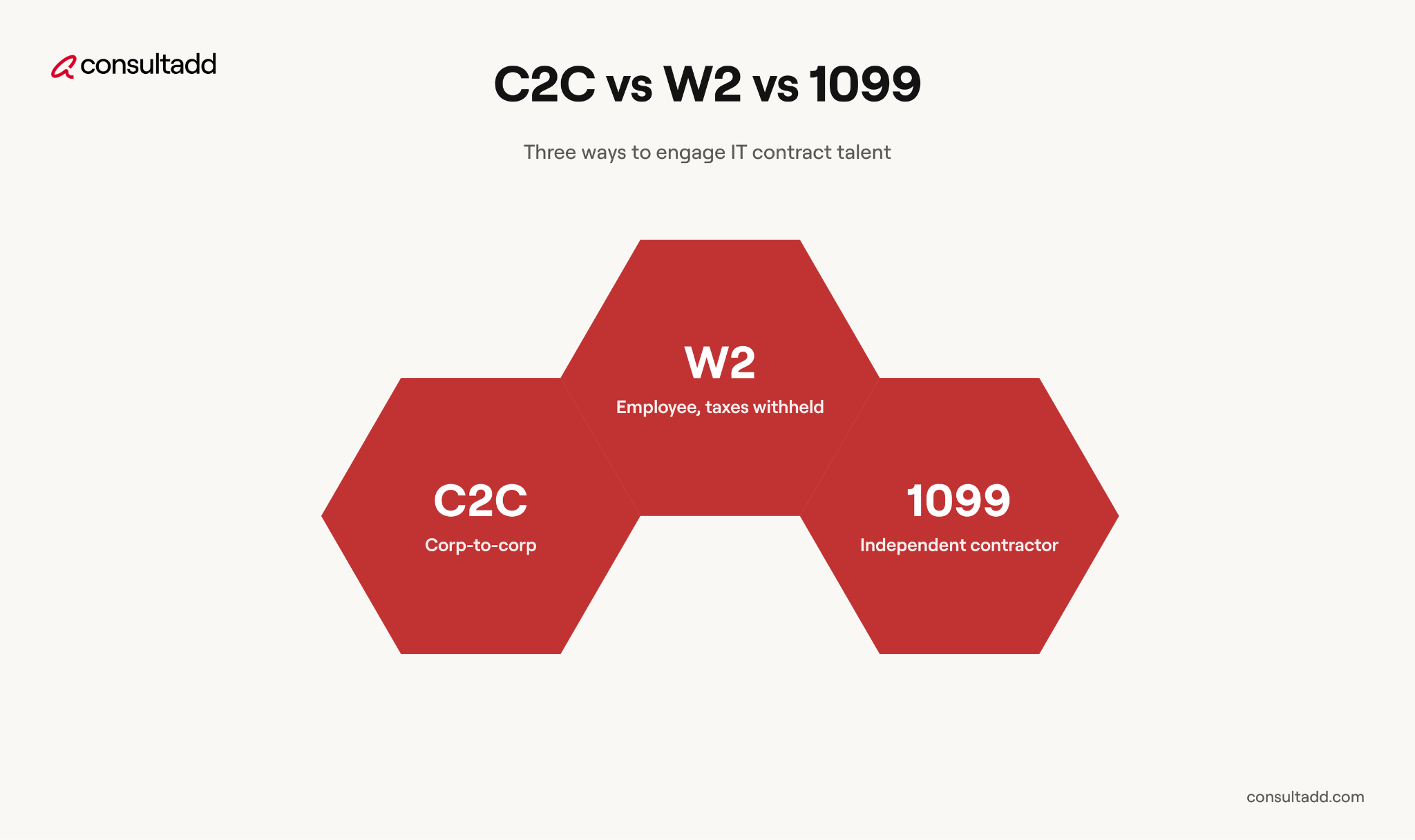
A pattern worth noticing: C2C and 1099 are cousins. Both are independent contractor arrangements. The difference is purely structural.
A 1099 contractor is paid as a person; a C2C contractor is paid as a company. That structural layer matters more to the client than to the worker, because contracting with a vetted corporation reduces (but doesn't eliminate) the client's misclassification exposure.
Under US law, the default assumption is that a worker is a W-2 employee unless the hiring party can show the relationship genuinely meets independent contractor criteria.
That's why W2 remains the dominant model in professional staffing, something we see reflected across the market in our review of the best IT staffing firms in 2026.
Pros and cons of C2C employment
C2C tends to attract experienced contractors who treat their work as a business. Here's the honest ledger, for both sides:
C2C and Work Visas: What H-1B and OPT holders should know
This is where a lot of misinformation circulates, so let's be precise.
H-1B status requires an employer to sponsor and employ you.
That means you can't simply form an LLC and contract yourself out solo the way a citizen or green card holder can. When an H-1B professional works "on C2C," what's really happening is that a consulting or staffing company employs them on W2 and holds their visa, and that company has a corp-to-corp agreement with the vendor or client upstream.
The C2C layer exists between companies, not between the worker and the client.
For F-1 students on OPT, the picture is different but has its own constraints.
Standard OPT allows properly documented self-employment related to your field, but STEM OPT requires an E-Verify enrolled employer and a formal training plan, which effectively rules out working through your own single-member entity for most students.
So when a recruiter asks a visa-holding candidate "are you open to C2C?", the practical question is usually "does your employer allow you to work through their corp-to-corp agreements?"
If you're navigating this, our guide on H-1B visa sponsorship for tech professionals explains the employer-side mechanics in detail.
Misclassification: the risk nobody prices in
Here's the uncomfortable truth about C2C: the entity is evidence, not a shield.
The IRS looks at behavioral control, financial control, and the nature of the relationship. The Department of Labor applies its own economic reality test under the FLSA, and it runs independently of the IRS analysis. Some states, notably California and Massachusetts, layer an ABC test on top that's stricter than both.
A worker who formed an LLC last month, has one client, works set hours under that client's daily direction, and uses the client's equipment is not running a business-to-business relationship. It's an employment relationship with extra paperwork, and regulators treat it that way.
Penalties can reach 100% of the taxes owed, plus fines per unfiled form, plus exposure to wage-and-hour claims.
What a legitimate C2C engagement looks like:
For staffing agencies, vetting the entity on the other side of a C2C agreement isn't optional paperwork. It's the difference between a clean audit and a very expensive year.
It's also one of the compliance gaps we flagged in our look at what's broken in IT recruitment in 2026.
Is C2C right for you?
Now that you know what C2C employment is, the decision comes down to your situation, not the label.
C2C fits well if you're an experienced independent contractor with multiple clients, you're comfortable running a business (or paying someone to), you have your own benefits sorted, and the higher gross rate genuinely outpaces the added costs.
It also fits consulting firms that deploy their own W2 employees to clients through corp-to-corp agreements, which is the standard model across US tech staffing.
W2 fits better if you value stability, employer-paid benefits, unemployment protection, and zero tax administration. And if you're on a work visa, W2 employment through a sponsoring company isn't just the better option, it's usually the only compliant one at the individual level.
Whichever side of the contract you're on, the fundamentals are the same: read the agreement, verify the entity, and make sure the substance of the relationship matches the label on it.
Start Strong With Consultadd
With 15 years in business and 5,000+ successful staffing engagements, we don't just fill roles, we build reliability into your process. We've supported 65 staffing companies in the past year alone and maintain MSAs with industry leaders like Robert Half and TEKsystems.
Here's what working with Consultadd looks like:
- Talent sourced in under 24 hours
- Ready-to-deploy candidates, vetted for experience and compliance
- Lower turnover risk: we match long-term goals, not just short-term needs
- Seamless compliance: visa, documentation, onboarding? Handled.
- Dedicated 1:1 account managers for responsive, personalized support
- Top 100 candidate matches delivered in the past year
- Strong partnerships with universities to tap into fresh, committed talent
- Post-placement support so your investment grows beyond day one
For candidates, your next opportunity is more than just a job title, it's a chance to build skills, gain experience, and move your career forward. At Consultadd, we connect technology professionals with projects and employers that align with their goals, whether they're looking for contract, contract-to-hire, or long-term opportunities.
The tech job market moves fast, but the right guidance can make all the difference. Ready to take the next step in your career journey? Explore Opportunities >>
Key takeaways
- C2C employment means a company contracts with the worker's registered business entity (LLC, S-corp, or corporation) rather than hiring the individual, and the entity handles all taxes, benefits, and insurance.
- Compared with W2, C2C offers higher gross pay and business deductions but no benefits, no unemployment coverage, and the full 15.3% Social Security and Medicare burden.
- Compared with 1099, C2C is structurally similar; the difference is that payment flows to a corporation, which lowers (but never eliminates) the client's misclassification risk.
- Regulators judge the substance of the working relationship, not the entity paperwork. A single-client LLC under daily client direction is an employee in everything but name.
- H-1B professionals participate in C2C through a sponsoring employer's corp-to-corp agreements, not through a personal entity, and STEM OPT students need an E-Verify employer.
FAQs
What does C2C mean in employment?
C2C stands for corp-to-corp. It's a contract arrangement where the hiring company pays the worker's business entity, such as an LLC or S-corporation, instead of paying the worker directly. The worker's corporation then handles payroll, taxes, insurance, and benefits.
What is the difference between C2C and W2?
A W2 worker is an employee: the employer withholds taxes, pays half of Social Security and Medicare, and usually provides benefits. A C2C contractor works through their own corporation, receives no benefits from the client, and their entity covers the full 15.3% in payroll taxes. C2C gross rates are higher precisely because all of that responsibility shifts to the contractor.
What is the difference between C2C and 1099?
Both are independent contractor arrangements without benefits or withholding. The difference is who receives payment: a 1099 contractor is paid as an individual and gets a 1099-NEC, while a C2C contractor is paid through a registered business entity. Clients often prefer C2C because contracting with a corporation reduces their misclassification exposure.
Do I need an LLC for C2C employment?
Yes, C2C requires a registered business entity, typically an LLC, S-corporation, or C-corporation. A sole proprietorship doesn't qualify. Many clients and staffing agencies also require the entity to carry general liability insurance before signing a corp-to-corp agreement.
Can H-1B visa holders work on C2C?
Not independently. H-1B status requires a sponsoring employer, so an H-1B professional can't contract through their own personal entity. In practice, H-1B workers on "C2C" projects are W2 employees of a consulting or staffing firm, and the corp-to-corp agreement exists between that firm and the client or vendor.
Is C2C better than W2?
Neither is universally better. C2C usually pays a higher gross rate and unlocks business tax deductions, but you give up benefits, unemployment coverage, and simplicity, and you take on the full self-employment tax load. Compare the full-year net of each option, including insurance costs and unpaid gaps between contracts, before deciding.

What Is OPT/CPT? A Clear Guide For Students In The US
Introduction
If you're an international student in the US, or planning to become one, you've probably heard OPT and CPT mentioned in the same breath a hundred times. So what is OPT/CPT, really?
In short, they're the two work authorization programs that let F-1 students gain real work experience in the United States. CPT (Curricular Practical Training) lets you work during your degree. OPT (Optional Practical Training) lets you work during or, more commonly, after it.
That one-line answer hides a lot of fine print, though. Use CPT the wrong way and you can lose your OPT eligibility entirely. Miss an OPT deadline and there's no do-over. We've seen talented graduates lose job offers over paperwork timing, which is a painful way to learn immigration rules.
This guide walks through how each program works, who qualifies, how they differ, and what's changing in 2026.
TL;DR
- OPT and CPT are the two work programs available to F-1 students. CPT happens during your degree and is tied to your curriculum. OPT usually happens after graduation.
- CPT is approved by your school's DSO and shows up on your I-20. OPT requires a USCIS application (Form I-765) and an EAD card before you can work.
- Twelve months or more of full-time CPT makes you ineligible for post-completion OPT at the same degree level. This is the single biggest trap.
- Standard OPT gives you 12 months of work authorization. STEM graduates can extend it by 24 months, for 36 months total.
- In 2026, both programs face tighter scrutiny, higher fees, and a proposed shift to fixed admission periods, so early planning matters more than ever.
What is OPT/CPT?
Both programs fall under what US immigration law calls "practical training" for F-1 students.
The idea is simple: your education shouldn't stop at the classroom door. Practical training lets you apply what you're studying in a real workplace, legally, without a separate work visa.
Here's the shared foundation. To qualify for either program, you must:
- Be enrolled full-time at an SEVP-certified school
- Have completed at least one full academic year (with a narrow exception for graduate programs that require earlier training)
- Work in a role directly related to your major field of study
Students in English language training programs don't qualify for either one.
The difference comes down to timing, approval, and purpose.
CPT is part of your curriculum, approved by your school, and happens before your program's end date.
OPT is optional (hence the name), approved by USCIS, and most students save it for after graduation.
How CPT works
Curricular Practical Training covers internships, co-ops, and practicums that are an integral part of your established curriculum. The keyword is "curricular."
If the work isn't connected to your coursework, either through a required internship, a course that awards credit for the work, or a formal cooperative agreement between your school and the employer, it doesn't qualify.
Who approves CPT and how fast
Your Designated School Official (DSO) authorizes CPT directly in SEVIS. No USCIS application, no filing fee, no months of waiting.
Once approved, the authorization appears on page 2 of your Form I-20, listing your employer, dates, and whether the training is part-time or full-time. Most schools turn this around in one to two weeks, which is why CPT works well for internships with quick start dates.
One thing that surprises students: you need a specific job offer before your DSO can authorize CPT. The authorization is employer-specific. Switch employers, and you need a new authorization.
Part-time vs Full-Time CPT and the 12-Month rule
CPT comes in two flavors:
- Part-time CPT: 20 hours per week or less. You can use unlimited part-time CPT without affecting your OPT.
- Full-time CPT: more than 20 hours per week. This is where the trap sits.
An F-1 student who completes 12 months or more of full-time CPT becomes ineligible for post-completion OPT at the same educational level. Eleven months and 29 days? You're fine. Twelve months? Your OPT is gone.
We'd argue this rule causes more heartbreak than any other in the F-1 system, mostly because students don't track their cumulative CPT time across semesters. Keep a running count. Your DSO can pull the totals from SEVIS if you ask.
Also worth knowing: when school is in session, you must maintain a full course load even while on CPT. CPT authorization is only required for training inside the United States. A summer internship back home doesn't need it.
How OPT works
Optional Practical Training gives you up to 12 months of work authorization per degree level, in a job directly related to your major. Unlike CPT, you don't need a job offer to apply.
That flexibility is exactly why OPT is the standard launchpad for international graduates starting careers in the US.
Pre-completion vs post-completion OPT
You can use OPT before finishing your degree (pre-completion) or after (post-completion).
Here's the catch: it's one shared 12-month bucket. Every month of full-time pre-completion OPT you use gets deducted from your post-completion time. Six months of full-time pre-completion OPT leaves you with only six months after graduation.
Because CPT usually covers during-degree work needs without touching the OPT clock, most students save their full 12 months for after graduation. That's usually the smarter play.
The application process
OPT approval comes from USCIS, not your school, and the process takes real time. Here's the typical sequence:

Two hard rules here. First, USCIS must receive your I-765 within 30 days of your DSO's SEVIS recommendation, or the application gets denied. Second, working even one day before your EAD start date is a status violation.
The 90-day unemployment rule
Once your post-completion OPT starts, a clock begins. You're allowed a maximum of 90 days of unemployment across your 12-month OPT period. Go over, and you've violated your F-1 status automatically. The clock starts on your EAD start date, not the day you find a job, so applying for OPT without any job leads in motion is risky.
Part-time work of 20+ hours per week in your field counts as employment, and multiple part-time jobs can be combined. Properly documented self-employment can count too.
OPT vs CPT: side-by-side comparison
The two programs aren't rivals. Used well, they're a sequence: part-time CPT for internships during school, then the full 12 months of OPT (plus a possible STEM extension) after graduation.
Employers hiring international talent see this pattern constantly, and recruiters who understand it move faster.
That knowledge gap is one reason companies lean on staffing partners who work with visa-holding candidates every day, something we've covered in our guide to the best IT staffing firms in 2026.
The STEM OPT extension
If your degree appears on the DHS STEM Designated Degree Program List, you can apply for a 24-month extension of your post-completion OPT. That brings your total to 36 months of US work authorization on a single degree.
The requirements are stricter than standard OPT:
- Your employer must be enrolled in E-Verify
- You and your employer must complete Form I-983, a formal training plan
- You must report to your DSO every six months, even if nothing changed
- Unemployment allowance increases by only 60 days (150 days total across all 36 months)
For most students, those 36 months matter for one big reason: the H-1B lottery. Three years of OPT typically means three lottery attempts while working legally.
If you're mapping that path, our breakdown of H-1B visa sponsorship for tech professionals explains what happens after OPT, and the recent H-1B $100K fee ruling covers the cost side employers are now weighing.
Common mistakes that cost students their status
Most F-1 status problems aren't dramatic. They're small timing errors with outsized consequences.
One more from the recruiting side: interview readiness. Work authorization gets you eligible, but it doesn't get you hired.
If you're a student heading into technical rounds, our 2026 coding interview playbook is a practical place to start.
What's changing for OPT and CPT in 2026
The core rules of both programs remain intact, but the environment around them is shifting. A few developments worth watching:
Fixed admission periods. In May 2026, DHS proposed replacing the long-standing "Duration of Status" framework with fixed admission periods of up to four years for F-1 students. Programs running longer would require a formal Extension of Stay filed with USCIS.
A shorter grace period. The same proposal would cut the post-completion grace period from 60 days to 30. If finalized, that halves the window you have after graduation to file for OPT, change status, or depart.
Higher fees. The Form I-765 filing fee rose to $1,780 in 2026, and some applicants now face in-person biometrics appointments, which can add processing time.
More scrutiny, not elimination. Despite the rumors that circulate every year, OPT is not ending. What's real is tighter compliance checking: closer review of whether jobs match fields of study, stricter SEVIS reporting expectations, and more attention on schools that authorize aggressive full-time CPT.
Start Strong With Consultadd
With 15 years in business and 5,000+ successful staffing engagements, we don't just fill roles, we build reliability into your process. We've supported 65 staffing companies in the past year alone and maintain MSAs with industry leaders like Robert Half and TEKsystems.
Here's what working with Consultadd looks like:
- Talent sourced in under 24 hours
- Ready-to-deploy candidates, vetted for experience and compliance
- Lower turnover risk: we match long-term goals, not just short-term needs
- Seamless compliance: visa, documentation, onboarding? Handled.
- Dedicated 1:1 account managers for responsive, personalized support
- Top 100 candidate matches delivered in the past year
- Strong partnerships with universities to tap into fresh, committed talent
- Post-placement support so your investment grows beyond day one
For candidates, your next opportunity is more than just a job title, it's a chance to build skills, gain experience, and move your career forward. At Consultadd, we connect technology professionals with projects and employers that align with their goals, whether they're looking for contract, contract-to-hire, or long-term opportunities.
The tech job market moves fast, but the right guidance can make all the difference. Ready to take the next step in your career journey? Explore Opportunities >>
Key takeaways
- OPT/CPT are the two F-1 work authorization programs: CPT for curriculum-connected work during your degree, OPT for up to 12 months of work per degree level, usually after graduation.
- CPT is fast and free through your DSO but requires a job offer. OPT costs $1,780, takes months to process, and requires an EAD before you can work.
- Never cross 12 months of cumulative full-time CPT at one degree level, or you forfeit post-completion OPT entirely.
- On OPT, you get a maximum of 90 unemployment days, so line up your job search before your start date, not after.
- STEM graduates can extend OPT to 36 total months, which usually means three shots at the H-1B lottery while working legally.
FAQs
What is the difference between OPT and CPT?
CPT is work authorization used during your degree for training that's an integral part of your curriculum, and your school's DSO approves it. OPT is a separate 12-month work benefit, usually used after graduation, that requires USCIS approval and an EAD card. CPT needs a job offer upfront; OPT doesn't.
Can I use both CPT and OPT?
Yes, and most students do. You can use part-time CPT for internships during school without losing any OPT time. The only restriction is full-time CPT: hit 12 cumulative months of it and you lose post-completion OPT at that degree level.
Does CPT affect my OPT eligibility?
Part-time CPT (20 hours a week or less) never affects OPT, no matter how long you use it. Full-time CPT only becomes a problem at 12 or more cumulative months at the same degree level. Under that threshold, your full 12 months of OPT stay intact.
How long does OPT last for F-1 students?
Standard post-completion OPT lasts 12 months per degree level. Students with qualifying STEM degrees can apply for a 24-month extension, bringing the total to 36 months. Any full-time pre-completion OPT you use gets subtracted from your post-completion balance.
Do I need a job offer to apply for OPT?
No. You can file Form I-765 for post-completion OPT without any job lined up. Just remember the 90-day unemployment limit starts running on your EAD start date, so it's smart to have your search well underway before then.
How much does it cost to apply for OPT in 2026?
The Form I-765 filing fee is $1,780 as of 2026, up from $1,685. CPT, by contrast, has no filing fee since your school authorizes it directly. Always confirm the current fee on the USCIS website before mailing your application, because an incorrect fee gets the whole package rejected.
.jpg)
H-1B $100K Fee Ruling: Everything You Need to Know
Introduction
If you've been trying to keep up with the H-1B $100,000 fee ruling over the past month, you're not alone. The story has flipped twice in under two weeks, and employers who paused hiring plans back in September 2025 are now wondering if they jumped the gun, or if they were right to wait.
Here's the short version. A federal judge in Massachusetts struck down the fee. Days later, the same judge paused his own ruling. The government appealed. And as of now, the fee is still being collected while the courts sort out who actually has the authority to impose it.
This guide breaks down what happened, why it matters, and what your company should do while the case works its way through the appeals process.
TL;DR
- A Massachusetts federal court vacated the $100,000 H-1B fee on June 8, 2026, ruling it was an unlawful tax that only Congress could impose.
- On June 12, the same court partially reinstated the fee through an administrative stay while the government appeals.
- The fee currently applies only to new H-1B petitions requiring consular processing, and it remains in effect for now.
- A parallel case at the D.C. Circuit upheld the fee, creating a circuit split that could send the issue to the Supreme Court.
- Employers should keep documenting fee payments, avoid assuming the fee is gone, and build flexibility into their H-1B hiring plans.
Where the H-1B $100,000 Fee Came From
On September 19, 2025, President Trump signed Proclamation 10973, titled "Restriction on Entry of Certain Nonimmigrant Workers." The proclamation added a $100,000 fee to new H-1B petitions filed for workers who need consular processing, meaning workers applying for their visa stamp from outside the United States.
The fee took effect on September 21, 2025.
The administration framed the fee as a way to reduce misuse of the H-1B program and protect STEM jobs for U.S. workers. Critics saw it differently.
Twenty state attorneys general, along with universities, healthcare groups, and labor unions, filed lawsuits arguing the fee was really a tax dressed up as an immigration rule, and that no president can impose a tax without Congress.
That disagreement is what landed the case in federal court.
The June 8 Ruling: Fee Vacated
On June 8, 2026, Judge Leo T. Sorokin of the U.S. District Court for the District of Massachusetts sided with the plaintiffs in State of California et al. v. Mullin et al. He granted summary judgment and vacated the fee entirely, pointing to three problems with how it was rolled out.
The fee functioned as a tax. Sorokin found that a $100,000 charge on visa petitions isn't really an immigration restriction. It's a revenue-raising measure, and the Constitution gives that power to Congress, not the president. His opinion referenced the Supreme Court's earlier ruling against the administration's tariffs, applying similar reasoning here. The court also issued declaratory relief for the plaintiffs but decided a permanent injunction wasn't necessary.
The rollout skipped proper procedure. The court found the agency guidance implementing the fee violated the Administrative Procedure Act because it bypassed the notice-and-comment process required for major policy changes.
It exceeded the president's statutory authority. The ruling held that nothing in the Immigration and Nationality Act gives the executive branch the power to attach a six-figure fee to a visa category Congress already created and funded through its own filing fee structure.
For a few days, this looked like a clean win for employers. Then came June 12.
The June 12 Reversal: Fee Reinstated (For Now)
Four days after his own ruling, Sorokin partially paused it. The government had asked for a full stay pending appeal. He denied that request on the merits, but granted a narrower administrative stay instead.
In his order, Sorokin stated the court would stay its June 8 order "pending a decision by the United States Court of Appeals for the First Circuit on the anticipated Motion to Stay pending appeal from the Defendants," on the condition that the government actually file that motion with the First Circuit by June 18, 2026.
The government met that deadline. On June 18, it formally asked the First Circuit to keep the fee in place while the broader appeal plays out. That request is still pending.
Practically, this means USCIS can currently require the $100,000 fee for H-1B petitions tied to consular processing. If you're filing one of those petitions today, you should plan on paying it unless your immigration counsel tells you otherwise.
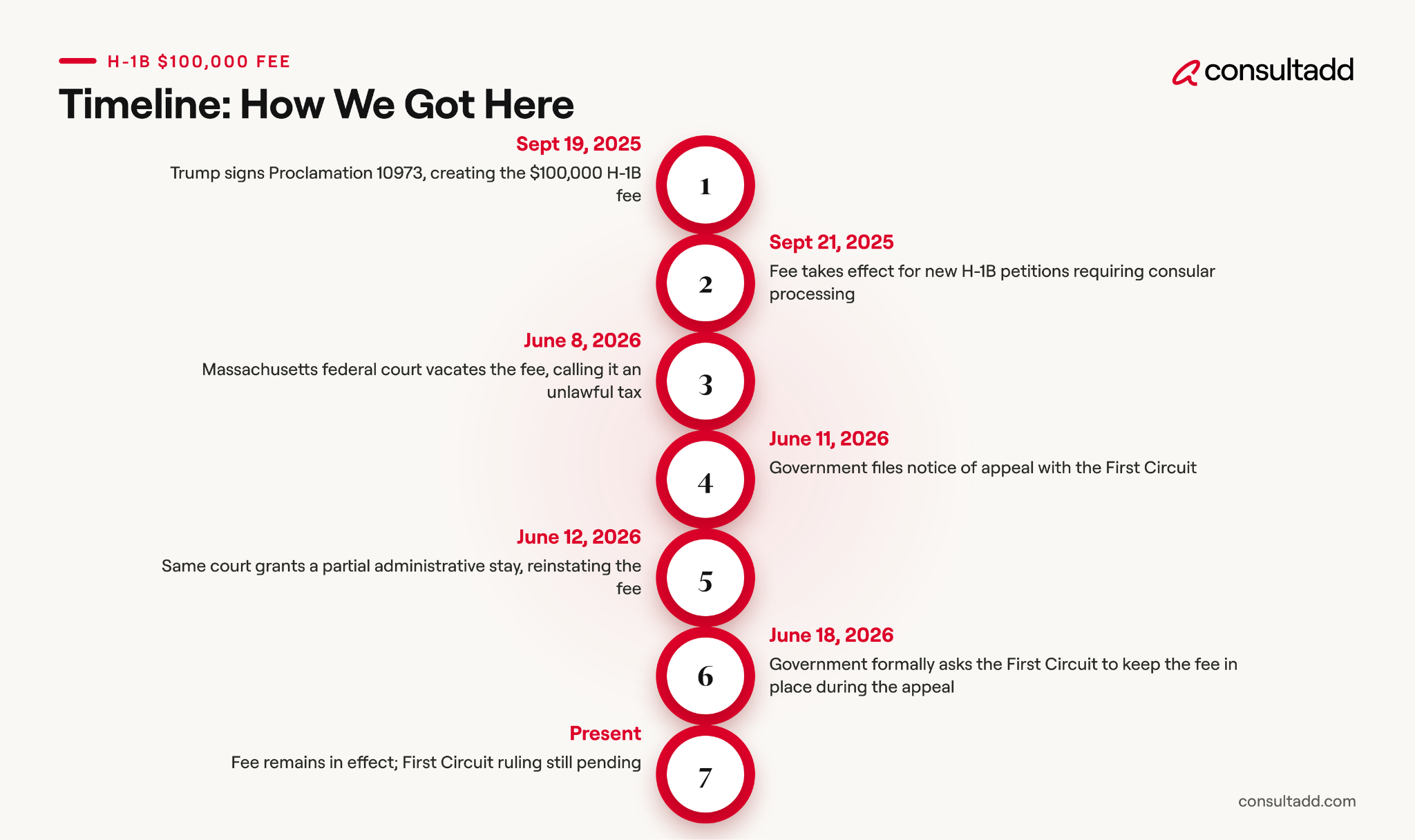
Timeline: How We Got Here
The legal status of the proposed $100,000 H-1B fee has changed several times in less than a year, creating significant uncertainty for employers and foreign professionals alike.
From its introduction through a federal court challenge and the government's appeal, each development has influenced whether the fee remains enforceable. The timeline below outlines the key events that have shaped the policy's current status.
Why There's a Circuit Split Brewing
Here's where it gets messier. The Massachusetts ruling isn't the only word on this fee. A separate case filed by the U.S. Chamber of Commerce and the Association of American Universities went the opposite direction. The U.S. District Court for the District of Columbia upheld the fee proclamation, and that decision is now on appeal before the D.C. Circuit, which already held oral argument back in March 2026.
So you've got one district court calling the fee an unconstitutional tax, and another upholding it as a valid exercise of presidential authority. Add in a third pending case in the Northern District of California, and you've got the ingredients for a genuine circuit split. When federal appeals courts disagree on the same question, the Supreme Court often steps in to resolve it. Immigration attorneys following the case expect this could eventually land there, though that's likely still six to eighteen months out.
I'll be honest: watching two courts reach opposite conclusions on the exact same proclamation is a little wild. It tells you how genuinely unsettled this area of law is right now, not just how contentious it is politically.
Who the Fee Actually Applies To
A lot of confusion around this fee comes from not knowing which petitions it touches. Here's the breakdown.
If your hiring pipeline is mostly domestic transfers and change-of-status cases, this litigation affects you far less than it does companies sponsoring candidates directly from overseas.
What This Means for Staffing Companies and Employers
For staffing firms and employers who lean on H-1B talent to fill specialized roles, the past ten months have been a lesson in building flexibility into hiring plans. A few practical takeaways:
Keep paying the fee where it applies. Until the First Circuit rules otherwise, USCIS is authorized to collect it.
Document every payment. If the fee is eventually struck down for good, employers who paid may be eligible for refunds, but only if the paper trail is solid.
Don't shelve international pipelines entirely. The June 8 ruling, even paused, signals real weakness in the government's legal position. Building a candidate pipeline now means you're ready to move fast if the fee goes away.
Keep other visa categories warm. Options like L-1, O-1, and TN visas remain useful fallback paths while H-1B economics stay uncertain. If you're mapping out a broader visa sponsorship strategy, this is a good moment to revisit it with your immigration counsel.
Talk to candidates honestly. If you're extending offers contingent on H-1B sponsorship, be upfront that the fee situation is still moving. A conditional offer tied to the litigation's outcome is often fairer than a firm promise you can't guarantee.
None of this is a reason to freeze hiring. It's a reason to build a plan that works whether the fee survives or not.
Start Strong With Consultadd
With 15 years in business and 5,000+ successful staffing engagements, we don't just fill roles, we build reliability into your process. We've supported 65 staffing companies in the past year alone and maintain MSAs with industry leaders like Robert Half and TEKsystems.
Here's what working with Consultadd looks like:
- Talent sourced in under 24 hours
- Ready-to-deploy candidates, vetted for experience and compliance
- Lower turnover risk: we match long-term goals, not just short-term needs
- Seamless compliance: visa, documentation, onboarding? Handled.
- Dedicated 1:1 account managers for responsive, personalized support
- Top 100 candidate matches delivered in the past year
- Strong partnerships with universities to tap into fresh, committed talent
- Post-placement support so your investment grows beyond day one
For candidates, your next opportunity is more than just a job title, it's a chance to build skills, gain experience, and move your career forward. At Consultadd, we connect technology professionals with projects and employers that align with their goals, whether they're looking for contract, contract-to-hire, or long-term opportunities.
The tech job market moves fast, but the right guidance can make all the difference. Ready to take the next step in your career journey? Explore Opportunities >>
Key Takeaways
- The $100,000 H-1B fee was vacated on June 8, 2026, then partially reinstated four days later through an administrative stay.
- The fee currently applies only to new H-1B petitions requiring consular processing, and it's still being collected.
- A separate D.C. Circuit case upheld the fee, setting up a circuit split that may eventually reach the Supreme Court.
- Employers should keep paying the fee where required, document payments carefully, and avoid assuming the litigation is settled.
- This is a good time to review your broader hiring and recruitment strategy so you're not caught flat-footed by the next court order.
FAQs
Is the H-1B $100,000 fee still in effect in 2026?
Yes, as of now. The fee was struck down on June 8, 2026, but a court-ordered administrative stay reinstated it four days later while the government's appeal moves through the First Circuit.
Why did a federal court strike down the H-1B fee?
The Massachusetts district court ruled the fee was effectively an unauthorized tax, something only Congress can impose. It also found the rollout violated the Administrative Procedure Act.
What happens if my company already paid the $100,000 fee?
If the fee is ultimately struck down and that ruling holds up on appeal, employers who paid may be able to request refunds. No formal refund process exists yet, so keep detailed records of every payment.
Does the $100,000 fee apply to H-1B extensions or transfers?
No. The fee only applies to new H-1B petitions for workers who need consular processing from outside the United States. Extensions, amendments, and change-of-status petitions filed within the U.S. aren't subject to it.
What is Proclamation 10973?
It's the presidential proclamation, signed September 19, 2025, that created the $100,000 H-1B fee. It's formally titled "Restriction on Entry of Certain Nonimmigrant Workers."
Will the H-1B fee case go to the Supreme Court?
Possibly. A separate case in the D.C. Circuit upheld the fee, creating a direct conflict with the Massachusetts ruling. When appeals courts disagree on the same rule, the Supreme Court often takes the case to resolve it, though that could still be a year or more away.

Sponsoring H1B Visa: What Tech Professionals Need to Know
Introduction
The US tech job market still runs on H1B sponsorship. For international technology professionals, sponsoring an H1B visa is the most direct path to working legally in the United States in a specialty role, whether that is software engineering, data science, cloud infrastructure, or IT consulting.
However, the landscape changed considerably in late 2025 and into 2026, and what worked for candidates three years ago no longer applies.
The H1B program has undergone what immigration attorneys are calling its most significant structural overhaul in decades. A weighted lottery replaced the old random draw. A new $100,000 fee now applies to certain petitions.
USCIS scrutiny on petition consistency has intensified. For candidates who do not have a staffing partner guiding them through this, the process can feel like trying to navigate a maze that keeps redesigning itself.
This guide explains how sponsoring an H1B visa actually works in 2026, what has changed and why it matters to you, and how partnering with a company like Consultadd gives you a genuine edge.
TL;DR
- H1B sponsorship is employer-driven. You cannot apply on your own, and success depends on finding an employer willing to sponsor your petition.
- The 2026 H1B process has changed significantly, with a wage-weighted lottery giving higher-paid, experienced candidates better selection odds.
- Preparation is critical, from securing a sponsor early to ensure your documentation and eligibility meet USCIS requirements.
- OPT, STEM OPT, and Cap-Gap provisions can help international graduates remain work-authorized while pursuing H1B status.
- Working with an experienced staffing partner like Consultadd can simplify the sponsorship process through immigration expertise, employer connections, and ongoing support.
What Sponsoring an H1B Visa Actually Means
The H1B is a temporary, nonimmigrant work visa that allows US employers to hire foreign nationals in specialty occupations. A specialty occupation is one that requires at minimum a bachelor's degree or its equivalent in a field directly related to the job duties.
Here is the part many candidates do not fully grasp: you cannot apply for an H1B yourself. The employer must initiate and file the petition on your behalf. There is no self-petition option.
The employer becomes the legal sponsor, owns the compliance obligations, and pays the filing fees. You cannot pay a company to sponsor you, that is illegal. The right employer relationship is the entire foundation of the process.
Once an employer agrees to sponsor you, here is roughly what happens:
The employer files a Labor Condition Application (LCA) with the Department of Labor, attesting to prevailing wage compliance and working conditions. If selected in the lottery (more on that in a moment), they then file an H1B petition with USCIS. Processing takes roughly two to three months after filing, or fifteen business days with premium processing. If approved and you are already in the US, your status changes. If you are abroad, you apply for the visa stamp at a US consulate.
The annual cap is 65,000 visas, plus an additional 20,000 for individuals who hold an advanced degree from a US institution. Demand consistently exceeds supply, which is why the lottery has historically been the defining moment in the process.
What Changed in 2026 And Why It Matters
The 2026 H1B cap season is the first year operating under a fundamentally different selection system. The Department of Homeland Security finalized a rule in December 2025, effective February 27, 2026, that replaced the random lottery with a wage-weighted selection process for the FY 2027 cap.
Under the old system, every registration had roughly the same chance of selection around 30% regardless of salary or experience level. Under the new system, your odds are tied directly to the Department of Labor's prevailing wage level for your occupation and location. There are four wage levels:
- Level I (entry-level): 1 lottery entry
- Level II (qualified): 2 lottery entries
- Level III (experienced): 3 lottery entries
- Level IV (fully competent): 4 lottery entries
USCIS modeling suggests Level IV positions may see selection rates approaching 60%, while Level I positions could fall below 15%. That is not a small shift, that is a complete restructuring of who gets through.
A separate Presidential Proclamation added a $100,000 fee for new H1B petitions where the beneficiary is abroad and requires consular processing.
This does not apply to change-of-status petitions for candidates already in the US, which is one reason international graduates currently on OPT or F1 have become significantly more attractive to employers this year.
For candidates, the practical implications are direct: the more experienced and specialized you are, the better your odds. And the right employer matters more than ever, because employers who cannot justify a higher wage level for your role are statistically putting you in a much weaker position in the lottery.
For more on how the weighted system works, the official guidance from USCIS is available.
Who Qualifies for H1B Sponsorship
To be eligible for sponsoring an H1B visa, candidates generally need to meet a few core criteria:
A qualifying degree. You need a US bachelor's degree or higher or a foreign equivalent in a field that is directly related to the job. Three years of relevant work experience is treated as equivalent to one year of university education for evaluation purposes, which helps professionals who did not attend a four-year institution but built deep technical knowledge on the job.
A specialty occupation role. The position itself must require that degree. Roles in software development, data engineering, cloud architecture, cybersecurity, IT consulting, and finance analytics typically qualify. Generalist roles that accept any degree field face heavier scrutiny from USCIS.
A genuine job offer. You need a formal offer from a US employer who is prepared to sponsor the petition, file the LCA, and meet prevailing wage requirements for your location and occupation.
Proper documentation. This includes educational credential evaluations (especially for foreign degrees), work history verification, and skill-specific supporting evidence. Candidates with three-year bachelor's degrees from certain countries may need supplementary coursework evaluations.
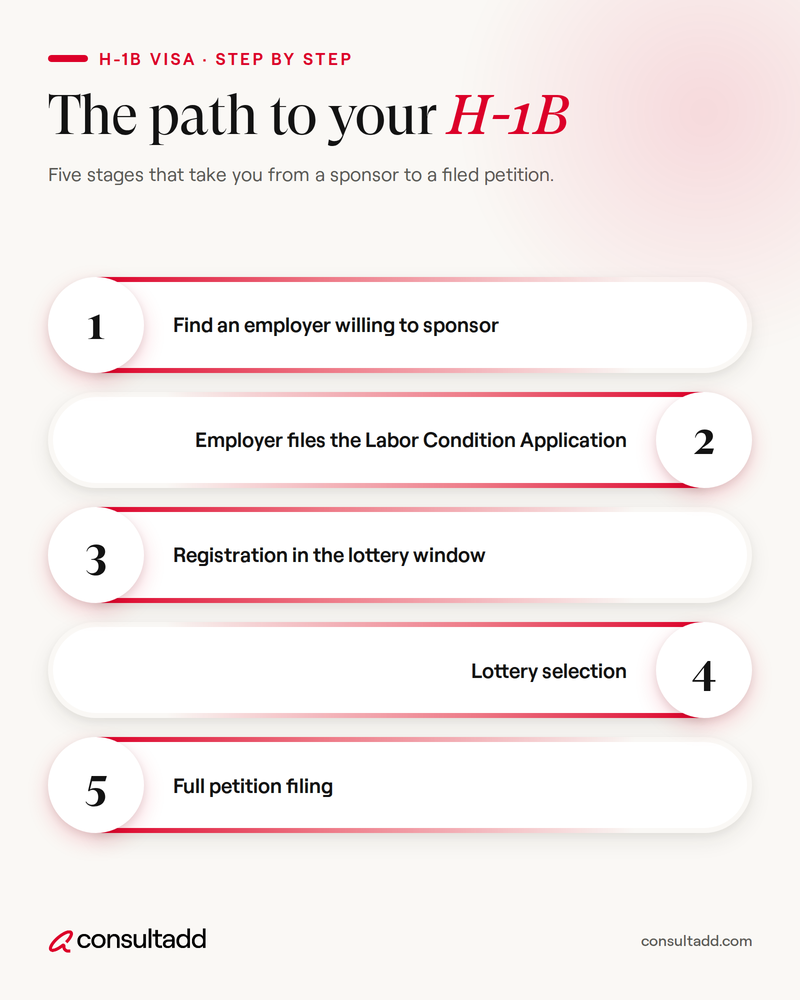
The H1B Sponsorship Process, Step by Step
Understanding the sequence helps candidates avoid the common mistake of treating visa sponsorship as an afterthought. Bring it up before you get deep into the interview process, not after you've already accepted an offer contingent on visa approval.
Step 1: Find an employer willing to sponsor. This is the hardest step for most candidates, and the one where staffing firms like Consultadd play the biggest role. Most large employers do sponsor, but their timelines, internal processes, and appetite for sponsoring entry-level versus senior candidates vary considerably.
Step 2: Employer files the Labor Condition Application. Before anything goes to USCIS, the employer submits an LCA to the Department of Labor certifying that they will pay the prevailing wage and that hiring you will not adversely affect working conditions for US workers.
Step 3: Registration in the lottery window. The registration window typically opens in early March. For FY 2027, it ran from March 4 to March 19, 2026. The employer submits a registration fee and enters the candidate's information, including the SOC code, location, and wage level into the USCIS online system.
Step 4: Lottery selection. USCIS runs the weighted selection and notifies employers of results. Selected registrations proceed to the full petition stage.
Step 5: Full petition filing. Approved registrations trigger a filing window (April 1 to June 30 for FY 2027). The employer submits the complete H1B petition with all supporting documentation. Premium processing expedites USCIS review to fifteen business days for an additional fee.
How Consultadd Helps Candidates Navigate H1B Sponsorship
Finding an employer who will sponsor you is the central challenge and that challenge has gotten harder, not easier, in 2026. Companies with no prior immigration infrastructure often say they are open to sponsorship in theory but freeze when they see the actual compliance requirements, the lottery timing, and the attorney fees involved.
Consultadd has been sponsoring H1B visas for IT professionals for years. We have an established immigration process and an in-house team that handles the mechanics from LCA filing and petition preparation to RFE responses and green card support.
Candidates who have worked with Consultadd consistently point to the immigration team's transparency as one of the most valuable parts of the relationship. You know what is happening at each stage, you understand your timeline, and you are not left waiting on email replies to understand your status.
Fast-track your hiring process without cutting corners. Consultadd handles technical assessments, background checks, visa support, and payroll management so you get fully trained, ready-to-deploy developers faster. Explore our immediately available core talent pool now.
This matters for H1B candidates for a specific reason: IT consulting firms that have cap-exempt institutional clients can sometimes place workers under cap-exempt arrangements, which means no lottery, no annual cap, and year-round filing eligibility.
That option is not available to every candidate, but it is worth exploring when you speak with the Consultadd team.
For candidates already on OPT or STEM OPT, Consultadd can help bridge the gap between your current authorization and your H1B, including managing Cap-Gap extensions if your OPT expires while your H1B petition is pending.
For a look at companies currently active in H1B sponsorship and their approval histories, the H1B Grader database is a useful public resource.
Practical Tips for Candidates Seeking H1B Sponsorship
Target companies with a proven sponsorship track record. Past behavior is the most reliable signal. Check public LCA databases. Consultancies, larger tech firms, and healthcare organizations tend to have established immigration pipelines.
Do not wait until March. The registration window is narrow. Employers need to have their LCA submitted and their petition documentation ready well before the window opens. If you are not in active conversations with a potential sponsor by December or January, you are likely missing the current cycle.
Know your wage level before conversations start. Your offered salary determines your lottery entry weight. Going into employer conversations without knowing where your compensation lands in the OEWS wage structure for your occupation and city means you cannot have an informed conversation about your odds.
OPT and STEM OPT are your bridging tools. If you are currently on F1 and working on OPT, you have a window. Use it to build experience, pursue senior-tier roles, and work with a staffing partner on your H1B strategy before your OPT window closes.
Understand the Cap-Gap. If your OPT expires between April 1 and September 30 and your H1B petition has been filed, you are covered by Cap-Gap protection and can continue working. Your employer needs to know this rule applies, not all HR teams do.
For candidates who want a comprehensive breakdown of the employer process and what documents are required, check out the Department of Labor's H1B program page.
Start Strong With Consultadd
With 15 years in business and 5,000+ successful staffing engagements, we don't just fill roles, we build reliability into your process. We've supported 65 staffing companies in the past year alone and maintain MSAs with industry leaders like Robert Half and TEKsystems.
Here's what working with Consultadd looks like:
- Talent sourced in under 24 hours
- Ready-to-deploy candidates, vetted for experience and compliance
- Lower turnover risk: we match long-term goals, not just short-term needs
- Seamless compliance: visa, documentation, onboarding? Handled.
- Dedicated 1:1 account managers for responsive, personalized support
- Top 100 candidate matches delivered in the past year
- Strong partnerships with universities to tap into fresh, committed talent
- Post-placement support so your investment grows beyond day one
For candidates, your next opportunity is more than just a job title, it's a chance to build skills, gain experience, and move your career forward. At Consultadd, we connect technology professionals with projects and employers that align with their goals, whether they're looking for contract, contract-to-hire, or long-term opportunities.
The tech job market moves fast, but the right guidance can make all the difference. Ready to take the next step in your career journey? Explore Opportunities >>
Key Takeaways
- The 2026 weighted lottery is a fundamental change. Higher wage levels (Level III and IV) now have dramatically better selection odds than Level I positions.
- A $100,000 fee applies to new petitions for candidates abroad requiring consular processing; candidates already in the US changing status are not subject to this fee.
- The annual cap is 85,000 visas. Candidates with US advanced degrees access a separate 20,000-visa pool.
- IT staffing firms like Consultadd offer established immigration infrastructure, in-house immigration support, and access to cap-exempt placement opportunities that most direct employers cannot offer.
- OPT and STEM OPT are strategic bridging tools. The sooner you align with a sponsoring employer, the better positioned you are for the March registration window.
FAQs
Can I sponsor my own H1B visa?
No. The H1B is an employer-sponsored visa. A US employer must file the petition on your behalf. You cannot initiate or file the petition yourself.
How long does the H1B visa last?
The initial H1B is granted for up to three years, with one extension available for a total of six years. Extensions beyond six years are possible in specific circumstances, typically tied to a pending green card application.
What is the H1B cap, and does it apply to everyone?
The standard annual cap is 65,000 visas, with an additional 20,000 for US advanced degree holders. However, employers such as universities, nonprofit research organizations, and government research institutions are cap-exempt, meaning they can file year-round without the lottery.
What happens if I am not selected in the lottery?
You can register in the following year's lottery. If you are in the US on OPT or STEM OPT, you may be able to continue working while you try again. Consulting firms like Consultadd can also explore cap-exempt placement arrangements depending on your role and the client environment.
Does H1B sponsorship affect my green card path?
Not negatively. The H1B is a dual-intent visa, which means you can apply for permanent residency while on H1B status. Many candidates use the H1B period to initiate their I-140 green card petition with employer support.
What is a Cap-Gap extension?
If your OPT status expires between April 1 and September 30 and a timely-filed H1B petition is pending or approved, Cap-Gap protection allows you to continue working until October 1, when H1B status begins.

What Does Contract Work Mean?
Introduction
You see a job listing you like, then spot the word "contract" next to it. Suddenly you're not sure what you'd be signing up for. Is it a real job? Do you get benefits? Who handles your taxes?
So what does contract work mean? In plain terms, contract work is a job you take for a set project or period rather than a permanent, open-ended role. You agree to deliver specific work, usually for a fixed time or a defined deliverable, and the arrangement ends when the contract does.
That's the short version. The longer version matters, because "contract work" covers a few different setups, and each one changes how you get paid, who handles your taxes, and what protections you have. This guide walks through the types, the money, and the trade-offs so you can decide with your eyes open.
TL;DR
- Contract work means taking a role for a defined project or time period instead of a permanent position.
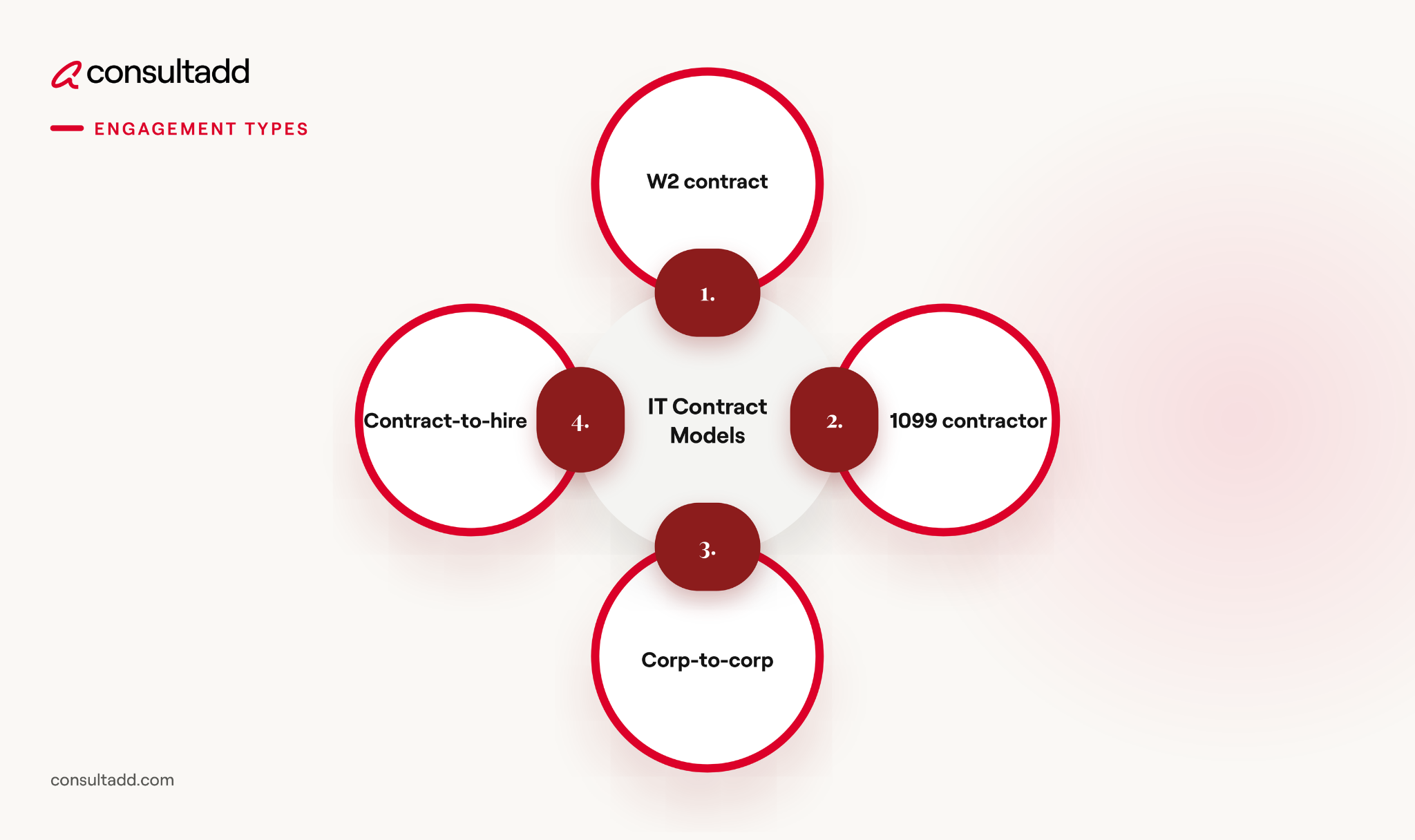
- It comes in a few forms: W2 contract, 1099 independent contractor, corp-to-corp, and contract-to-hire.
- The core difference is control and taxes. Employees have taxes withheld; independent contractors handle their own.
- Contractors often earn a higher hourly rate but usually give up benefits like health insurance and paid time off.
- Classification is a legal matter, and the IRS looks at behavioral control, financial control, and the relationship.
What contract work actually means
Contract work is work you do under an agreement that spells out the scope, the pay, and the timeline. When the project wraps or the term ends, so does the arrangement, unless both sides choose to extend.
The defining feature is that it's temporary by design. A permanent employee is hired to do ongoing work with no end date in mind. A contractor is brought in for a reason and a window: a project to ship, a gap to cover, a skill the team doesn't have in-house.
Here's the part that confuses people. "Contract work" isn't a single tax or legal status. It's an umbrella. Under it sit several arrangements that look similar on the surface but work very differently once you read the fine print.
That difference usually comes down to one question: are you an employee of someone, or are you running your own show? The answer decides your taxes, your benefits, and your protections.
The main types of contract work
Most contract roles fall into one of four buckets. Knowing which one you're being offered tells you almost everything about how the job will actually work.
W2 contract
A W2 contract means you're an employee, often of a staffing agency, placed on a client's project for a set time. Taxes come out of your paycheck automatically, and the agency may offer some benefits. You get an employee's protections and a temporary role at the same time.
1099 independent contractor
Here you're self-employed. You contract your services to a client, use your own tools, set much of your own schedule, and handle your own taxes. The client reports what they paid you on a Form 1099-NEC. No withholding, no employer benefits.
Corp-to-corp
In a corp-to-corp setup, you work through your own registered business, usually an LLC or S-corp, and the client contracts with that business rather than with you as an individual. It's a business-to-business relationship. This is common in tech and IT staffing.
ConsultAdd breaks down how corp-to-corp arrangements work for staffing if you want the mechanics.
Contract-to-hire
This one is a trial run. You start on a contract, and if it goes well for both sides, the role converts to a permanent position. It lets an employer test fit before committing, and it lets you test the company too.
ConsultAdd's look at the contract-to-hire model covers how the "try before you buy" approach plays out.
Here's how the four compare at a glance.
How pay and taxes work in contract roles
This is where contract work surprises people, usually at tax time. The rules split along one line: are you an employee or are you self-employed?
If you're a W2 contractor, your employer withholds federal, state, and local income taxes, plus your half of Social Security and Medicare. The employer pays the other half. It works like any regular paycheck.
If you're a 1099 contractor or corp-to-corp, nobody withholds anything. You get the full amount, then you owe taxes on it later. That includes self-employment tax, which covers both halves of Social Security and Medicare at 15.3% total (12.4% for Social Security and 2.9% for Medicare). Most contractors pay estimated taxes quarterly to avoid a penalty.
This is why contractors often charge a higher rate. They're covering taxes and expenses an employer would otherwise handle. A $50 hourly contract rate is not the same as a $50 hourly wage once self-employment tax and lost benefits are factored in.
A quick note on the paperwork. Clients issue a 1099-NEC to report payments to independent contractors. Starting in the 2026 tax year, the reporting threshold rises from $600 to $2,000 under the One Big Beautiful Bill Act, so smaller payments may not generate a form. The obligation to report your income doesn't change, though.
If any of this feels murky, the IRS guidance on contractor versus employee status is worth a read before you sign anything.
Contract work vs full-time employment
The clearest way to understand contract work is to line it up against a permanent job. The gap comes down to control, security, and money.
Control is the big one. A full-time employer directs how, when, and where you work. A true contractor controls their own methods and often their own hours, delivering a result rather than following a manager's daily instructions. The IRS actually uses this control test to decide classification, weighing behavioral control, financial control, and the nature of the relationship.
Neither column is better in the abstract. They serve different needs at different points in a career.
Pros and cons of contract work
Contract work gets talked about as either a dream or a trap. The truth sits in the middle, and it depends on what you want right now.
On the upside, contract roles tend to pay a higher hourly rate. They offer flexibility over your schedule and the projects you take. They let you build a range of experience quickly, and they can get your foot in the door at companies that aren't hiring permanently. Independent contractors can also write off legitimate business expenses.
On the downside, the income is less predictable. You usually lose employer benefits, so health insurance and retirement fall to you. You carry the tax burden yourself, and a contract can end with little notice. There's also the paperwork of running your own affairs if you go the 1099 or corp-to-corp route.
One thing worth saying plainly: worker misclassification is a real risk on the employer side. Calling someone a contractor when the working relationship looks like employment can trigger back taxes and penalties. If you're unsure which side of the line a role sits on, ask before you start.
Who contract work suits best
Contract work fits some people and some moments better than others.
It tends to suit professionals with in-demand skills who value flexibility and can handle variable income. It works well for anyone testing a new field, building a portfolio, or bridging between permanent roles. In tech especially, contract and contract-to-hire roles are a common way to move between projects and companies.
It fits less well if you need steady, predictable income right now, or if you'd rather someone else handle taxes and benefits. There's no wrong answer here. It's about matching the arrangement to your situation.
If you're weighing contract options in tech, working with a staffing partner can take the guesswork out of finding roles that match your skills and preferred setup. That's a large part of what contract work looks like when it's done well: the right project, clear terms, and support through the paperwork.
Start Strong With Consultadd
With 15 years in business and 5,000+ successful staffing engagements, we don't just fill roles, we build reliability into your process. We've supported 65 staffing companies in the past year alone and maintain MSAs with industry leaders like Robert Half and TEKsystems.
Here's what working with Consultadd looks like:
- Talent sourced in under 24 hours
- Ready-to-deploy candidates, vetted for experience and compliance
- Lower turnover risk: we match long-term goals, not just short-term needs
- Seamless compliance: visa, documentation, onboarding? Handled.
- Dedicated 1:1 account managers for responsive, personalized support
- Top 100 candidate matches delivered in the past year
- Strong partnerships with universities to tap into fresh, committed talent
- Post-placement support so your investment grows beyond day one
For candidates, your next opportunity is more than just a job title, it's a chance to build skills, gain experience, and move your career forward. At Consultadd, we connect technology professionals with projects and employers that align with their goals, whether they're looking for contract, contract-to-hire, or long-term opportunities.
The tech job market moves fast, but the right guidance can make all the difference. Ready to take the next step in your career journey? Explore Opportunities >>
Key takeaways
- Contract work means taking a role for a set project or period rather than a permanent, open-ended position.
- It comes in four common forms: W2 contract, 1099 independent contractor, corp-to-corp, and contract-to-hire.
- The dividing line is employee versus self-employed, which decides who handles your taxes and whether you get benefits.
- Contractors often earn more per hour but carry the tax burden and usually forgo employer benefits.
- Classification is a legal matter the IRS takes seriously, so confirm which type of contract work you're signing up for.
FAQs
What does contract work mean in simple terms?
Contract work means you're hired for a specific project or set period instead of a permanent job. You agree to deliver defined work, and the arrangement ends when the contract does. It can be structured as employment or as self-employment, depending on the setup.
Is contract work the same as being self-employed?
Not always. A 1099 or corp-to-corp contractor is self-employed and handles their own taxes and benefits. A W2 contractor is an employee, usually of a staffing agency, with taxes withheld from their paycheck. The label "contract" covers both, so it's worth clarifying which one applies.
Do contract workers pay more in taxes?
Self-employed contractors pay the full 15.3% self-employment tax, since no employer covers half of Social Security and Medicare. W2 contractors split that tax with their employer, just like regular employees. This is one reason independent contractors usually charge higher rates.
Do contract jobs offer benefits?
It depends on the type. W2 contract roles through an agency may include some benefits, while 1099 and corp-to-corp contractors generally provide their own health insurance and retirement. Contract-to-hire roles typically add benefits once the position converts to permanent.
What is contract-to-hire?
Contract-to-hire is a role that starts as a contract and can convert to a permanent job if both sides agree. It lets employers evaluate fit before committing and gives workers a chance to test the company. It's common in tech and other project-heavy fields.
Can contract work lead to a permanent job?
Yes. Contract-to-hire roles are built for exactly that, and even standard contracts often turn into permanent offers when the work goes well. Contract roles are also a practical way to get in the door at companies that aren't actively hiring for full-time positions.