
Contracts
.png)
Understanding Different Types of Employment Status
Introduction
You’ve sourced, screened, and prepped the candidate. Now you’re negotiating terms, but employment status is still a sticking point.
Maybe it’s because the role is contract-based. Perhaps it's confusion over pay, benefits, or what they’re signing up for. Either way, you're still confused.
For recruiters and hiring managers, employment status isn’t just a checkbox; it’s a deal-maker or a deal-breaker. It determines everything from legal protections and tax responsibilities to whether a candidate accepts the offer.
In April 2025, the U.S. reported 163.94 million people in employment. However, not all jobs or jobholders are created equal. Each full-time, part-time, or contractual employment status comes with its own set of expectations and obligations.
If you misunderstand it, you risk delays, compliance issues, or losing the candidate entirely. If you get it right, you set the stage for smoother placements, faster onboarding, and stronger relationships.
Let’s examine the different types of employment status and why they matter more than ever.
TL;DR
- Employment status affects compliance, taxes, benefits, onboarding, and candidate acceptance, making it a critical hiring decision.
- The three primary employment types are full-time, part-time, and contractual (1099/C2C) and each offer different levels of flexibility, responsibility, and legal obligations.
- Employment classifications vary across countries, so global hiring requires careful attention to local labor laws, tax rules, and worker protections.
- Changing a candidate’s employment status can impact compliance, costs, retention, and employee satisfaction, making proper planning essential.
- Choosing the right employment status depends on the role, business goals, legal requirements, and candidate expectations.
Types of Employment Status
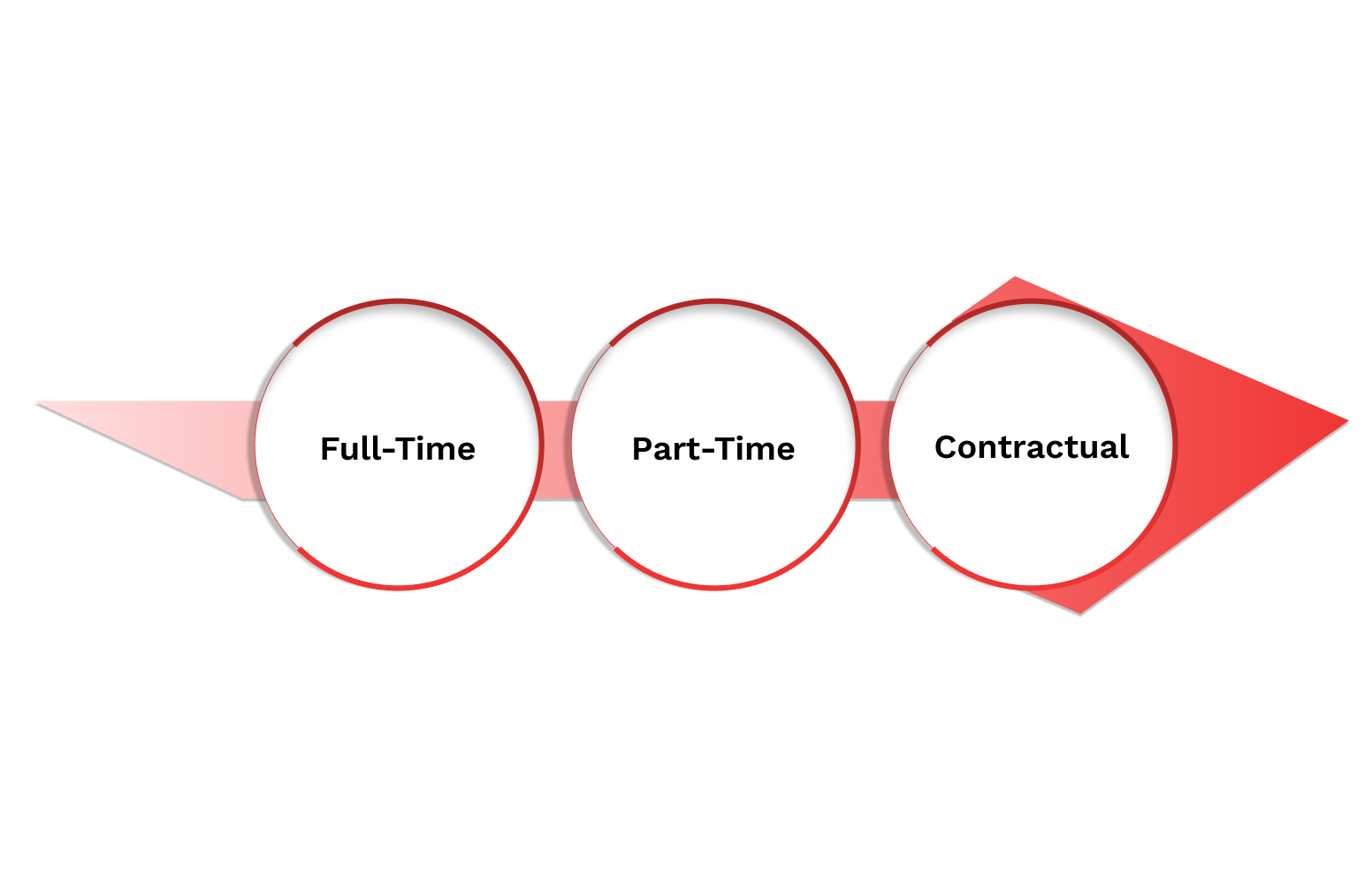
There are three primary types of employment status commonly used in the United States. These are as follows:
1. Full-Time
These individuals work 30–40+ hours per week under a formal contract with a single business.
- Fixed schedules: Set working hours and clear job responsibilities.
- Benefits eligible: Health insurance, paid time off, retirement plans, and more.
- Protected rights: Includes unemployment insurance, workers’ comp, and FMLA (Family and Medical Leave Act).
2. Part-Time
Part-time employees individuals have fewer scheduled hours (typically under 30 hours/week).
- Flexible hours: Often arranged around peak times or seasonal needs.
- Limited benefits: May include some workplace protections but often without full health or retirement benefits.
3. Contractual
Contractual employees are hired for a specific duration or project. This category includes:
- 1099 Independent Contractors: Self-employed individuals managing their own taxes.
- Corp-to-Corp (C2C): Individuals work via registered business entity (LLC or S-Corp).
Each status has its place, but matching it with the role and the expectations correctly is everything.
This is where Consultadd steps in. From screening candidates by classification to ensuring proper documentation and benefits alignment, we help you move from decision to placement faster with fewer risks and greater confidence.
Let’s see how these classifications shift globally, and why your location matters more than you think.
Global Perspectives on Employment Status
Talent knows no borders, but laws and classifications absolutely do.
When you work across borders, you manage time zones and interviews as well as navigate different employment definitions, rights, and risks.
Miss the fine print, and you could be exposed to audits, fines, or lawsuits.
Here’s how employment status shifts worldwide, and what you must check before going global.
Varied Definitions, One Common Goal
Each country has its criteria for what makes someone a full-time, a part-time, or a contractual employee.
- U.S.: Classification hinges on control, how, when, and where work is done.
- U.K.: Recognizes three statuses, employee, worker, and self-employed, with layered rights.
- India: Adds complexity with contract labor laws and social security considerations.
- Canada: Heavily scrutinizes employer control and financial independence to avoid misclassification.
Pro Tip: A one-size-fits-all approach doesn’t work. Definitions shift your hiring strategy as well.
How Rights, Benefits & Protection Vary by Country?
Candidates around the globe don’t receive the same baseline protections.
Here’s what recruiters must check before presenting a candidate:
Pro Tip: Always check local classification tests before assigning status; it’s not just a formality, it’s a legal safeguard.
Must-Check Before Hiring Across Borders:
- Is the candidate entitled to benefits in their home country?
- Will the classification affect the client’s tax reporting obligations?
- Can the candidate legally provide services under a contract in that country?
If you're unaware of these differences, your placements could trigger legal or financial trouble.
Consultadd handles all U.S.-based compliance requirements, including tax regulations, employment classifications, and visa matters, so you can hire with confidence. We help you avoid costly compliance missteps that could delay onboarding or damage client trust. Our support ensures that your placements are quick, seamless, and enduring.
Key Considerations for Changing Employment Status
Shifting a candidate from one employment status to another, such as from contractual to full-time or vice versa, isn’t a simple decision. It impacts compliance, cost, engagement, and client outcomes.
Here are the must-consider factors before making the change:
Changing status isn’t just about paperwork; it changes how people feel about work.
A study by Korea National University of Transportation revealed clear patterns in a financial institution’s temp-to-perm shift. Employees in planning or skilled roles were far more likely to secure full-time positions than those in routine or manual jobs.
Skilled or planning roles had better chances of conversion than those in simple tasks.
This distinction is critical when evaluating which roles are worth investing in for permanent transition and which may require reskilling.
The same study found that those transitioned to permanent roles reported higher job satisfaction and more substantial commitment to the company. If the business struggles with retention, this is a lever worth pulling.
Those converted to regular status reported higher job satisfaction and more substantial organizational commitment.
For hiring managers, this is a chance to future-proof relationships.
One of the most effective ways to bridge uncertainty, for both employer and candidate, is through the contract-to-hire model. In our blog, Should You Choose Contract-to-Hire? A Practical Look at the Model, we explain how this approach boosts flexibility, reduces turnover, and supports more intelligent scaling in competitive markets.
Remember: Even one change in employment status can trigger a domino effect. Make it count, clean, and always lead transparently for your team and the candidate.
Selecting the Right Employment Status
The candidate you hire shapes far more than their contract; they define outcomes. It impacts cost, culture, compliance, and the candidate’s long-term potential.
The right choice can drive retention, client satisfaction, and speed-to-fill. The wrong one can drain budgets and damage relationships.
Let’s explore how to get it right every single time.
Match the Status to the Role's Nature
Before you draft a contract, assess what the job actually requires.
Stay on the Right Side of Compliance
Misclassifying employees isn’t just risky, it’s expensive.
A contractor treated like an employee can trigger:
- Back taxes
- Legal action
- Reputational fallout
Align With Candidate Expectations
The talent you place isn’t just looking for a paycheck; they’re looking for purpose.
- Some crave the freedom of flexible work.
- Others seek the security of benefits.
- Many want to grow into long-term roles.
The right employment status ensures better engagement and stronger referrals.
Evaluate Long-Term Strategic Fit
Don't just solve the current problem, solve the one six months from now.
Ask:
- Will the business still need this role in a year?
- Can this person grow with the company?
- Is the client open to temp-to-perm transitions?
The best status supports both today’s sprint and tomorrow’s marathon.
Talent mapping offers a more innovative solution if you are still unsure about the long-term need for a role or face skill shortages. Read our blog, From Skills Gap to Strategic Growth: Talent Mapping That Delivers, we explain how talent mapping helps shift from reactive hiring to strategic workforce planning.
Remember that every hiring decision is a reflection of your judgment.
Conclusion: Confidently Choose Employment Status
Hiring managers are constantly under pressure to get employment decisions right.
One wrong call on status can affect compliance, trust, and talent satisfaction in seconds.
We at Consultadd have unpacked the key considerations, the global view, and how to choose the right employment status.
The goal? This is to help you always make smarter, faster, and more confident hiring choices.
Here’s how we transform your hiring process:
- Safe, reliable hires: Candidates are screened for compliance, experience, and long-term commitment.
- Lower turnover risk: We place professionals who stay and grow, not disappear after onboarding.
- Continuous support: Our job doesn’t end at placement. We stay engaged to ensure long-term success.
- Speed and scale: We move rapidly from last-minute sourcing to high-volume projects.
At Consultadd, we simplify the complex. Why should you trust us?
- 1:1 account managers for dedicated partnership and faster response times
- Top 100 candidates delivered across roles in the last 12 months
- ~65 staffing companies successfully served in the past year
- MSAs signed with top firms, including Robert Half, Teksystems, and more
- 5,000+ successful staffing engagements and growing
- 14+ years of experience in recruiting and workforce strategy
- Talent sourced in under 24 hours for urgent requirements
- Ready-to-deploy professionals across domains and functions
- Strong university partnerships to bring in fresh, job-ready talent
Start Strong With Consultadd
Working with an experienced partner like Consultadd ensures you hire smarter. From structured processes to real-time market insights, we help you avoid costly missteps and build teams that deliver from day one.
In a market where great tech talent is hard to find and harder to keep, your approach to staffing makes all the difference. Looking to build a future-ready tech team? Contact Us>>
Key Takeaways
- Selecting the correct employment status is essential for balancing compliance, cost efficiency, workforce flexibility, and candidate satisfaction.
- Full-time, part-time, and contractual employment models each serve different business needs and should be matched carefully to the role.
- Cross-border hiring requires understanding country-specific employment laws, worker rights, tax obligations, and classification rules to avoid legal risks.
- Transitioning employees between employment types requires careful planning to maintain compliance, improve retention, and support long-term workforce goals.
- Misclassifying workers can lead to legal penalties, tax liabilities, and reputational damage, making accurate classification a business priority.
- Consultadd helps employers navigate employment classifications, documentation, compliance, and talent placement, enabling faster and more confident hiring decisions.
FAQs
What are the main types of employment status?
The three primary employment statuses are full-time, part-time, and contractual employment. Contractual arrangements commonly include 1099 independent contractors and Corp-to-Corp (C2C) engagements.
Why is employment status important for employers?
Employment status determines payroll taxes, benefits eligibility, legal protections, compliance requirements, and worker responsibilities. Choosing the wrong classification can lead to penalties and hiring delays.
What is the difference between a full-time employee and a contractor?
A full-time employee works directly for an employer, typically receives benefits, and is covered by employment laws. A contractor operates independently or through a business entity, manages their own taxes, and generally receives greater flexibility but fewer employer-provided benefits.
Can an employee change from contract to full-time employment?
Yes. Many organizations convert contractors into full-time employees when business needs become long-term. The transition should be planned carefully to address legal, tax, payroll, and compliance requirements.
How does employment status affect international hiring?
Employment classifications differ by country, affecting worker rights, taxes, benefits, and compliance obligations. Employers should always follow local labor laws before hiring internationally.
What are the risks of employee misclassification?
Misclassification can result in back taxes, legal claims, government penalties, compliance violations, and reputational damage. Proper worker classification helps reduce these risks.
How can businesses choose the right employment status?
The right employment status depends on the role's duration, project requirements, compliance obligations, business objectives, budget, and the candidate's expectations regarding flexibility, benefits, and long-term career opportunities.
W2 Visa vs C2C: Key Differences Explained
Introduction
You’re expected to fill positions fast, stay compliant, and keep both clients and candidates happy. But when terms like “W2” and “C2C” get thrown around, and visa questions start piling up, even seasoned recruiters can hit pause.
The difference between getting someone onboarded in days or losing them altogether often comes down to understanding these models clearly.
This isn’t about legal fine print. It’s about giving your clients answers, protecting your placements, and making smart calls that keep your pipeline moving.
Let’s walk through the essentials so you can cut through the confusion and stay a step ahead.
TL;DR
- W2 and C2C serve different hiring needs. W2 is ideal for long-term stability and employer-managed compliance, while C2C offers flexibility and quick access to specialized contract talent.
- Visa compliance can make or break a placement. Understanding sponsorship responsibilities, documentation, and employment structures helps avoid delays and compliance issues.
- Administrative responsibilities differ significantly. W2 requires employer-managed payroll, taxes, and benefits, whereas C2C shifts many operational responsibilities to the contractor or vendor.
- Candidate expectations matter. Some professionals value the security and benefits of W2, while others prefer the independence and higher earning potential of C2C engagements.
- A knowledgeable staffing partner reduces hiring risk. Working with an experienced firm like Consultadd simplifies compliance, accelerates hiring, and improves placement success.
Overview of Employment Models
Every hiring decision is a balancing act, and speed, compliance, cost, and candidate expectations all collide.
But when you’re clear on employment models, you’re not guessing. You’re making confident, fast, and risk-free decisions.
Here’s a simplified comparison to help you understand when W2 or C2C makes sense:
Knowing these differences puts you in control, giving you the clarity to recommend what’s best for your client and your candidate.
For a deeper dive into how C2C engagements are becoming more essential in modern recruitment strategies especially for niche skills and fast-paced project work check out our blog on How Important Are C2C Contract Hiring Solutions in Recruitment?
Visa Sponsorship and Compliance
You finally find a brilliant candidate.
But then comes the visa question.
The uncertainty. The paperwork. The fear of a deal slipping through the cracks.
Visa sponsorship isn't just about compliance. It's about control of timelines, placements, and client trust.
Here’s how the two models stack up:
W2 Employment
With W2, the employer (often the staffing agency) is the direct H-1B sponsor.
- Full responsibility for filing, renewals, and LCA compliance
- Less confusion around reporting structure and work location
- Candidate has fewer reasons to drop out mid-process
C2C Employment
In C2C, the candidate is employed through their own company, usually an LLC.
The actual visa sponsor may be different from the entity paying the contractor.
- Requires tight coordination between vendor, end client, and candidate
- Visa holder must remain in status and keep USCIS paperwork up to date
- Some clients refuse C2C due to added legal scrutiny
C2C employment gives access to specialized talent who prefer and value flexibility. While it requires coordination and managing contracts, it reduces payroll, insurance overhead, ensuring smooth placements and allowing you to focus on priorities.
Concerns often arise from unclear sponsorship or inconsistent documentation. With Consultadd, we pre-screen candidates with valid work authorization, reducing visa status confusion. Our candidates are fully authorized and documented, eliminating delays and drop-offs.
Legal and Immigration Implications
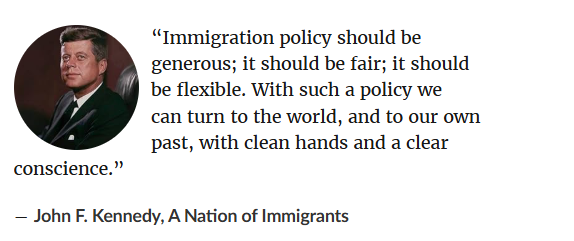
President John F. Kennedy once said,
“Immigration policy should be generous; it should be fair; it should be flexible.”
That clarity still matters today. For staffing firms, aligning the right work model with a candidate’s visa status isn’t just good practice, it’s essential.
The legal side of hiring isn’t optional; it’s your shield. Especially when visas are involved, one wrong move can jeopardize a contract or trigger a costly audit.
Knowing the compliance rules for W2 and C2C models? That’s what keeps you (and your placements) safe.
This is where Consultadd steps in. As the contractor in C2C engagements, we manage all backend administration like contracts, payroll, insurance, 401(k), and relocation support, so staffing firms don’t get overwhelmed by setup or compliance tasks. You focus on facilitating the placement; we take care of the operational heavy lifting.
Work Structure and Lifestyle Considerations
Every candidate brings more than a resume; they bring expectations for how work fits into their life.
Some chase stability. Others crave flexibility. If the structure doesn’t align, they’ll pass fast.
Let’s break down what each employment model means for work style and life balance:
W2 Employment: Predictability and Perks
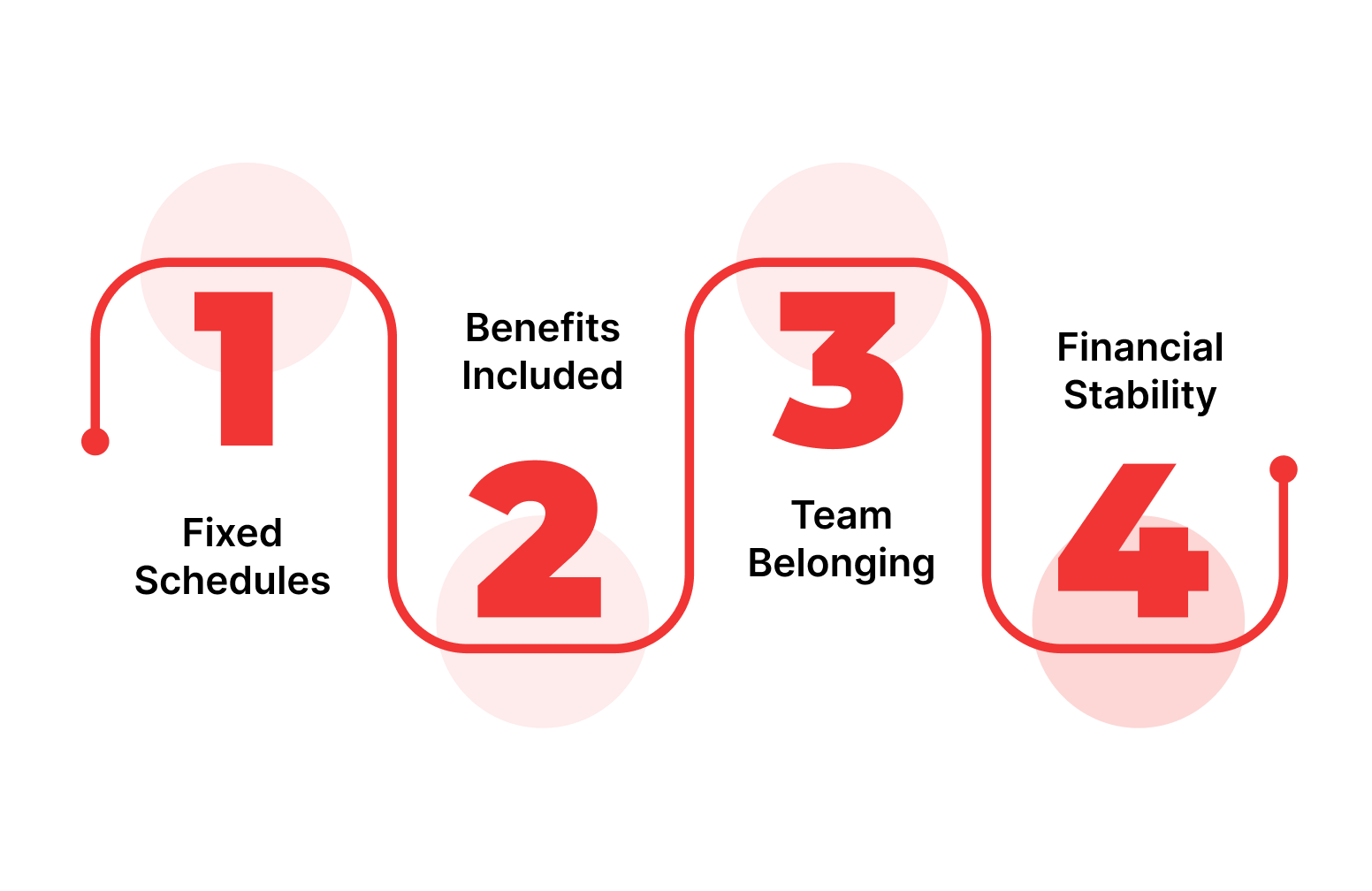
- Fixed Schedules
Set hours offer routine and work-life consistency. - Benefits Included
Health insurance, PTO, and retirement plans add long-term appeal. - Team Belonging
W2 roles often feel more integrated into the company culture. - Financial Stability
Consistent paychecks help reduce personal stress for many professionals.
C2C Engagements: Autonomy with Trade-Offs
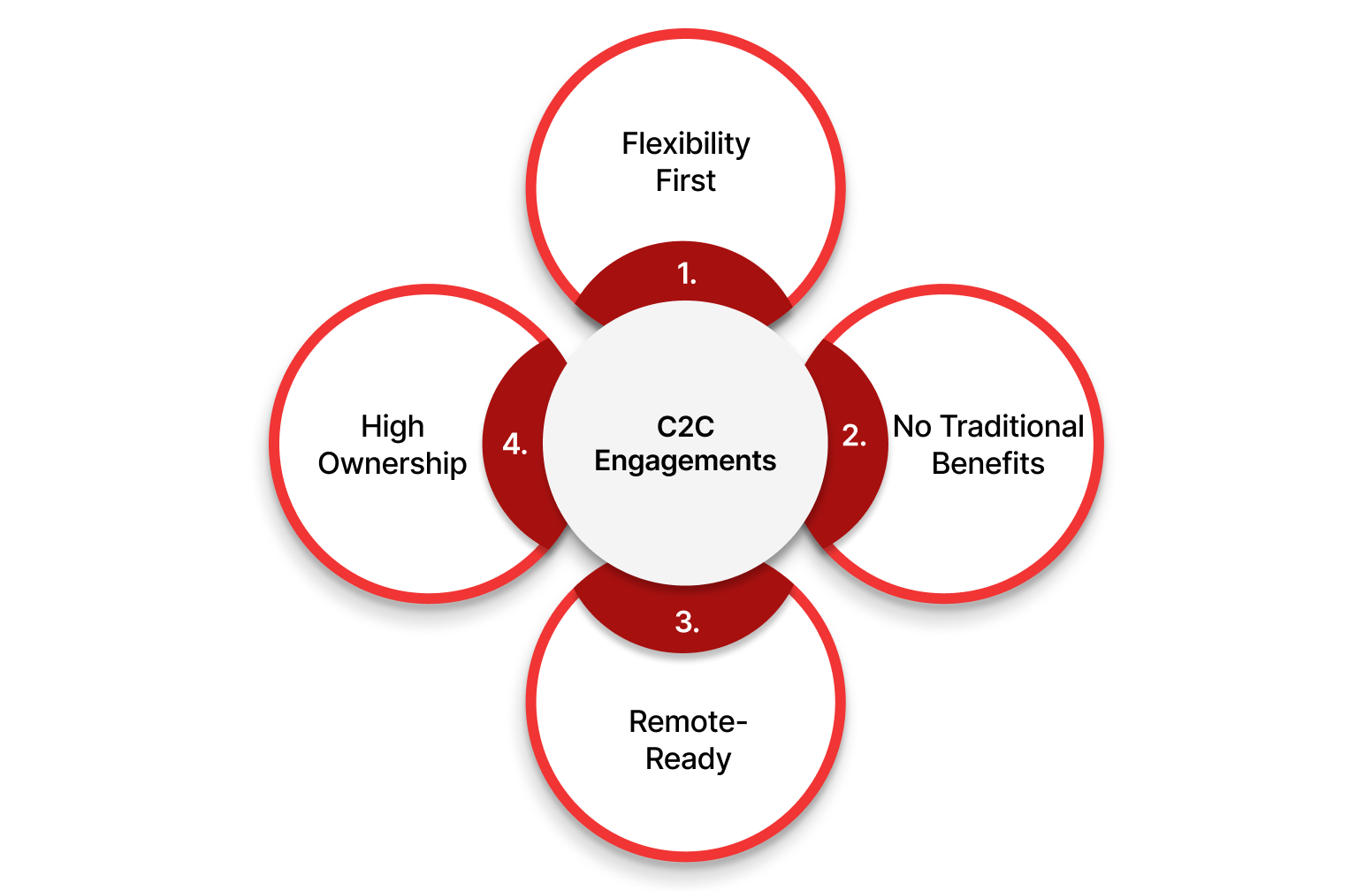
- Flexibility First
Candidates choose their hours, pace, and often their project types. - No Traditional Benefits
Healthcare and taxes? That's on the contractor. - Remote-Ready
C2C roles are often more remote-friendly, ideal for digital nomads or solo workers. - High Ownership
Contractors manage their own taxes and client relationships.
Administrative Burden and Paperwork
Let’s face it, no hiring manager dreams of spending their day buried in compliance docs and time sheets.
But the model you hire under determines just how deep into the admin spiral you go.
Here’s a side-by-side look at how W2 and C2C stack up on paperwork, reporting, and overall effort:
- W2 – Centralized: More upfront steps, with defined checkpoints and documentation. Heavier at the start, but streamlined by the employer.
- C2C – Distributed: Lighter upfront, but more legal/tax complexity across states or clients. Requires organized handling by the contractor and firm.
- Both Require Precision: Missing forms or delays can stall onboarding. Attention to detail is critical in both models.
In C2C, contractors like Consultadd are responsible for handling tax filings and expenses, reducing your administrative load. With full-service support, we manage all operational details, ensuring compliance and legal concerns are expertly handled.
For hiring managers looking to streamline these processes from the ground up, refining your sourcing and procurement workflow is critical. Learn how to do that efficiently in our blog: The Smart Way to Approach Sourcing & Procurement.
Conclusion: Align Work Model with Immigration and Career Needs
Recruiting today is about making lasting, compliant placements that deliver from day one. With tighter timelines, legal risks, and higher turnover, there's little room for error.
Understanding W2 vs. C2C, tax, and compliance is crucial. C2C offers flexibility and scalability, making it an excellent choice.
That’s where Consultadd steps in. We support through:
- Safe, reliable hires: With 5,000+ staffing engagements completed, we know how to identify real talent and make it stick.
- Low turnover, high trust: Our top 100 candidates last year weren’t just skilled; they were committed.
- Seamless compliance: Visa documentation, state taxes, employment law—we’ve handled it all for 14+ years.
- Fast turnaround: We can source ready-to-deploy talent in under 24 hours.
- Backed by strong relationships: Our MSAs with Robert Half, Teksystems, and 65+ staffing firms prove we deliver.
- 1:1 account managers: Dedicated experts who know your market and reduce your admin workload.
- University-backed talent pipeline: Our academic ties give you early access to emerging tech and business talent.
- Support beyond placement: Because true ROI begins after the hire.
Start Strong With Consultadd
Working with an experienced partner like Consultadd ensures you hire smarter. From structured processes to real-time market insights, we help you avoid costly missteps and build teams that deliver from day one.
In a market where great tech talent is hard to find and harder to keep, your approach to staffing makes all the difference. Looking to build a future-ready tech team? Contact Us>>
Key Takeaways
- Choose W2 when stability, employee benefits, and employer-controlled compliance are the priority.
- Choose C2C when you need specialized talent, flexible staffing, and scalable project-based hiring.
- Always verify visa status, sponsorship, and work authorization before moving candidates through the hiring process.
- Understanding tax, legal, and administrative differences helps prevent onboarding delays and costly compliance issues.
- Partnering with an experienced staffing provider like Consultadd streamlines sourcing, documentation, and contractor management.
FAQs
What is the main difference between W2 and C2C employment?
W2 employees work directly for an employer, who manages payroll, taxes, benefits, and compliance. In C2C, the professional typically works through their own business entity or consulting company and is responsible for managing many of these obligations.
Which employment model is better for H-1B visa holders?
It depends on the candidate's employment arrangement and visa sponsorship. W2 generally provides a more straightforward sponsorship structure, while C2C can be used when all immigration and compliance requirements are properly managed.
Why do some clients prefer W2 over C2C contractors?
Many clients prefer W2 because it offers clearer employment relationships, simplified compliance, and lower perceived legal risk. However, organizations seeking niche expertise or project-based talent often choose C2C for its flexibility.
Is C2C more cost-effective than W2 hiring?
C2C can reduce employer expenses related to payroll taxes, benefits, and insurance, making it attractive for short-term or specialized projects. The overall cost depends on contract terms, compliance requirements, and project duration.
How can Consultadd simplify W2 and C2C hiring?
Consultadd helps staffing firms source qualified talent, verify work authorization, manage contractor administration, support compliance, and accelerate placements, allowing recruiters to focus on building successful client relationships.

What Is a Work Authorization? Explained
Introduction
Have you ever had a perfect candidate for a role but hit a roadblock because their work authorization isn’t in place? It’s a situation that hiring managers face often, and it can be a major setback.
In staffing, we know how fast things move. But one thing that can’t be rushed is ensuring that your candidates have the proper legal permissions to work. If they don’t, it could cause delays, compliance issues, and headaches you just don’t need.
In this article, we'll get into what work authorization actually means.
TL;DR
- Work Authorization refers to the legal permission granted to individuals, particularly non-citizens, to work in a specific country.
- Importance: Ensures legal compliance, protects employers from fines, and builds trust with clients.
- Types of Work Authorization: Includes work visas, Employment Authorization Documents (EADs), and permanent residency statuses.
- Who Needs It: Non-citizens, international students, contractors, and temporary workers.
- Verification: Employers must verify work authorization to avoid legal issues and maintain a compliant workforce.
What Is Work Authorization?
In simple terms, work authorization is the legal permission granted to individuals (especially non-citizens or foreign nationals) that allows them to work in a particular country.
Without work authorization, hiring someone can lead to major legal issues, fines, and even lawsuits. It's like a VIP pass to legally be a part of the workforce.
Here’s a breakdown:
- What It Means: Work authorization means an employee is legally allowed to be employed in a country.
- Why It Matters: Without it, employment is illegal, which could lead to significant fines and penalties for employers.
When staffing agencies are sourcing candidates, ensuring the candidate has proper work authorization is a must.
It guarantees legal compliance, minimizes risk, and smoothens the hiring process for everyone involved.
Pro Tip: To ensure a smooth hiring process, always verify a candidate’s work authorization early in the recruitment cycle. This avoids delays later and helps keep the hiring process moving quickly without legal hiccups.
Why Is Work Authorization Important?

Work authorization isn’t just a formality; it’s a must-have for smooth and legal staffing operations.
Here’s why you shouldn’t overlook it:
1. Legal Compliance
In most countries, you must verify a candidate's right to work before hiring them. Failure to do so can result in serious legal penalties.
2. Protecting Your Reputation
Hiring without proper work authorization can damage your business’s reputation, resulting in loss of trust from clients and partners.
3. Building Trust with Clients
When staffing agencies prioritize work authorization, clients know they’re dealing with a compliant and reliable partner. This builds trust and strengthens business relationships.
4. Client Satisfaction
Transparent processes around work authorization ensure smoother placements and better client relationships, helping you maintain a solid reputation.
Taking the time to verify work authorization not only keeps you on the right side of the law but also builds trust and strengthens client relationships in the long run.
Need help with work authorization? Reach out to Consultadd now and let us take care of it, so you can focus on getting the perfect fit for your clients!
Work Authorization vs Work Visa
Work authorization and work visas can be confusing, but understanding the difference is key for a smooth hiring process. Let’s break it down in simple terms.

Now that you know the difference, understanding work authorization and work visas is a lot easier. Keep this in mind to make your hiring process quicker and hassle-free.
Types of Work Authorization
Let’s talk about the different types of work authorization, because no, not all work permits are created equal.
Here’s a quick guide to help you understand the key options:

Different countries have their own rules for these authorizations. Depending on your staffing needs, these types of work permits will be relevant to the candidates you are placing.
Who Needs Work Authorization?
Work authorization is essential for anyone looking to work in a country they aren’t a citizen of.
Here's a quick breakdown of who needs it:

If someone isn’t a citizen or permanent resident, they need work authorization to work. The rules apply to non-citizens, students, temporary workers, and contractors.
Keep track of these details to avoid any compliance issues!
When verifying a candidate's work authorization, don’t forget the importance of reference checks. Check out our blog on Smart Reference Questions to Make Better Hiring Decisions to guide your conversations and ensure you're making the best choices.
Conclusion: Simplify Work Authorization with Consultadd
Managing work authorization can be a complex task, but it doesn’t have to slow you down. Understanding the ins and outs of work authorization not only helps ensure compliance but also speeds up the hiring process.
Here’s a quick recap of what we've covered:
- Work Authorization Essentials: Understanding the importance of legal work permits for non-citizens.
- Why It’s Crucial: Legal compliance and protecting your agency from fines or lawsuits.
- Different Types: H-1B, EAD, Green Cards, and more.
- Who Needs It: Non-citizens, international students, contractors, and temporary workers.
Now that you're equipped with all the necessary information, it’s time to make the process smoother and quicker for your agency.
Start Strong With Consultadd
Working with an experienced partner like Consultadd ensures you hire smarter. From structured processes to real-time market insights, we help you avoid costly missteps and build teams that deliver from day one.
In a market where great tech talent is hard to find and harder to keep, your approach to staffing makes all the difference. Looking to build a future-ready tech team? Contact Us>>
Key Takeaways
- Work authorization is essential for legal hiring, ensuring candidates have the right to work and protecting employers from compliance risks.
- Verifying work authorization early in the recruitment process helps prevent onboarding delays, legal penalties, and hiring disruptions.
- Understanding the differences between work authorization, work visas, EADs, and permanent residency helps staffing teams make informed hiring decisions.
- Employers are responsible for verifying work authorization and maintaining compliance with applicable immigration and employment regulations.
- Partnering with an experienced staffing firm like Consultadd simplifies work authorization, visa support, and compliance while accelerating successful placements.
FAQs
What is the difference between work authorization and a work visa?
Work authorization is the legal permission to work in a country, which can be obtained through various means, including work visas, Employment Authorization Documents (EADs), or permanent residency statuses.
A work visa is a specific type of work authorization granted to foreign nationals for employment in a particular country.
Who is responsible for verifying a candidate's work authorization?
Employers are responsible for verifying that all employees, regardless of citizenship or national origin, are authorized to work in the United States.
This includes completing Form I-9 and reviewing acceptable documentation as per the U.S. Citizenship and Immigration Services (USCIS) guidelines.
What are the consequences of hiring someone without proper work authorization?
Hiring individuals without proper work authorization can lead to significant legal penalties, including fines and potential lawsuits. It also risks damaging the employer's reputation and client trust.
What is the role of an Employment Authorization Document (EAD)?
An EAD is a document issued by USCIS that proves an individual's authorization to work in the U.S.
It is typically required for individuals in certain immigration statuses, such as F-1 students on OPT or asylum applicants, to legally work in the country.
How does Consultadd ensure compliance with work authorization regulations?
Consultadd ensures compliance by staying updated with the latest immigration laws and regulations, providing guidance on visa processes, and assisting with the necessary documentation to maintain legal employment practices.
%20for%20Work%20Authorization.jpg)
Understanding Optional Practical Training (OPT) for Work Authorization
Introduction
You finally find a promising candidate, only to lose them the moment you mention it’s a contract role. Sound familiar? For hiring managers, it’s a constant tug-of-war, tight deadlines, picky clients, and a shallow talent pool that just won’t cooperate.
But what if you could tap into a growing pipeline of highly educated, U.S.-trained professionals who are not only work-authorized but also actively looking for real-world experience? That’s where OPT work authorization becomes a strategic advantage, not just a visa detail.
Over the past two decades, the number of international students using OPT has surged from under 25,000 to more than 220,000 annually. It’s no longer a niche option; it’s a talent goldmine hiding in plain sight.
In this article, we’ll explore Optional Practical Training (OPT) for work authorization and what makes a candidate a good fit.
TL;DR
- OPT talent is U.S.-educated, work-authorized, and ready to fill contract roles quickly and compliantly.
- STEM graduates can work for up to 36 months under OPT, offering long-term placement stability.
- Strict compliance rules like EAD requirements, job relevance, and reporting make the right staffing partner critical.
- Consultadd handles everything from sourcing to compliance, helping you hire faster and smarter with zero risk.
Understanding Optional Practical Training (OPT)
When roles stay open and time’s ticking, OPT talent could be the solution you’ve overlooked.
Here’s why it might transform your tech hiring process.
What Is OPT?
Optional Practical Training (OPT) is a work authorization benefit for F-1 international students in the U.S.
- It allows them to gain hands-on work experience related to their major.
- Students can work during or after their academic program.
- It offers up to 12 months of work authorization per degree level.
This means more qualified, ready-to-work talent entering the job market every year.
Two Types of OPT
OPT is divided into two main categories, each with distinct conditions and benefits.

The STEM OPT Extension
Some candidates can work longer under the STEM OPT extension.
- Adds 24 months to the initial 12-month OPT period.
- Applies only to STEM (Science, Tech, Engineering, Math) degree holders.
That’s a total of 36 months of work authorization for tech roles, if you play your cards right.
Application Process for OPT

Hiring international students can often feel like navigating red tape, but the OPT process is more structured and manageable than it appears.

Here’s some inspiration from Bill Clinton:
“In each generation, they have proved to be the most restless, the most adventurous, the most innovative…”
Clinton wasn’t just talking about history; he was recognizing a workforce that drives innovation today, one often overlooked by staffing agencies.
When paperwork drags and timing slips, the result is lost talent and missed placements.
Understanding the OPT process helps you stay ahead, so you can deliver faster and avoid those pitfalls.
Step 1: School Authorization
Before anything else, the student must get approval from their university.
- They request an OPT recommendation from their Designated School Official (DSO).
- The DSO endorses their Form I-20 and updates their SEVIS record.
Without this, no application can move forward.
Step 2: USCIS Application
After school approval, it’s time to apply for official work authorization.
- Students submit Form I-765 to USCIS for an EAD (Employment Authorization Document).
- Required documents include the endorsed I-20, passport copies, and a filing fee.
This is a crucial legal step; no shortcuts here.
Step 3: Know the Timelines
Timing isn't just important, it’s everything.

Missed deadlines lead to missed placements. Awareness now prevents headaches later.
Step 4: Wait for Approval
Patience is part of the process, but planning can reduce stress.
- USCIS may take 2–5 months to approve an application.
- Students cannot begin working until the EAD card is in hand.
No exceptions. Even volunteering before approval can breach F-1 status.
By mastering the OPT process, staffing agencies can move faster, smarter, and with total confidence.
Navigating the OPT process can be time-consuming. With Consultadd, you get ready-to-hire candidates, reducing sourcing time and eliminating the risk of unqualified applicants. We manage work authorization, compliance, and paperwork, so you don’t have to.
Understanding the STEM OPT Extension
Twelve months of OPT can fly by, just as a candidate starts proving their worth.
The 24-month STEM OPT extension ensures you don’t lose that momentum or talent.
With this extension, you get up to three years of uninterrupted work authorization, a major advantage in long-term project staffing.
Who Qualifies for the STEM OPT Extension?
To be eligible, the candidate must:
- Be in valid F-1 status and on active post-completion OPT.
- Hold a STEM degree from a SEVP-certified, accredited U.S. school (bachelor’s, master’s, or doctorate).
- Work in a job that directly relates to that STEM field.
- Be employed by an E-Verify-enrolled employer in good standing.
Bonus: Candidates can use a previous STEM degree from an accredited U.S. school if the job aligns. They can also apply for another STEM extension after earning a higher-level STEM degree later.
Application Essentials
To apply, students must file Form I-765 along with:
- The correct filing fee
- Form I-20 (endorsed by the DSO within 60 days)
- A copy of the qualifying STEM degree
- Their employer’s legal name and E-Verify number
Deadlines matter:
- Application must be filed within 90 days before OPT expires.
- It must also be submitted within 60 days of DSO’s recommendation in SEVIS.
Employer Responsibilities
Employers must:
- Be enrolled in E-Verify
- Sign and maintain Form I-983 (Training Plan)
- Offer structured, goal-driven training
- Report job changes or termination in 5 business days
- Not displace U.S. workers
Note: Only employers providing hands-on training can sponsor. Intermediaries won’t qualify.
Adhering to OPT and STEM OPT requirements is key, while sourcing the right candidates efficiently. Learn more about optimizing your recruitment process in our blog, The Smart Way to Approach Sourcing & Procurement.
Maintaining F-1 Status and Reporting During OPT
When a candidate’s visa status slips, so does your placement. Staying compliant with F-1 rules isn’t optional, it’s essential to protect contracts, timelines, and trust.
What Is F-1 Status?
The F-1 visa is for full-time international students in U.S.-approved academic programs. It allows eligible students to apply for OPT for a 12-month work period in their field of study.
Who Is Eligible for OPT?
- Must hold a valid F-1 visa.
- Must have completed one academic year of full-time study.
- Must be seeking work directly related to their major.
Work Must Be Degree-Related
Every job must directly relate to the student’s major field of study.
Roles tied to minors or unrelated degrees don’t qualify and could jeopardize their visa.
Mandatory Reporting: What Needs to Be Updated
F-1 students must report any of the following within 10 days to their DSO:
- Legal name
- Residential or mailing address
- Email address
- Employer name
- Employer address
Even if nothing changes, they must reconfirm details every 6 months.
Unemployment Limits You Should Know

Hiring managers should track timelines to avoid status violations due to unemployment gaps.
What Can Go Wrong (And Often Does)
- Forgetting SEVP Portal updates
- Working outside their degree field
- Failing to report job changes
- Listing the wrong start/end dates
These missteps can lead to loss of F-1 status, forcing you to replace your candidate mid-project.
F-1 compliance is the backbone of long-term contract success. Candidates who maintain status stay billable, engaged, and secure. That’s less stress and more consistency for you.
While understanding OPT compliance is crucial, it’s equally important to be vigilant about candidate authenticity. For tips on how to spot and prevent issues with fake candidates, check out our blog on Identifying and Preventing Fake Candidates in Recruitment.
OPT Employment Conditions
Compliance isn’t optional when it comes to OPT candidates; it’s the line between placement success and visa failure. Knowing what’s allowed helps you reduce risks, build trust, and keep candidates billable.
Candidates Can’t Work Without an EAD
- Candidates must receive their Employment Authorization Document (EAD) before starting any job.
- No exceptions, even unpaid roles require a valid EAD.
Minimum Work Hours Apply
- OPT candidates must work at least 20 hours per week.
- This applies to both paid and unpaid roles.
Unpaid Internships and Volunteer Work
- Unpaid work is allowed only if it complies with labor laws.
- Recruiters should confirm the internship meets the Department of Labor’s fair work criteria.
Understanding employment rules means fewer drop-offs, cleaner audits, and longer-lasting placements.
Compliance can be challenging, but Consultadd makes it simple. We handle all the paperwork compliance, 401(k), insurance, and more, helping you fill roles faster and scale without administrative burdens.
Challenges and Considerations for OPT Participants
Hiring managers dealing with OPT candidates aren’t just chasing placements; you're racing against deadlines, documentation, and visa complexities.
Here's what you need to know to avoid surprises and build stronger pipelines.

Conclusion: The Value and Future of OPT in U.S. Tech Hiring
In a hiring world of ghosted interviews and last-minute dropouts, OPT talent offers stability. Skilled and committed, they’re valuable assets for staffing agencies needing reliable results.
We've outlined OPT work authorization, application steps, STEM extensions, and key employer responsibilities to help you confidently integrate OPT candidates into your pipeline.
And here’s where Consultadd becomes your behind-the-scenes powerhouse.
- 5K+ placements made with zero compromise on compliance or candidate quality
- Top 100 OPT candidates sourced in the past year
- 65+ staffing firms served—including MSAs with Robert Half, Teksystems, and others
- Talent ready in 24 hours, with deep pipelines from U.S. universities
- 1:1 account managers ensuring clarity, speed, and proactive communication
We don’t just drop a resume and disappear. Our 14+ years in the industry have taught us that long-term success comes from:
- Thorough vetting for skills and visa compliance
- Candidates who stay, grow, and add value, not vanish after onboarding
- Full support through onboarding, documentation, and beyond
Start Strong With Consultadd
Working with an experienced partner like Consultadd ensures you hire smarter. From structured processes to real-time market insights, we help you avoid costly missteps and build teams that deliver from day one.
In a market where great tech talent is hard to find and harder to keep, your approach to staffing makes all the difference. Looking to build a future-ready tech team? Contact Us>>
Key Takeaways
FAQs
What is meant by Optional Practical Training?
Optional Practical Training (OPT) is temporary employment that allows eligible F-1 international students in the U.S. to gain practical experience in their major field of study. It can be used during or after academic completion.
What is the meaning of OPT work authorization?
OPT work authorization allows F-1 students to legally work in the U.S. for up to 12 months in a job directly related to their field of study. Students must apply to USCIS and receive an Employment Authorization Document (EAD) before starting work.
What is hold F-1 Optional Practical Training (OPT)?
Holding F-1 OPT means a student is in valid F-1 visa status and approved for OPT. They are authorized to work in roles related to their degree for a set period, typically 12 months, while still under F-1 visa conditions.
What happens after 1 year of OPT?
After 12 months of OPT, students must stop working unless they qualify for a STEM OPT extension or obtain a different visa, such as the H-1B. Without further authorization, they must either leave the U.S. or enroll in another academic program.

Classifying Employees the Right Way: A Compliance Guide
Introduction
When you're running point on multiple job reqs, moving fast is non-negotiable. But even the most seasoned staffing professionals can get tripped up by one critical detail: employee classification.
Classifying workers correctly isn't just a legal box to tick; it’s the foundation of compliance, pay structures, benefits, and client trust. One misstep? You’re not just risking payroll errors; you could be opening the door to audits, penalties, and damage to your agency’s reputation.
And the rules are far from simple.
In fact, the U.S. Department of Labor outlines a range of labor laws that impact millions of workers and employers across the country. Knowing where your candidates fit in isn’t a nice-to-have. It’s a must.
Before you place your next tech candidate, let’s take a closer look at the classification types you should understand.
TL;DR
- Correct employee classification is essential for legal compliance, accurate payroll, and protecting client relationships.
- Understanding classifications such as exempt, non-exempt, and contingent workers helps reduce compliance and financial risks.
- Misclassification can lead to IRS audits, wage claims, penalties, lawsuits, and reputational damage.
- Regularly reviewing and updating employee classifications ensures compliance as job duties and employment relationships evolve.
- ConsultAdd simplifies compliant hiring by providing correctly classified, fully vetted tech talent while managing documentation and regulatory requirements.
Overview of Employee Classification Types
- Hiring in today’s market is fast-paced, but compliance isn’t something you can afford to rush.
- Every role you fill must come with clarity: not just who you're hiring, but how they're classified.
- When employment classification is accurate, everything flows: contracts, payroll, benefits, and client trust.
- When it's wrong, it costs you. Time. Money. Credibility.
Exempt vs. Non-Exempt Employees
This is one of the most misunderstood yet critical classifications.
It determines whether one qualifies for overtime pay under the Fair Labor Standards Act (FLSA).
Think of it this way: It’s not just about how much someone earns, but how they earn it and what duties they perform.
1. Exempt Employees
These employees are exempt from FLSA overtime rules.
To qualify, they typically:
- Are paid a fixed salary, not hourly
- Earn at least $684/week (as per FLSA guidelines)
- Perform executive, professional, or administrative duties
Key Rights & Protections:
- No overtime pay, even if they work 50+ hours
- Still protected by anti-discrimination, workplace safety, and harassment laws
- Often receive benefits like health insurance, PTO, and retirement plans
2. Non-Exempt Employees
These workers must be paid overtime, 1.5 times their regular rate, for any hours worked over 40 hours per week.
They usually:
- Are paid hourly
- Perform more routine or operational tasks
- Have tightly tracked work schedules
Key Rights & Protections:
- Guaranteed overtime pay under federal law
- Must be paid at least the minimum wage
- Protected under wage and hour laws, and entitled to breaks (in many states)
- May or may not receive benefits, depending on their employment type
What Are Contingent Workers?
Contingent workers are your on-demand workforce brought in for the short haul.
Think contractors, freelancers, consultants, gig workers, and temps.
They're not on your permanent payroll, but they’re often the ones who help you hit deadlines, scale up fast, or fill skill gaps overnight.
Why they matter:
- They let teams flex up or down without long-term commitment.
- They bring niche skills you may not need full-time.
- They support project-based or seasonal surges.
Pay and benefits?
That depends. Many are hourly or project-based. Some handle their own taxes and insurance. Others go through tech talent partners that cover part of the admin lift.
Understanding this difference is key not just for legal compliance, but for setting accurate client expectations.
Types of Employees in the US
Classifying employees correctly isn’t just a legal formality but a competitive advantage.
Here’s a simplified breakdown of the most common employee types in the U.S. hiring system:

Each classification comes with its own rights, risks, and regulations.
Remember, understanding these from the start helps you match the right talent with the proper role and keeps you and your clients out of trouble.
The U.S. Department of Labor enforces multiple labor laws that impact classification, ranging from the FLSA to IRS guidelines. Staying compliant isn’t optional. It’s essential.
If you’re looking for specialized talent in Full-Stack Development, Cloud Technology, or DevOps, Consultadd can help. Our C2C contract hiring model ensures that all candidates are properly classified and compliant with IRS guidelines, reducing the risk of misclassification.
Let’s understand why getting these classifications right matters more than ever.
Importance of Correct Employee Classification

Misclassify one role, and you're not just filing the wrong paperwork; you’re opening the door to risk.
Here are the risks of misclassifying employees:
- Owed taxes, interest, penalties, and IRS investigations
- Claims for unpaid overtime or wages, costly payouts
- Fines for not providing health insurance, leave, etc.
- Expensive, lengthy legal battles and settlements
- Loss of team trust and damage to company image
In staffing, speed is important, but getting it right is crucial, most importantly when it comes to correct employee classification.
1. It's the Foundation of Compliance
Employee classification determines tax treatment, labor rights, and eligibility for benefits. Get it wrong, and you violate federal and state laws.
2. Legal Protection For You and Your Clients
When classification is correct:
- Your clients avoid wage-and-hour lawsuits.
- Your contracts hold up in court.
- Your candidates get what they’re owed.
Incorrect classification can result in:
3. Financial Accuracy
Misclassify an employee and you're likely:
- Paying incorrect taxes or benefits.
- Billing clients under the wrong terms.
- Losing revenue due to errors in scope.
Every classification choice affects payroll, margin, and benefits costs. Errors compound quickly.
4. It Builds Long-Term Trust
When clients know you’re buttoned-up with classification, they stick around.
You’re not just providing talent, you’re reducing their legal and compliance exposure.
That's the real value.
5. Sets the Standard for Ethical Recruiting
Ethical classification means:
- Interns aren't doing unpaid work illegally.
- On-call workers understand their rights.
It’s more than rules, it’s respect.
If you’re looking to simplify classification and reduce the risk of misclassification, C2C contract hiring offers a flexible and compliant solution. Learn more in our blog: Why C2C Contract Hiring Solutions Are Ideal for Modern Businesses.
Creating and Implementing Employee Classification Policies
Here’s how to build a policy that supports speed, trust, and compliance even during crunch time.

The Legal Consequences of Employee Misclassification
Misclassifying workers can hit hard with lawsuits, fines, audits, and the kind of reputational damage that sends clients running. And in an industry built on trust, that’s a price you can’t afford to pay.
Let’s understand what’s at stake:
1. Tax Trouble That Lingers
- You might owe years of back taxes, plus interest and penalties.
- The IRS won’t just send a letter, they’ll likely audit your books.
- If you skipped withholding payroll taxes (like Social Security or Medicare), expect that bill to balloon.
2. Labor Law Breaches
- Misclassified workers often miss out on minimum wage, overtime, or meal break protections.
- This opens the door to employee lawsuits and trust us, they’re not cheap or quiet.
- Some states, like California, allow workers to sue on behalf of the state under laws like the Private Attorneys General Act (PAGA).
3. Benefit Promises That Backfire
Employees are entitled to certain benefits, health insurance, paid time off, retirement contributions.
- Misclassified workers often miss out on these
- That gap creates liability for reimbursement or retroactive coverage
- It also signals to clients that your agency may not be compliance-ready
4. Litigation That Drains Focus
Legal battles over misclassification are rarely small or swift.
- They demand time, resources, and expert counsel
- Settlements and judgments can quickly surpass six figures
- More than the money, it’s the reputational toll that hurts long-term growth
5. Unemployment Insurance Claims That Don’t Add Up
When misclassified workers file for unemployment, states investigate.
- You may face non-compliance for failing to pay into unemployment funds.
- This often results in fines and red-flag status with state agencies
Changing Employment Classification


Orlando A. Battista, a chemist known for his breakthroughs during WWII, once shared:
“An error doesn't become a mistake until you refuse to correct it.”
He wasn’t talking theory, he lived it. When a small misstep in his lab could affect lives, he learned the value of stepping in early and fixing what others might ignore.
In his labs, that meant pausing production to fix miscalculations even when it cost time. Because catching errors early saved the mission later.
In staffing, it’s no different. Roles shift. Clients change scope. But ignoring outdated classifications? That’s the real mistake.
Here’s how to avoid it with precision and confidence.
1. Know When to Consider a Change
Some of the most common reasons for reclassification include:
- If hours or responsibilities change in reference to what’s mentioned.
- An intern or temp becomes a core contributor.
- A client requests a shift in role structure.
- Legal audits reveal misclassification risks.
If the working relationship evolves, classification should evolve too.
2. Build a Reclassification Checklist
Don’t reinvent the wheel each time. Create a go-to checklist like this:
- Review original contract and scope of work
- Document what has changed (hours, duties, oversight, etc.)
- Run through FLSA exemption rules
- Cross-check with IRS 20-Factor Test (especially for ICs)
- Loop in legal/compliance team
- Notify client and get their approval
- Draft new contract or offer letter
- Re-onboard if status changes
3. Communicate the Shift Internally and Externally
This is where most staffing teams drop the ball. Here’s how to get it right:
For the candidate:
- Give at least 1–2 weeks' notice
- Walk them through what changes (taxes, benefits, hours)
- Provide a point of contact for questions
For the client:
- Explain the compliance risk and your recommendation
- Show how you're solving the issue quickly
- Offer to update contracts and handle new onboarding
Internally:
- Make sure payroll and HRIS are updated
- Inform the account manager and recruiter to avoid miscommunication
4. Maintain a Classification Log
You need a paper trail. Create a simple shared sheet.
Keep this updated. If a client or auditor asks why you reclassified someone, you have your proof.
5. Train Your Team
Incorporate classification training for internal teams. Use scenarios like:
- “If a contractor is using the client’s equipment and gets daily direction…”
- “If a worker sets their own hours and works for other clients simultaneously…”
Teach them to spot the edge cases before they become problems.
Done right, reclassification is a competitive edge.
If you’re looking to scale quickly, Consultadd acts as an extension of your recruitment team, providing tech talent that already meets your classification and compliance needs, so you can focus on what matters most—your client relationships.
Conclusion: Ensure Compliance Through Accurate Employee Classification
You must have seen or heard how a single misstep in classification can slow everything down or worse, break trust.
But with a system that’s clear, compliant, and scalable, classification becomes a strength not a risk. When you get this right, your team works faster, your clients feel protected, and your candidates stay longer.
Consultadd helps make that your reality.
With 14+ years in business, 5K+ successful staffing engagements, and MSAs with top firms like Robert Half and Teksystems, we’ve built the systems, speed, and scale to support elite staffing teams.
Here’s how we help you stay ahead:
- Safe, reliable hires: Every candidate is vetted for experience, compliance, and readiness from day one.
- Lower turnover risks: You get professionals committed to long-term success, not short-term fixes.
- Seamless compliance: Visa issues? Documentation? Regulation changes? We’ve got it handled.
- Continuous support: Post-placement, we remain a partner in growth and retention.
With 1:1 account managers, access to the top 100 candidates placed in the past year, and talent sourced in under 24 hours, we’re built for fast-moving staffing teams. Add in strong university ties and ~65 satisfied agencies last year, and you get a partner who understands what excellence really takes.
Start Strong With Consultadd
Working with an experienced partner like Consultadd ensures you hire smarter. From structured processes to real-time market insights, we help you avoid costly missteps and build teams that deliver from day one.
In a market where great tech talent is hard to find and harder to keep, your approach to staffing makes all the difference. Looking to build a future-ready tech team? Contact Us>>
Key Takeaways
- Understand the differences between exempt, non-exempt, and contingent workers to ensure proper classification and compliance.
- Accurate employee classification reduces legal, financial, and operational risks for staffing firms and their clients.
- Establish clear classification policies, maintain documentation, and train recruitment teams to prevent costly mistakes.
- Regularly review employee classifications as job responsibilities, contracts, or employment conditions change.
- Partner with compliance-focused staffing experts like ConsultAdd to minimize misclassification risks and streamline hiring.
FAQs
What is employee classification?
Employee classification is the process of determining a worker's employment status, such as exempt, non-exempt, independent contractor, or contingent worker, which affects taxes, pay, benefits, and legal protections.
Why is correct employee classification important?
Proper classification helps organizations comply with labor laws, avoid penalties, ensure accurate payroll, and provide the correct wages, overtime, and employee benefits.
What are the risks of employee misclassification?
Misclassification can result in IRS audits, back taxes, unpaid overtime claims, legal penalties, employee lawsuits, benefit liabilities, and damage to an organization's reputation.
When should an employee's classification be reviewed?
Employee classifications should be reviewed whenever job responsibilities, reporting structures, work schedules, or employment arrangements change, as well as during regular compliance audits.
How can staffing firms reduce employee classification risks?
Staffing firms can reduce risk by following federal and state labor laws, maintaining clear classification policies, documenting employment changes, training recruiters, and partnering with experienced staffing providers like ConsultAdd.

Employee Misclassification: Why It Matters and What It Costs
Introduction
You’re expected to move fast, fill roles quickly, keep clients happy, and stay compliant at every step.
But even when everything looks right on paper, one misclassified worker can throw your entire process off course.
For recruiters and hiring managers, employee misclassification isn’t just a paperwork mistake; it’s a legal and financial risk that’s more prevalent than many realize. Recent DOL investigations found two Louisiana home care providers misclassified workers, resulting in $844,000 in penalties and exposing the businesses to significant legal, financial, and operational risks.
Sometimes it happens out of confusion. Other times, filling roles is a rush without thoroughly assessing the classification. Either way, the impact can be costly with wage disputes, back taxes, and broken trust.
Before we explore how to address it, let’s start with the basics: what exactly is employee misclassification, and why should recruiters care?
TL;DR
- Employee misclassification occurs when workers are incorrectly classified as independent contractors instead of employees, creating significant legal, tax, and financial risks.
- Common causes include unclear employment laws, pressure to hire quickly, inconsistent internal processes, and the rise of remote and gig work.
- Proper classification depends on evaluating behavioral control, financial control, and the overall working relationship—not just contract language or job titles.
- Regular audits, clear documentation, and compliance reviews help prevent costly penalties, lawsuits, and reputational damage.
- Staffing firms that prioritize compliant hiring protect clients, workers, and long-term business relationships while reducing operational risk.
Definition and Overview of Employee Misclassification
Employee misclassification happens when a business treats an employee as a contractor. This can lead to:
- Missed tax withholdings
- Lack of access to overtime pay and benefits
- Legal issues for both the employer and the client
Misclassification usually isn’t intentional. But intent doesn’t matter when the IRS or DOL comes knocking.
Employee vs. Contractor: Key Differences

Why Is It Important Right Now?
Government agencies closely monitor classification errors and take quick action when they identify them.
Here’s why the pressure is increasing:
- Growth of gig and contract work is blurring traditional employment lines
- State and federal audits are on the rise, with stricter penalties
- Public focus on worker rights is pushing companies to be more accountable
Employee misclassification isn’t just a risk. It’s a red flag that could hurt client trust, delay placements, and cause long-term damage to your credibility.
To avoid these risks, it’s important to understand the factors behind misclassification.
Factors Contributing to Misclassification

When the pressure’s on to deliver talent yesterday, it’s easy to overlook red flags. But misclassification isn’t always about negligence. Sometimes it’s a mix of systemic confusion, shifting work models, and misunderstood laws.
Let’s break down why these errors keep happening.
1. Chasing Cost Savings
Hiring independent contractors can reduce payroll taxes, benefits, and onboarding costs.
Some businesses take advantage of this, whether intentionally or not, to reduce expenses quickly. However, cutting corners in this area often results in expensive penalties down the line.
Pro Tip: If the role requires set hours, regular supervision, and long-term commitment, structure the agreement appropriately, not as a 1099 independent contractor, but according to your defined C2C terms and client expectations.
2. Confusion Around Employment Laws
Employment laws differ from state to state and are constantly evolving.
Without clear guidelines, many companies guess or assume. That’s when contractors start doing employee-level work, quietly exposing the agency to risk.
Pro Tip: Don’t rely solely on job titles. Assess the working relationship, not just what’s on paper.
3. The Rise of the Gig and Remote Economy
The workforce has changed. So has the definition of “employee.”
With hybrid setups, flexible hours, and remote teams, roles look less traditional. This makes it harder to get the proper classification right, especially when clients prioritize skills over contracts.
4. Lack of Internal Checks
Fast-growing teams often skip structured classification reviews.
This leads to inconsistencies in how similar roles are handled, which can lead to potential misclassification issues later on.
5. Pressure to Fill Roles Fast
Speed is non-negotiable in staffing. However, under tight deadlines, vetting classification can get rushed or ignored.
It’s not just about placing a candidate. It’s about protecting the client and the agency from long-term fallout.
In such situations, Consultadd ensures all candidates are thoroughly screened for skills, experience, and compliance. By presenting only qualified candidates, we reduce the risk of misclassification and ensure compliance.
Misclassification often comes from unclear criteria, not bad intent. Next, we'll look at how to define those criteria more clearly.
Criteria for Correctly Classifying Employment Status

Hiring quickly is important, but hiring right is essential.
Misclassifying a worker can trigger audits, fines, or lawsuits that take months to clean up. To avoid this, every staffing pro should run new roles through a simple classification test based on three key criteria.
1. Behavioral Control
Does your client control how the work is done?
Employers dictating daily tasks, hours, or processes typically signal an employee relationship.
Quick Checks:
- Is the worker being trained or supervised like a regular employee?
- Does the client expect specific tools or processes to be used?
- Are there set work hours or mandatory meetings?
What You Can Do:
- Ask your client to describe the day-to-day involvement with the worker.
- Document whether the role involves independent decision-making or direct oversight.
2. Financial Control
Who manages the money side of the job?
This looks at how the worker is paid, whether expenses are reimbursed, and whether there is a chance of loss or profit.
Quick Checks:
- Is the worker paid hourly/salary, or do they invoice per project?
- Does the client provide tools, software, or workspace?
- Can the worker take on multiple clients or just this one?
What You Can Do:

3. Relationship Type
What’s the bigger picture of this engagement?
Beyond tasks and pay, consider how integrated the worker is with the client’s business.
Quick Checks:
- Is there an ongoing, indefinite contract?
- Does the role offer benefits, PTO, or job security?
- Is the work core to the client’s daily operations?
What You Can Do:
- Review the contract terms, but don’t stop at just that.
- Observe if the worker is treated like one of the team.
Implementing these checks early in the hiring process minimizes costly mistakes and fosters trust with clients.
Let’s look at the signs of employee misclassification and how to catch them before they snowball.
Identifying Employee Misclassification
You can’t afford to question a worker’s status, especially when compliance risks are high.
So, how do you spot red flags before they turn into fines? Let’s break it down.
1. W-2 vs. 1099: The Tax Form Test
If a worker receives a 1099-NEC instead of a W-2, it means they’re being paid as an independent contractor.
Pro Tip: Always reconcile tax form data during onboarding audits. Discrepancies here are early warning signs.
2. Contractor Agreement vs. Actual Duties
Sometimes, a person signs a contractor agreement but performs like a full-time employee.
3. Verbal “Independent Contractor” Claims
Some clients or hiring managers may casually call workers independent contractors, but that’s insufficient.
Quick Insight: Courts and auditors focus on facts, not labels. Verbal claims won’t hold up legally.
When in doubt, document everything.
Next, we’ll explore how this impacts your teams, clients, and bottom line.
How can you spot red flags before they turn into fines? To tackle staffing challenges more effectively, check out our blog: From Skills Gap to Strategic Growth: Talent Mapping That Delivers and discover how talent mapping can drive proactive solutions.
Impacts of Misclassification on Different Stakeholders

Misclassification isn’t just a payroll concern; it’s a people problem. Here’s a clear breakdown of how it affects everyone in the chain.
1. Effects on Employees’ Pay, Benefits, and Protections
When workers are misclassified, the financial and personal toll can be steep.
Key consequences for employees:
- No access to overtime, minimum wage, or paid time off
- No employer-sponsored health insurance or retirement plans
- Ineligibility for unemployment benefits or workers' compensation
- Full responsibility for self-employment taxes
2. Impact on Employer Operations and Legal Liabilities
Misclassification creates legal landmines that can derail even the strongest client relationships.
What employers risk:
- Penalties for unpaid payroll taxes and benefits
- Lawsuits from workers claiming misclassification
- Damage to brand reputation and trust
- Disruptions from audits and legal inquiries
3. Cost Implications for the Government
Misclassification doesn’t just harm companies, it diminishes public funding for essential programs.
Consequences at the federal and state levels:
- Loss of Social Security and Medicare tax contributions
- Lower unemployment insurance reserves
- Delays in benefits for workers in need
Misclassification impacts more than just compliance; it reduces trust, stability, and long-term growth.
Now let’s break down how to spot the warning signs early.
Prevention and Correction Strategies
Getting classified is about protecting the business that’s been built. These strategies help reduce risks before they snowball and fix issues quickly when they do slip through.

We Source Tech Talent, You Close Deals. At Consultadd, we take care of all the hiring tasks, so you can focus on matching the right talent with the right clients.
Reporting and Addressing Misclassification
Misclassification doesn’t just go away if you ignore it. And when state authorities come knocking, the real cost isn’t just the back pay; it’s your firm’s reputation, client trust, and long-term revenue.
Labor attorney Shannon Liss-Riordan made headlines by taking on Uber and Lyft for misclassifying drivers. Her lawsuits demanded reimbursements for job-related expenses that drivers had to cover themselves.
“We've seen a lot of companies in a lot of different industries try and get away with this,” she said.
“We’re just seeing a new wave of companies that are pushing the envelope.”
Her cases served as a warning: misclassification isn’t uncommon; it’s increasing. And the cost of getting it wrong? Enormous.
Uber and Lyft agreed to pay $328 million in a New York settlement for unlawfully withholding driver earnings and must now improve wages, benefits, and transparency for their drivers.
How They Addressed the Misclassification
To adapt, the company reorganized and began hiring new drivers as incorporated contractors. Here’s what they implemented:

This hybrid model, mixing employees and independent contractors, passed State scrutiny but came at a cost.
Lessons for Staffing Managers
If you suspect misclassification, act quickly. Here’s what you can do:
- Review worker status regularly, especially when scopes or control dynamics shift
- Get legal eyes on your IC agreements
- Know your State’s standards; some, like New York, are more aggressive
- Prepare to correct without delay, since fighting the State can be more costly in the long run.
Proactive reporting doesn’t indicate weakness; it demonstrates leadership.
Start Strong With Consultadd
With 15 years in business and 5,000+ successful staffing engagements, we don't just fill roles, we build reliability into your process. We've supported 65 staffing companies in the past year alone and maintain MSAs with industry leaders like Robert Half and TEKsystems.
Here's what working with Consultadd looks like:
- Talent sourced in under 24 hours
- Ready-to-deploy candidates, vetted for experience and compliance
- Lower turnover risk: we match long-term goals, not just short-term needs
- Seamless compliance: visa, documentation, onboarding? Handled.
- Dedicated 1:1 account managers for responsive, personalized support
- Top 100 candidate matches delivered in the past year
- Strong partnerships with universities to tap into fresh, committed talent
- Post-placement support so your investment grows beyond day one
For candidates, your next opportunity is more than just a job title, it's a chance to build skills, gain experience, and move your career forward. At Consultadd, we connect technology professionals with projects and employers that align with their goals, whether they're looking for contract, contract-to-hire, or long-term opportunities.
The tech job market moves fast, but the right guidance can make all the difference. Ready to take the next step in your career journey? Explore Opportunities >>
Key Takeaways
- Understand classification rules: Evaluate workers based on behavioral control, financial control, and relationship type instead of relying solely on contracts or titles.
- Reduce compliance risks: Conduct regular classification reviews, maintain documentation, and stay current with federal and state employment regulations.
- Avoid costly mistakes: Misclassification can result in back taxes, wage claims, penalties, legal action, and reputational damage.
- Train hiring teams: Ensure recruiters, hiring managers, and clients understand the differences between employees and independent contractors.
- Prioritize compliance from the start: Integrating classification checks into the hiring process prevents problems before placements are finalized.
FAQs
1. What is employee misclassification?
Employee misclassification happens when a worker who should legally be treated as an employee is incorrectly classified as an independent contractor, potentially violating tax and labor laws.
2. Why is employee misclassification a problem?
Misclassification can lead to unpaid taxes, wage disputes, employee benefit claims, government penalties, legal action, compliance audits, and damage to an organization's reputation.
3. How do employers determine the correct worker classification?
Employers typically evaluate three primary factors: the level of behavioral control over the worker, financial control of the work arrangement, and the overall nature of the working relationship.
4. What are common signs of employee misclassification?
Warning signs include contractors working fixed schedules under direct supervision, using employer-provided equipment, performing core business functions, receiving ongoing assignments, or being treated like regular employees despite contractor agreements.
5. How can businesses prevent employee misclassification?
Businesses can reduce misclassification risks by reviewing worker classifications regularly, documenting employment relationships, training hiring teams, consulting legal or HR experts when needed, and staying current with federal and state labor regulations.