
Hiring & Recruitment

Comprehensive Guide to Workplace Diversity Types
Introduction
You’ve been there, emails go unanswered, promising candidates drop off, and clients still expect results.
Now, add another layer: they don’t just want a skilled hire, they want a diverse one. And not just for the sake of it. Because diversity delivers.
Companies with inclusive teams report 19% higher revenue from innovation.
But what exactly counts as diversity? It's no longer limited to what’s visible on the surface. Today’s workplace spans a wide range of lived experiences, identities, and values, all of which shape how people work, think, and contribute.
As a hiring manager, understanding the full spectrum of diversity categories isn’t just helpful, it’s essential. This article breaks it down in a way that’s practical, thoughtful, and built to help you move faster with clarity.
Let’s start by understanding why diversity is more than just a metric; it’s a competitive edge.
TL;DR
- Workplace diversity goes beyond visible differences and includes experiences, identities, perspectives, and backgrounds that strengthen organizations.
- Diverse and inclusive teams drive innovation, improve decision-making, and contribute to stronger business performance.
- Understanding different diversity categories helps hiring managers make fairer, more informed recruitment decisions.
- Building an inclusive workplace requires unbiased hiring practices, leadership commitment, employee support, and continuous measurement.
- ConsultAdd helps organizations build diverse, compliant, and high-performing teams through fast sourcing, candidate vetting, and end-to-end hiring support.
The Strategic Importance of Diversity in the Workplace
Filling roles fast is important, but future-ready agencies know that who you place matters just as much. Diversity isn’t a hiring trend. It’s a long-term strategy that drives performance, trust, and relevance in every client conversation.
Value of Diversity in Business
- Innovation & Creativity
Diverse teams bring fresh ideas and new perspectives. This sparks innovation and smarter problem-solving. - Better Decision-Making
Different viewpoints mean fewer blind spots. Teams make stronger, more balanced decisions. - Financial Performance and Revenue Growth
Inclusive teams perform better. That leads to higher revenue and long-term growth.
Diversity drives innovation and growth, but finding the right candidates fast can be tough. That’s where Consultadd steps in, delivering pre-screened, skilled talent quickly while managing compliance and paperwork, so agencies can hire diverse teams without delays.
Moral and Social Importance of Diversity
- Equity and Inclusion
Fair hiring builds trust with candidates and clients alike. Inclusion strengthens team engagement. - Corporate Social Responsibility
Supporting diversity shows your commitment to values. It builds credibility with clients and partners.
Let’s explore how to categorize different diversity types, so you can hire with more clarity and confidence.
Core Frameworks for Understanding Diversity
To hire talent that truly stands out, understanding diversity beyond buzzwords is key. Recognizing different types of diversity helps build stronger, more effective teams.
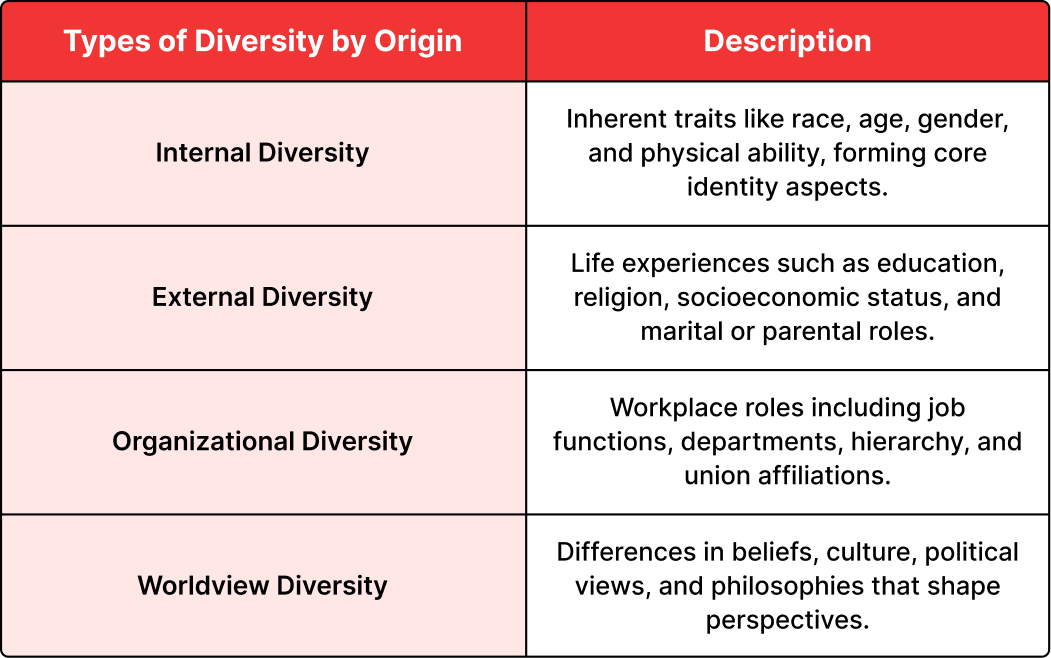
1. Types of Diversity by Origin
Diversity isn’t just about visible traits, it’s rooted in who people are and what they’ve experienced.
2. Types of Diversity by Visibility
Some diversity traits are obvious; others lie beneath the surface. Both are crucial for authentic inclusion.
- Visible Diversity
It includes traits like race, gender, and age, shaping first impressions and team dynamics. - Invisible Diversity
It involves traits like sexual orientation, education, and mental health, influencing a person’s experience.
Balancing visible and invisible diversity ensures hiring decisions are more inclusive, leading to authentic and supportive workplaces.
3. Types of Diversity by Intersectionality
People don’t fit into single categories, identities overlap, creating unique experiences and challenges.
Intersectionality looks at how multiple identity traits combine in one person.
Examples:
- A woman of color with a disability
- A veteran from a rural area
Why it matters:
- Reveals how barriers and strengths can be compounded
- Reminds recruiters to view candidates holistically, not just by individual traits
Incorporating intersectionality into talent sourcing helps agencies deliver candidates who bring complex, enriching perspectives to any team.
To truly embrace intersectionality, it’s essential to focus on the unique skills candidates bring, rather than traditional qualifications. To learn more about how skills-based hiring can help you unlock a more diverse talent pool, read our blog on Redefining the Future Workforce with Skills-Based Hiring.
15 Major Types of Workplace Diversity
Diversity goes beyond box-checking; it's about valuing the full range of human experience.
1. Cultural Diversity
Cultural diversity is the vibrant blend of people from varied backgrounds, each with unique traditions, customs, and worldviews.
It fosters stronger connections, enriches team dynamics, and expands the lens through which we see the world.
It creates richer teams and broadens perspectives.
What It Is?
- A mix of customs, and beliefs.
- Different ways people think and solve problems.
Train teams, celebrate cultures, and value different viewpoints.
Embracing these differences helps build teams that are adaptive, inclusive, and forward-thinking.
2. Racial Diversity
Racial diversity means having team members from different racial and ethnic backgrounds. It brings fresh perspectives and drives innovation.

3. Gender Diversity
Gender diversity means building a workforce that includes all genders.
It goes beyond hiring more from underrepresented genders; it requires fairness in pay, promotions, and opportunities.
Two Key Dimensions
- Gender identity: How someone personally understands their gender, which might differ from their birth-assigned sex.
- Gender expression: How a person shows their gender through behavior, clothing, or style.
4. Sexual Orientation Diversity
Sexual orientation diversity celebrates the inclusion of individuals with varied romantic and sexual identities. It’s about creating an inclusive workplace where all identities are valued, boosting creativity and trust.

5. Linguistic Diversity
Linguistic diversity means building teams fluent in multiple languages. This enriches communication and broadens opportunities.
Why Does It Matter?
- Multilingual teams connect better with diverse clients.
- Speaking clients’ languages boosts trust and loyalty.
- Language skills open access to new markets and talent pools.
Language diversity provides a competitive edge by meeting client needs with multilingual candidates. It also helps create more personalized and inclusive workplaces.
6. Socioeconomic Diversity
Socioeconomic diversity refers to employees from different economic and social backgrounds, including variations in education, income, occupation, and life experiences.
- Different Views on Money and Status
Employees bring unique attitudes toward finances, career paths, and social standing. These perspectives shape their approach to work and collaboration. - Diverse Educational and Residential Backgrounds
People come from different schools and neighborhoods, enriching workplace culture with varied worldviews and problem-solving styles.
Mixing these diverse experiences sparks fresh ideas and innovative solutions, making teams more adaptable and competitive.
Moreover, this approach builds resilient, dynamic teams.
7. Geographical Diversity
Expanding your talent pool beyond familiar locations transforms how you compete and deliver.

8. Disability Diversity
Disability diversity means recognizing and valuing talent beyond physical or mental differences. It’s about inclusion, not just acceptance.
- Candidates with disabilities bring fresh perspectives and innovative ideas.
- Their unique experiences drive creativity and positive change.
Remember, productivity and performance match those of any other team member.
9. Religious & Spiritual Diversity
Religious and spiritual diversity embraces all beliefs, shaping teamwork, ethics, and problem-solving while fostering empathy and collaboration.
How to Support Religious Diversity
- Flexible Holidays: Offer floating holidays to celebrate different religious observances.
- Quiet Spaces: Provide prayer or meditation rooms for reflection and peace.
- Personal Expression: Allow religious attire like hijabs, turbans, or symbols such as rosaries.
10. Age & Generational Diversity
Five generations. One workforce. That’s your competitive advantage.

Pro Tip: Diversity isn’t just hiring across age groups; it’s making sure they all thrive together.
11. Citizenship & Immigration Status
Candidates who are citizens, visa holders, or permanent residents.
- Adds global viewpoints and multilingual skills.
- Shows commitment to inclusive hiring, regardless of documentation.
Pro Tip: Streamline onboarding for international hires and support visa needs proactively.
12. Physical Abilities & Disabilities
Team members with varying physical and mental abilities visible or not.
- Inclusive of All Capabilities
Includes individuals with varying physical abilities, whether disabled or not. - Necessary Accommodations
Provides accommodations to ensure full participation and contribution. - Opportunities for Talent
Opens opportunities for talented individuals, regardless of physical abilities.
13. Behavioral & Ethnodiversity
Differences in values, customs, and interaction styles shaped by culture or upbringing.
- Broadens collaboration and team understanding.
- Builds cultural agility in client-facing teams.
Pro Tip: Train teams on cross-cultural communication and behavioral awareness.
14. Employment Type Diversity
Not everyone works a 9-to-5 and that’s the point.
15. Life Experiences
Personal stories that shape mindset, e.g., travel, adversity, caregiving, military service.
- Deepens emotional intelligence in teams.
- Fuels resilience and creative problem-solving.
Pro Tip: Ask open-ended questions during interviews to uncover these enriching experiences.
Managing and Supporting Diversity in the Workplace
Diversity is no longer a “nice to have”, it’s a non-negotiable for competitive, future-ready workplaces.
But managing and supporting that diversity can feel like a balancing act, especially when the stakes are high and expectations even higher.

Alan Joyce, former CEO of Qantas Airways, shared a revealing insight from his leadership journey:
“We have a very diverse environment and a very inclusive culture, and those characteristics got us through the tough times.”
At Qantas, diversity became the backbone of their resilience.
Therefore, diversity alone won’t move the needle. It needs structure, support, and everyday action to thrive.
1. Build Inclusive Hiring Processes
- Rewrite job descriptions with neutral language and accessible terms.
- Use diverse interview panels to reduce bias and widen perspective.
- Standardize screening criteria to focus on skills, not just “culture fit.”
When refining your hiring processes, using smart reference questions can help ensure you're selecting candidates who thrive in diverse environments. For tips on what to ask, read our blog on Smart Reference Questions to Make Better Hiring Decisions.
2. Train Leadership for Real Impact
- Educate hiring managers on bias, microaggressions, and inclusive leadership.
- Encourage vulnerability, leaders who listen build teams that thrive.
- Accountability matters; tie DEI metrics to leadership performance.
3. Invest in Employee Resource Groups (ERGs)
- Create safe spaces for underrepresented talent to connect and grow.
- Support with funding, visibility, and leadership access.
- Encourage cross-functional ERGs to build bridges, not silos.
4. Make Accommodations Normal
- Offer flexible schedules for caregivers, religious practices, or neurodiverse needs.
- Design accessible workspaces, physical, digital, and emotional.
- Promote mental health awareness as a core workplace value.
5. Measure What Matters
- Track hiring, retention, and promotion across different demographics.
- Use anonymous surveys to gather feedback on belonging and inclusion.
- Don’t just collect data, act on it visibly and consistently.
While managing diversity is key, it can be overwhelming. Consultadd takes the burden off your shoulders by handling the administrative aspects, from compliance and visa management to paperwork, ensuring smooth onboarding and long-term success for diverse hires.
Challenges to Achieving Diversity
Diversity doesn’t just happen, it’s built, brick by brick, often against resistance.
Even the most committed teams face real barriers when trying to build inclusive workplaces. But knowing what’s holding you back is the first step toward moving forward.

Conclusion: The Impact and Importance of Embracing Workplace Diversity
Hiring managers face a growing demand; clients don’t just want talent fast; they want diverse, compliant, and committed teams. And with rising pressure to meet DEI goals, the weight of delivering on all fronts can feel overwhelming.
That’s where Consultadd steps in, not just as a vendor, but as your strategic partner.
With over 14 years of experience, we've helped 65+ staffing companies succeed in the last year alone, supporting 5,000+ successful placements and working with leaders like Robert Half, Teksystems, and more.
Here’s what sets us apart:
- Safe, reliable hires: Every candidate is pre-vetted for skill, compliance, and culture fit.
- Lower turnover risks: We place talent with long-term commitment, not flight risks.
- Seamless compliance: Visa? Documentation? Regulatory red tape? We take care of it all.
- Post-placement support: Our help doesn’t stop after the hire—we ensure ongoing growth.
- Speed: With talent sourcing in under 24 hours, you’ll never lose a deal to delays.
- Precision: We’ve delivered the top 100 performers in the past year alone.
- University ties: Our deep roots with campuses mean fresh, diverse talent is always within reach.
- Ready-to-deploy talent: You get plug-and-play professionals, no hand-holding required.
- 1:1 account managers: Because your staffing needs deserve personal, proactive support.
Start Strong With Consultadd
Working with an experienced partner like Consultadd ensures you hire smarter. From structured processes to real-time market insights, we help you avoid costly missteps and build teams that deliver from day one.
In a market where great tech talent is hard to find and harder to keep, your approach to staffing makes all the difference. Looking to build a future-ready tech team? Contact Us>>
Key Takeaways
- Workplace diversity includes visible, invisible, cultural, generational, socioeconomic, and experiential differences that enrich organizational performance.
- Inclusive hiring practices help organizations attract broader talent pools, improve innovation, and build stronger teams.
- Supporting diversity requires leadership commitment, accessible workplaces, employee resource groups, and equitable career opportunities.
- Measuring diversity and inclusion metrics helps organizations continuously improve hiring, retention, and employee engagement.
- Partner with experienced staffing providers like ConsultAdd to source diverse, qualified talent while ensuring compliance and efficient hiring.
FAQs
What are the main types of workplace diversity?
Workplace diversity includes cultural, racial, gender, age, disability, religious, linguistic, socioeconomic, geographic, citizenship, employment type, life experience, and other visible and invisible differences that contribute to unique perspectives.
Why is workplace diversity important?
Diverse workplaces encourage innovation, improve decision-making, strengthen employee engagement, enhance problem-solving, and help organizations better serve diverse customers and markets.
How can companies build a more diverse workforce?
Organizations can build diverse teams by using inclusive hiring practices, reducing bias in recruitment, expanding talent sourcing channels, supporting employee resource groups, and creating equitable workplace policies.
What challenges do organizations face when improving workplace diversity?
Common challenges include unconscious bias, limited talent pipelines, inconsistent inclusion practices, lack of leadership accountability, and difficulties measuring diversity and inclusion outcomes.
How can staffing firms support workplace diversity?
Staffing firms can help by expanding candidate networks, implementing unbiased sourcing and screening processes, ensuring compliance, and connecting employers with qualified candidates from diverse backgrounds.

Creating a Strategic Talent Management Framework
Introduction
As hiring managers, you are tired of playing catch-up.
Timelines shrink. Client pressure builds. And you're left scrambling to find someone again.
The demands aren’t slowing down. Clients want specialized talent, faster. Candidates seek flexibility, growth opportunities, and a sense of purpose.
And amid all this, your team is expected to deliver without burning out or dropping the ball. You need a smarter, sharper approach to train and develop talent that aligns with business goals.
One that helps you attract the right people, retain them longer, and consistently meet client expectations.
It starts with a strategy built for how work really happens today.
In this article, we’ll define what strategic talent management means and explain how to create an effective framework for it.
TL;DR
- Workplace diversity goes beyond demographics and includes different experiences, perspectives, abilities, and backgrounds.
- Diverse teams drive innovation, improve decision-making, and strengthen business performance.
- Inclusive hiring and workplace practices help organizations attract, retain, and develop top talent.
- Supporting diversity requires continuous action through equitable policies, leadership commitment, and measurable DEI initiatives.
- ConsultAdd helps organizations build diverse, compliant, and high-performing teams through fast, strategic staffing solutions.
Defining Strategic Talent Management
When hiring feels like a sprint but success depends on long-term wins, strategy matters more than speed.
Strategic talent management is a business necessity.
What Does It Really Mean?
Strategic talent management isn’t just filling roles.
It’s about creating a system where talent drives the business forward.
- Every hire serves a purpose.
- Every development plan has a goal.
- Every process is tied to business impact.
It's a shift from reacting to planning, from transactional to intentional hiring.
Benefits of a Talent Management Strategy
A well-crafted strategy doesn’t just fill seats, it builds unstoppable teams.
- Improved Retention
Career development and recognition help retain high-value talent. - Higher Productivity
Aligned roles and clear goals boost focus and performance. - Greater Agility
Skilled teams adapt quickly to market and client demands. - Stronger Company Performance
Engaged employees drive measurable business outcomes. - Minimized Disruption
Planning ahead ensures critical roles are always covered.
Traditional Talent Management vs. Strategic Talent Management

The Core Objectives
- Attract Top Talent
Target skilled professionals who align with evolving client needs. - Train and Develop Continuously
Upskill and reskill talent to stay ahead of market shifts. - Retain with Purpose
Offer clear career paths and growth opportunities to keep top talent engaged. - Drive Innovation Through People
Encourage fresh ideas by building a culture of learning and progress. - Use Data to Guide Every Move
Make decisions based on real insights, not assumptions.
Strategic talent management is about doing more with intention, not just doing more.
10 Ways to Create a Strategic Talent Management Framework
A strong talent management framework doesn’t just fix broken processes; it builds a system that scales.
Here are ten simple, smart ways to do just that in 2025:
1. Aligning Talent Management with Business Strategy
The biggest hiring mistakes happen when talent decisions run on autopilot.

Jack Welch, the legendary former CEO of General Electric, understood this well.
He said,
“Talent management is the lifeblood of any organization.”
At General Electric, Welch ensured that every role was closely tied to strategic business outcomes.
Therefore, alignment matters more than ever since:
- Business goals shift fast, new markets, tech adoption, budget cuts.
- Talent plans that stay static quickly fall out of sync.
- When hiring lags behind strategy, growth stalls or worse, reverses.

Turn insights into hiring actions.
- If speed to market is critical, build a bench of deployable contractors.
- If innovation is the focus, find talent with startup energy and problem-solving muscle.
- If customer retention is the goal, prioritize client-facing roles with empathy and adaptability.
Remember, great hiring doesn’t just react, it predicts.
2. Leveraging Technology to Optimize Talent Management
Clients want talent faster. Candidates want better experiences. And hiring managers? They're tired of burnout.
The pressure to deliver is real, so tech needs to actually help, not overwhelm.
It’s not about the latest tool. It’s about choosing the right ones that cut noise, not add to it.
Here’s how to use it strategically:

And when the right tools are paired with the right partner, the impact multiplies. That’s where Consultadd comes in. We bring relief where it matters most, with access to pre-vetted, ready-to-hire talent and full support for compliance, documentation, and payroll.
3. Fostering a Personalized Employee Experience
In a market flooded with job offers, personalization is your edge.
Today’s talent is drawn to roles that feel tailor-made for them.
And that starts the moment they say yes.
Start with a personalized welcome.
People remember how they were treated on Day One.
Instead of a generic onboarding doc, try:
- Intro emails from the team
- A role-specific roadmap based on their goals
- A mentor match that fits their style, not just their skillset
Build growth into the job, not just the title.
Employees want to evolve. When you ignore that, they quietly start browsing LinkedIn.
Create space for personalized growth by:
- Asking how each person defines “career success”
- Offering learning paths that match their pace
- Giving feedback in a way that fits their preferences
Let them work how they work best.
Some love morning stand-ups. Others thrive with quiet, deep work.
It’s not about being flexible. It’s about being intentional.
- Let them choose between remote, hybrid, or in-office (if possible)
- Learn their collaboration style: meetings, async updates, or both
- Adjust KPIs to reflect how they get results, not just what they deliver
Recognize them in a way that lands.
Public shoutouts don’t work for everyone. For some, they feel awkward.
Instead:
- Ask: “How would you like to be recognized?”
- Use tools that let peers give private kudos
- Celebrate milestones they actually care about
The takeaway? Personalization isn’t a perk. It’s a retention strategy.
4. Skills-Based Hiring and Development
Hiring managers who shift focus from resumes to real capabilities win faster and build lasting impact.
Why Skills Over Titles?
Degrees can mislead. Titles can inflate. But skills tell the real story.
You are tired of poor fits. Clients crave hires who can do, not just say.
Candidates with verified skills ramp faster, adapt quicker, and outperform legacy hires.
What Skills-Based Hiring Looks Like?
Use these checkpoints to design a skills-first process:

Want to know which specific skills are in highest demand right now? Check out our blog on the Most Wanted Skills You Should Know in Skills-Based Hiring to ensure you're building a workforce that’s ready.
Development Doesn’t Stop at Placement
A placement isn’t the finish line; it’s the launchpad.
- Offer upskilling paths tailored to each candidate's goals
- Track progress in client-facing dashboards
- Suggest stretch projects to build experience and loyalty
This ensures clients feel reassured seeing proof of skill, not buzzwords.
Candidates feel seen when developed for their unique strengths.
And you stand out as not just faster but smarter and stronger.
5. The Hybrid Work Revolution and Talent Management
Hybrid work isn’t a phase, it’s the future.
And it’s rewriting every rule of talent engagement.
- Assess for remote-readiness
Don’t just screen for skills. Screen for focus, self-drive, and digital communication. - Align with client flexibility levels
Make sure expectations are crystal clear, from start dates to working hours. - Standardize virtual onboarding
Support placements with templates, guides, and check-ins so no one feels lost on Day - Measure outcomes, not presence
Help clients shift from time-tracked models to output-based success metrics.
6. Aligning Talent Acquisition with Talent Management
When recruiting and development operate in silos, candidates slip through the cracks.
Bringing these functions together turns hires into long-term contributors.
Set Shared Objectives
Agree on business goals before sourcing begins.
Use that vision to shape job specs and development plans.
- Define success metrics together (e.g., time-to-impact, retention rates)
- Align candidate profiles with both immediate needs and future growth
Create Continuous Feedback Loops
Feedback shouldn’t end at offer acceptance.
Keep insights flowing between hiring managers and L&D teams.
- Share early performance data after 30 days
- Discuss skill gaps spotted in the first projects
- Adjust sourcing and training based on real outcomes
A well-optimized recruiting funnel is essential to ensure these insights actually translate into better hires. For a step-by-step breakdown, check out our blog on How to Master Your Recruiting Funnel Strategy, it’s your playbook for turning talent insights into hiring wins.
Co-Design Candidate Journeys
Hiring managers and coaches should build the onboarding path together.
That ensures each hire hits the ground running.
- Map key touchpoints: interview, offer, Day 1, Week 4
- Embed mentoring check-ins into the plan
- Include client-side and agency-side support steps
Bridging acquisition and management creates a seamless talent flow and strong, loyal teams.
7. Agile Performance Management
Annual reviews don’t work when projects move at the speed of client demands.
You need systems that keep pace with shifting expectations, talent dynamics, and business goals.
Agile performance management offers:
- Continuous Feedback Loops
Frequent check-ins keep talent aligned and clients informed. - Real-Time Goal Adjustment
Talent can pivot goals as business needs evolve. - OKRs Over KPIs
OKRs link individual performance to broader strategic outcomes—not just activity tracking. - Coaching vs. Critiquing
Agile focuses on guiding talent, not grading them after the fact.
Agile performance keeps your talent aligned, your clients happy, and your placements competitive.
8. Building a Future-Ready Leadership Pipeline
The leaders of tomorrow won’t come pre-packaged; they need to be discovered, developed, and trusted.

Strong pipelines protect against risk and fuel growth, especially in unpredictable markets.
Strategic frameworks only succeed when they drive real results and that's where Consultadd makes a measurable difference. Whether it’s managing visas, handling end-to-end onboarding, or keeping candidates engaged with clear career support, we turn hiring metrics into performance wins.
9. Metrics for Measuring the Effectiveness of Your Talent Strategy
Gut feeling doesn’t scale. Metrics do.
Tracking the right talent data gives you power, clarity, and control in a competitive market.
Time-to-Fill
Speed reflects efficiency. Long cycles hint at gaps in sourcing or decision-making.
- Track average days from job order to placement
- Compare performance by role, client, and hiring manager
- Shorten time without sacrificing quality
Quality of Hire
Fast hires are meaningless if they don’t perform.
- Measure 90-day retention and client satisfaction
- Include performance reviews from clients
- Ask: Would they rehire this candidate?
Submittal-to-Interview Ratio
Are your submissions actually what the client wants?
- Low ratios signal strong vetting and alignment
- High ratios may indicate poor matching or unclear requirements
- Ideal target: 2–3 submittals per interview
Offer Acceptance Rate
You found them. Did they say yes?

Talent Retention (Post-Placement)
Turnover hurts trust. Retention builds long-term relationships.
- Monitor how many hires stay beyond 6 months
- Ask clients why someone left
- Offer re-engagement support for churned candidates
Client Satisfaction
Retention isn’t just about candidates. Clients need to feel supported too.
- Run post-placement scorecards
- Track Net Promoter Scores (NPS) over time
- Collect qualitative insights from account managers
With every metric, you’re not just reporting, you’re refining.
10. The Critical Role of Soft Skills in Talent Management
Hard skills may win the offer. But soft skills win trust, loyalty, and long-term success.

Soft skills are no longer optional; they’re essential.
Talent Management vs. Talent Development
- Talent Management
A strategic process focused on attracting, hiring, and retaining top talent.
It includes everything from recruitment and onboarding to performance reviews and succession planning. - Talent Development
Focused on nurturing and growing your existing workforce.
It emphasizes upskilling, continuous learning, leadership training, and career pathing.
In short, talent management brings great people in and keeps them. Talent development helps them grow into future leaders.
Conclusion: Designing a Strategic Talent Management Framework
We’ve explored how to align hiring with long-term value, adapt to hybrid demands, and measure what matters. From building leadership pipelines to prioritizing soft skills, every piece forms a stronger, smarter hiring strategy.
The future belongs to agencies that think beyond the placement. That builds systems, not shortcuts. They choose partners who make talent work harder for longer.
That’s where Consultadd delivers real change.
With 14+ years of experience and 5,000+ successful staffing engagements, we help staffing leaders build resilient, future-ready teams.
- Top 100 vetted candidates delivered in the last year
- ~65 satisfied staffing firms we’ve partnered with recently
- MSAs signed with powerhouses like Robert Half and Teksystems
- Talent sourced in <24 hours, often ready to deploy immediately
- Strong university ties to access fresh, skilled professionals
- 1:1 account managers who understand your unique hiring needs
We don’t just fill roles. We transform your hiring process:
- Safe, compliant hires with zero guesswork
- Lower turnover, thanks to long-term candidate commitment
- Seamless visa and regulatory support
- Ongoing post-placement assistance to ensure success
Start Strong With Consultadd
Working with an experienced partner like Consultadd ensures you hire smarter. From structured processes to real-time market insights, we help you avoid costly missteps and build teams that deliver from day one.
In a market where great tech talent is hard to find and harder to keep, your approach to staffing makes all the difference. Looking to build a future-ready tech team? Contact Us>>
Key Takeaways
- Workplace diversity includes visible and invisible differences that strengthen collaboration, innovation, and organizational success.
- Inclusive hiring practices help businesses attract wider talent pools and build more resilient, high-performing teams.
- Creating an inclusive workplace requires equitable policies, accessible environments, leadership support, and employee development.
- Tracking diversity metrics helps organizations improve hiring outcomes, retention, and employee engagement over time.
- Partnering with staffing experts like ConsultAdd enables organizations to hire diverse, qualified talent while maintaining compliance and hiring efficiency.
FAQs
What is workplace diversity?
Workplace diversity refers to the inclusion of people with different backgrounds, identities, experiences, abilities, cultures, perspectives, and life experiences within an organization.
Why is diversity important in the workplace?
Diversity encourages innovation, improves decision-making, increases employee engagement, strengthens business performance, and helps organizations better understand and serve diverse customers.
What are the different types of workplace diversity?
Workplace diversity includes cultural, racial, gender, age, disability, religious, linguistic, socioeconomic, geographic, generational, citizenship, employment type, and life experience diversity.
How can organizations create a more inclusive workplace?
Organizations can promote inclusion by implementing unbiased hiring practices, providing leadership training, supporting employee resource groups, offering workplace accommodations, and measuring DEI progress regularly.
How can staffing firms help companies build diverse teams?
Staffing firms can expand access to diverse talent networks, implement inclusive recruitment strategies, ensure compliance, reduce hiring bias, and connect employers with highly qualified candidates from a wide range of backgrounds.

Proven Strategies to Retain Top Tech Talent
Introduction
You’ve filled the role. The client’s happy. But a few weeks in, the candidate backs out, or worse, disappears without a word.
In a market where demand for tech talent is skyrocketing, this isn’t just frustrating, it’s costly. According to the U.S. Bureau of Labor Statistics, employment for software developers, QA analysts, and testers is projected to grow 17% through 2033. That means more openings, more competition, and less room for error.
For hiring managers, retaining top tech applicants is no longer optional. It's what separates high-performing firms from those constantly scrambling to refill the same roles.
And here’s the shift: talented engineers are looking for consistency, growth, and a partner who sees the bigger picture.
In this article, we break down how to build that kind of loyalty, by aligning with what top talent actually value.
TL;DR
- Retaining top tech talent requires more than competitive salaries—it demands career growth, strong relationships, and meaningful work.
- Building trust through transparent communication and a positive candidate experience significantly improves retention.
- Career development, redeployment opportunities, and continuous learning help keep skilled professionals engaged long-term.
- Inclusive cultures, employee recognition, and regular feedback create stronger loyalty and reduce turnover.
- Consultadd helps staffing firms retain high-quality tech talent through pre-vetted candidates, ongoing support, and fast, compliant hiring solutions.
Why Tech Talent Leaves?

Every contract starts with potential. However, too often, it ends in silence, stagnation, or a competing offer. To retain top tech applicants, you need to understand what’s driving them away:
1. They Feel Like a “Resource,” Not a Person
When talent feels transactional, they stop investing emotionally.
2. Weak Relationships or Inconsistent Communication
Weak or inconsistent communication signals indifference, and top talent won’t wait.
3. There’s No Room to Grow
If a role feels like a dead-end, ambitious developers move on quickly.
4. The Work Feels Misaligned
Misaligned values or tech stacks push talent toward more meaningful opportunities.
5. They Get a Better Offer
Without strong relationships or value adds, it’s easy to lose them to higher bidders.
The good news? Retention isn’t random. It’s built deliberately.
With Consultadd, you get ready-to-hire, fully vetted candidates, reducing hiring cycles and minimizing turnover risks. A steady talent pipeline means you can focus on long-term retention, not constant rehires.
The strategies below help in retaining top talent applicants.
1. Build a Strong Employer Brand as a Tech Career Partner
Top tech talent isn't just job-hunting, they're shaping their next career chapter.
If your firm feels transactional, they'll move on. If it’s a launchpad, they’ll stay.
To build this strong employer brand, focus on these strategies:
- Position Your Agency as a Career Partner
Focus on long-term career growth, offering coaching, skill development, and pathways beyond job placements. - Showcase Authentic Success Stories
Use testimonials and case studies to highlight real career progress, building credibility and emotional connection. - Engage Actively with Tech Communities
Be present in forums, hackathons, and open-source projects to build trust and connect before mentioning roles. - Maintain Ongoing Relationships Beyond Placement
Regular check-ins and event invitations nurture loyalty, positioning your agency as a consistent support system. - Align Your Brand with What Tech Talent Values
Highlight autonomy, learning, remote work, and inclusivity to attract today’s tech professionals. - Deliver Transparent and Respectful Candidate Experiences
Provide clear expectations, honest feedback, and open communication to build trust and enhance your reputation.
When your brand becomes a tech professional’s go-to partner, not just a hiring manager, you’re no longer competing for attention. You’re earning loyalty.
But there’s one more factor that can boost your employer brand: efficiency. Read our blog, “Efficient Hiring: Strategies to Reduce Time Without Sacrificing Quality,” to discover how streamlining your hiring process can help you attract top talent faster, while maintaining quality.
2. Nurture Relationships, Not Transactions

Marissa Mayer, former CEO of Yahoo!, understands this deeply. She emphasizes that technology truly thrives on people:
“Really in technology, it’s about the people, getting the best people, retaining them, nurturing a creative environment and helping to find a way to innovate.”
When every interaction is treated as just a deal, candidates and clients feel like numbers.
But building genuine connections transforms hiring into lasting partnerships.
Why shift from transactions to relationships?
- Relationships foster trust that withstands market fluctuations.
- Candidates who feel understood are more loyal and engaged.
- Clients who experience genuine care bring ongoing business and referrals.
This isn’t just feel-good advice; it’s a strategic advantage that directly impacts your bottom line.
Keys to nurturing authentic connections
- Listen actively to uncover deeper needs and motivations.
- Communicate consistently with meaningful updates, not just job offers.
- Provide insights and guidance that empower candidates and clients alike.
- Customize your approach to reflect each person’s unique goals.
- Be transparent about challenges and timelines to build respect.
When your focus shifts from closing deals to building partnerships, you create a pipeline of trust and collaboration.
3. Prioritize Transparency and Open Communication
In staffing, trust is everything. Without clear communication, candidates and clients quickly lose confidence.

By making transparency your foundation, you empower yourself to build lasting partnerships.
4. Offer Competitive Compensation and Benefits
Attracting and retaining top tech talent starts with competitive pay and meaningful benefits. This is more than just numbers, it’s about showing candidates their value.
- Understand Market Standards
Stay updated on salary benchmarks to offer competitive, market-aligned compensation. - Create Tailored Compensation Packages
Customize packages with bonuses, stock options, and flexible pay to meet diverse needs. - Offer Comprehensive Benefits
Provide essential benefits like health insurance, plus perks like remote work and development opportunities. - Communicate Value Clearly
Be transparent about salary, bonuses, and benefits to build trust and excitement. - Stay Agile with Adjustments
Regularly review and adjust compensation to stay competitive and show commitment to candidate well-being.
Competitive compensation fosters a reputation that consistently attracts high-caliber candidates, reducing turnover and enhancing agency credibility.
5. Invest in Ongoing Learning and Career Growth
In today’s fast-paced tech world, continuous learning isn’t optional; it’s essential. Talent that grows stays relevant and motivated, creating lasting value.

Investing in learning isn’t just a benefit; it’s the heartbeat of sustained staffing excellence.
6. Prioritize Redeployment and Career Pathing
Keeping talent engaged is about building futures.
Redeployment and career pathing are powerful strategies for retaining top performers and fostering loyalty.
When talent sees a clear future, they bring energy, trust, and commitment to every role.
Redeployment: Turning Change Into Opportunity
- Reduce turnover risk by offering new roles instead of letting talent go.
- Save hiring time and costs by filling openings with known, trusted candidates.
- Boost morale as candidates feel valued and secure in their growth.
- Stay agile with a ready pool of skilled professionals who can quickly shift roles.
Imagine a staffing partner who invests in talent, turning disruption into success. With Consultadd, redeployment becomes seamless, offering a pipeline of qualified candidates that reduce turnover and ensure quick, reliable placements.
Career Pathing: Empower Growth and Commitment
- Create transparent career maps showing advancement opportunities.
- Align talent goals with client needs to maximize fit and satisfaction.
- Use regular check-ins to update plans and track progress.
- Encourage skill-building aligned with future roles and industry trends.
Career pathing empowers talent with clarity and control. When professionals see a roadmap, they stay motivated and loyal.
How This Transforms Talent Acquisition
- Reduces client churn with adaptable, invested talent.
- Strengthens employer brand as a growth partner.
- Speeds placements by minimizing external candidate searches.
- Fosters long-term relationships beyond single transactions.
Prioritizing redeployment and career pathing turns staffing from a series of transactions into a journey of transformation.
7. Foster a Supportive and Inclusive Culture
Creating a workplace where everyone feels valued isn’t just nice—it’s essential. Here’s how to make it real:
Encourage Open Dialogue
- Create safe spaces for honest conversations.
- Listen actively without judgment.
- Act on feedback quickly.
Pro Tip: Regular pulse surveys reveal hidden issues early.
Celebrate Differences
- Highlight diverse backgrounds and perspectives.
- Recognize cultural events and milestones.
- Encourage team sharing sessions.
Pro Tip: Use storytelling to build empathy and connection.
Build Team Trust
- Promote collaboration over competition.
- Share successes and challenges openly.
- Provide consistent support and recognition.
Pro Tip: Small daily gestures build lasting trust.
Support Growth for All
- Offer equal access to training and mentoring.
- Set inclusive goals for career advancement.
- Remove barriers to opportunity.
Pro Tip: Track diversity metrics to ensure fairness.
8. Empower Autonomy and Innovation
True growth happens when talent feels trusted to lead and create. Empowerment fuels innovation, driving staffing agencies beyond ordinary limits.

9. Recognize Loyalty and Performance
True success thrives when loyalty and performance lead, setting the stage for innovative talent strategies.
Celebrating wins inspires commitment and drives results.
Celebrate Consistent Excellence
Acknowledge steady performers often.
Small rewards keep motivation alive.
Pro Tip: Public shout-outs spark healthy competition.
Reward Loyalty with Meaning
Loyalty is a treasure in staffing.
Show appreciation with tailored incentives.
Pro Tip: Long-term rewards create lasting bonds.
Make Recognition Personal and Timely
Recognize achievements promptly and personally.
It shows genuine care and respect.
Pro Tip: A quick thank-you note can change engagement levels.
Remember to encourage daily peer-to-peer recognition. Making appreciation a routine boosts culture and morale.
10. Use Feedback and Data to Refine the Experience
Great staffing thrives on constant improvement. Listening closely and measuring impact drives excellence.

Pro Tip: Start small. Focus on one or two feedback channels and a handful of key metrics. Scale as you see results.
Want to learn more about what metrics really matter in recruitment? Read our blog, “Measure What Matters: Recruitment KPIs That Drive Real Results,” to understand the key performance indicators that can make a real impact.
Avoid Common Mistakes That Make Great Talent Walk Away
Even well-meaning companies can unknowingly push great talent away. Recognizing these missteps early helps staffing agencies guide their clients toward long-term retention success.
1. Waiting for Talent to Come to You
Posting jobs and hoping the right candidate applies just doesn’t cut it anymore.
You need to be proactive, think about outreach, referrals, and consistent pipeline nurturing.
Pro Tip: Start building candidate relationships before the job opens.
2. Making the Hiring Process a Tiring
Long interview cycles and unclear timelines frustrate candidates.
If you’re slow to move, they’ll move on.
3. Thinking Salary Is the Only Deal-Maker
Money matters, but it’s not everything.
Flexibility, values alignment, and career impact hold more weight for many today.
4. Ignoring the Need for Flexibility
Inflexible work models are a red flag for modern professionals.
Remote and hybrid options broaden your reach and appeal.
5. Using Tech That’s Past Its Prime
Outdated systems can signal a stagnant culture.
Top talent wants to innovate, not wrestle with legacy tools.
6. Skipping Career Development Conversations
Tech talent thrives on growth.
If they don’t see learning opportunities, they’ll chase them elsewhere.
7. Forgetting to Celebrate Wins
Silence feels like indifference.
Recognition, both public and personal, keeps employees engaged and motivated.
Pro Tip: A quick shout-out can be more powerful than a bonus.
Retention is about crafting an environment where people grow and thrive.
Conclusion: Great Talent Stays Where They’re Valued
Great talent leaves when they feel unseen or undervalued. That fear keeps staffing agencies awake at night. But when talent feels truly appreciated, they stay loyal, motivated, and ready to deliver excellence.
By prioritizing recognition, career growth, and honest feedback, you create a culture where talent thrives. This transforms recruitment from a challenge into a powerful advantage.
Consultadd transforms your hiring process to make this possible by ensuring:
- Safe, reliable hires: Every candidate is thoroughly vetted for experience and compliance.
- Lower turnover risks: Professionals are committed to long-term success, not short stints.
- Seamless compliance: Visa, documentation, and regulatory issues handled smoothly.
- Continuous support: Ongoing help after placement to ensure growth and success.
Our track record speaks volumes:
- Over 5,000 successful staffing engagements completed.
- Provided Top 100 candidates in the last year.
- Served ~65 satisfied staffing companies in the last year.
- MSAs signed with leaders like Robert Half and Teksystems.
- Ability to source and deploy talent in less than 24 hours.
- Strong ties with top universities.
- Dedicated 1:1 account managers supporting you every step.
Start Strong With Consultadd
Working with an experienced partner like Consultadd ensures you hire smarter. From structured processes to real-time market insights, we help you avoid costly missteps and build teams that deliver from day one.
In a market where great tech talent is hard to find and harder to keep, your approach to staffing makes all the difference. Looking to build a future-ready tech team? Contact Us>>
Key Takeaways
- Build long-term relationships with tech professionals by acting as a career partner rather than simply filling vacancies.
- Improve retention through transparent communication, competitive compensation, continuous learning, and clear career progression.
- Foster an inclusive, supportive workplace that values recognition, autonomy, and employee well-being.
- Use feedback, performance data, and candidate insights to continuously improve the hiring and retention experience.
- Partner with staffing experts like Consultadd to access qualified tech talent, reduce turnover, and strengthen long-term workforce stability.
FAQs
Why is retaining top tech talent important?
Retaining skilled tech professionals reduces hiring costs, minimizes project disruptions, improves client satisfaction, and helps organizations maintain critical technical expertise.
What are the main reasons tech professionals leave their jobs?
Common reasons include limited career growth, poor communication, lack of recognition, uncompetitive compensation, misaligned work, and better opportunities elsewhere.
How can companies improve tech talent retention?
Organizations can improve retention by offering career development opportunities, competitive compensation, transparent communication, flexible work arrangements, meaningful recognition, and an inclusive workplace culture.
What role does employer branding play in talent retention?
A strong employer brand positions the organization as a long-term career partner, helping attract high-quality candidates, build trust, and increase employee loyalty.
How can staffing firms help clients retain top tech talent?
Staffing firms can improve retention by providing well-matched candidates, supporting career development, maintaining regular candidate engagement, ensuring smooth onboarding, and delivering ongoing post-placement support.

High Volume Hiring Strategies and Best Practices
Introduction
It starts with one urgent email. Then another.
Soon, you’re racing to fill dozens of roles, each one high priority, all due yesterday.
High-volume recruitment isn’t just about hiring at scale. It’s about doing it without shortcuts.
No room for weak resumes, inconsistent vetting, or late-stage dropouts.
But when candidates ghost after the first call, or disappear, you’re left chasing shadows while clients grow impatient.
Your team feels the strain. Screening, scheduling, paperwork, it all adds up.
And in the rush to deliver, quality can slip through the cracks.
Still, expectations stay the same: find top-tier talent. Fast. Without error.
So, how do the best staffing leaders meet that demand and still sleep at night?
In this article, let’s explore the strategies that make high-volume recruitment not just manageable, but masterful.
TL;DR
- High-volume recruitment is about hiring at scale without sacrificing quality, speed, or candidate experience.
- Technology, automation, and standardized hiring processes help recruiters manage large hiring demands efficiently.
- Building and nurturing talent pipelines reduces sourcing time and improves hiring outcomes during recruitment surges.
- A positive candidate experience and strong employer branding reduce drop-offs and improve offer acceptance rates.
- Tracking recruitment metrics enables continuous process improvements and better hiring decisions.
Understanding the High-Volume Hiring Challenge

When demand surges, hiring becomes a race against time and burnout. From sorting stacks of resumes to chasing no-show candidates, high-volume recruitment tests every system in place.
The challenge? Fill roles quickly without compromising quality, compliance, or candidate experience.
1. Speed vs. Accuracy
Filling roles fast often means compromising on quality or consistency.
2. Candidate Drop-Off is Real
Many candidates drop out or disappear mid-process.
3. Administrative Overload
Hours are lost to scheduling, compliance, and documentation that slow down hiring.
4. No Ready Pipeline
Without pre-vetted talent on standby, every new req starts from scratch.
Struggling with sourcing at scale? That’s where partners like Consultadd make the difference. With pre-screened, ready-to-deploy talent, we help you cut sourcing time, reduce unqualified applicants, and keep up with hiring surges without compromising on quality.
5. Constant Pressure to Deliver
Clients expect speed, precision, and zero excuses every single time.
High-volume hiring doesn’t have to be chaotic; the right systems turn it into a strength.
Mastering High-Volume Hiring: Top Strategies & Best Practices
In high-volume hiring, structure, tools and the right strategies help scale recruitment without sacrificing quality.
1. Leverage Technology and Automation
Manual hiring processes? They're holding you back. The right tech gives you speed, scale, and sanity.
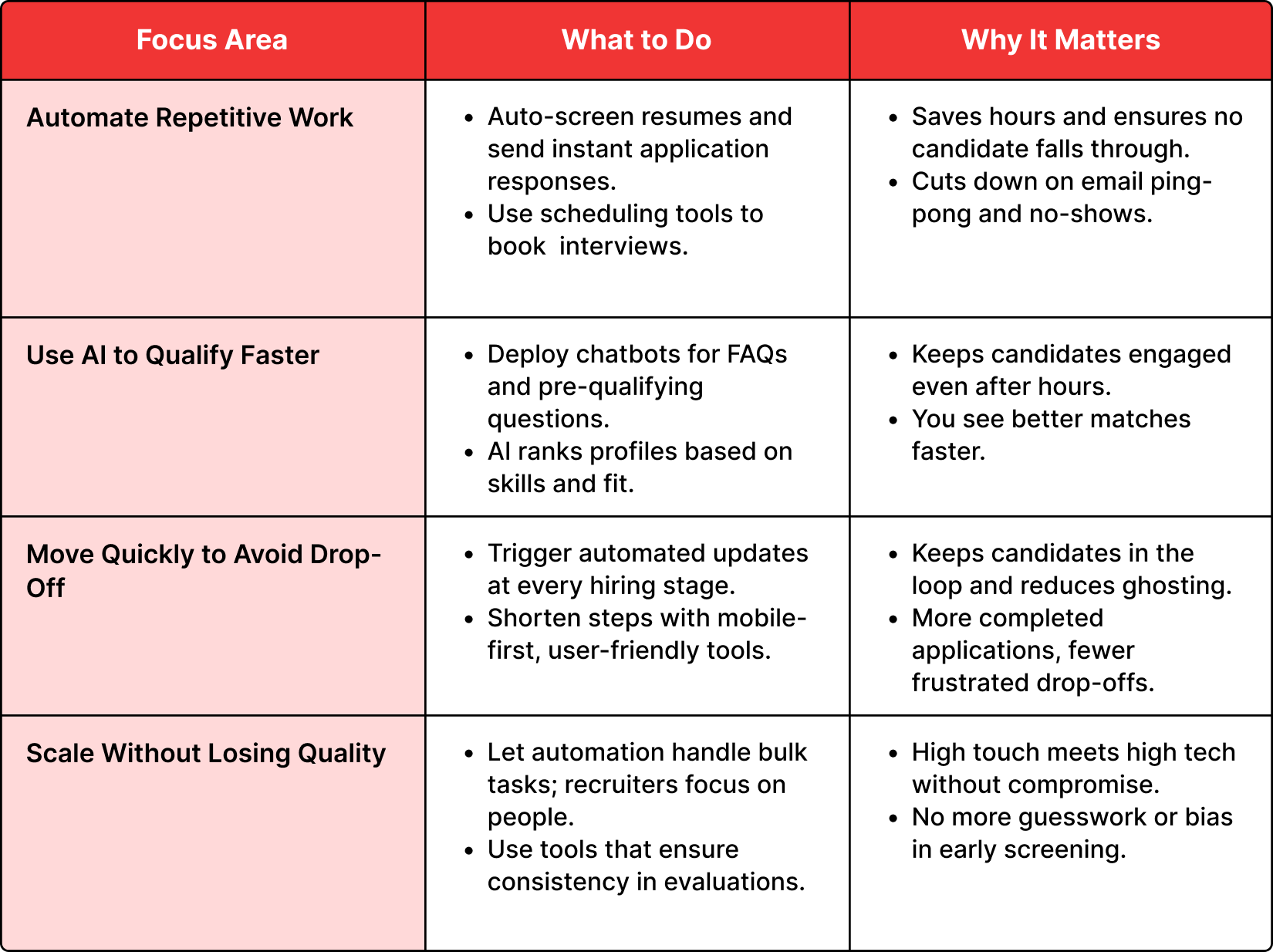
Manual hiring processes? They're holding you back. The right tech gives you speed, scale, and sanity. Want to go deeper on speeding up hiring without cutting corners? Check out our blog on Efficient Hiring: Strategies to Reduce Time Without Sacrificing Quality.
2. Tap Into Existing Talent Databases
Your best candidates might already know you therefore reactivating your database is faster, cheaper, and more effective than starting fresh.
Reconnect With Dormant Talent
They interviewed before. Maybe even reached the final rounds. But the role didn’t work out.
- Send tailored check-ins based on their past stage or client.
- Highlight new, relevant roles, don’t just ask for updated resumes.
Why it works: Familiar candidates close faster and are less likely to ghost.
Organize and Maximize Your CRM
Most databases are messy. Fix that.
- Use tags like “Java | East Coast | Green Card” or “No-shows Q1.”
- Add notes after every touchpoint: interview feedback, rate changes and sync with your ATS.
Why it works: The clearer your system, the quicker your shortlist.
Build Your Own Talent Community
Don’t just store candidates, keep them engaged.
- Create WhatsApp groups, email newsletters, or invite-only Slack channels.
- Share exclusive openings, client success stories, or visa updates.
Why it works: Warm pipelines are easier to activate than cold ones.
3. Streamline and Standardize Hiring Processes
Consistency drives performance. Following a proven playbook boosts results, keeps candidates engaged, and builds client trust.
Here’s how you can do so:
- Create a Repeatable Intake Workflow
Use a standard form to collect role requirements, timelines, and expectations every time. - Build Role-Based Email and Message Templates
Automate responses for outreach, follow-ups, and feedback requests to reduce turnaround time. - Use Scorecards for Every Interview
Replace vague opinions with measurable feedback aligned across all interviewers. - Establish a Checklist and Candidate Milestones
Ensure every resume meets standards and track candidate progress with clear status markers: submitted, shortlisted, interviewed, offered. - Automate Candidate and Client Notifications
Keep both sides informed using triggers tied to key process events without manual check-ins. - Monitor SLA Compliance with Dashboards
Track recruiter response times, submittal quality, and client feedback speed in real-time.
When hiring runs smoothly, your team spends less time fixing issues and more time closing roles.
4. Optimize Job Marketing and Sourcing Channels
Your job postings are only as good as where and how they're seen. This strategy is about making every listing count by being intentional with platforms, messaging, and data.

Remember, visibility without strategy leads to volume without value.
Make every channel work harder for your hiring goals.
5. Make Applications Accessible and Mobile-Friendly
A candidate’s first touchpoint with a role shouldn’t feel like a chore.
If the application is slow, confusing, or clunky, especially on mobile, talent walks away.
Cut the Clutter
- Long forms are deal-breakers. Ask only what’s essential upfront.
- Add follow-up stages later for deeper insights.
Design for Mobile-First
- Over half of job seekers apply via phone. Your process must reflect that.
- Mobile-friendly means smart, smooth, and swipe-ready.
Enable One-Click Apply
- Let candidates apply using LinkedIn, resumes-on-file, or job board profiles.
- Remove unnecessary login walls and extra steps.
Let Progress Be Saved
- Allow candidates to pause and return to incomplete applications.
- A saved draft is better than a lost applicant.
When applications feel effortless, conversion rates spike and the best talent sticks around.
6. Prioritize Candidate Experience

Sir Richard Branson said,
“Train people well enough so they can leave, treat them well enough so they don't want to.”
This mindset helped him build and retain talent across 400+ companies. In high-volume hiring, the difference between an accepted offer and a ghosted one often comes down to this: Candidates remember how you made them feel, not just the outcome.

Candidate experience doesn’t end with an offer and neither does Consultadd’s support. We help keep candidates engaged throughout the process and beyond, offering guidance that reduces ghosting and boost retention.
7. Employ Data-Driven Decision Making
Decisions come fast. But are they smart or just reactive?
Let data be your edge. When used well, it doesn’t just track performance, it transforms it.
Where are you losing time?
Speed matters. Every day a role stays open, someone’s losing patience or revenue.
- Track time-to-fill by job and client to spot bottlenecks.
- Prioritize process tweaks, not guesswork.
Which sourcing channels actually work?
Posting everywhere is exhausting. ROI matters.
- Analyze sources for top performers and cut what doesn’t work.
- Double down on high-converting sources.
Why are candidates dropping off?
Good candidates don’t ghost without reason.
- Measure abandonment and no-shows. Too many steps? Delayed feedback?
- Remove friction before it costs a placement.
Are your hires sticking around?
No one wins if a placement quits in 60 days.
- Track short-term retention by recruiter, job function, and client.
- Use this to set clearer expectations or rethink fit during screening.
How many interviews to land one hire?
Too high a ratio? That’s a red flag.
- Aim for tighter screening and better candidate briefs.
- Fewer interviews, better matches, happier clients.
Pro Tip: Data reveals quiet excellence: track revenue, submittals, and fall-offs to shape winning strategies. Let data be your compass.
8. Foster Diversity and Inclusion
Inclusive hiring isn’t a checkbox. It’s a competitive edge.
Diverse teams drive better results and top candidates know it.

Expand Your Sourcing Network
- Partner with organizations that support underrepresented talent.
- Tap into alumni groups, DEI job boards, and niche communities.
Use Structured Interviews
- Same questions, same criteria, every time.
- Reduces bias and levels the field.
Track Diversity Metrics
- Know who’s applying, who’s interviewing, and who’s getting offers.
- Adjust strategies where gaps show up.
9. Communicate Your Company Culture and Employer Brand
Top candidates don’t just chase paychecks, they seek purpose, people, and a promise of belonging.
That’s where culture and branding becomes your superpower.
Why Should Culture Be Front and Center?
- Because people remember how a company feels more than what it does.
- Because authenticity builds trust, and trust attracts top-tier candidates.
Ways to Bring Your Employer Brand to Life
Share Real Voices
- Feature team testimonials, not templated slogans.
- Candidates connect with real stories, not buzzwords.
Post With Purpose
- Use LinkedIn, Instagram, and YouTube to share day-in-the-life content.
- Behind-the-scenes posts perform 3x better than generic job alerts.
Align Job Descriptions with Values
- Go beyond tasks. Show how the role contributes to bigger goals.
- Highlight impact, not just requirements.
Make the Brand Visible Across Touchpoints
- Career sites, email signatures, social profiles, ensure consistent brand messaging.
- Even your ATS confirmation emails matter.
10. Continuously Gather Feedback and Optimize
The best recruitment strategies don’t just run, they evolve.
Here’s how top staffing teams listen, learn, and grow.

The best recruitment strategies don’t just run, they evolve. See what changes make the biggest impact in our blog Make Every Hire Count: Key Recruitment Improvements.
Conclusion: Building an Efficient High-Volume Hiring Strategy
High-volume hiring doesn’t have to feel like a constant scramble.
With the right strategy, staffing agencies can achieve speed and consistency without cutting corners.
Streamlined systems, smarter sourcing, and data-driven decisions make high-volume hiring a competitive edge.
That’s where Consultadd comes in.
We don’t just help you fill roles, we help you fill them with confidence.
- Safe, reliable hires vetted for skill, compliance, and day-one performance
- Lower attrition rates with professionals committed to long-term success
- Seamless visa and documentation support to eliminate compliance stress
- Post-hire care that ensures each placement grows with your client needs
And it’s not just words, it’s backed by performance:
- 1:1 account managers supporting you throughout the hiring cycle
- 5,000+ successful staffing engagements and counting
- Talent sourced and ready to deploy in under 24 hours
- Top 100 candidates provided in the last year alone
- 65+ staffing companies supported last year
- MSAs signed with leaders like Robert Half and Teksystems
- 14+ years of expertise in recruitment
- Deep connections with universities for early access to top talent
Start Strong With Consultadd
Working with an experienced partner like Consultadd ensures you hire smarter. From structured processes to real-time market insights, we help you avoid costly missteps and build teams that deliver from day one.
In a market where great tech talent is hard to find and harder to keep, your approach to staffing makes all the difference. Looking to build a future-ready tech team? Contact Us>>
Key Takeaways
- Automate repetitive tasks like resume screening, scheduling, and candidate communication to improve recruiter productivity.
- Leverage existing talent pools by re-engaging previous applicants and maintaining an organized CRM for faster hiring.
- Standardize recruitment workflows with interview scorecards, templates, and hiring checklists to ensure consistency.
- Focus on candidate experience through mobile-friendly applications, timely communication, and transparent hiring processes.
- Use recruitment data such as time-to-fill, source effectiveness, and candidate drop-off rates to optimize hiring strategies continuously.
FAQs
What is high-volume recruitment?
High-volume recruitment is the process of hiring a large number of candidates within a short timeframe while maintaining hiring quality, compliance, and a positive candidate experience.
What are the biggest challenges in high-volume hiring?
Common challenges include sourcing qualified candidates quickly, managing administrative workloads, reducing candidate drop-offs, and maintaining consistent hiring standards.
How can recruiters improve high-volume hiring efficiency?
Recruiters can improve efficiency by using automation, building talent pipelines, standardizing hiring processes, optimizing sourcing channels, and leveraging recruitment analytics.
Why is candidate experience important in high-volume recruitment?
A smooth, transparent, and responsive hiring process reduces candidate drop-offs, improves employer reputation, and increases offer acceptance rates.
How can staffing partners support high-volume recruitment?
Staffing partners provide pre-vetted talent, faster sourcing, compliance support, and scalable recruitment resources that help organizations meet hiring demands without compromising quality.

Effective Cost-Saving Strategies for Recruitment
Introduction
You’re expected to move fast, but nothing about hiring feels fast anymore.
Candidates ghost after the first call. Job board fees keep climbing. And by the time you finally find someone who might be a fit, your client’s already losing patience.
It’s no wonder that 45% of business leaders now spend more than half their working hours chasing down talent. That’s time pulled away from building relationships, managing teams, and growing the business.
The problem isn’t that you're not working hard enough. It’s that traditional hiring methods are working against you.
A cost-effective hiring strategy isn’t just a budget decision; it’s a performance decision. When done right, it reduces waste, protects your team’s time, and helps you deliver better candidates, faster.
Let’s understand what actually moves the needle, starting with why fewer, stronger candidates always beat a bloated pipeline.
TL;DR
- Rising recruitment costs make hiring efficiency just as important as hiring quality.
- Focusing on qualified candidates instead of high application volume reduces costs and improves placement success.
- Automation, social sourcing, referrals, and streamlined workflows help reduce hiring expenses without sacrificing results.
- Building talent pools and improving candidate experience shorten hiring cycles and lower turnover.
- Consultadd helps staffing agencies cut recruitment costs by delivering pre-vetted talent, handling compliance, and accelerating placements.
The Importance of Effective Cost-Saving Strategies in Recruitment
High costs. Slow processes. Pressure to deliver top talent fast.
The demand for speed is rising, but so are the obstacles:
- Job board fees keep climbing.
- Candidate ghosting and drop-offs delay the pipeline.
- Unqualified resumes flood your inbox, stretching your team thin.
- Re-hires and churn eat into margins.
And the real cost? Time.
You spend most of your precious time on recruitment tasks, stealing focus from revenue-driving work.
Here’s why cost-saving strategies matter:
Smart hiring isn’t about spending less. It’s about spending better.
You need to control costs without compromising quality or speed.
- Sharper focus on qualified candidates
- Faster placements that impress clients
- Fewer backfills thanks to better fit and retention
- More time for strategic work, not admin overload
The result? A hiring engine that’s lean, agile, and ready to scale.
10 Cost-Saving Strategies for Recruitment
Recruiting top talent doesn't need to be expensive. These 10 smart strategies will help you reduce recruitment costs while still attracting the best candidates.
1. Prioritize Quality Over Quantity
Speed is great, until it leads to the wrong hire. Too many candidates? Not always a win.
What You’re Really Losing with High-Volume Hiring
- Wasted hours screening unqualified resumes
- Interview fatigue for your team and your clients
- Short-term hires who don’t stick around
Quantity clogs the process. Quality clears the path.
What You Trade for Quality
Let’s be real, prioritizing quality takes guts. It means saying no to the flood of resumes and yes to better results. Here’s what to expect:

This isn’t just about saving costs, it’s about saving your credibility.
2. Cut Expenditure on Job Boards
Hiring managers often spend a big chunk of their budget on job boards. But is that always the smartest move?
- Use free or lower-cost platforms: Post openings on LinkedIn, Indeed, or niche sites.
- Optimize your job ads: Clear, SEO-friendly descriptions increase visibility organically.
- Tap into community groups: Engage industry-specific forums and social media groups for organic reach.
While social media recruiting offers broad reach and cost benefits, it does demand ongoing attention and consistent effort. Discover how AI is making this easier and more scalable in our blog, How AI and Social Media Revolutionize Recruitment for the Future.
What to watch out for
- Reaching niche or highly specialized candidates can be tougher.
- It may take more effort to maintain visibility without paid boosts.
Cutting job board costs doesn’t mean sacrificing reach. It means being smarter, more creative and ultimately, more cost-effective.
3. Use Social Media for Sourcing

Social media is no longer just about sharing updates, it’s a vital recruiting channel.
- Expand Your Reach
Tap into platforms like LinkedIn, Twitter, and Facebook to access a broader talent pool beyond traditional job boards. - Showcase Your Culture
Share authentic stories about your company values and work environment to attract candidates who fit your brand. - Engage Actively
Participate in industry groups and conversations to build genuine relationships and establish your presence. - Respond Quickly
Prompt and thoughtful replies to comments and messages increase candidate trust and interest. - Stay Consistent
Regularly post updates and openings to keep your brand visible and top of mind for potential hires. - Balance Effort with Reward
Though time-intensive, social media recruiting offers high-impact, cost-effective sourcing opportunities.
While social media recruiting offers broad reach and cost benefits, it requires ongoing attention and consistent effort to maintain momentum. When done right, it turns social platforms into dynamic talent magnets.
4. Implement an Employee Referral Program
An employee referral program isn’t just a tool; it’s a game-changer. It taps into your team’s network and trust, turning hiring into a collective mission.

Pro Tip: Employee referral programs transform hiring into a shared mission and that drives real results.
5. Invest in Digital Recruiting Software and Automation
Bill Gates, co-founder of Microsoft, once said:
“Automation applied to an efficient operation will magnify the efficiency.”
His insight highlights a simple truth: automation only enhances what already works well.
This means ensuring your recruitment process is solid before layering in technology.
Therefore, the right tools empower your team to hire faster and smarter.
Streamline Your Workflow
- Applicant Tracking Systems (ATS):
Use Greenhouse, Lever, or Workday to manage candidates seamlessly. - Scheduling & Communication:
Tools like Calendly automate interview bookings and follow-ups.
Boost Quality and Speed
- AI-Powered Screening:
Platforms such as HireVue and Pymetrics help identify top talent quickly. - Real-Time Analytics:
SmartRecruiters offers dashboards that track hiring progress and KPIs.
Read our blog, Measure What Matters: Recruitment KPIs That Drive Real Results, for a deeper dive into the key recruitment metrics that help you optimize every stage of your hiring process.
Empower Your Team
- Collaboration Made Easy:
Share candidate feedback instantly with Workable or BambooHR. - Candidate Engagement:
Use chatbots like Olivia by Paradox for timely, personalized candidate conversations.
Future-Proof Your Recruitment
- Scalable Solutions:
Choose tools like iCIMS or Jobvite that grow with your agency. - Cost Efficiency:
Automation reduces manual tasks, saving time and money.
Digital recruiting tools aren’t just tech; they’re your secret weapon for winning top talent.
6. Conduct Remote Interviews
Remote interviews have become a powerful way to connect with talent, regardless of their location.

Remote interviews expand your reach and speed up hiring while maintaining high standards.
Of course, remote interviews only accelerate hiring when the right candidates are already in your pipeline. Consultadd makes this easy, supplying pre-screened professionals who are not only qualified but also ready to work remotely or on-site, with visas, documentation, and onboarding handled. That means fewer delays, fewer no-shows, and more confident hiring decisions.
7. Build and Nurture Internal Talent Pools
Smart hiring managers know that not every great candidate is placed immediately. But what if the right role appears tomorrow? That’s where internal talent pools give you an edge, fueling speed, trust, and quality.
What Is It?
A living database of pre-vetted candidates, former silver medalists, referrals, and known performers.
How to Build It?
- Source Intentionally: Pull in high-potential candidates from previous roles and interviews.
- Mine Referrals: Tap employees and contractors who’ve seen excellence firsthand.
- Use Every "No" Wisely: Not hired doesn’t mean not qualified. Store them for the right fit.
Keep It Organized
- Use Smart Tech: Tools like Bullhorn, Avionté, or JobDiva let you tag by skill, location, and availability.
- Set a Review Cycle: Update your database monthly like status, certifications, preferences.
Keep Candidates Warm
- Send Micro-Touches: Share job market updates or quick industry news.
- Offer Light Upskilling: Suggest short-term certifications or courses relevant to your clients' needs.
- Personalize Check-Ins: A quick "thinking of you" message goes further than you think.
Segment for Speed
Group talent by niche, DevOps, healthcare tech, project managers. You’ll reduce sourcing time drastically when urgency strikes.
The Result? A trusted talent base that makes you faster, sharper, and always ready to impress demanding clients.
Pro Tip: After every screening or placement, make it a habit to tag top talent into your candidate pool.
8. Streamline the Recruitment Process
The most successful staffing teams simplify, then scale. It’s not about rushing. It’s about refining each step until it works like clockwork.
- Clarify Job Requirements Early
Align with clients upfront to avoid revisions and delays later in the funnel. - Use Scheduling Tools
Automate interview coordination with tools like Calendly or GoodTime. - Set Response SLAs
Define feedback timelines with hiring managers to keep momentum going. - Automate Candidate Touchpoints
Use platforms like Sense or Herefish to send timely updates and reminders. - Build Internal Scorecards
Create reusable templates for structured, faster candidate evaluation. - Digitize Offer Letters and Documents
Speed up the close with tools like DocuSign or PandaDoc. - Create Role-Based Talent Pools
Pre-source candidates for high-demand or repeat job categories. - Track Time-to-Fill Metrics
Use benchmarks to identify where bottlenecks occur and fix them. - Monitor Drop-Off Rates
Improve candidate experience to reduce ghosting and offer declines. - Standardize Interview Questions
Make decisions easier with consistent, bias-free evaluation across teams.
You can also lighten your team’s load by partnering with providers like Consultadd, who take ownership of every operational detail from compliance paperwork and relocation logistics to 401(k) setup and payroll.
9. Use Comprehensive Assessments for Better Hiring Decisions
Hiring on instinct is risky. Assessments bring clarity, speed, and confidence, so every placement hits the mark.

10. Collect and Act on Candidate Feedback

Listening to candidates isn’t just polite, it’s powerful. Their feedback reveals insights that fuel better hiring and build stronger relationships.
- Use Short, Focused Surveys
Keep surveys brief and relevant to maximize response rates and quality insights. - Encourage Honest, Confidential Responses
Assure candidates that their feedback is confidential to get genuine, constructive input. - Offer Multiple Feedback Channels
Provide options like email, SMS, or phone to accommodate candidate preferences. - Analyze Feedback for Patterns
Look beyond individual comments to spot recurring themes and systemic issues. - Make Data-Driven Adjustments
Use insights to improve interview steps, communication clarity, and candidate engagement. - Communicate Improvements Back to Candidates
Show candidates that their input matters by sharing changes made from their feedback.
Start Strong With Consultadd
With 15 years in business and 5,000+ successful staffing engagements, we don't just fill roles, we build reliability into your process. We've supported 65 staffing companies in the past year alone and maintain MSAs with industry leaders like Robert Half and TEKsystems.
Here's what working with Consultadd looks like:
- Talent sourced in under 24 hours
- Ready-to-deploy candidates, vetted for experience and compliance
- Lower turnover risk: we match long-term goals, not just short-term needs
- Seamless compliance: visa, documentation, onboarding? Handled.
- Dedicated 1:1 account managers for responsive, personalized support
- Top 100 candidate matches delivered in the past year
- Strong partnerships with universities to tap into fresh, committed talent
- Post-placement support so your investment grows beyond day one
For candidates, your next opportunity is more than just a job title, it's a chance to build skills, gain experience, and move your career forward. At Consultadd, we connect technology professionals with projects and employers that align with their goals, whether they're looking for contract, contract-to-hire, or long-term opportunities.
The tech job market moves fast, but the right guidance can make all the difference. Ready to take the next step in your career journey? Explore Opportunities >>
Key Takeaways
- Quality beats quantity: Hiring fewer, better-qualified candidates reduces screening time, bad hires, and replacement costs.
- Leverage cost-effective sourcing: Employee referrals, social media recruiting, and optimized job advertising can lower recruitment spend while expanding talent reach.
- Automate repetitive tasks: ATS platforms, AI screening, scheduling tools, and recruitment automation improve efficiency and reduce manual workload.
- Build long-term talent pipelines: Maintaining engaged talent pools enables faster hiring and reduces future sourcing costs.
- Partner strategically: ConsultAdd enables staffing agencies to reduce hiring costs with ready-to-deploy tech talent, compliance support, and faster recruitment processes.
FAQs
What are the most effective ways to reduce recruitment costs?
The most effective strategies include prioritizing candidate quality, using employee referrals, leveraging social media, automating recruitment tasks, building talent pools, and streamlining the hiring process.
How does automation help lower recruitment costs?
Automation reduces manual work by handling candidate screening, interview scheduling, communication, and tracking, allowing recruiters to focus on high-value activities while shortening hiring timelines.
Why is candidate quality more important than candidate volume?
High-quality candidates lead to better placements, lower turnover, fewer replacement hires, and less time spent screening unsuitable applicants, ultimately reducing overall recruitment costs.
How can staffing agencies improve recruitment efficiency?
Staffing agencies can improve efficiency by standardizing hiring workflows, maintaining talent pipelines, using digital recruiting tools, collecting candidate feedback, and optimizing sourcing channels.
How does Consultadd help agencies reduce hiring costs?
Consultadd provides pre-screened tech professionals, manages compliance and documentation, reduces hiring delays, supports candidate retention, and delivers deployment-ready talent, helping agencies lower recruitment costs while maintaining hiring quality.

Identifying and Preventing Fake Candidates in Recruitment
Introduction
You spend hours sourcing, screening, and prepping, only to find out your “perfect” candidate was never real.
Fake candidates aren’t a rare inconvenience anymore, they're showing up in nearly every hiring manager’s inbox. And they’re getting harder to spot.
The trend is exploding. In fact, by 2028, one in four job candidates globally is expected to be fake.
For hiring managers, this isn't just frustrating, it’s damaging. It wastes valuable time, erodes client trust, and throws your placements off track.
It’s no longer enough to spot red flags, you need a system that stops fake profiles before they even reach your shortlist.
Before we dive into how to protect your process, let’s talk about just how much damage a fake candidate can do.
TL;DR
- Fake candidates are becoming increasingly common, making identity verification a critical part of modern recruitment.
- Fraudulent applicants waste recruiter time, increase hiring costs, damage client trust, and create compliance risks.
- Strong verification practicesincluding ID checks, background screening, resume validation, and reference checks—help stop fake candidates early.
- A proactive hiring process combined with continuous monitoring reduces hiring risks and protects organizational security.
- Consultadd minimizes recruitment risk by delivering thoroughly vetted, compliant, and deployment-ready tech professionals.
The Growing Prevalence and Threat of Fake Candidates
The pressure to deliver quality talent quickly has never been higher. However, a new challenge is quietly eroding productivity: fake candidates.
Why Fake Candidates Are On the Rise
The digital hiring process has opened the door for fraud. And tech-savvy impersonators are taking full advantage.

What’s at Stake
Every minute spent on a fraudulent profile is a minute lost on real talent.
The impact runs deeper than time:
- Wasted resources: Interviews, onboarding, and client updates, gone in a flash.
- Lost revenue: Fake placements collapse mid-project, leaving clients frustrated.
- Damaged trust: Clients question your screening process, and future deals hang in the balance.
- Operational risk: Unvetted hires can lead to serious compliance and legal concerns.
Why It's Harder Than Ever to Spot Them
These aren’t clumsy, typo-filled resumes anymore. Fake candidates are smarter, faster, and alarmingly polished.
And when you’re juggling 15 roles with tight deadlines, it’s easy to miss the signs.
At Consultadd, we help you skip the guesswork and avoid fake profiles altogether. By delivering pre-screened, fully screened, and compliant candidates, we significantly reduce sourcing time and eliminate unqualified or risky applicants before they even reach your pipeline.
Let’s understand the real risks of fake candidates and why it’s time to take this seriously.
Risks and Consequences Associated with Fake Candidates

A successful placement isn’t just a win, it’s a reflection of your reputation, reliability, and results. When that candidate turns out to be fake, the fallout is far-reaching.
1. Financial Losses That Hit Hard
Every minute spent on a fake candidate is a missed revenue opportunity.
- Time lost on sourcing, screening, and onboarding.
- Replacement delays cause billing gaps and reduced margins.
- Hidden costs mount across recruitment, training, and operations.
2. Reputation on the Line
Trust is the currency of staffing, and fake candidates can bankrupt it overnight.
- Clients begin questioning your screening standards.
- Confidence dips with each failed placement.
- Damaged trust can lead to lost accounts and fewer referrals.
3. Compliance and Security Red Flags
Fake candidates don’t just threaten hiring, they expose broader risks.
- False identities compromise onboarding accuracy
- Background discrepancies may breach legal and audit standards
- Unvetted hires can pose serious data and access security issues
4. Potential for Fraud and Espionage
In rare but serious cases, fraud extends beyond fake resumes.
- Scammers seek sensitive data or system access
- Intellectual property theft becomes a real risk
- A breach in one placement can affect your entire client base
A fake candidate isn't just a hiring mistake, it’s a business risk waiting to happen.
Identifying and Recognizing Fake Candidates

In the relentless pursuit of great talent, one truth stands clear: small falsehoods often reveal bigger risks. Albert Einstein, a genius who transformed how we understand the universe, once said,
“Whoever is careless with the truth in small matters cannot be trusted with important matters.”
His words resonate deeply with hiring managers facing the challenge of fake candidates today. Even the most polished resumes can be deceptive. And fake candidates always leave behind a trail, if you know what to watch for.

Many fake candidates excel technically but lack key interpersonal traits. Learn how to evaluate these better in our blog: “The Importance of Soft Skills in the Hiring Process.”
Verification Techniques to Prevent Hiring Fake Candidates

Catching fake candidates early is crucial. A strong verification process is your best defense. Moving fast doesn’t mean cutting corners. It means being smart, thorough, and using the right tools to build trust.
1. Advanced ID and Video Verification
Trust starts by confirming identity, no exceptions.
- Require government-issued ID verification during screening.
- Conduct live video interviews to confirm face, voice, and communication skills.
- Use skill demonstrations during video calls to validate real expertise.
Note: Avoid pre-recorded interviews, they’re easy to fake.
2. AI-Driven Background Checks
Utilize technology to dig deeper, faster.
- Use AI-powered tools to verify employment history and detect anomalies.
- Cross-reference work records with tax filings, pay stubs, and employer databases.
- Automate alerts for inconsistencies that need human review.
3. Authenticating Contact Information and Digital Footprint
Verify the candidate’s online presence, consistency matters.
- Confirm emails and phone numbers across multiple platforms.
- Check LinkedIn activity, connections, and recommendations for genuine engagement.
- Review GitHub, portfolios, and public profiles for consistency and authenticity.
4. Automated Resume Analysis
Let technology flag red flags before human eyes see them.
- Use automated tools to spot exaggerated skills, date overlaps, or keyword stuffing.
- Detect AI-generated text patterns or generic phrasing common in fake resumes.
- Highlight inconsistencies for targeted manual review.
5. Rigorous Reference Checks
Don’t just check boxes, dig into real stories.
- Contact references using verified, independent contact details.
- Ask specific questions about candidate performance and work ethic.
- Watch for scripted or vague responses, those usually signal trouble.
A strong reference check can uncover hidden truths.
To dive deeper into asking the right questions, check out our blog: “Smart Reference Questions to Make Better Hiring Decisions.” It helps you go beyond the surface to truly validate candidate credibility.
Verification is your secret weapon. When combined with speed and precision, it transforms hiring from a risk into a competitive advantage.
Implementing a Proactive Approach in the Hiring Process
The best way to fight fake candidates is to stay one step ahead. Proactive hiring is about more than just checks, it’s about creating a system that works seamlessly, protects your brand, and accelerates quality placements.

A proactive approach transforms hiring from a risk-laden challenge into a strategic advantage. With the right mindset and tools, you can lead with confidence and integrity.
Building Defenses and Protecting the Organization

Building strong defenses is the key to protecting your organization from fake candidates.
1. Cultivate a Culture of Awareness
- Encourage every team member to recognize signs of fraud.
- Make internal reporting simple and valued.
- Awareness keeps everyone alert, reducing risks early on.
2. Scrutinize Profiles Before Interviews
- Review resumes and application details carefully for inconsistencies.
- Verify key facts before moving candidates forward.
- Early scrutiny saves time and prevents costly mistakes.
3. Secure Onboarding and Access Control
- Ensure a thorough onboarding process that confirms identity and credentials.
- Implement role-based access to protect sensitive data.
- This reduces the chance of internal breaches and operational risks.
Managing onboarding, documentation, and compliance can quickly become overwhelming especially at scale. With Consultadd, all hiring admin is taken care of, from salaries and benefits to 401(k), relocation, and visa management. This ensures not just smooth onboarding, but peace of mind.
4. Continuous Monitoring Post-Hire
- Regularly review employee performance and compliance.
- Stay vigilant for signs of discrepancies or fraudulent activity.
- Ongoing checks protect your team and reputation long term.
By embedding these defenses, organizations stay one step ahead, safeguarding talent and trust.
Start Strong With Consultadd
With 15 years in business and 5,000+ successful staffing engagements, we don't just fill roles, we build reliability into your process. We've supported 65 staffing companies in the past year alone and maintain MSAs with industry leaders like Robert Half and TEKsystems.
Here's what working with Consultadd looks like:
- Talent sourced in under 24 hours
- Ready-to-deploy candidates, vetted for experience and compliance
- Lower turnover risk: we match long-term goals, not just short-term needs
- Seamless compliance: visa, documentation, onboarding? Handled.
- Dedicated 1:1 account managers for responsive, personalized support
- Top 100 candidate matches delivered in the past year
- Strong partnerships with universities to tap into fresh, committed talent
- Post-placement support so your investment grows beyond day one
For candidates, your next opportunity is more than just a job title, it's a chance to build skills, gain experience, and move your career forward. At Consultadd, we connect technology professionals with projects and employers that align with their goals, whether they're looking for contract, contract-to-hire, or long-term opportunities.
The tech job market moves fast, but the right guidance can make all the difference. Ready to take the next step in your career journey? Explore Opportunities >>
Key Takeaways
- Fake candidates are a growing threat: AI-generated resumes, identity fraud, and sophisticated impersonation make detecting fraudulent applicants more challenging than ever.
- Verification is essential: Combining identity verification, background checks, digital footprint analysis, and reference validation strengthens hiring decisions.
- Protect more than hiring outcomes: Preventing fake candidates safeguards your reputation, client relationships, sensitive data, and regulatory compliance.
- Build proactive hiring processes: Standardized screening, recruiter awareness, secure onboarding, and post-hire monitoring reduce long-term recruitment risks.
- Partner with trusted staffing experts: Consultadd helps staffing agencies avoid fraudulent candidates through comprehensive vetting, compliance management, and ongoing candidate support.
FAQs
What is a fake candidate in recruitment?
A fake candidate is someone who misrepresents their identity, qualifications, work experience, or technical abilities, often using fraudulent documents, AI-generated content, or impersonation to secure a job.
Why are fake candidates becoming more common?
The rise of remote hiring, AI-generated resumes, identity fraud tools, and virtual interviews has made it easier for fraudulent applicants to create convincing profiles and bypass traditional screening methods.
How can recruiters identify fake candidates?
Recruiters can detect fake candidates by verifying government-issued IDs, conducting live video interviews, validating employment history, reviewing digital footprints, performing reference checks, and using AI-powered resume analysis.
What risks do fake candidates pose to organizations?
Fake candidates can lead to financial losses, project delays, reputational damage, compliance violations, security breaches, and the potential exposure of sensitive company data.
How does Consultadd help prevent fake candidate placements?
Consultadd thoroughly vets candidates through identity verification, skills assessments, compliance checks, and background screening before presenting them to clients, helping staffing agencies reduce hiring risks and improve placement quality.