
Hiring & Recruitment

Measure What Matters: Recruitment KPIs That Drive Real Results
Introduction
You’re chasing hiring targets, juggling multiple roles, and managing expectations that change by the hour. But somewhere between reviewing resumes and coordinating interviews, you’re left wondering, is all this effort actually working?
For recruiters, hiring success can feel like a moving target. One month, you're over-delivering, and the next, you're dealing with delayed feedback, vanishing candidates, or roles that suddenly go on hold.
That’s why recruitment KPIs are a way to stay in control, improve outcomes, and show the real value of your work.
Let’s explore the recruitment KPIs that help you measure hiring success through a process that delivers the best results.
TL;DR
- Recruitment KPIs help hiring teams measure efficiency, improve decision-making, and demonstrate the business impact of recruitment.
- Core metrics like time-to-hire, cost per hire, quality of hire, offer acceptance rate, and candidate experience directly influence hiring success.
- Tracking sourcing channel performance enables recruiters to invest in the channels that consistently deliver high-quality hires.
- Candidate experience and diversity metrics strengthen employer brand, improve offer acceptance, and support long-term retention.
- Using recruitment KPIs consistently helps organizations optimize hiring strategies, reduce costs, and build scalable talent acquisition processes.
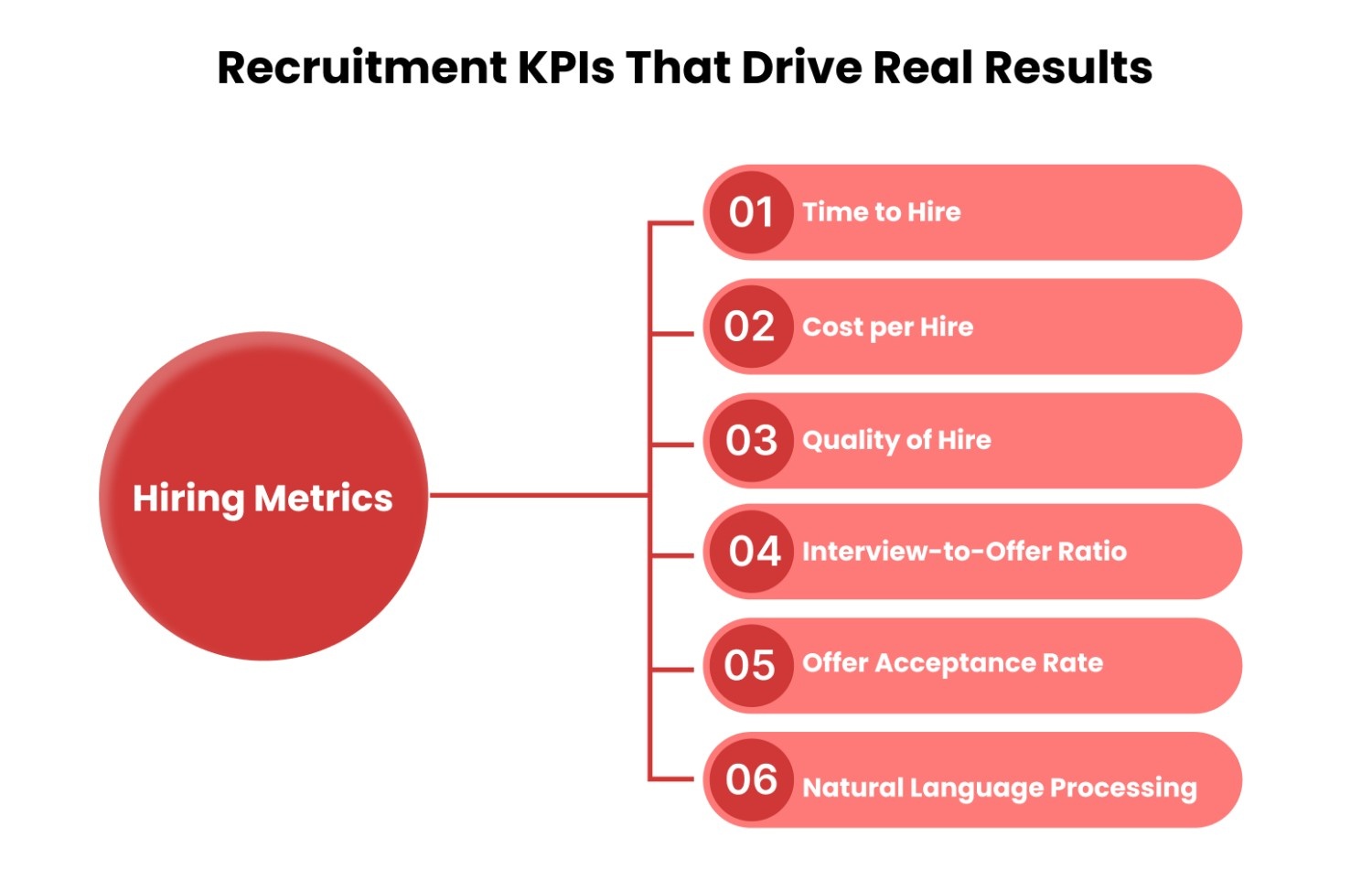
1. Time to Hire
When time is running out and stakeholders are expecting results, speed often feels like the most important factor. Every extra day between job requisition and offer letter isn’t just a delay; it’s a risk. Moreover, the best candidates don’t wait around.
What is Time to Hire?
Time to hire measures how quickly you move a candidate from application to signed offer.

Note: This isn’t about rushing, it’s about readiness.
Why Time to Hire is a Deal-breaker?
Long hiring cycles send the message, "We’re not ready," while fast hires say, "We’ve got our act together."
Here’s how a slow process affects your business:
- Top candidates drop off: They accept offers elsewhere before your team decides.
- Loss of trust: Delays signal disorganization, even when it’s not your fault.
- Margins shrink: The longer a seat stays open, the more expensive it becomes.
Tracking your time to hire is a strategy for consistency, trust, and business growth.
Understanding the right support from a staffing partner is crucial to optimizing this process and speeding up your hiring. Read: What to Expect When Working with a Staffing Agency.
And while time is critical, so is cost.
2. Cost per Hire
There’s nothing worse than pouring time, energy, and budget into hiring, only to question where it all went. When costs creep up and ROI stays unclear, pressure builds fast. Moreover, in staffing, every dollar spent has to prove its worth.
What is Cost per Hire?
Cost per hire shows how much you spend to make one successful hire. It’s the most straightforward way to track recruitment spending and justify hiring decisions.
Here's how it works:

These numbers help spot what’s working and what’s draining your budget.
What’s Included in Cost per Hire?
It’s not just job ads. Here’s what usually makes up the total cost:
- Sourcing tools: Job boards, LinkedIn licenses, recruiter platforms.
- Recruitment team salaries: Time spent per role filled.
- Background checks: Verifications, screenings, compliance fees.
- Interview logistics: Time, software, scheduling tools.
- Onboarding: Tech setup, paperwork, initial training.
Remember that every step has a cost and adds up quickly if the process drags or restarts.
Compare Costs Across Sources
Knowing the average cost per hire is good, but comparing by channel is great.

With visibility into performance and cost, you can direct spending toward results, not noise.
If you’re still weighing whether a staffing agency is cost-effective, compare it to low-cost options like internal databases and referrals. Then, explore how to choose the right IT staffing agency and discover what sets exceptional partners apart.
Therefore, when you understand cost per hire, you stop guessing and start hiring smarter. Next, let’s discuss the quality of the hire, because low-cost means nothing if the hire doesn’t perform.
3. Quality of Hire
Filling a role doesn’t always mean winning the hire.
You can tick all the boxes; skills, timeline, budget and still end up with a mismatch. When that happens, it’s not just disappointing; it’s expensive for everyone.
That’s why quality of hire is the KPI that separates placements from partnerships.
What Does Quality of Hire Really Mean?
It’s the outcome that follows the offer.
High-quality hires:
- Stick around long enough to make a difference.
- Earn the trust of clients and team leads.
- Deliver value faster, with fewer hand-holds.
- Fit the culture without forcing it.
Here, it's less about resumes and more about results.
How to Measure It (Without Overcomplicating Things)
Here’s a simple framework:

Pro Tip: Always aim for a score of 4+ consistently. Below that? Time to review sourcing or screening.
Why Recruiters Should Care Deeply About This Metric?
- It reduces churn and rehire panic.
- It creates measurable business value.
- It positions you as a strategic recruiter
Always remember that every successful hire boosts your track record, while every bad one lasts longer than you’d like. Now, you’ve made a great hire, but the hiring process isn’t over until they say yes.
Next, let's focus on candidate experience, which most influences that 'yes'.
4. Interview-to-Offer Ratio
Your hiring process speaks volumes before an offer is even made.
If too many interviews lead nowhere, it signals inefficiencies in candidate screening or unclear role requirements. This KPI measures the percentage of interviewed candidates who receive a job offer.
Here’s how you can calculate it:
Interview-to-Offer Ratio = (Number of offers extended / Number of candidates interviewed) × 100
A healthy ratio means your team is interviewing the right candidates and making informed decisions quickly.
5. Offer Acceptance Rate
Say you’ve found the perfect match. The interview went well, and everyone’s excited. You extend the offer. And then silence. Or worse, a polite “Thanks, but I’m going in another direction.”
It stings, not just because of the lost placement but also because of the time, trust, and margin that disappear with it. That’s why the offer acceptance rate (OAR) matters. It’s your deal-closure metric and it speaks volumes.
What Is the Offer Acceptance Rate?
OAR tracks how many candidates say “yes” to a job offer.
As a recruiter, you should calculate this:
Offer Acceptance Rate = (Accepted Offers / Total Offers Extended) × 100
Let’s simplify it:
If you roll out 20 offers and 15 are accepted, (15 ÷ 20) × 100 = 75% OAR
Why This KPI Deserves Your Attention
- It reflects candidate trust in your process.
- It helps diagnose gaps between the offer and expectation.
- It gives clients confidence in your delivery reliability.
Note: A high OAR? It means alignment. A low one? It’s a red flag waiting to spread.
Top Reasons Offers Get Declined and How to Fix Them
- The role isn’t the right fit?
Fix: Tighten your screening to match the right people with the right roles. - They got a better offer elsewhere?
Fix: Move faster. Speed can be a deciding factor. - Expectations weren’t clear?
Fix: Set them early for both you and the candidate. - Salary didn’t match?
Fix: Align on total comp early: base, bonuses, equity, and growth. Pay bands are public, but expectations still vary. Close the gap before the offer stage. - The experience felt off?
Fix: Communicate clearly and consistently at every stage.
Pro Tip: Ask for feedback from candidates who decline an offer to improve your process and make adjustments for the future.
When candidates say yes, it's not luck, it’s precision.
5. Hires to Goal
Hiring plans mean nothing without follow-through. This KPI tracks how close you are to meeting your recruitment targets within a set timeframe.
Hires to Goal = (New hires / Hiring goal) × 100
A strong ratio shows your team is on track and aligned with business needs. Falling short? It’s a signal to reassess your strategy and resources.
5. Candidate Experience
Your reputation begins long before a candidate signs the offer. Delayed responses, vague job descriptions, and robotic interview processes aren’t just red flags; they’re reasons top talent walks away.
In today’s talent-short market, you don’t get second chances. Therefore, a strong candidate experience doesn’t just impress, it converts, driving business-critical results.
Why Candidate Experience Is Business-Critical
- Candidates are customers. And they share their experiences online, good or bad.
- Most job seekers say the hiring experience directly impacts their decision to accept.
- A poor experience reflects poorly not just on your business, but on the brand as well.
In short, experience shapes perception, and perception shapes results.
The Candidate Experience Checklist
Use this guide to ensure a seamless and positive experience for every candidate.

Each touchpoint is a brand moment. Treat it like one.
Evaluate with Candidate Experience Metrics
Candidate experience is no longer a soft metric. It’s a growth lever.
1. Candidate NPS (cNPS)
This is your reality check. Candidate Net Promoter Score measures a candidate's overall experience and likelihood of recommending the company to others based on their recruitment experience.
Therefore ask:
“How likely are you to recommend your experience with us to a friend or peer?”
And then score on a scale of 0-10 to calculate as follows:
cNPS = (% of Promoters: 9–10) – (% of Detractors: 0–6)
- +50 or above: You're doing great.
- 0 to +50: There's room to grow.
- Below 0: It's a red flag.
Pro Tip: Follow-up surveys can also uncover gaps in communication, clarity, or empathy.
Why Does It Pay Off?
- Higher offer acceptance rates
- Stronger Glassdoor reviews
- Shorter hiring cycles through positive referrals
- Better long-term retention
2. Diversity and Inclusion Metrics
Diversity isn’t just good ethics, it’s innovative business.
But diversity must go hand-in-hand with inclusion. Without it, retention drops, and engagement falters.
Key metrics to track:
- % of underrepresented groups in the candidate pool.
- Diversity across interview panels.
- Retention of diverse hires over 6–12 months.
How to elevate inclusion:
- Use blind resume screening to remove bias.
- Partner with affinity networks to broaden sourcing.
- Train hiring teams to recognize and reduce bias.
3. Adverse Impact Detection
Unintentional discrimination can happen even with the best intentions.
Adverse impact metrics help ensure your hiring process is fair to everyone, without disadvantaging any group.

To stay compliant and fair:
- Use structured interviews for consistency.
- Run periodic audits of conversion rates by demographic.
- Document decisions to show objectivity and fairness.
The experience you deliver determines which way candidates lean.
To help meet these key recruitment KPIs, Consultadd simplifies the hiring process by reducing sourcing overhead and minimizing restarts. Our candidates are thoroughly screened, which shortens time-to-fill and minimizes post-hire issues, ultimately driving greater hiring success.
Next, let’s dive into what attracts them with source quality and channel effectiveness.
6. Source Quality and Channel Effectiveness
Source quality and channel effectiveness reveal where your best candidates are really coming from.
These ensure high-quality hires so you can focus your efforts, save time, and boost hiring success.
Source Quality Matters More Than Ever
Staffing today is about precision sourcing, finding talent that isn’t just qualified but high-impact.
Here’s what quality really looks like:
- Retention-ready: Candidates who stay and grow, not ghost or churn.
- Cultural fit: People who click with clients, teams, and expectations.
- High-performance: Talent that delivers results faster with less handholding.
Low-quality sources don’t just miss the mark; they cost time, trust, and team morale.
As we know, Steve Jobs didn’t talk about sourcing channels or recruiting metrics, but lived and implemented them.
He said,
“Great things in business are never done by one person. They're done by a team of people.”

His model for business was The Beatles, where each brought different strengths, and by supporting and balancing one another, they achieved more as a group than they could have individually.
That belief shaped everything he built, including his approach to talent. Jobs saw talent not as a transaction but as the lifeblood of innovation. It wasn’t just about hiring skilled people; it was about building teams that clicked, challenged each other, and created something bigger than themselves.
And to do that, he needed more than resumes. He required quality people.
The Channel Effectiveness Equation
Not all sourcing channels are created equal. And more is not better, better is better.
Here’s a comparison to make that clear:

The most innovative staffing leaders aren’t on every channel. They’re on the right ones, consistently.
How to Measure Channel Effectiveness
You can’t improve what you don’t track. Here's what to measure and monitor:
Sourcing Channel Efficiency = (Total Number of Hire via the Channel / Total Number of Applications via Channel x 100) × 100
Moreover, monitoring the following KPIs closely can provide insight into how each channel is performing:
- Conversion Rate (Views to Hires)
- Source of Hire (% hires per channel)
- Cost per Hire (per channel)
- Retention Rate (by channel)
- Time to Fill (per source)
Use this data to double down on what’s working and drop what’s draining time and trust.
Inspired by Jobs, Measured by You
Steve Jobs knew talent drives innovation, not just product specs or roadmaps.
“The total was greater than the sum of the parts.”
That’s precisely what excellent sourcing should do: create teams that outperform, outlast, and outshine.
When you track source quality and channel effectiveness, you're not just filling roles. You're building something greater: a hiring process that scales trust and performance.
With access to deep university partnerships, specialized talent pools, and a proprietary database of ready-to-go candidates, Consultadd is a high-yield sourcing partner. We don’t just deliver resumes, we deliver results that stick.
Start Strong With Consultadd
With 15 years in business and 5,000+ successful staffing engagements, we don't just fill roles, we build reliability into your process. We've supported 65 staffing companies in the past year alone and maintain MSAs with industry leaders like Robert Half and TEKsystems.
Here's what working with Consultadd looks like:
- Talent sourced in under 24 hours
- Ready-to-deploy candidates, vetted for experience and compliance
- Lower turnover risk: we match long-term goals, not just short-term needs
- Seamless compliance: visa, documentation, onboarding? Handled.
- Dedicated 1:1 account managers for responsive, personalized support
- Top 100 candidate matches delivered in the past year
- Strong partnerships with universities to tap into fresh, committed talent
- Post-placement support so your investment grows beyond day one
For candidates, your next opportunity is more than just a job title, it's a chance to build skills, gain experience, and move your career forward. At Consultadd, we connect technology professionals with projects and employers that align with their goals, whether they're looking for contract, contract-to-hire, or long-term opportunities.
The tech job market moves fast, but the right guidance can make all the difference. Ready to take the next step in your career journey? Explore Opportunities >>
Key Takeaways
- Measure hiring efficiency: Track KPIs like time-to-hire, cost per hire, and interview-to-offer ratio to identify process bottlenecks.
- Focus on quality, not just speed: Monitor quality of hire and offer acceptance rates to ensure successful long-term placements.
- Prioritize candidate experience: Fast communication, transparency, and positive interactions improve employer reputation and hiring outcomes.
- Evaluate sourcing channels: Measure source quality, conversion rates, retention, and hiring costs to optimize recruitment investments.
- Use data to improve continuously: Regular KPI reviews enable smarter decisions, better forecasting, and stronger recruitment performance.
FAQs
What are recruitment KPIs?
Recruitment KPIs (Key Performance Indicators) are measurable metrics that evaluate the effectiveness, efficiency, quality, and overall success of an organization's hiring process.
Which recruitment KPIs are the most important?
The most commonly tracked KPIs include time-to-hire, cost per hire, quality of hire, offer acceptance rate, interview-to-offer ratio, candidate experience, and source quality.
Why is quality of hire an important KPI?
Quality of hire measures how well new employees perform, fit the organization, and remain with the company, making it one of the strongest indicators of long-term recruitment success.
How can recruiters improve recruitment KPIs?
Recruiters can improve KPIs by streamlining hiring workflows, strengthening candidate communication, using data-driven sourcing strategies, improving screening processes, and regularly analyzing recruitment performance.
Why should companies track source quality and channel effectiveness?
Tracking source quality helps identify which recruitment channels consistently produce high-performing, long-term hires, allowing organizations to reduce hiring costs, improve efficiency, and maximize recruitment ROI.

How to Hire the Best: The Best Recruiting Practices You Need
Introduction
You’re under pressure: tight deadlines, talent shortages, and clients who expect results.
While your clients demand top talent delivered quickly, as a hiring manager, you may be wondering how exactly you can attract this talent.
Imagine top talent candidates staying with you because your process feels transparent, supportive, and human. In turn, you show up to client calls already trusted because your reputation for delivering quality talent speaks for itself.
That’s the power of best recruiting practices. They draw in clients and candidates before the conversation even begins. It’s not just about looking polished; it’s about being known for the one thing that truly matters: delivering quality results with confidence.
Let’s explore how the best recruiting practices can strengthen your brand and position your agency as the top choice for talent and clients.
TL;DR
- Strong recruiting practices combine employer branding, candidate experience, data-driven decisions, and diverse sourcing to attract top talent faster.
- A positive candidate experience improves offer acceptance, referrals, and long-term retention while strengthening your employer brand.
- Recruitment metrics help optimize hiring processes, identify bottlenecks, and demonstrate ROI to clients and stakeholders.
- Expanding sourcing channels, employee referrals, virtual hiring events, and skills-based hiring increase access to high-quality candidates.
- Consistently refining recruitment strategies helps staffing firms build trust, fill roles faster, and create lasting client relationships.
Leverage Your Staffing Brand to Win More Clients and Candidates
There’s nothing more frustrating than losing a top candidate after doing everything. You’ve built relationships and pitched the role perfectly. But still, someone else got there first. Or worse, looked more credible.
This is where a strong staffing brand changes everything. It doesn’t just support your pitch, it supercharges it.
1. Build a Reputation for Speed and Trust
Logos don’t win business; your speed and reliability do.
Show real data that backs your value.
Proven consistency builds trust with both clients and candidates.
2. Tell a Compelling Story
Your brand isn’t just what you post; it’s what people remember.
It should reflect your values, standards, and candidate-first mindset.
- Share placement wins
- Highlight hiring success stories
- Show how your team supports growth
It makes you memorable and preferred.
3. Build a Contractor Value Proposition (CVP)
Why should top talent choose you and stay with you?
Your CVP should answer that in one sentence.
Offer:
- Visa support
- Upskilling opportunities
- Dedicated account managers
- Community and benefits
This builds loyalty and keeps your pipeline engaged long after placement. When your brand speaks for your performance, you're not chasing business. You’re attracted to it.
Next, let’s explore how experience shapes your ability to keep top talent engaged.
Enhance the Candidate Experience

Top talent doesn’t ghost interviews because they’re flaky; they ghost because the experience feels forgettable.
Tech professionals today want more than a paycheck. They want clarity, respect, and a process that values their time. If they don’t feel it? They move on.
Creating a standout candidate experience isn’t a nice-to-have. It’s the edge that sets great staffing teams apart.
1. Communicate With Clarity and Respect
Silence kills trust. Delayed feedback breeds doubt.
The best agencies act fast and keep it human.
- Send updates, even if there’s no news
- Be upfront about timelines and expectations
- Personalize messages, ditch the cold auto-replies
Clear, timely communication shows candidates they matter.
2. Streamline Interviews and Onboarding
Clunky scheduling. Repetitive rounds. Endless paperwork. These are candidate deal-breakers.
Your process should feel smooth, not stressful.

Less friction means more accepted offers.
3. Reduce Offer Rejections and Boost Retention
Candidates accept offers when they feel seen, heard, and supported.
They stay when promises are kept after the contract is signed.
- Send welcome kits
- Assign check-ins during the first 90 days
- Offer career planning conversations
Remember, It’s not about perks, it’s about partnership.
A memorable candidate experience builds trust, drives referrals, and shortens your hiring cycle.
Moreover, Consultadd can help enhance your post-placement experience with benefits, visa support, and career guidance that reinforce loyalty. Our holistic approach ensures that the candidate journey doesn’t end with an offer; it continues with commitment, minimizing drop-offs and driving referrals.
Let’s now look at how data can sharpen every decision you make.
Utilize Recruitment Metrics and Data
Guesswork slows you down. Data-driven decisions speed you up and build trust with clients and candidates.
1. Track Metrics That Matter
Focus on what moves the needle, not just what looks good.
- Time to fill: How fast are roles getting closed?
- Quality of hire: Are placements staying and succeeding?
- Drop-off rate: Where are candidates bailing out?
Pro tip: Use dashboards for a weekly pulse check.
2. Let Data Guide Every Decision
Numbers tell you what’s working and what’s costing you hires.
- Spot bottlenecks in your process
- Match candidate skills with project outcomes
- Show clients clear ROI with every placement
Pro tip: Always have one data point ready to back your pitch.
One often-overlooked but powerful way to validate a hire is through thoughtful reference checks. Instead of going through the motions, strategic recruiters ask smart reference questions that reveal performance patterns, red flags, and alignment with the role. Read our blog: Smart Reference Questions Top Agencies Use to Make Better Hiring Decisions with Confidence.
3. Keep Evaluating and Improving
Recruitment isn’t static; your metrics shouldn’t be either.
- Review numbers monthly
- Adjust goals based on trends
- Share insights with your team
Let’s dig into sourcing strategies that attract hard-to-reach, high-performing talent.
Diversify Sourcing Strategies

Relying on the same old sources shrinks your talent pool and slows your growth. Breaking out of routine opens doors to untapped talent, fresh ideas, and faster placements.
Here’s how to widen your reach and bring diverse candidates into the fold.
1. Engage Passive Candidates
Most top talent isn’t actively job hunting; they wait to be noticed.
- Build relationships through industry events and online communities.
- Share content that speaks to their interests and career goals.
2. Explore Beyond Job Boards
Job boards are crowded. It’s time to think differently.
- Tap into coding forums, niche Slack groups, and tech meetups.
- Partner with training programs or bootcamps for early access.
3. Focus on Diversity, Equity, and Inclusion (DEI)
DEI is more than a trend; it's a competitive advantage that reshapes teams.
- Source from underrepresented groups to create balanced, innovative teams.
- Use inclusive language in job postings to attract a broader audience.
- Train hiring managers to reduce unconscious bias during interviews.
Research shows companies with the highest levels of ethnic diversity are 39% more likely to outperform financially.
This isn’t just good ethics, it’s good business.

Expanding your sourcing strategy transforms your talent pool and strengthens your agency’s edge.
Host Virtual Recruitment Events
Virtual recruitment events are a game-changer in today’s hiring landscape, offering cost-effective ways to connect with top talent from anywhere.
- Interactive Sessions: Incorporate live Q&As, webinars, and panel discussions.
- Invest in Career Fair Software: Streamline the process with virtual career fair platforms that facilitate easy, interactive chats.
Offer Flexible Work Arrangements
Flexibility is now a top priority for job seekers. Embracing remote and hybrid work models attract and retain the best talent.

Leverage Social Media to Attract Talent and Build Trust
Social media is no longer optional; it’s a powerful tool to connect with top talent.
Using it well can transform your agency’s reputation and candidate pipeline.

Social media isn’t just about posting jobs, it’s about building relationships and trust. With the right approach, you turn passive candidates into eager applicants.
Next, let’s explore building a robust employee referral program to accelerate talent acquisition further.
Develop a Robust Employee Referral Program
Finding top talent isn’t just about casting a wide net, it’s about tapping into the networks of your strongest team members.
Dennis de Munck, Director of Recruitment Methods at L’Oreal, shares how their referral program transformed their hiring success.
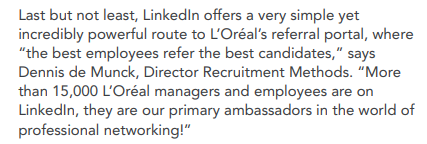
He says, “The best employees refer the best candidates.”
This simple truth became a cornerstone for their talent strategy.
Referrals bring faster, better candidates.
1. Make the program clear and simple.
Explain how it works and what rewards people get. Avoid complicated steps.
2. Offer meaningful rewards.
Cash bonuses, extra time off, or public recognition motivate employees to refer.
3. Build diversity into the program.
Encourage referrals from different backgrounds to grow a more inclusive talent pool.
4. Keep employees updated.
Share progress on their referrals to keep excitement and trust alive.
5. Track and improve.
Use data to see what’s working and adjust rewards or communication accordingly.
A strong referral program turns your team into powerful talent ambassadors.
This is where Consultadd can make a difference. With thoroughly screened, ready-to-hire candidates, your agency gets a head start in every search. By cutting down sourcing time and reducing early-stage screening hurdles, Consultadd empowers recruiters to deliver the best talent faster and precisely.
Implement Skills-Based Recruitment
Making skills the heart of your hiring process takes intentional steps. Here’s how to do it right:
1. Redefine Job Descriptions
- List specific skills and competencies needed for the role.
- Remove rigid degree or certification requirements unless essential.
2. Source Candidates Differently
- Use platforms and job boards focused on skills (e.g., GitHub for developers, Behance for designers).
- Look beyond resumes: check portfolios, project samples, or open-source contributions.
3. Implement Skills Testing Early
- Use short, relevant assessments to evaluate candidates’ abilities.
- Tools like HackerRank, Codility, or customized practical tasks work well.
- Share tests upfront to set expectations and respect the candidate's time.
4. Align Interview Questions to Skills
- Develop interview questions that probe real-world problem-solving.
- Use scenario-based questions and role-play exercises.
Following these steps simplifies hiring and expands your access to top talent only.
To stay ahead of evolving skill demands, smart agencies use talent mapping to proactively identify gaps, anticipate client needs, and build future-ready pipelines. Learn more in From Skills Gap to Strategic Growth: Talent Mapping That Delivers.
Bridge the Gap Between Sourcing and Client Expectations
Misaligned expectations waste time. Clear communication earns trust and repeat business. Therefore, it is crucial to keep talent engaged throughout the process and even after.

Start Strong With Consultadd
With 15 years in business and 5,000+ successful staffing engagements, we don't just fill roles, we build reliability into your process. We've supported 65 staffing companies in the past year alone and maintain MSAs with industry leaders like Robert Half and TEKsystems.
Here's what working with Consultadd looks like:
- Talent sourced in under 24 hours
- Ready-to-deploy candidates, vetted for experience and compliance
- Lower turnover risk: we match long-term goals, not just short-term needs
- Seamless compliance: visa, documentation, onboarding? Handled.
- Dedicated 1:1 account managers for responsive, personalized support
- Top 100 candidate matches delivered in the past year
- Strong partnerships with universities to tap into fresh, committed talent
- Post-placement support so your investment grows beyond day one
For candidates, your next opportunity is more than just a job title, it's a chance to build skills, gain experience, and move your career forward. At Consultadd, we connect technology professionals with projects and employers that align with their goals, whether they're looking for contract, contract-to-hire, or long-term opportunities.
The tech job market moves fast, but the right guidance can make all the difference. Ready to take the next step in your career journey? Explore Opportunities >>
Key Takeaways
- Build a trusted recruitment brand: Showcase consistent hiring success, tell compelling stories, and create a strong contractor value proposition to attract clients and candidates.
- Prioritize candidate experience: Clear communication, streamlined interviews, and strong post-placement support improve offer acceptance and retention.
- Use recruitment data strategically: Monitor KPIs like time-to-fill, quality of hire, and candidate drop-off rates to improve hiring outcomes.
- Diversify sourcing methods: Go beyond job boards by leveraging referrals, social media, niche communities, virtual events, and DEI-focused recruitment strategies.
- Adopt skills-based hiring: Evaluate candidates based on demonstrated abilities through practical assessments rather than relying primarily on degrees or traditional credentials.
FAQs
What are the best recruiting practices for attracting top talent?
The most effective recruiting practices include building a strong employer brand, providing an excellent candidate experience, using data-driven hiring, diversifying sourcing channels, implementing employee referral programs, and adopting skills-based hiring.
Why is candidate experience important in recruitment?
A positive candidate experience increases offer acceptance rates, improves employer reputation, generates referrals, and encourages high-quality candidates to stay engaged throughout the hiring process.
How can recruiters find better candidates beyond job boards?
Recruiters can expand their talent pool through employee referrals, social media, professional communities, industry events, coding platforms, virtual career fairs, university partnerships, and passive candidate outreach.
How do recruitment metrics improve hiring?
Recruitment metrics help identify hiring bottlenecks, measure recruiter performance, optimize sourcing strategies, improve hiring quality, reduce costs, and support better business decisions.
Why is skills-based recruitment becoming more popular?
Skills-based recruitment focuses on proven capabilities instead of degrees or job titles, helping employers access larger talent pools, reduce hiring bias, improve candidate quality, and hire people who can perform the job effectively.

How Big Companies Choose the Best: A Step-by-Step Hiring Guide
Introduction
Hiring for big companies isn’t just about filling roles; it’s about meeting sky-high expectations, quickly.
The truth is, big companies don’t leave hiring to chance. These processes have to be refined into a highly effective method that filters not just for skills, but for mindset, leadership potential, and cultural fit.
They’re not just hiring for today’s role. They’re investing in tomorrow’s team.
And while that might sound difficult for giants like Amazon or Google, the methods used are worth a closer look for every hiring manager trying to build better pipelines, faster.
Let’s understand the practical steps that make up a big company hiring process and what you pros can learn from them.
TL;DR
- Big companies use structured, multi-stage hiring processes to evaluate technical skills, adaptability, leadership potential, and cultural fit.
- Successful recruitment combines targeted sourcing, employee referrals, technical assessments, and panel-based interviews.
- Objective scorecards and hiring committees help reduce bias and improve hiring quality.
- Keeping candidates engaged throughout lengthy hiring processes reduces drop-offs and improves offer acceptance.
- Staffing partners like Consultadd help accelerate hiring with pre-vetted, compliant talent ready for deployment.
Recruitment Methods
When hiring for big companies, there’s no room for guesswork. Every channel must deliver. That means knowing where to find the right talent and how to reach them before someone else does.
Here’s how the smartest teams attract high-caliber candidates and stay ahead of hiring demands:
1. Job Boards Still Matter, But Only the Right Ones
- Niche tech job boards often outperform general platforms.
- Think Stack Overflow, GitHub Jobs, or Dice, not just LinkedIn.
Use boards where your ideal candidate spends time.
2. Referrals Are Gold
- Big companies rely heavily on internal referrals, and for good reason.
- Referred candidates are 3-4x more likely to be hired and stay longer.
Build structured referral programs with clear incentives.
3. Tech Talent Loves a Challenge
- Coding competitions, hackathons, and open-source projects attract top Full-Stack and DevOps talent.
- Many companies scout for talent on platforms like HackerRank and Codeforces.
It’s not just about skills; it shows initiative and problem-solving under pressure.
4. Headhunting: Still King for Hard-to-Fill Roles
- For senior Cloud, DevOps, or niche contract positions, passive outreach is key.
- But generic InMails won’t work: personalized, well-researched messages get better response rates.
Big companies expect candidates to be approached strategically, not spammed.
5. Industry-Specific Targeting
- Smart hiring managers go where the talent already works.
- Utilize tools like LinkedIn Boolean searches to pinpoint role-specific profiles.
Each of these methods plays a role in building a pipeline that’s not just wide, but precise.
Through Consultadd, you can quickly access a pipeline of pre-screened, qualified candidates ready to deploy in less than 24 hours. This helps combat the problem of slow hiring cycles, ensuring that the best talent isn’t left waiting while competitors fill roles faster.
Interview Process

Big companies don’t gamble on talent; they build interviews that reveal more than resumes ever could. They know a candidate’s potential isn't just in what they say, but how they think, solve, and connect.
Sundar Pichai, CEO of Alphabet, shared on what sets top candidates apart.
He says Google hires “superstar software engineers” who are “not only excellent but also willing to learn, grow, and adapt.”
This mindset is critical, technical skill alone won’t cut it. If you're helping candidates step into this world, understanding this process mindset is half the battle.
1. Multiple Rounds. Minimal Flexibility
- Contain several stages: phone screens, technical interviews, virtual/on-site loops, and final reviews.
- The format rarely changes, no matter how impressive the resume.
Each round builds on the last; consistency is key.
2. Interview Panels Are Carefully Selected
- HR, engineers, and hiring committees all play a role.
- It’s rarely just one manager making the call.
- Panels assess for technical fit, soft skills, and long-term potential.
Want to know why soft skills are crucial in hiring? Read our blog: The Importance of Soft Skills in the Hiring Process.
3. The Focus Is Deep, Not Just Broad
- Core computer science fundamentals: algorithms, data structures, system design.
- Big companies prioritize how a candidate solves problems, not just if they can.
Remember, code quality, logic, and efficiency all matter.
4. Assessments Are Objective and Stress-Tested
- Live coding, whiteboard challenges, and take-home tasks are the norm.
- Interviewers use scorecards and rubrics, not gut feelings.
Candidates can prep effectively, but can’t fake adaptability or clarity.
5. Hiring for Role Fit and Future Fit
- Some roles demand deep specialization (think Cloud Architects).
- Others value generalists who grow into leadership.
- Either way, adaptability is just as prized as experience.
6. Decisions Aren’t Personal, They’re Panel-Based
- Final calls are made by hiring committees, not individuals.
- This reduces bias but raises the bar on documentation and consensus.
Here’s how big companies typically approach interviews:

To learn how cultural fit can reshape hiring success, read our blog: How Cultural Fit Transforms Hiring Outcomes. Mastering this structure lets recruiters do more than just prep candidates; they position them for success.
Final Review and Decision Making

Big companies don’t rush this step. Every hire is a calculated decision, shaped by group input and data-driven insights. That can feel agonizing when your candidate’s other offers are piling up fast.
But understanding the method behind the slowness? That gives you power.
1. Hiring Committees Take the Reins
- No single manager makes the call at this stage.
- Committees review feedback from all interviewers.
- Decisions are made collectively, reducing personal bias but increasing complexity.
2. Amazon’s “Bar Raisers” Model is a Game-Changer
- A dedicated “bar raiser” ensures every hire meets a higher standard than the last.
- They’re trained to spot red flags others miss and push for long-term value.
- This makes hiring tougher, but also more consistent.
3. Feedback Isn’t Just Heard, It’s Graded
- Interviewers use structured rubrics to rate skills, culture fit, and potential.
- Comments must be specific and supported by evidence.
- Gut feelings aren’t enough in this final room.
4. Time Kills Deals, So Keep Momentum Alive
- The decision process can take days (sometimes weeks).
- Use this time to keep your candidate engaged and reassured.
- Regular check-ins and transparency go a long way.
5. The Yes Must Be Universal
- One strong “no” from the panel can sink a great candidate.
- That’s why thorough preparation on your end matters.
- You’re not just submitting talent, you’re submitting confidence.
Decision time isn’t just about the candidate; it’s about the confidence of the company.
With Consultadd, you can reduce hiring delays by providing a steady pipeline of ready-to-hire candidates. Whether it’s ensuring compliance, managing documentation, or handling the logistics of relocation, we streamline the process so you can keep momentum during each interview stage, ensuring faster decisions and smoother transitions.
Improving the Hiring Process
Every hiring team dreams of a process that is fast, fair, and effective. But the reality often involves endless delays, unclear decisions, and losing great talent to competitors.
The good news? Big companies have cracked the code, and their methods offer a blueprint for success.
1. Spread the Interview Load
- Assign different interviewers for technical, behavioral, and cultural assessments.
- This avoids burnout and brings diverse perspectives to candidate evaluation.
2. Make Decisions Together
- Include multiple team members in the final hiring choices.
- Collective insight reduces bias and boosts confidence in selections.
3. Use Clear Scoring Systems
- Define key skills and rate candidates objectively against them.
- This creates consistency and clearly highlights top performers.
4. Keep Candidates Engaged
- Communicate regularly to maintain interest and trust.
- Silence often leads to candidate drop-off and lost opportunities.
5. Train Interviewers
- Equip interviewers with best practices and calibration sessions.
- Skilled interviewers identify true potential more quickly and accurately.
By adopting these strategies, staffing teams can transform chaos into clarity and win the talent race.
Start Strong With Consultadd
With 15 years in business and 5,000+ successful staffing engagements, we don't just fill roles, we build reliability into your process. We've supported 65 staffing companies in the past year alone and maintain MSAs with industry leaders like Robert Half and TEKsystems.
Here's what working with Consultadd looks like:
- Talent sourced in under 24 hours
- Ready-to-deploy candidates, vetted for experience and compliance
- Lower turnover risk: we match long-term goals, not just short-term needs
- Seamless compliance: visa, documentation, onboarding? Handled.
- Dedicated 1:1 account managers for responsive, personalized support
- Top 100 candidate matches delivered in the past year
- Strong partnerships with universities to tap into fresh, committed talent
- Post-placement support so your investment grows beyond day one
For candidates, your next opportunity is more than just a job title, it's a chance to build skills, gain experience, and move your career forward. At Consultadd, we connect technology professionals with projects and employers that align with their goals, whether they're looking for contract, contract-to-hire, or long-term opportunities.
The tech job market moves fast, but the right guidance can make all the difference. Ready to take the next step in your career journey? Explore Opportunities >>
Key Takeaways
- Successful enterprise hiring starts with targeted sourcing, using niche job boards, referrals, headhunting, hackathons, and industry-specific outreach.
- Big companies rely on structured interview processes with multiple rounds, technical assessments, panel interviews, and standardized evaluation criteria.
- Hiring decisions are collaborative, with hiring committees and structured scorecards ensuring objective, evidence-based decisions.
- Candidate engagement throughout the hiring process is critical to maintaining momentum and preventing candidates from accepting competing offers.
- Recruiters can improve hiring outcomes by using standardized scoring, training interviewers, sharing decision-making, and maintaining clear communication with candidates.
FAQs
How do big companies typically hire employees?
Large companies use structured hiring processes that include targeted sourcing, multiple interview rounds, technical assessments, panel interviews, and committee-based final decisions to ensure high-quality hires.
Why are employee referrals so effective?
Referral candidates are often higher quality, have better cultural alignment, are hired more quickly, and typically remain with organizations longer than candidates from other sourcing channels.
What do large companies evaluate besides technical skills?
They assess problem-solving ability, adaptability, communication, leadership potential, cultural fit, collaboration, and long-term growth potential in addition to technical expertise.
Why do enterprise hiring processes take longer?
Multiple interview stages, panel evaluations, structured assessments, hiring committee reviews, and consensus-based decisions help reduce hiring bias and improve long-term hiring success.
How can recruiters improve hiring for enterprise clients?
Recruiters should diversify sourcing channels, standardize interview evaluations, keep candidates engaged throughout the process, train interviewers, and use objective scorecards to make faster, more consistent hiring decisions.

How Cultural Fit Transforms Hiring Outcomes
Introduction
You find the perfect resume, schedule the interviews, and get approval, but the placement still falls apart.
As a recruiter, this sounds familiar. The candidate checked every box. But once they joined, something didn’t click. Maybe the new hire clashed with the team. Perhaps they didn’t align with the company’s pace, tone, or values. Either way, you’re back to square one.
That’s not a skill problem. It’s a cultural fit problem.
Cultural fit refers to how well a candidate’s values align with an organization. It’s not just a nice-to-have; it's a critical factor in long-term success.
Deloitte reports that 94% of executives believe a strong culture is essential for business performance. When people fit, they’re more engaged, productive, and likely to stay.
In the staffing world, that means fewer replacements, greater satisfaction, and reputations that speak for themselves.
TL;DR
- Cultural fit improves hiring success and long-term retention.
- Assess values, behaviors, and work style not just technical skills.
- Use structured interviews, scorecards, and team feedback to reduce hiring mistakes.
- Balance cultural fit with cultural add to avoid bias and encourage innovation.
- Strong cultural alignment leads to better performance, engagement, and lower turnover.
What is a Cultural Fit?
It’s not just skills. It’s how someone works, communicates, and collaborates.
Cultural fit means a candidate’s values, behaviors, and work style align with the company’s. Let’s examine this in more detail.
Why Does Culture Fit Matter?
Culture affects everything from team dynamics to business results. Here’s why it matters:
- Better teamwork: Aligned values mean smoother communication and fewer conflicts.
- Higher productivity: When people feel they belong, they show up, work hard, and stay longer.
- Lower hiring costs: Wrong-fit hires leave early. That means wasted time and money again.
- Stronger company culture: The right people add energy. The wrong ones drain it.
So, how do you assess cultural fit before the first day on the job? Let’s explore that.
Assessing Cultural Fit in Hiring

Hiring for skills is straightforward. But hiring for fit is where the real challenge lies. As tech recruiters, you’re not just matching a resume to a job; you’re matching a human to a company’s heartbeat.
Here’s how to assess cultural fit with precision, speed, and confidence:
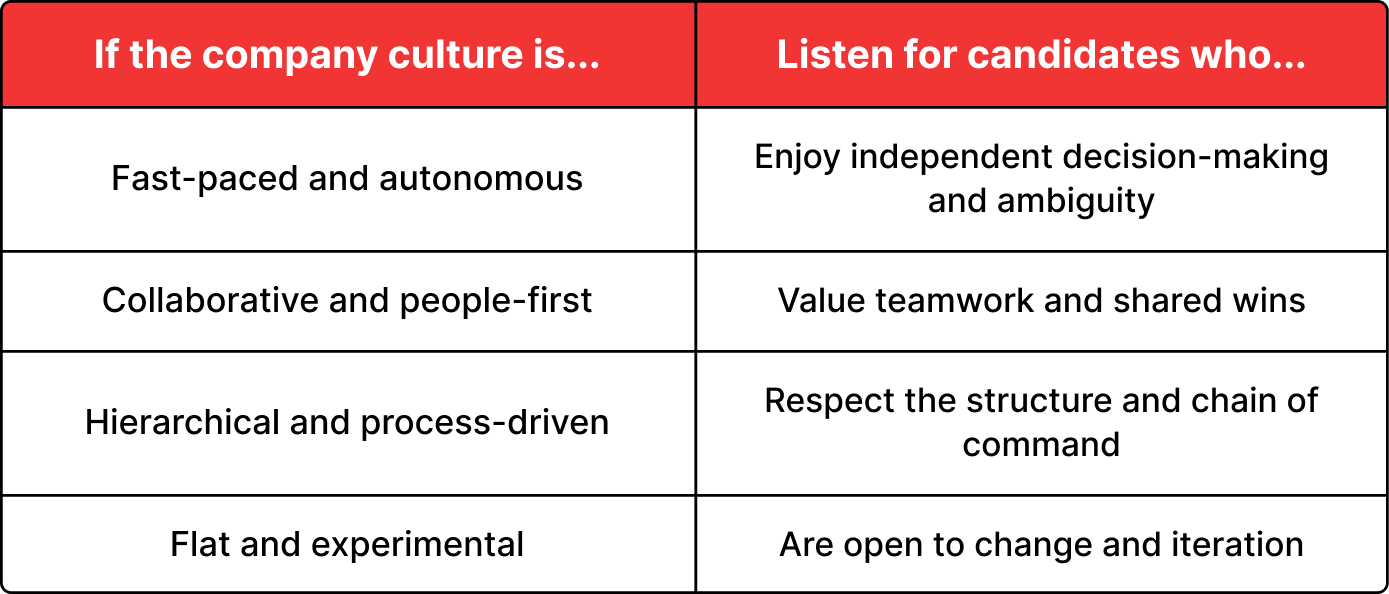
1. Ask Culture-Revealing Questions (And Know What to Listen For)
Technical skills tell you what a person can do. Cultural questions reveal how they do it.
Ask questions like:
- “Describe your ideal manager or team lead.”
- “What kind of feedback helps you improve?”
- “Tell me about a time you disagreed with a team decision. What did you do?”
Know what to look for:
2. Get Specific with the Company Culture
The best cultural assessments start with clarity on what the culture is.
Find out:
- What’s one trait all top performers share?
- How are wins celebrated? How are failures handled?
- Is success driven by speed, innovation, structure, or something else?
Remember to document the vibe and values. Whether it’s fast-paced, consultative, autonomous, or deeply collaborative, this will help you filter candidates who will not only survive but succeed and stay.
3. Use Role-Play or Situational Tests
A resume can’t show how someone handles pressure, teamwork, or ambiguity.
Simple, tailored exercises like:
- A mock stand-up meeting
- A team conflict resolution scenario
- Prioritizing tasks under deadline pressure
These simulations highlight emotional intelligence and interpersonal style crucial for fit.
4. Get the Team Involved
Culture lives in the team, not just with you.
- Include future peers in interviews.
- Gather feedback from different team members.
- Look for consistency in how candidates engage across roles
This brings perspective and improves placement success rates.
5. Reflect on Cultural Impact Like a Business Metric
Culture-fit hires don’t just blend in; they elevate the team.
Track results over time:
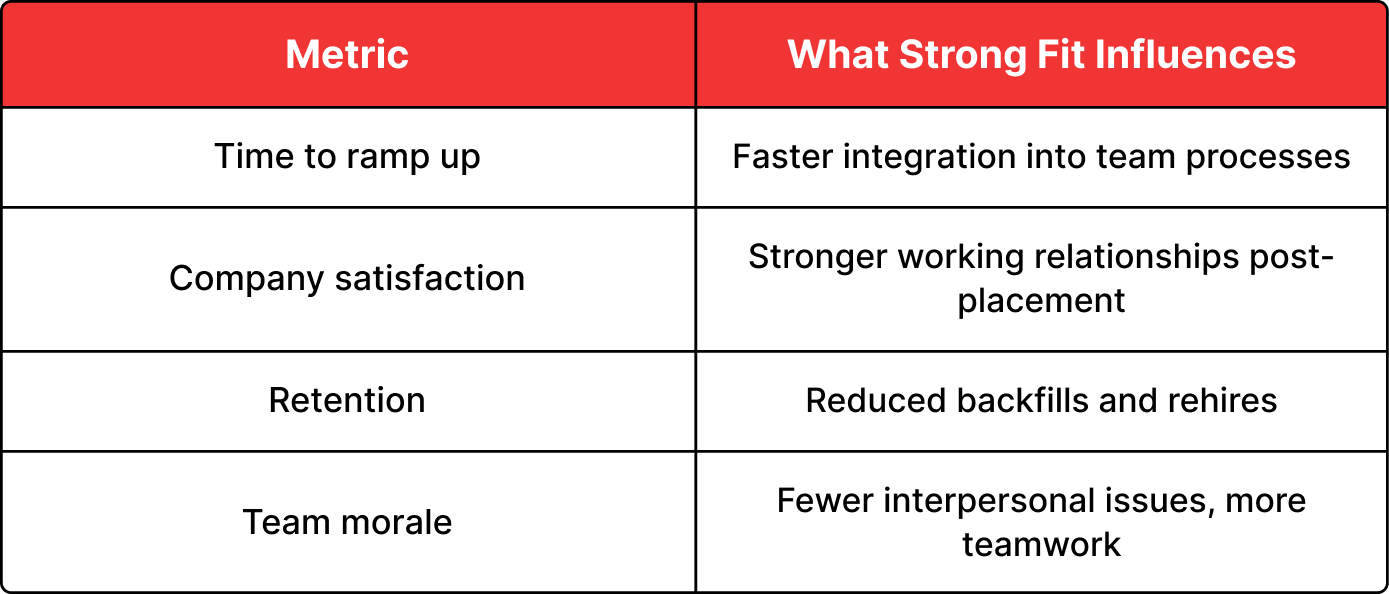
The right hire adds value beyond their job title and strengthens your reputation.
When you prioritize cultural fit, you're not just filling roles; you’re shaping the future teams to rely on. To assess cultural fit effectively, it's essential to consider soft skills.
To know more, read our blog on The Importance of Soft Skills in the Hiring Process and how they influence team dynamics and long-term success.
Next, let’s explore the business benefits of cultural fit and how it can provide a competitive edge.
Benefits of Cultural Fit
When a candidate aligns with the values, team dynamics, and work style, you get performance, loyalty, and kudos.
Here’s what that looks like:
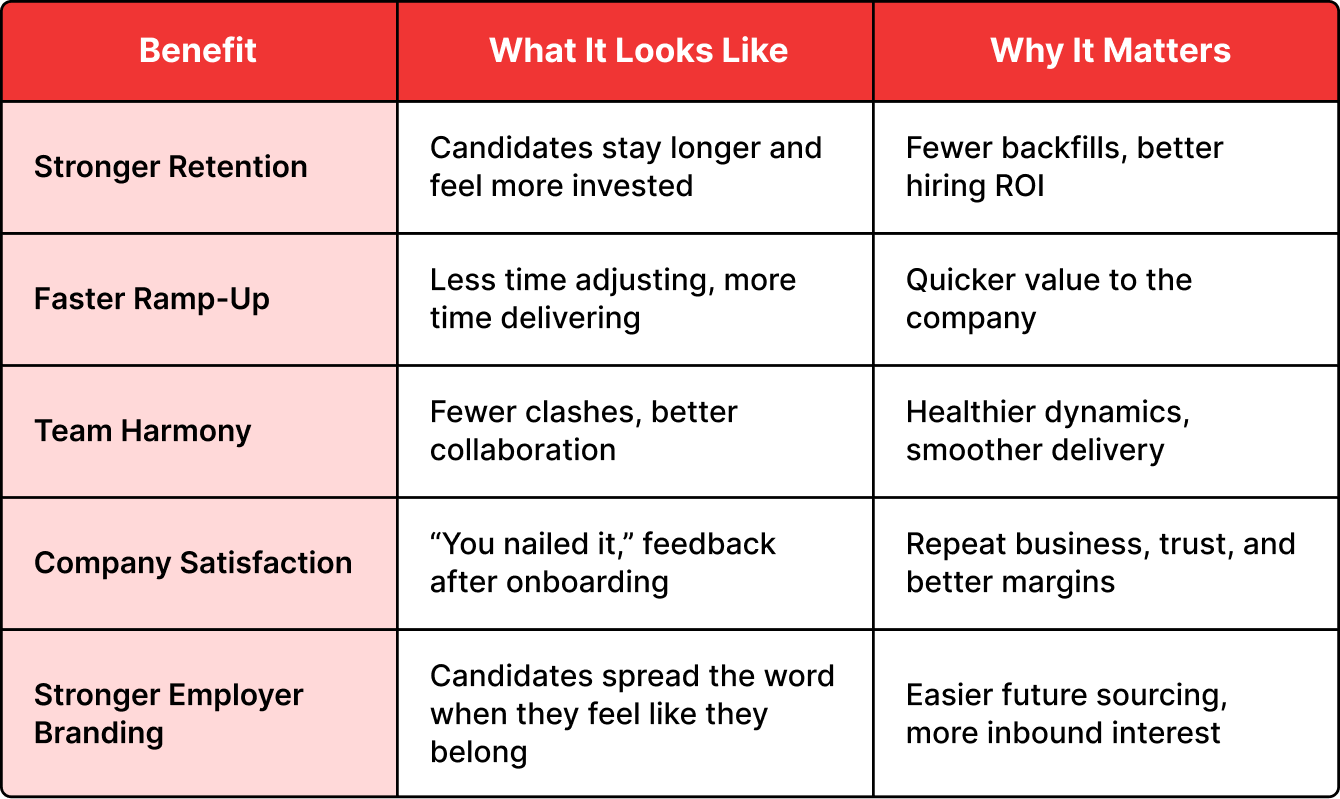
It’s not about perfection, it's about alignment. When values and working styles match, everything simply runs smoother.
By partnering with Consultadd, you can access all the above benefits, thus significantly reducing your hiring cycles. We provide a steady pipeline of ready-to-hire candidates, enabling faster placements and better alignment with cultural fit.
Potential Pitfalls of Cultural Fit
As a recruiter, hiring for cultural fit feels like playing it safe, but it can sometimes cost you great talent.
When “fit” becomes a filter, your shortlist looks unnaturally similar. That’s when good intentions start blocking smart hiring.
Let’s break it down with a quick look:
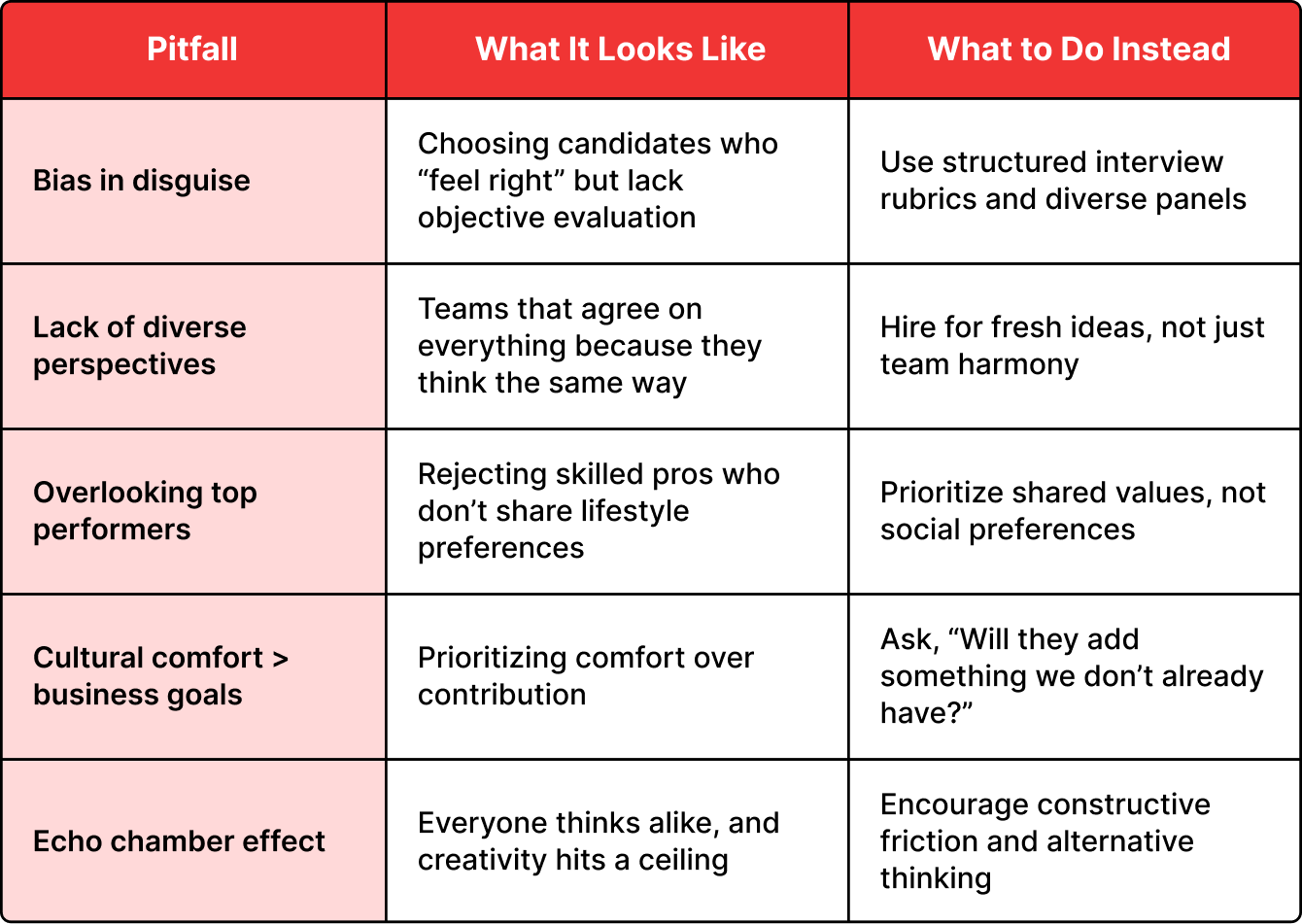
Key Signs You Might Be Overdoing “Fit”
- Every hire looks, thinks, and works the same
- Rejections often include “just not the right vibe.”
- Innovation is stalling, and groupthink is taking over
Tips to Avoid the Trap
- Focus on value alignment, not personality sameness
- Define your culture in terms of behaviors, not hobbies
- Ask: Does this person challenge us in the right ways?
It’s time to expand how we think about culture, not just fit, but what people can add. Therefore, addressing and bridging the skills gap is key to strategic growth. Learn from our blog, From Skills Gap to Strategic Growth: Talent Mapping to drive impactful hires.
Cultural Fit vs. Cultural Add
While hiring for cultural fit feels like safeguarding your team, it limits its potential for growth and innovation.
While “fit” keeps the peace, “add” drives progress.
Let’s compare the two approaches side-by-side:

Striking the Right Balance
You don’t need to throw out “fit” entirely. But refine how you define it:
- Keep: Alignment with core values like integrity, accountability, and collaboration
- Rethink: Requiring the same communication style or background
- Encourage: Candidates who challenge your team in healthy, productive ways
In short, hiring for "fit" might fill the seat while hiring for "add" builds the future.
Measuring Cultural Fit
Cultural fit isn’t something you “sense” in a handshake or guess from a resume.
And when hiring moves fast, intuition alone isn’t just risky, it’s expensive.
Let’s replace gut-feel with simple, structured methods that help you hire smarter.
1. Ask the Right Questions
Surface-level questions miss the mark. Dig into what drives behavior.
2. Use a Cultural Scorecard
Define the company's 3–5 core values and score each candidate (1–5) on how well they align with those values.
Not a perfect science, but it gives hiring managers clarity and confidence in decision-making.
3. Back It Up with Behavioral Assessments
You don’t need fancy tools, though some work great.
Even a lightweight personality, reference checks, or values assessments can spotlight blind spots early.
They help reveal:
- Communication style mismatches
- Work pace differences
- Openness to feedback and change
While measuring cultural fit, managing the administrative side of hiring, salaries, benefits, insurance, and relocation can be overwhelming. Consultadd handles all the paperwork, including wages, 401(k) plans, insurance, and relocation, reducing your burden and ensuring a smooth hiring process.
Implementing Cultural Fit in Hiring Practices
So, how do you make sure you're hiring for fit and not falling for bias? You have already seen how to define culture practically, ask the right questions, and take measurable decisions.
The image below shows how using the previously said steps can help you implement the perfect plan for hiring practices.

A thoughtful process doesn’t slow hiring; it strengthens it. Cultural alignment is the kind of value that’s remembered.
Remember: Managers seek alignment with the organization’s mission; candidates look for someone they can trust to have their back. The best hiring practice balances both.
Start Strong With Consultadd
With 15 years in business and 5,000+ successful staffing engagements, we don't just fill roles, we build reliability into your process. We've supported 65 staffing companies in the past year alone and maintain MSAs with industry leaders like Robert Half and TEKsystems.
Here's what working with Consultadd looks like:
- Talent sourced in under 24 hours
- Ready-to-deploy candidates, vetted for experience and compliance
- Lower turnover risk: we match long-term goals, not just short-term needs
- Seamless compliance: visa, documentation, onboarding? Handled.
- Dedicated 1:1 account managers for responsive, personalized support
- Top 100 candidate matches delivered in the past year
- Strong partnerships with universities to tap into fresh, committed talent
- Post-placement support so your investment grows beyond day one
For candidates, your next opportunity is more than just a job title, it's a chance to build skills, gain experience, and move your career forward. At Consultadd, we connect technology professionals with projects and employers that align with their goals, whether they're looking for contract, contract-to-hire, or long-term opportunities.
The tech job market moves fast, but the right guidance can make all the difference. Ready to take the next step in your career journey? Explore Opportunities >>
Key Takeaways
- Define company culture before evaluating candidates.
- Ask behavioral questions that reveal workplace values.
- Measure cultural fit using consistent hiring frameworks.
- Prioritize value alignment over personality similarity.
- Combine technical skills with cultural alignment for lasting placements.
FAQs
1. What is cultural fit in hiring?
Cultural fit is how well a candidate's values, behaviors, communication style, and work approach align with an organization's culture and expectations.
2. Why is cultural fit important?
Employees who fit the company culture are typically more engaged, collaborate better, stay longer, and contribute to stronger team performance.
3. How can recruiters assess cultural fit?
Recruiters can use behavioral interview questions, situational exercises, cultural scorecards, team interviews, and reference checks to evaluate alignment.
4. What is the difference between cultural fit and cultural add?
Cultural fit focuses on shared values and ways of working, while cultural add emphasizes hiring people who bring fresh perspectives while still supporting the company's core values.
5. Can hiring for cultural fit create bias?
Yes. If "fit" is based on personal preferences instead of defined workplace values, it can reduce diversity. Focusing on value alignment and cultural add helps minimize this risk.

Smart Reference Questions to Make Better Hiring Decisions
Introduction
You’ve reviewed the resume, led the interviews, and your client is nearly ready to say yes. But there’s still that quiet uncertainty: Is this candidate really who they say they are?
In the staffing world, there’s little room for error. A single misstep, like placing someone who can’t deliver, can strain client relationships and stall your momentum. That’s why reference checks aren’t just a routine step. They’re a critical safeguard.
Done right, they offer real insight into how a candidate performs, collaborates, and handles pressure. And you’re not alone in valuing them, a SHRM survey shows that 92% of employers conduct background screenings, underscoring just how vital it is to verify what’s on paper.
Reference checks bring clarity when it matters most. Before you move forward, make sure you’ve asked the right questions—the ones that reveal more than just job titles and timelines.
Let’s start with how to set up a solid reference check process.
TL;DR
- Reference checks verify performance beyond resumes and interviews.
- Ask structured questions to uncover strengths, reliability, and work style.
- Evaluate communication, teamwork, and long-term career motivation.
- Look for patterns, not just positive references or generic praise.
- Strong reference checks reduce hiring risks and improve placement success.
Best Practices for Conducting Reference Checks
Reference checks shouldn’t slow you down, but skipping them can set you back. Here’s how to make them fast, focused, and effective.

1. Ask for the Right References
Avoid friendly peers, go straight to former managers or supervisors.
Pro Tip: Ask for someone who managed the candidate for at least six months.
2. Keep the Process Transparent
Let candidates know what to expect and why references matter.
Pro Tip: A well-informed candidate leads to a better-prepared reference.
3. Respect Confidentiality
Never involve current employers unless you have clear permission.
Pro Tip: Phrase your request as follows: “Someone who can speak to recent performance, not necessarily your current manager.”
4. Stay Consistent with Questions
Use the same core questions across candidates to stay fair and focused.
Pro Tip: A template helps you compare answers and spot patterns quickly.
5. Pay Attention to What’s Not Said
Notice hesitations, vague responses, or over-polished praise.
Pro Tip: Follow up with, “Can you give me an example?” to dig deeper.
Reference checks, done right, can reveal what no resume or interview will ever show. Having said this, let’s look into some of the essential questions that can separate a good hire from a bad one.
When implementing reference check best practices, it’s crucial to have a clear understanding of your talent pool and how to effectively map it.
For more insights on refining your recruitment strategy, check out our Comprehensive Guide to Talent Mapping Best Practices.
Essential Reference Check Questions
The right reference questions don’t just verify employment—they uncover patterns, red flags, and potential. Ask targeted questions that reveal how the candidate actually showed up at work.
Here are the must-ask questions and what each one tells you.
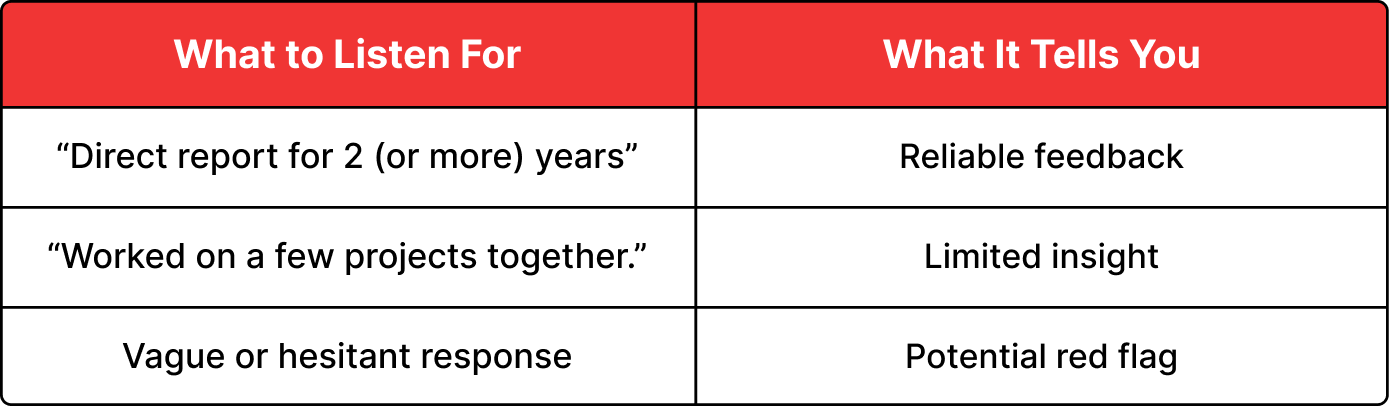
1. “What was your relationship with the candidate?”
This sets the context for the reference’s credibility and perspective. It also helps you understand if feedback is based on close observation or second-hand opinions.
2. “What were the candidate’s core responsibilities?”
Check for alignment between the resume and reality. This also helps validate technical skills and role depth.
What to expect:
- Seasoned candidates: Clear, detailed breakdown of projects, tech used, and impact.
- Newer or exaggerated claims: General answers, lacking specifics or outcomes.
3. “Was the candidate dependable and reliable?”
Look beyond skills into consistency and accountability. This is great for gauging work ethic, timeliness, and follow-through.
Good signs:
- “Always met deadlines”
- “Could be trusted with high-stakes tasks”
Concerning signs:
- “Usually dependable, but…”
- “Needed some reminders”
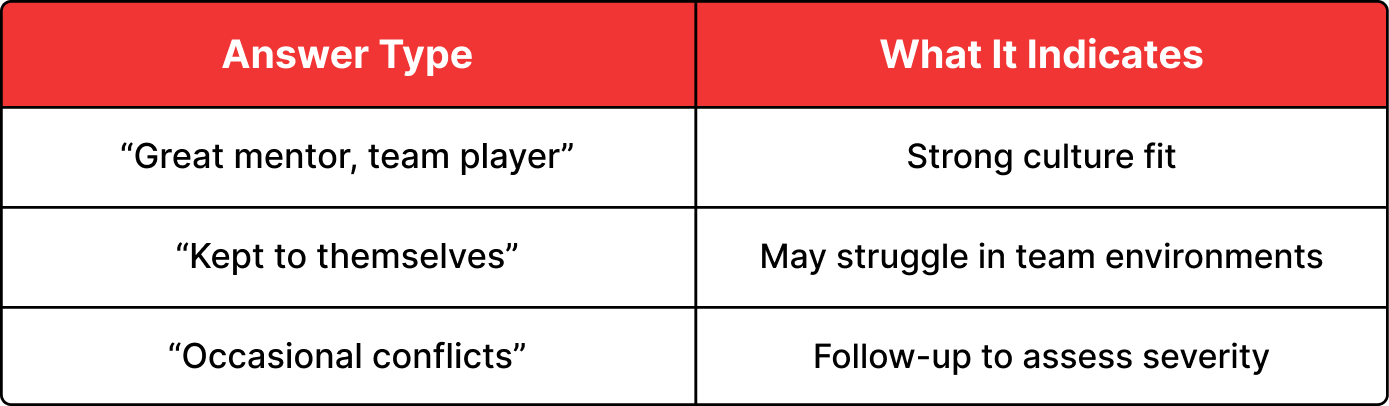
4. “How did they support coworkers and build relationships?”
Reveals team dynamics and emotional intelligence. This is a must ask question for client-facing or collaborative roles.
Insights you gain:
Asking the right questions helps you look past job titles and dig into behavior, not just performance.
Next, we’ll cover how to assess core skills, stress response, and work style.
Evaluating Candidate Skills and Performance
A strong resume doesn’t always mean strong on-the-job results. These questions help you understand how the candidate actually performed in real situations and whether they’ll thrive in the roles you place them in.
1. “What are the candidate’s strengths and weaknesses?”
Reveals self-awareness, coachability, and key performance areas.
What to expect:
- Seasoned professionals: Balanced feedback with clear examples of both.
- Red flag: Overly positive or vague—“nothing comes to mind” could signal a lack of engagement.
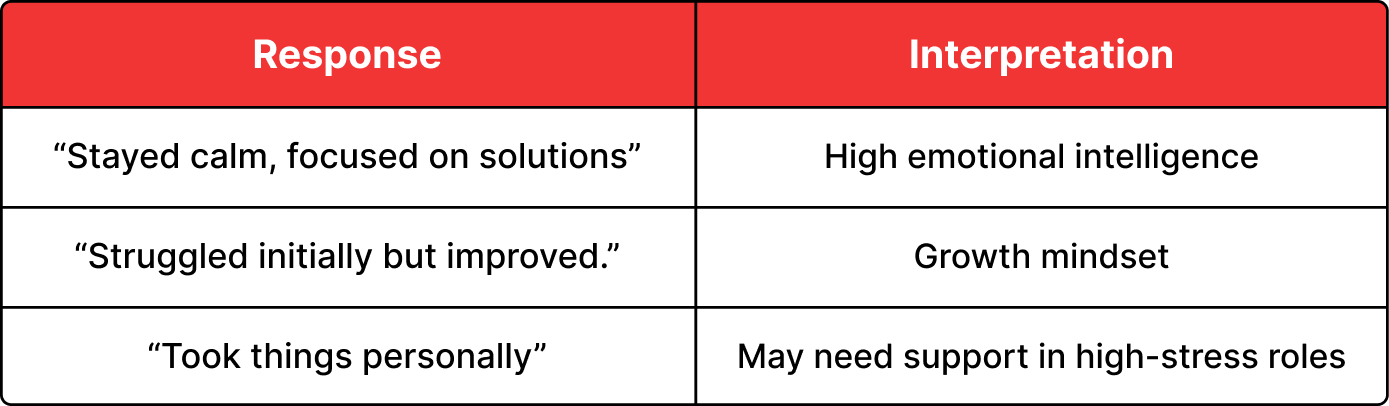
2. “How did the candidate handle stress or setbacks?”
Assesses resilience, problem-solving, and maturity—especially in high-pressure roles.
Common responses:
3. “Did they prefer solo work or team collaboration?”
Helps match the candidate to the right environment: startups, enterprise teams, or hybrid roles.
Pro Tip: There's no right answer—only fit for the role you’re hiring for.
Listen for:
- “Thrived in both settings” → Versatile and adaptable
- “Preferred working alone” → Best in focused, independent roles
- “Needed direction in teams” → May require hands-on management
When clients expect top-tier performance from day one, these questions give you a preview of what they’ll actually get.
It’s important to note that while technical expertise is essential, soft skills play a critical role in ensuring a candidate’s long-term success.
To explore why these skills matter so much in the hiring process, Read: The Importance of Soft Skills in the Hiring Process.
Assessing Communication and Relationship Building
Technical skills get candidates through the door. But communication and emotional intelligence keep them there. If a candidate can’t navigate feedback, collaborate with a team, or present ideas clearly, clients will notice fast.
Here’s how to dig deeper into their interpersonal game:
1. “How would you describe the candidate’s communication style?”
This isn’t just about public speaking. It’s about tone in emails, clarity in meetings, and confidence in updates.
Red flags:
- Struggles to explain ideas
- Frequently misunderstood by others
- Over-talks in group settings
Green flags:
- Communicates clearly and proactively
- Adjusts tone depending on the audience
- Known for “keeping everyone on the same page”
2. “How did they get along with peers and supervisors?”
You’re looking for emotional intelligence in action, especially in team-driven roles.
Instead of generic answers, listen for:
- “They were the go-to for cross-team collaboration.”
- “Trusted by both peers and leadership.”
- “Sometimes they isolate themselves from the team.”
Even subtle tension in past roles can hint at future cultural mismatches.
3. “Tell me about a time they handled conflict or received tough feedback.”
This is where things get real. Do they shut down? Get defensive? Or reflect and improve?
What you want to hear:
- A specific challenge
- A thoughtful response
- A shift in behavior or mindset afterward
Pro Insight: Candidates who’ve grown from hard feedback tend to thrive long term.
Strong communicators don’t just talk—they listen, adapt, and build trust. And that’s exactly what your clients expect when hiring for team-critical roles.
Next, let’s explore how to assess a candidate’s career journey, motivations, and long-term potential.
Understanding Career Progression and Motivation
Hiring the right candidate isn’t just about what they’ve done—it’s about why they’ve done it and where they want to go next. A candidate’s career trajectory speaks volumes about their work ethic, ambition, and whether they’re truly in it for the long haul.
Are they driven by growth? Do they learn from past experiences? Let’s uncover their motivations:
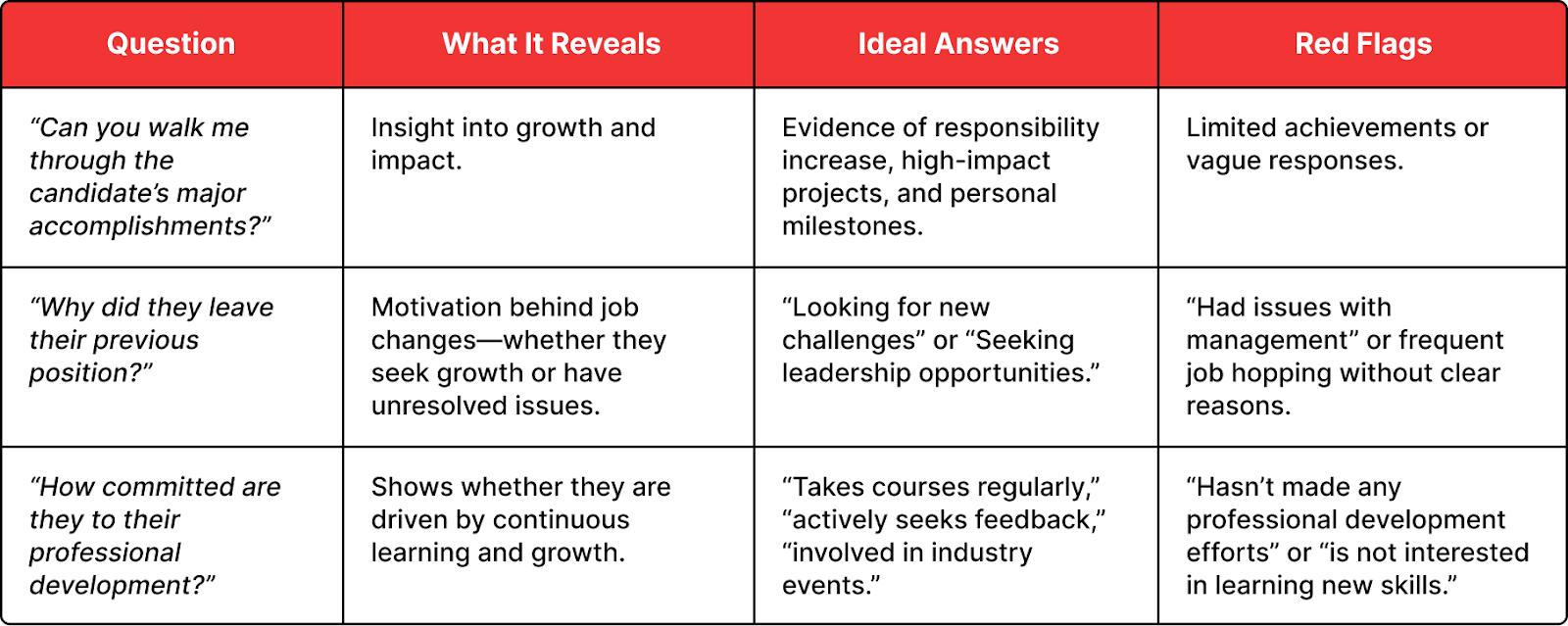
Alice Baker, a senior healthcare recruiter, shared an insightful experience about the importance of understanding a candidate’s career progression:

This experience serves as a reminder that career decisions reflect a candidate’s values and growth trajectory. It’s essential to consider not just where they’ve been, but also how those experiences shape where they’re headed. Are they ready to evolve with your clients' needs?
With these answers, you can wrap up your reference checks with the final, crucial insights that will help guide your hiring decision.
Concluding the Reference Check
The final steps in a reference check can often feel like the finishing touches on a puzzle. You’ve gathered key insights, but these closing questions help you ensure you’re getting the full picture of a candidate’s potential.
Here’s how to wrap it up with precision:
1. “Would you rehire the candidate?”
- What it reveals: The ultimate stamp of approval.
- Look for: A confident “yes” means they made a lasting positive impact.
- Red flag: If there’s hesitation or “only under specific conditions,” dig deeper.
2. “Do you have any additional insights about the candidate?”
- What it reveals: Uncover any lingering concerns or standout traits you might not have covered.
- Look for: Positive mentions of work ethic, leadership, or team spirit.
- Red flag: Any “hesitations” that didn’t come up earlier—maybe a subtle warning sign.
3. Open-ended follow-ups
- Examples: “What type of work environment do they thrive in?” or “How did they contribute to the company culture?”
- What it reveals: Gives you deeper insights into their potential fit.
- Look for: Alignment with your client’s culture and expectations.
By the time you reach these final questions, you’ve likely gathered the bulk of the information you need. These closing remarks, however, give you one last chance to ensure the candidate truly aligns with the role.
With these final steps, you can confidently wrap up the reference check, leaving no stone unturned.
Start Strong With Consultadd
With 15 years in business and 5,000+ successful staffing engagements, we don't just fill roles, we build reliability into your process. We've supported 65 staffing companies in the past year alone and maintain MSAs with industry leaders like Robert Half and TEKsystems.
Here's what working with Consultadd looks like:
- Talent sourced in under 24 hours
- Ready-to-deploy candidates, vetted for experience and compliance
- Lower turnover risk: we match long-term goals, not just short-term needs
- Seamless compliance: visa, documentation, onboarding? Handled.
- Dedicated 1:1 account managers for responsive, personalized support
- Top 100 candidate matches delivered in the past year
- Strong partnerships with universities to tap into fresh, committed talent
- Post-placement support so your investment grows beyond day one
For candidates, your next opportunity is more than just a job title, it's a chance to build skills, gain experience, and move your career forward. At Consultadd, we connect technology professionals with projects and employers that align with their goals, whether they're looking for contract, contract-to-hire, or long-term opportunities.
The tech job market moves fast, but the right guidance can make all the difference. Ready to take the next step in your career journey? Explore Opportunities >>
Key Takeaways
- Speak with former managers whenever possible.
- Use consistent questions for every candidate.
- Assess technical skills and cultural alignment together.
- Pay attention to vague answers and hesitations.
- End every reference check by asking if they'd rehire the candidate.
FAQs
1. Why are reference checks important in hiring?
Reference checks validate a candidate's experience, work ethic, communication skills, and overall performance, helping recruiters make more informed hiring decisions.
2. Who should recruiters contact for a reference check?
The best references are former managers or supervisors who directly oversaw the candidate's work and can provide detailed, objective feedback.
3. What are the most important reference check questions?
Ask about the candidate's responsibilities, strengths, reliability, teamwork, communication, ability to handle feedback, and whether the employer would hire them again.
4. What are common red flags during a reference check?
Vague responses, hesitation when discussing performance, inconsistent job responsibilities, concerns about reliability, or reluctance to rehire can all indicate potential hiring risks.
5. How do reference checks improve hiring outcomes?
They help reduce bad hires, improve candidate quality, lower turnover, strengthen client confidence, and increase long-term placement success.
.png)
From Skills Gap to Strategic Growth: Talent Mapping That Delivers
Introduction
The need to address the skills gap has never been more urgent. Research indicates that by 2030, there could be a shortage of more than 85 million skilled workers globally.
If left unaddressed, this gap may result in an annual loss of up to $8.5 trillion in revenue. This shows the critical need for effective talent mapping strategies.
In the present job market, talent mapping has become an essential strategy for overcoming this challenge. It is the process of identifying, assessing, and planning for the talent your business will need in the future.
Talent mapping helps you proactively create a talent pool for future roles, based on your company’s goals and anticipated needs.
For recruiters, talent mapping helps streamline the hiring process by providing a clear understanding of the available talent in the market. At the same time for candidates, it means better opportunities to be discovered by companies seeking specific skills.
In this blog, we will explore how proactive talent mapping can help organizations identify and address skill shortages, ensuring a solid and future-ready workforce.
TL;DR
- Talent mapping helps businesses prepare for future hiring needs.
- It identifies skill gaps and builds a pipeline of qualified candidates.
- Proactive workforce planning reduces hiring costs and time-to-hire.
- Regular updates and data-driven insights improve recruitment decisions.
- A strong talent mapping strategy creates a future-ready workforce.
What is Talent Mapping?
Talent mapping involves identifying, assessing, and strategically planning for the talent your business needs both now and in the future. Taking this proactive approach ensures businesses can anticipate and prepare for upcoming hiring needs.
Moreover, it goes beyond simply filling open positions by creating a strategy to attract and retain top talent. This process also enables businesses to plan ahead, ensuring they have qualified candidates when needed.
By continuously mapping talent, companies can stay ahead of the competition and avoid talent shortages.
Effective talent mapping helps businesses to recruit for hard-to-fill roles with a prepared, qualified candidate pool.
Given its importance in both recruitment and long-term workforce planning, it’s clear that talent mapping is vital. Let’s now explore why talent mapping is so crucial for businesses, and how it can elevate your hiring strategy.
Benefits of Talent Mapping
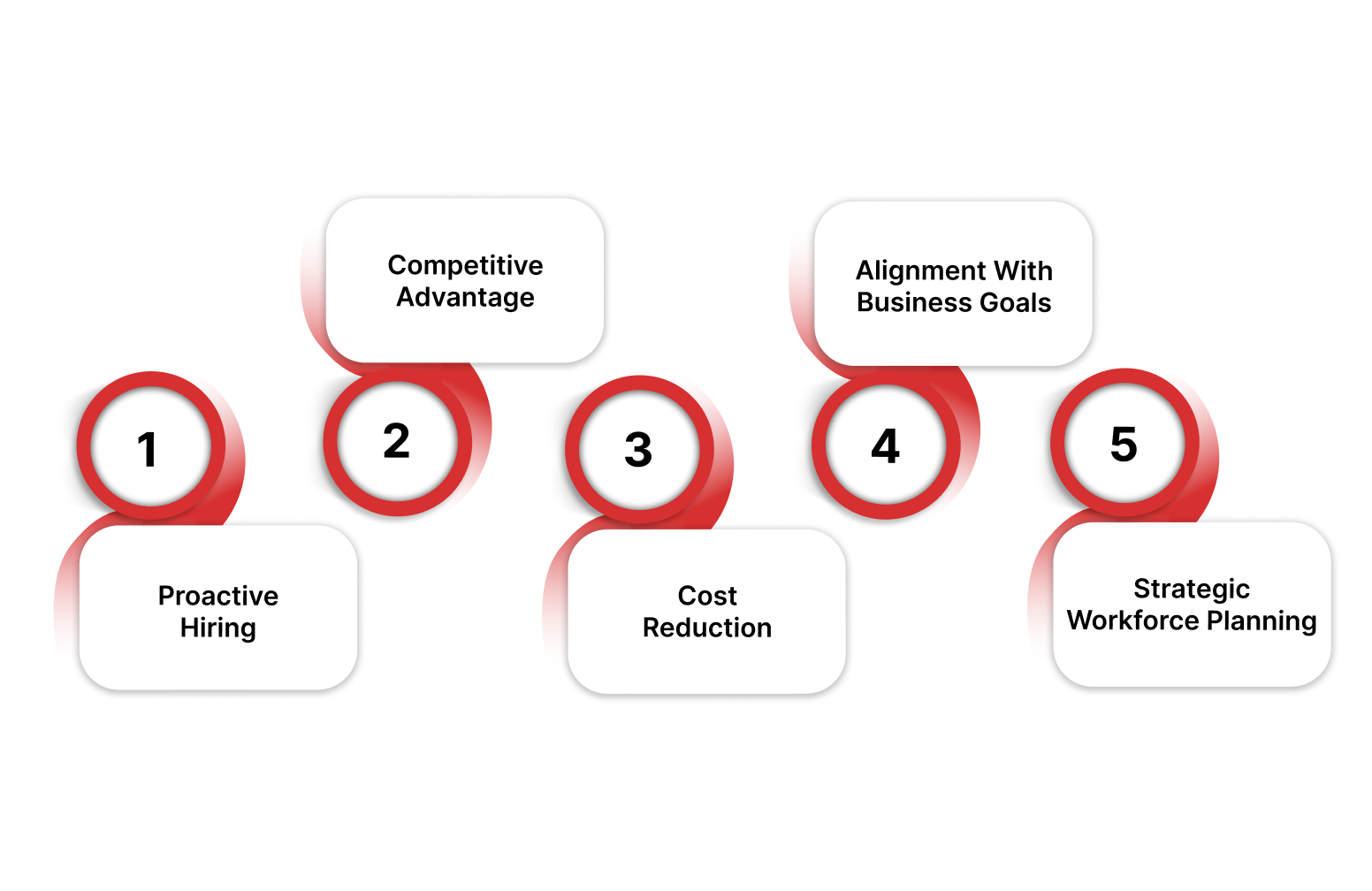
Talent mapping plays a crucial role in helping businesses stay ahead in a competitive job market. By anticipating future talent needs, organizations can build a strong foundation for long-term success.
Here’s why talent mapping is essential:
- Proactive Hiring: Talent mapping helps companies anticipate hiring needs before they arise, reducing delays.
- Competitive Advantage: It ensures businesses have access to the right skills at the right time, staying ahead of competitors.
- Cost Reduction: By identifying potential profiles early, talent mapping helps reduce recruitment costs and time-to-hire.
- Alignment with Business Goals: Talent mapping aligns recruitment strategies with long-term company objectives, ensuring the right talent fits.
- Strategic Workforce Planning: It enables organizations to plan for future talent needs, ensuring a smooth transition as roles evolve.
Now that we understand why talent mapping is so important, let’s dive into the key benefits it provides to businesses
Step-by-Step Guide to Successful Talent Mapping Implementation
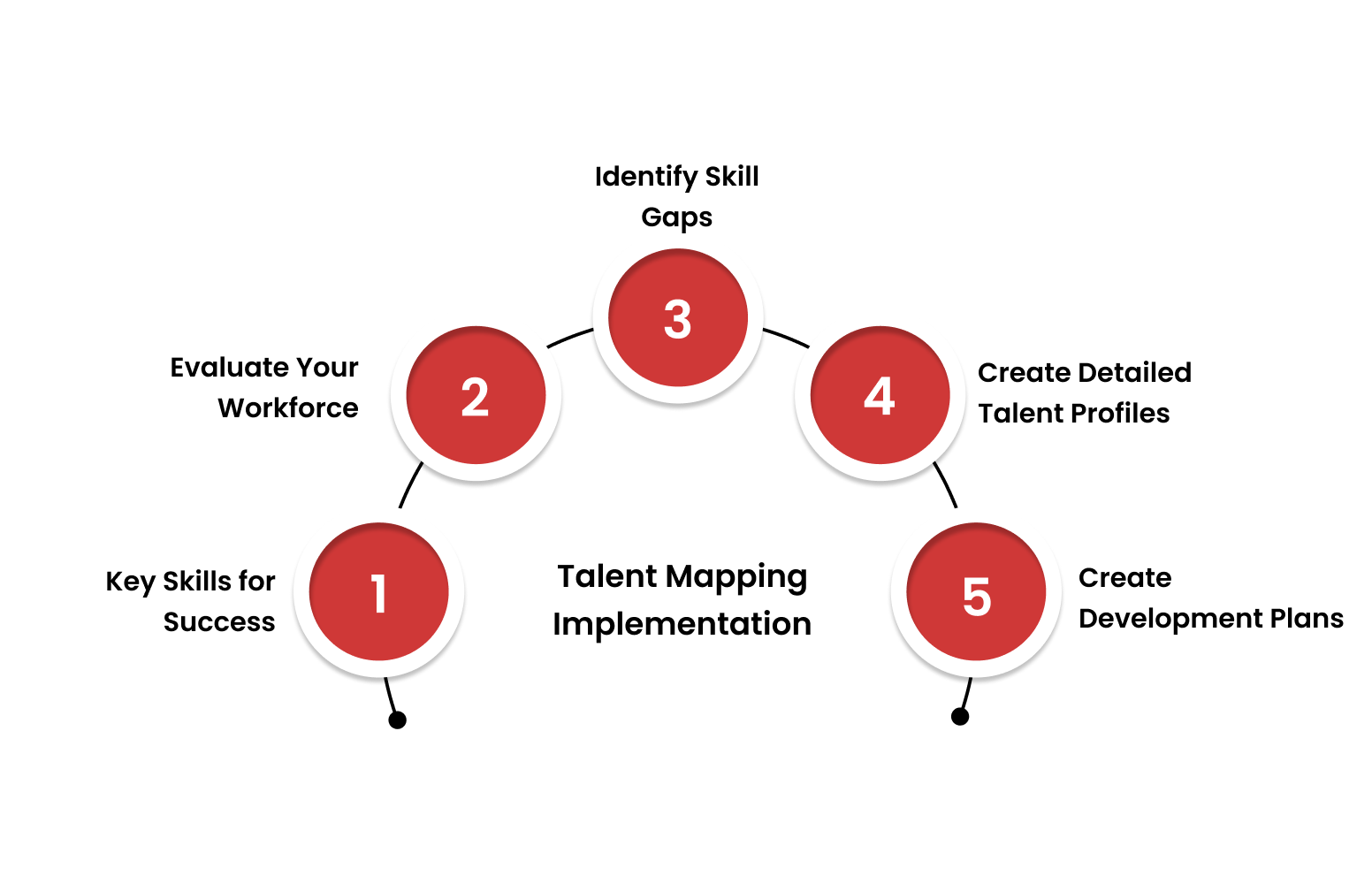
Implementing a talent mapping strategy involves several key steps that help organizations create a proactive hiring approach. By following a structured process, companies can efficiently identify, assess, and plan for the talent they will need in the future.
Here’s a step-by-step guide to successful talent mapping implementation:
1. Identify the Key Skills for Success
The first step in a solid talent mapping strategy is identifying the key skills required for your organization’s success. Collaborate with leadership and department heads to align on the strategic goals of the business and the competencies needed to achieve them.
This process goes beyond technical abilities, incorporating soft skills like communication, leadership potential, and adaptability. It is important to build a comprehensive skill set that will serve both your current and future needs.
Identifying and prioritizing these skills ensures that recruitment efforts are focused on candidates who can drive the organization’s growth.
You also need to assess the demand for these skills in the job market, as some may be harder to find, which will influence your hiring strategy.
As you identify critical skills, it’s essential to evaluate your current workforce to determine what talent you already have.
Let’s now look into how you can assess your current talent.
2. Evaluate Your Current Workforce
Evaluating your existing team’s skills is crucial for understanding both their capabilities and growth potential. Start by conducting performance reviews, skills assessments, and gathering feedback from managers and peers.
This assessment gives you insight into your top performers and areas where employees may need further development. You can also identify individuals who have the potential to step into higher-level roles in the future.
Additionally, this step also helps you identify skill gaps within your organization. It provides a clear picture of where the organization stands in terms of talent. So it tells you whether you need to invest in development or external recruitment.
After assessing your current workforce, the next step is identifying where the skill gaps exist. Let’s look at how to pinpoint these gaps.
3. Identify Skill Gaps Within the Organization
After evaluating your workforce, the next logical step is identifying where skill gaps exist. This process involves comparing the current skills of your employees with the critical skills required by the business.
The gaps could be specific to roles, departments, or even across the organization. It’s important to analyze areas where skills shortages could hinder business performance or delay projects.
This step helps focus recruitment efforts and employee training on the most critical needs. By addressing skill gaps, your organization becomes better prepared to adapt to future challenges and industry trends.
Once you’ve identified where gaps exist, you can now create detailed talent profiles to better understand the capabilities of your team.
We’ll now explore how talent profiles can aid in decision-making.
4. Create Detailed Talent Profiles
Building detailed talent profiles for your employees and potential candidates is key for long-term workforce planning. This involves collecting data about their career aspirations, skill sets, and experiences.
Talent profiles should go beyond resumes, including feedback from performance reviews, skills assessments, and even career goals. By creating comprehensive profiles, you can better identify the strengths and areas for development in your workforce.
These profiles also help with succession planning, ensuring that your business has the right talent for future leadership roles.
Furthermore, talent profiles allow you to track employee progress. This makes it easier to design development programs to individual needs.
As you create talent profiles, the next step is to develop individual growth plans for your employees. You’ll now see how to build these plans.
5. Develop Individual Development Plans
Once you have assessed the skills and career goals of your employees, it’s time to develop individual development plans. These plans should be tailored to address the specific skill gaps identified earlier while supporting employees’ career aspirations.
A well-rounded development plan can include on-the-job training, mentorship, workshops, and online courses.
This approach ensures employees are continually growing and improving their skills.
Regularly reviewing and updating these plans keeps them relevant and aligned with both personal and company goals.
Finally, after establishing development plans, it's important to assess how the overall talent mapping strategy aligns with your business objective.
Next, let’s explore some of the common challenges businesses face when implementing this strategy.
Common Challenges in Talent Mapping
Talent mapping can significantly improve your recruitment strategy, but it isn’t without challenges. Here are some common obstacles organizations face when implementing talent mapping:
- Gathering Accurate Data: Obtaining reliable and up-to-date information about potential candidates can be difficult.
- Engaging Passive Candidates: Finding and connecting with candidates who aren’t actively job hunting can be a challenge.
- Aligning Talent Maps with Business Needs: Adapting talent maps to rapidly changing business priorities or market conditions is often tough.
- Maintaining Up-to-Date Talent Maps: Continuously updating your talent pool to reflect current and future needs can be time-consuming.
By treading through these hurdles effectively, you can ensure an effective talent mapping process. We’ll next provide some practical insights to achieve this.
Best Practices for Effective Talent Mapping
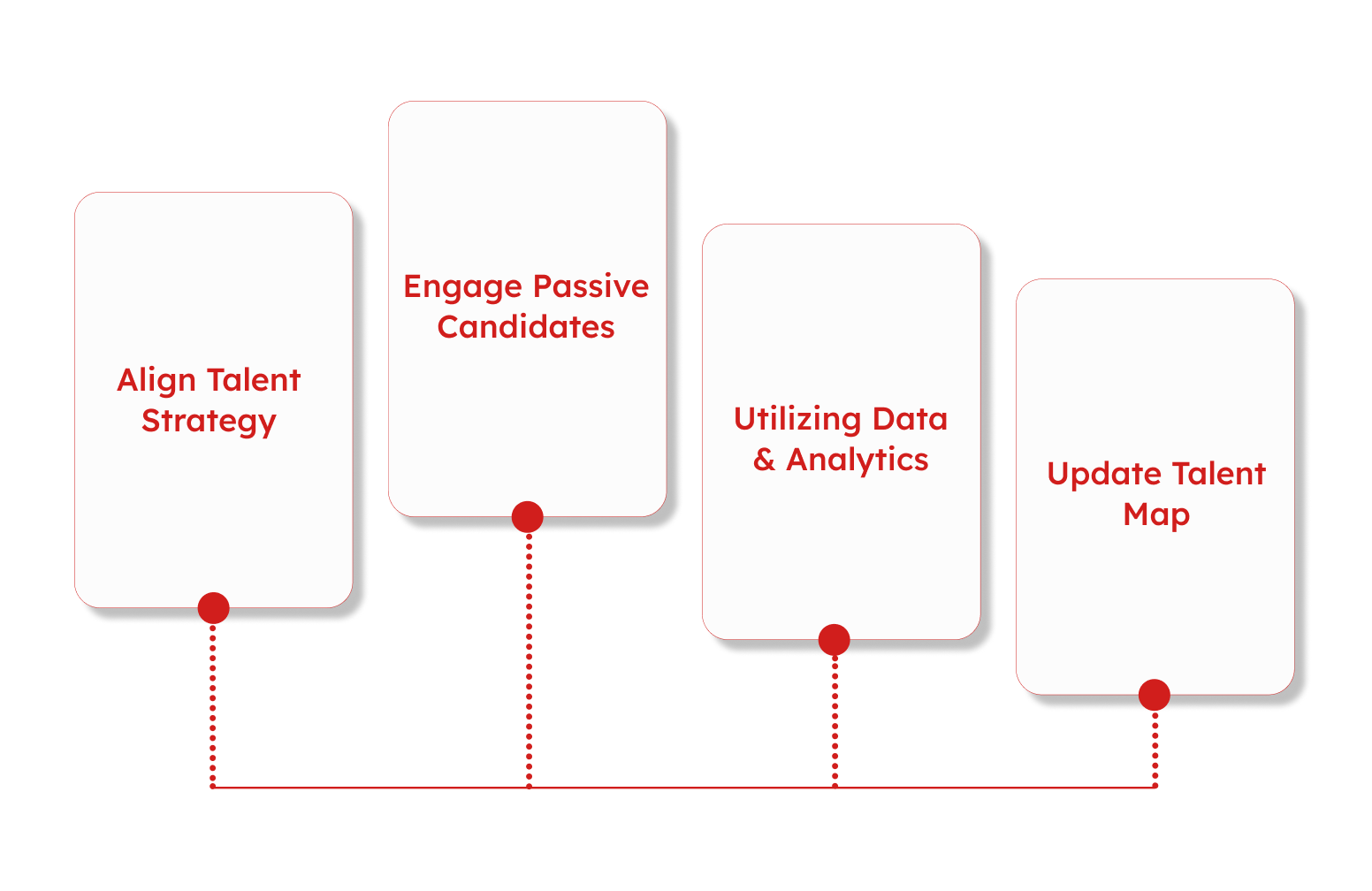
To ensure that talent mapping works effectively, it’s important to follow proven best practices. These strategies help overcome common challenges and optimize the process of identifying and engaging top talent.
So here are some effective practices to follow:
- Align Talent Mapping with Business Goals: Aligning with business goals ensures focused recruitment that supports company growth and objectives.
- Build and Nurture Relationships with Passive Candidates: Engaging with passive candidates keeps your talent pool active and ready for future opportunities.
- Utilizing Data and Analytics: Using data helps track trends, skill shortages, and hiring patterns, allowing for proactive recruitment.
- Update Your Talent Map Regularly: Regular updates ensure your talent map remains relevant and aligned with market trends and business needs.
Implementing these strategies is key to successful talent mapping, and Consultadd helps optimize your recruitment process at every stage. Take a look here to learn how we can streamline your hiring and connect you with top talent! You’ll now see how Consultadd is revolutionizing talent mapping and making it more effective for companies.
Start Strong With Consultadd
With 15 years in business and 5,000+ successful staffing engagements, we don't just fill roles, we build reliability into your process. We've supported 65 staffing companies in the past year alone and maintain MSAs with industry leaders like Robert Half and TEKsystems.
Here's what working with Consultadd looks like:
- Talent sourced in under 24 hours
- Ready-to-deploy candidates, vetted for experience and compliance
- Lower turnover risk: we match long-term goals, not just short-term needs
- Seamless compliance: visa, documentation, onboarding? Handled.
- Dedicated 1:1 account managers for responsive, personalized support
- Top 100 candidate matches delivered in the past year
- Strong partnerships with universities to tap into fresh, committed talent
- Post-placement support so your investment grows beyond day one
For candidates, your next opportunity is more than just a job title, it's a chance to build skills, gain experience, and move your career forward. At Consultadd, we connect technology professionals with projects and employers that align with their goals, whether they're looking for contract, contract-to-hire, or long-term opportunities.
The tech job market moves fast, but the right guidance can make all the difference. Ready to take the next step in your career journey? Explore Opportunities >>
Key Takeaways
- Plan hiring before talent shortages arise.
- Identify and close organizational skill gaps.
- Build detailed talent profiles for future roles.
- Align recruitment with business objectives.
- Continuously update talent maps using market data.
FAQs
1. What is talent mapping?
Talent mapping is the process of identifying, assessing, and planning for current and future workforce needs by building a pipeline of qualified candidates aligned with business goals.
2. Why is talent mapping important?
It helps organizations reduce hiring delays, address skill shortages, improve workforce planning, lower recruitment costs, and stay competitive in a changing job market.
3. How do you implement a talent mapping strategy?
Start by identifying critical skills, evaluating your current workforce, analyzing skill gaps, creating talent profiles, developing employee growth plans, and regularly updating your talent map.
4. What are the biggest challenges in talent mapping?
Common challenges include collecting accurate talent data, engaging passive candidates, adapting to changing business priorities, and keeping talent maps up to date.
5. What are the best practices for effective talent mapping?
Align talent mapping with business goals, leverage data and analytics, maintain relationships with passive candidates, and regularly refresh your talent pool to meet evolving hiring needs.