
Industry Insights

Most Wanted Skills You Should Know in Skills-Based Hiring
Introduction
You’re tired of sending candidates who look great on paper, only to fall flat in interviews. Your clients expect speed, precision, and people who can do the job from day one.
But here’s the truth: job titles and degrees don’t prove ability. They don’t tell you who can thrive in a high-pressure DevOps sprint or lead a full-stack deployment remotely.
That’s why skills-based hiring is revolutionizing the way we approach hiring. It prioritizes proven skills over polished resumes, and it’s helping staffing pros deliver stronger matches, faster.
LinkedIn shows that a skills-based talent pool, candidates with at least 50% overlap in key skills from recent roles, uncovers hidden talent. Moreover, these candidates often outperform those with traditional backgrounds, proving skills matter more than titles.
For hiring managers, this is a game-changer. Fewer mis-hires. Faster placements. Clients who trust your judgment. And it gets better: this approach opens access to a broader, more diverse talent pool that’s ready to hit the ground running.
Let’s dive into skills-based hiring and skills that matter most when ability, not credentials, is the new currency of hiring.
TL;DR
- Skills-based hiring focuses on proven abilities rather than degrees, job titles, or traditional career paths.
- Prioritizing skills improves hiring accuracy, reduces mis-hires, and helps recruiters fill roles faster.
- Employers increasingly value communication, problem-solving, adaptability, leadership, AI literacy, and continuous learning alongside technical expertise.
- This hiring approach expands access to diverse talent while improving long-term employee performance and retention.
- Consultadd helps staffing agencies hire skilled, pre-vetted professionals who are ready to contribute from day one.
What Is Skills-Based Hiring?

It’s a hiring approach that focuses on what candidates can do, not where they’ve been.
- Evaluates practical skills over formal credentials
- Prioritizes hands-on ability over resume polish
- Embraces non-linear career paths and unconventional talent
It’s not just a trend, it’s a performance strategy that works.
If you're curious about how this approach is shaping the workforce of tomorrow, check out our blog on Redefining the Future Workforce with Skills-Based Hiring.
Why This Matters Now
- Speed-to-hire is everything. You can’t afford misfires.
- Clients expect proof of capability, not just years of experience.
- Top candidates are skipping traditional roles for contract and gig work; they’re skills-first.
- More inclusive hiring broadens your talent reach and reduces bias.
Therefore, skills-based hiring builds a bridge between real-world capability and real-time demand. Let’s understand the top skills valued in skills-based hiring.
1. Core Competence in Communication Skills
Every hiring manager knows the pain of placing a technically sound candidate who fails to connect.
A lack of communication skills can sink even the strongest resume and cost you a client’s trust.
That’s why communication isn’t soft; it’s mission-critical in a skills-based hiring model.
Why Communication Skills Matter More Than Ever
Hybrid teams. Cross-functional roles. High-stakes deliverables. Clear communication drives performance across every setting.
Top communication traits in demand:
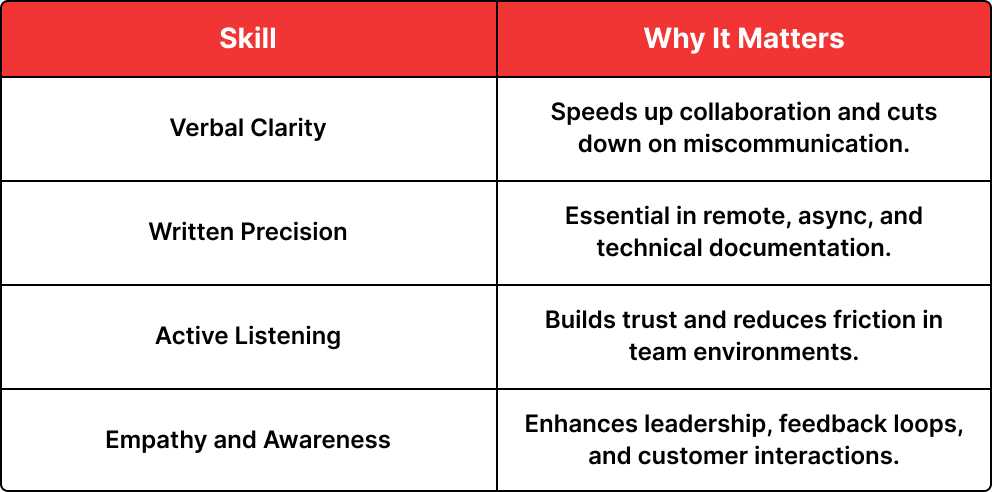
The best communicators aren’t always extroverts. They’re people who train intentionally:
- Practice summarizing complex topics in simple terms.
- Use frameworks like STAR for interview communication.
- Get feedback from peers on tone and clarity.
Great communicators aren’t born, they’re built. And they shine in high-stakes roles.
2. Proficiency in Problem Solving and Critical Thinking
You’ve seen it: a great resume crumbles in real-world chaos without critical thinking behind it.
That’s why this skill is no longer optional. It’s the engine of real impact on the job.
Which Skills Demonstrate Problem-Solving and Critical Thinking
Hiring technical talent is only half the equation. What separates a good hire from a great one?
They can analyze, prioritize, and take action when no script exists.
Here are the problem-solving and critical thinking skills that today’s roles demand:
- Analytical thinking: Candidates must break down complex issues into manageable parts.
- Decision-making under pressure: Confidence in high-stakes situations shows maturity and competence.
- Root cause analysis: Solving the problem, not just treating the symptom, is what clients value most.
- Strategic foresight: Looking beyond the immediate fix to consider long-term implications.
- Innovation: Thinking creatively when standard approaches don’t work.
Candidates with these skills don’t just “fit the job”, they move the business forward.
3. Importance of Teamwork and Collaboration
The best talent doesn’t just get the job done; they bring people together to do it better.
In an age of cross-functional teams, remote schedules, and rapid-fire deliverables, solo stars won’t cut it.
Clients want professionals who can seamlessly integrate into any team, establish trust quickly, and advance the mission forward.
Here’s what sets high-performing team players apart:
Emotional Intelligence on the Job
- They read the room, even on Zoom.
- Understand dynamics, personalities, and unspoken expectations.
Collaboration Without Micromanagement
- Share ownership while driving results.
- Deliver without constant oversight or drama.
Project Scoping and Independent Execution
- Break big goals into small wins.
- Stay on track, on time, and within brief even when flying solo.
Contract-Ready Mindset
- Confidently jumping into short-term projects.
- Thrive in high-speed, high-impact environments.
Strong collaborators multiply results. They raise the standard of work across entire teams without needing the spotlight.
Also, team success isn’t just about skills; it’s also about fit. Cultural alignment can be the difference between thriving teams and constant friction. Understand why cultural fit transforms hiring in our blog: How Cultural Fit Transforms Hiring Outcomes.
4. Self-Management and Accountability
Top talent thrives when given space but also takes charge without being told twice.
Hiring managers want professionals who deliver results independently and with focus.
Mastering Time and Priorities
- Set clear goals and hit deadlines without hand-holding.
- Balance urgent tasks with long-term projects effortlessly.
Initiative That Moves Projects Forward
- Spot gaps and act before issues escalate.
- Bring ideas to the table, not just execute orders.
Measurable Productivity
- Show consistent output even in flexible or remote setups.
- Use tools and habits that track progress and maintain momentum.
Taking Ownership
- Own mistakes and learn quickly from feedback.
- Build trust through reliability and transparent communication.
Self-managed professionals lighten the burden on teams, fueling faster, smarter hiring.
Need candidates who take ownership from day one? Consultadd delivers pre-vetted professionals who are not only technically sound but also self-managed and reliable. We handle all the back-end compliance, visas, and benefits so you can deliver results without the admin drag.
5. Adaptability and Flexibility in the Workplace
Change is the only constant, and top talent not only copes but thrives in it.
Therefore, focus on candidates who adjust quickly without losing momentum or focus. Adaptability transforms talent into reliable partners who power success in every assignment.
6. Emphasis on Leadership Skills
Leadership is more than a title; it’s the force that drives teams to win.

Malcolm Forbes, the publisher of Forbes magazine, built his empire by surrounding himself with high-performing individuals and leaders. He said,
“Never hire someone who knows less than you do about what he’s (or she’s) hired to do.”
Forbes believed in hiring people smarter than himself, those who could lead, not follow. He credited this philosophy with his long-term success.
Therefore, strong leaders inspire, solve problems, and create spaces where talent excels.
7. Transferable and Cross-Functional Competencies
- Transferable skills are the core strengths that fit any role, such as problem-solving or clear communication.
- Cross-functional competencies bridge departments and teams, like collaboration, leadership, and adaptability.
Candidates can quickly place talent in varied roles without waiting for exact experience matches.
These skills future-proof careers candidates who adapt and bring ongoing value. They reduce friction in teams, boosting productivity and innovation.
Scaling teams across functions or geographies? Consultadd keeps your pipeline full with high-demand, ready-to-deploy talent. From relocation and visa support to 401(k) and insurance, we simplify hiring at every level—so you can scale without the stress.
8. AI Literacy and Emerging Tech Skills
Talent fluent in AI and emerging technologies is no longer optional; it’s essential.

9. Continuous Learning and Upskilling
Remember, in a world where change is the only constant, talent that never stops learning becomes the ultimate winner.
Here are the skills that set them apart:
1. Curiosity Fuels Innovation
Lifelong learners don’t just ask, they explore. Their drive for knowledge sparks ideas and turns challenges into breakthroughs.
2. Adaptability is a Superpower
When the world shifts, they don’t follow, they lead. Quick to adjust and ready to act, they keep moving forward.
3. Growth Mindset Powers Progress
Mistakes aren’t failures, they’re fuel. Every challenge is an opportunity to learn, grow, and emerge stronger.
Continuous learners stand out, but smart reference checks confirm whether that curiosity translates into real growth on the job. Discover the most effective reference questions in our blog: Smart Reference Questions to Make Better Hiring Decisions.
10. Ethical Awareness and Sustainable Thinking
The smartest hires today don’t just think fast; they think responsibly. You need candidates who lead with integrity, care about the planet, and make decisions with long-term impact in mind.
Candidates with strong ethical and sustainability mindsets don’t just avoid risks; they build trust, shape culture, and future-proof your clients’ teams.
Here’s what you should look for:

These aren’t “nice to have” traits anymore; they’re becoming baseline expectations in most forward-thinking organizations.
Start Strong With Consultadd
With 15 years in business and 5,000+ successful staffing engagements, we don't just fill roles, we build reliability into your process. We've supported 65 staffing companies in the past year alone and maintain MSAs with industry leaders like Robert Half and TEKsystems.
Here's what working with Consultadd looks like:
- Talent sourced in under 24 hours
- Ready-to-deploy candidates, vetted for experience and compliance
- Lower turnover risk: we match long-term goals, not just short-term needs
- Seamless compliance: visa, documentation, onboarding? Handled.
- Dedicated 1:1 account managers for responsive, personalized support
- Top 100 candidate matches delivered in the past year
- Strong partnerships with universities to tap into fresh, committed talent
- Post-placement support so your investment grows beyond day one
For candidates, your next opportunity is more than just a job title, it's a chance to build skills, gain experience, and move your career forward. At Consultadd, we connect technology professionals with projects and employers that align with their goals, whether they're looking for contract, contract-to-hire, or long-term opportunities.
The tech job market moves fast, but the right guidance can make all the difference. Ready to take the next step in your career journey? Explore Opportunities >>
Key Takeaways
- Hire for capability, not credentials: Skills-based hiring evaluates what candidates can actually do, leading to stronger hiring decisions and better job performance.
- Balance technical and human skills: Communication, collaboration, critical thinking, leadership, accountability, and adaptability are essential for long-term success.
- Prepare for the future of work: AI literacy, cross-functional competencies, and continuous upskilling are becoming must-have skills across industries.
- Improve hiring outcomes: Skills-first recruitment reduces bias, broadens talent pools, accelerates hiring, and increases retention.
- Partner with experts: ConsultAdd delivers thoroughly vetted professionals with validated technical and workplace skills, helping staffing agencies make faster, higher-quality placements.
FAQs
What is skills-based hiring?
Skills-based hiring is a recruitment approach that evaluates candidates based on their demonstrated skills, competencies, and ability to perform the job rather than relying primarily on degrees, job titles, or years of experience.
Why is skills-based hiring becoming more popular?
Organizations are adopting skills-based hiring because it improves hiring quality, reduces talent shortages, expands access to qualified candidates, minimizes hiring bias, and better predicts on-the-job performance.
Which skills are most important in skills-based hiring?
The most valuable skills include communication, critical thinking, problem-solving, teamwork, adaptability, leadership, accountability, AI literacy, continuous learning, and ethical decision-making, alongside role-specific technical expertise.
How can recruiters assess skills instead of relying on resumes?
Recruiters can use practical assessments, technical tests, structured interviews, portfolio reviews, work samples, behavioral interview questions, and reference checks to validate a candidate's real-world capabilities.
How does Consultadd support skills-based hiring?
Consultadd provides pre-screened tech professionals whose technical expertise, workplace competencies, and compliance requirements are thoroughly validated, enabling staffing agencies to hire faster, reduce turnover, and deliver stronger client outcomes.

Why Do Hiring Processes Take So Long? 10 Key Reasons
Introduction
You’ve got a role to fill, a client waiting, and inboxes full of resumes that go nowhere.
Sometimes, candidates vanish after the first call. At other times, the process drags on until the right one is already off the market.
Sound familiar? You're not alone.
Globally, it takes an average of 44 days to fill a position. Yet top candidates? They’re gone in just 10. That gap isn’t just frustrating, it’s expensive.
When hiring stalls, so does momentum. Deadlines slip. Clients get anxious. And hiring managers are left playing catch-up.
But long hiring cycles aren’t always about inefficiency. Often, they’re built into the system.
Let’s take a closer look at what’s really slowing things down.
TL;DR
- Lengthy hiring processes are caused by inefficient screening, excessive interview rounds, internal approvals, and unclear hiring requirements.
- Delays increase the risk of losing top candidates, damaging client relationships, and extending time-to-fill.
- Streamlining screening, simplifying interviews, improving coordination, and setting realistic job requirements accelerate hiring.
- Better communication, faster decision-making, and data-driven recruitment reduce bottlenecks throughout the hiring process.
- Specialized staffing partners help organizations shorten hiring cycles by providing pre-vetted talent and handling compliance efficiently.

1. Early-Stage Screening Inefficiencies
Hiring often gets stuck before it even starts moving. At the top of the funnel, where speed and precision matter most, small inefficiencies snowball into weeks of delays. This is where you lose time and energy on things you shouldn’t have to.
Wasting Time on Unqualified Candidates
- Most applicant pools are noisy and chaotic.
- Hours spent chasing candidates who look good on paper but miss the mark.
Screening Based on Guesswork
- Without a solid process, screening becomes a gamble.
- Resumes get skimmed, not studied. Decisions happen on gut feel.
Noisy Tools, Missed Talent
- Automated filters often exclude great candidates.
- Meanwhile, polished but underqualified profiles keep rising to the top.
Manual Reviews Burn Momentum
- Reviewing every resume from scratch slows things down.
- There’s little consistency in what qualifies as a “yes.”
2. High Volume of Applicants
More candidates used to feel like a win. Now, it feels like drowning in noise. Too many resumes. Too little time. And often, the best talent disappears while you’re still sorting.
- Resume Overload Eats Time: Hundreds of applications per role make screening impossible to do well or fast. You lose valuable hours in the pile.
- Shiny Profiles, Weak Skills: Looks can be deceiving. Stylish resumes often hide missing experience or mismatched priorities.
- Great Candidates Get Missed: Strong talent doesn’t always look perfect on paper. They fall through the cracks when you're skimming fast.
- Response Times Get Slower: The more resumes, the longer it takes to reply. Top candidates walk away while you’re still reading.
- Every Delay Costs You Placements: Time-to-submit becomes time-to-lose. Faster firms win simply by showing up first.
Pro Tip: A curated, pre-vetted shortlist beats 200 raw resumes every time. Quality saves time and wins trust.
3. Multiple Interview Rounds & Complex Assessments

Richard Branson, founder of The Virgin Group, shares a powerful lesson:
“Clients do not come first. Employees come first. If you take care of your employees, they will take care of the clients.”
This mindset transforms how we approach interviews.
When interviews become a drawn-out process, top talent slips through the cracks and if you don’t show you care from the start, the best candidates won’t stick around to care about your clients.
Here’s what’s really slowing you down and what it’s costing you:

Long interview processes can cause candidates to lose interest. Consultadd helps streamline this by presenting pre-vetted candidates ready for fast interviews, cutting down on unnecessary rounds and speeding up the hiring process.
Remember, minimum interview rounds, that’s the best.
4. Key Decision-Makers Unavailable or Unresponsive
Even the best recruitment process can stall when key people go off the radar.
Vacations, Illness, or Shifting Priorities
- Decision-makers often disappear during critical phases.
- Priorities shift with business needs and recruitment gets pushed aside.
- Candidates lose interest when updates take too long.
Always confirm availability of approvers before interviews begin.
Approval and Feedback Bottlenecks
- Offers wait in queues while leaders “circle back.”
- Feedback is delayed, inconsistent, or incomplete.
- Top candidates accept faster offers elsewhere.
Use a shared tracker for post-interview decisions to keep everyone aligned.
5. Overly Rigid or Complex Job Requirements
Job descriptions should attract talent not scare them off before they apply.
Narrow Criteria Shrink the Talent Pool
- Requiring 10 years’ experience for a mid-level role? You’re filtering out great potential.
- Niche tech stacks limit reach and good developers adapt fast.
- Candidates self-reject if the checklist feels unrealistic.
Pro Tip: Aim for core skills and train for the rest.

Prioritize traits that predict success, not just what's easy to list.
6. Internal Bureaucracy and Red Tape
Speed matters in recruitment but internal processes often bring things to a grinding halt.
- Background checks can’t be rushed, but manual processes drag things out.
- Legal, finance, or HR often work in silos leading to missed handoffs.
Multi-Step Approvals Slow Everything

Pro Tip: Empower key decision-makers with pre-approved hiring workflows.
7. Delays in Reference Checks
Waiting on references can feel like hitting a brick wall.

One way to streamline this stage is by asking the right questions during reference checks. If you’re unsure where to start, check out our blog, ‘Smart Reference Questions to Make Better Hiring Decisions,’ to learn how the right questions can speed up the process and lead to better, more informed hires.
8. Changing Role Definitions or Budget Constraints Mid-Process
When role expectations shift or budgets tighten mid-hiring, it feels like chasing a moving target. This uncertainty drains energy, stalls momentum, and tests even the sharpest staffing pros.
Evolving Role Expectations
- Business priorities change, shifting job requirements unexpectedly.
- New skills or duties pop up after the search begins.
Result? Time lost and candidates left confused or disengaged.
Budget Constraints Tightening
- Market pressures can shrink budgets without warning.
- Salary bands get slashed, perks cut, or roles restructured midstream.
The fallout? Risk of losing top talent or dragging out negotiations.
When roles change or budgets are delayed, it can disrupt the hiring flow. Consultadd ensures you're always ready with a pipeline of qualified candidates, allowing you to adapt quickly without missing out on top talent.
9. Poor Interview Scheduling and Coordination
Scheduling interviews may seem simple, but missteps here cause ripple effects.
Missed slots, last-minute cancellations, and clashing calendars sap energy and slow momentum.
This frustrates everyone from hiring managers to candidates.
Here why:
- Back-and-forth emails cause confusion and delays.
- Time zone mismatches lead to missed interviews.
- Unclear instructions create candidate anxiety.
- Overlapping interviews overwhelm hiring teams.
10. Lack of Clear Decision-Making or Unrealistic Expectations
When clarity fades and expectations soar beyond reach, recruitment stalls and frustration mounts.
This disconnect drains confidence and stalls progress, even for the sharpest staffing pros.

If you are grappling with these very challenges, partnering with a staffing agency can be a game-changer. Our blog, “Should You Use a Staffing Agency for Tech Roles? A Candid Breakdown” provides a clear answer to that question and why many firms turn to us when facing the complexities of tech hiring.
Start Strong With Consultadd
With 15 years in business and 5,000+ successful staffing engagements, we don't just fill roles, we build reliability into your process. We've supported 65 staffing companies in the past year alone and maintain MSAs with industry leaders like Robert Half and TEKsystems.
Here's what working with Consultadd looks like:
- Talent sourced in under 24 hours
- Ready-to-deploy candidates, vetted for experience and compliance
- Lower turnover risk: we match long-term goals, not just short-term needs
- Seamless compliance: visa, documentation, onboarding? Handled.
- Dedicated 1:1 account managers for responsive, personalized support
- Top 100 candidate matches delivered in the past year
- Strong partnerships with universities to tap into fresh, committed talent
- Post-placement support so your investment grows beyond day one
For candidates, your next opportunity is more than just a job title, it's a chance to build skills, gain experience, and move your career forward. At Consultadd, we connect technology professionals with projects and employers that align with their goals, whether they're looking for contract, contract-to-hire, or long-term opportunities.
The tech job market moves fast, but the right guidance can make all the difference. Ready to take the next step in your career journey? Explore Opportunities >>
Key Takeaways
- Improve candidate screening: Use structured evaluation methods and pre-qualified talent pools to reduce time spent reviewing unsuitable applicants.
- Reduce hiring delays: Limit interview rounds, speed up approvals, and improve scheduling to keep candidates engaged.
- Write realistic job descriptions: Focus on essential skills instead of overly restrictive requirements that shrink the talent pool.
- Strengthen internal collaboration: Align hiring managers, recruiters, HR, and decision-makers to eliminate approval bottlenecks.
- Optimize every hiring stage: Track delays in reference checks, scheduling, and feedback to continuously improve time-to-hire.
FAQs
Why do hiring processes take so long?
Hiring delays are commonly caused by inefficient resume screening, high application volumes, multiple interview rounds, slow approvals, reference checks, changing job requirements, and scheduling conflicts.
How can companies shorten their hiring process?
Organizations can reduce hiring time by streamlining screening, limiting interview rounds, improving communication, automating repetitive tasks, setting clear job requirements, and accelerating decision-making.
What are the biggest bottlenecks in recruitment?
Common bottlenecks include unqualified applicant volumes, delayed feedback from hiring managers, lengthy reference checks, internal bureaucracy, complex approval workflows, and interview scheduling issues.
How do long hiring processes affect businesses?
Extended hiring cycles increase recruitment costs, reduce candidate engagement, cause top talent to accept competing offers, delay project delivery, and weaken client confidence.
How can staffing agencies help reduce hiring delays?
Staffing agencies speed up recruitment by providing pre-vetted candidates, managing sourcing, handling compliance and documentation, coordinating interviews, and maintaining talent pipelines that reduce time-to-fill.

Redefining the Future Workforce with Skills-Based Hiring
Introduction
You already know that in today’s market, the best talent doesn’t always come with the best-looking resume. So why are degrees still your first filter?
Skills-based hiring prioritizes what candidates can do, not just what they’ve studied. By focusing on capabilities, not credentials, you tap into a wider and more agile talent pool.
McKinsey finds that skill-based hiring can lead to five times better performance than education-based hiring and twice as effective as hiring based on past work experience. That means more potential matches for the roles.
This shift is more than a trend; it’s a more innovative, faster way to meet client demands. It prioritizes performance over pedigree and gives overlooked talent a real shot at shining.
Let’s explore how skills-based hiring is changing the game.
TL;DR
- Skills-based hiring focuses on candidates' abilities rather than degrees, helping organizations access larger and higher-quality talent pools.
- Employers are increasingly removing degree requirements and prioritizing proven skills to improve hiring speed and business performance.
- A skills-first approach promotes diversity, reduces hiring bias, and creates fairer opportunities for qualified candidates.
- Companies that invest in skill validation, upskilling, and talent development build stronger long-term workforces.
- Combining skills assessments with technology and strategic staffing partners leads to faster placements and better hiring outcomes.
Growing Trend and Adoption of Skills-Based Hiring

The rules of hiring are changing fast. Here’s how skills-based hiring is becoming the path forward:
1. Labor Market Pressure Is Driving Change
With high demand and scarce talent, employers are ditching rigid requirements to widen their options.
They’re choosing agility over tradition, and it’s paying off in better matches and faster hires.
2. Employers Are Dropping Degree Requirements
The shift is happening across industries:
- IBM, Google, and Bank of America no longer require degrees for many roles.
- 81% of employers say they now prioritize skills over education when screening talent.
This isn't a trend; it’s the reality of new hiring.
3. Job Ads Are Reflecting the Shift
More job descriptions are ditching degree filters:
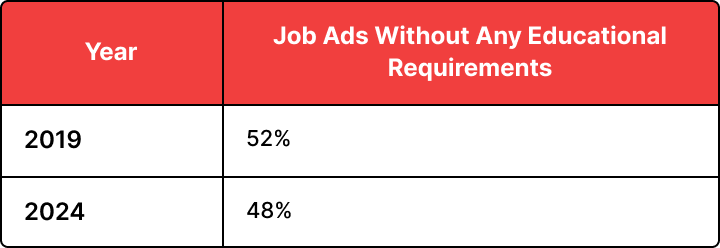
That’s a steady rise, giving staffing teams like yours more flexibility to pitch truly qualified talent.
4. Skills-Based Hiring Is Scaling Globally
Hiring for skills expands your reach and boosts placement success:
According to Silvia Lara, Senior Data Scientist Economic Graph at LinkedIn, hiring based on skills increases the eligible candidate pool by 6.1x globally.
This means more reach, placements, and ultimately more client wins for you.
Impact on Workforce and Diversity

Barriers like education bias, work experience focus, and geographic limits exclude diverse, skilled talent. Skills-based hiring tears down these barriers and opens access to talent that’s been overlooked for too long.
1. Expanding Access for Underrepresented Talent
When you drop unnecessary degree filters, you open doors to people with real-world skills and grit.
This means more opportunity for:
- Self-taught developers
- Veterans transitioning to tech
- Career switchers with project experience
- Candidates from underserved communities
These professionals often bring sharper adaptability and stronger loyalty than traditional hires.
2. Boosting Diversity and Inclusion Metrics
Diverse teams outperform homogeneous ones in creativity, decision-making, and innovation.
Skills-first hiring helps meet DEI goals without sacrificing speed or quality. You're not lowering the bar, you’re widening it to find hidden excellence.
3. Reducing Bias in the Screening Process
Skills-based evaluation reduces bias tied to college prestige or past employer branding.
It’s a step toward fairer hiring, which should be based on what people can do, not where they come from.
Common Biases and How Skills-Based Hiring Helps Fix Them:

This shift builds stronger teams and aligns with client expectations for equitable hiring practices.
Also, don’t overlook the human element: soft skills like communication, adaptability, and collaboration are key differentiators. Learn more in “The Importance of Soft Skills in the Hiring Process.”
Therefore, diversity isn’t a checkbox. It’s a business advantage and a hiring approach that prioritizes skill.
Challenges in Implementing Skills-Based Hiring
Shifting to a skills-first model is powerful, but it's not plug-and-play.
Here’s where most hiring managers hit roadblocks, and what you can do about them:

Pro tip: Start small. Pick one or two roles, build a skill-first hiring flow, and track performance.
Consultadd is here to help with all these challenges. By integrating hands-on skill validation, compliance checks, and candidate readiness reports, we remove friction from skills-first hiring and replace it with speed and confidence.
Corporate Strategies and Innovations
Skills-based hiring isn’t just a trend; it’s a strategic shift led by the biggest business players.
Top companies embracing it aren’t just improving hiring but rewriting the rules of workforce success.
Approaches to Upskilling and Talent Management
Filling roles fast is no longer enough. Clients want talent that grows with them.
That’s why smart staffing agencies shift from reactive placement to proactive talent development.
Here’s how you can ensure that yours is, too:
1. Build Talent Pools with Growth in Mind
- Don't wait for client demand. Create segmented pools of candidates trained in future-ready skills.
- Prioritize tech, automation, green energy, healthcare, and customer experience roles.
2. Track Skill Progress
- Use internal dashboards to monitor candidate skills, not just their job history.
- Build short “skill snapshots” for each candidate to showcase their value to clients.
By embedding upskilling into your pipeline, you become a true strategic partner, not just a supplier. For a deeper dive into how you can align candidate development with long-term business growth, check out “From Skills Gap to Strategic Growth: Talent Mapping That Delivers.”
Innovative Hiring Platforms and Internal Successes
Technology should remove friction, not add to it. Agencies adopting the right tools are outpacing the rest in speed and quality.
Here’s what you can apply right now:
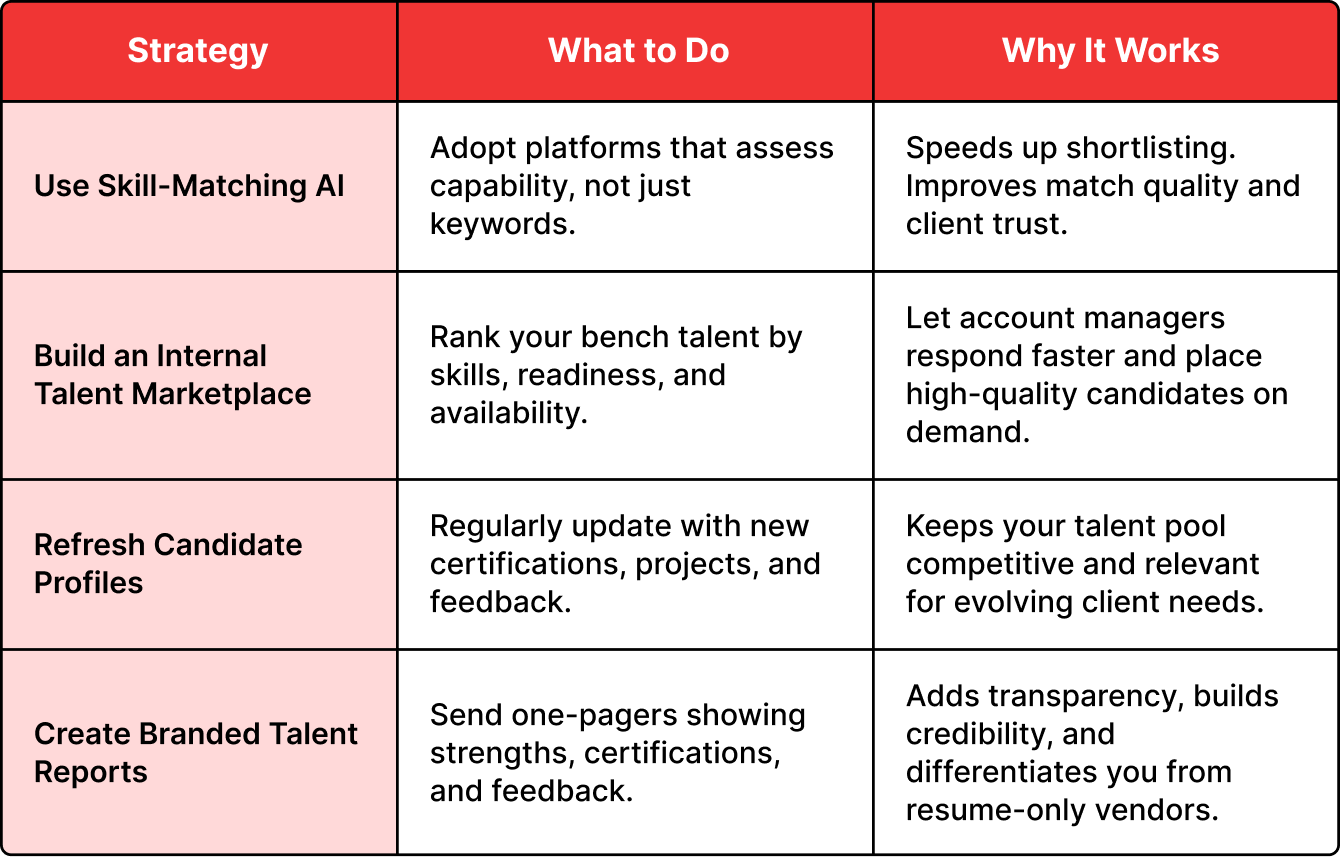
As hiring managers, driving real value isn’t just sourcing, it’s developing, matching, and future-proofing talent.
This is where Consultadd steps in. We go beyond sourcing; we actively vet, validate, and support talent with skill proof, live assessments, and performance documentation, helping you win client trust faster.
Next, let’s look at how skills-based hiring strengthens job fit and prepares the workforce for tomorrow.
Benefits of a Skills-Based Approach

When clients demand results yesterday, traditional hiring filters just slow you down.
Focusing on degrees or job titles leaves out incredible candidates ready to deliver today. A skills-based hiring approach isn't just a trend, it’s a competitive edge.
Here’s why more staffing leaders are rewriting the rules:
1. Bigger Talent Pools, Better Matches
- As Silvia Lara, Senior Data Scientist Economic Graph at LinkedIn says, you can 6x your qualified candidate pool when you focus on skills over job titles.
- That means faster placements, more options, and less scrambling to fill niche roles.
- Especially useful for emerging tech, remote work, or cross-functional teams.
2. Faster Placements, Lower Time-to-Fill
- Skills data lets recruiters skip the guesswork and zero in on real capability.
- Some agencies have reported a significant reduction in time-to-fill using skill-first platforms.
Moreover, faster placements mean happier clients and more repeat business.
3. Real DE&I Impact
- Hiring for skills removes hidden bias around schools, backgrounds, or job gaps.
- You’re giving qualified people a fair shot—and building diverse, high-performing teams.
- It’s not just ethical. It’s effective.
4. Improved Client Confidence
- Clients are tired of vague resumes and overused buzzwords.
- A skills-first submission backed by assessments or projects builds instant trust.
- It shows you understand what “good” looks like; you prove it, not pitch it.
5. Long-Term Talent Growth
- You’re not just filling jobs. You’re building communities.
- Skill-based hiring makes it easier to track growth, promote from within, and upskill over time.
That’s a retention win for clients and bragging rights for your agency.
A global talent expert, Bryan Hancock, highlights a decisive shift in hiring mindsets.
He shares,

“Look at a college degree: if it’s not needed for a job, not having one shouldn’t be a barrier.”
This thinking is reshaping corporate strategies. Businesses are realizing that talent can come from non-traditional paths, such as boot camps, self-learning, or previous roles without flashy titles.
Moreover, Bryan Hancock captured it perfectly: “If you have the skills, no matter where you learned them; you should be able to do the work.”
And that’s precisely what today’s best strategies are designed to prove.
Start Strong With Consultadd
With 15 years in business and 5,000+ successful staffing engagements, we don't just fill roles, we build reliability into your process. We've supported 65 staffing companies in the past year alone and maintain MSAs with industry leaders like Robert Half and TEKsystems.
Here's what working with Consultadd looks like:
- Talent sourced in under 24 hours
- Ready-to-deploy candidates, vetted for experience and compliance
- Lower turnover risk: we match long-term goals, not just short-term needs
- Seamless compliance: visa, documentation, onboarding? Handled.
- Dedicated 1:1 account managers for responsive, personalized support
- Top 100 candidate matches delivered in the past year
- Strong partnerships with universities to tap into fresh, committed talent
- Post-placement support so your investment grows beyond day one
For candidates, your next opportunity is more than just a job title, it's a chance to build skills, gain experience, and move your career forward. At Consultadd, we connect technology professionals with projects and employers that align with their goals, whether they're looking for contract, contract-to-hire, or long-term opportunities.
The tech job market moves fast, but the right guidance can make all the difference. Ready to take the next step in your career journey? Explore Opportunities >>
Key Takeaways
- Hire for skills, not credentials: Evaluate candidates based on demonstrated capabilities instead of relying primarily on degrees or job titles.
- Expand the talent pool: Skills-based hiring opens opportunities for self-taught professionals, career changers, veterans, and other overlooked talent.
- Reduce hiring bias: Structured skills assessments create a fairer recruitment process and support diversity and inclusion goals.
- Invest in continuous development: Upskilling, talent mapping, and skill tracking help build future-ready workforces and improve retention.
- Use technology to validate skills: Assessments, skills dashboards, and hiring platforms improve candidate matching, client confidence, and hiring efficiency.
FAQs
What is skills-based hiring?
Skills-based hiring is a recruitment approach that evaluates candidates primarily on their abilities, competencies, and practical experience rather than formal education, degrees, or job titles.
Why are companies adopting skills-based hiring?
Organizations are adopting skills-based hiring to access larger talent pools, fill roles faster, improve hiring quality, reduce skills shortages, and focus on candidates who can perform the job effectively.
How does skills-based hiring improve diversity?
By removing unnecessary degree and background requirements, skills-based hiring gives more opportunities to self-taught professionals, career changers, veterans, and candidates from underrepresented groups, creating a more inclusive hiring process.
What are the biggest challenges of implementing skills-based hiring?
Common challenges include developing reliable skills assessments, changing traditional hiring practices, training recruiters and hiring managers, and integrating skills validation into existing recruitment workflows.
What are the benefits of skills-based hiring for employers?
Skills-based hiring improves candidate quality, expands talent availability, reduces time-to-fill, supports workforce diversity, increases employee performance, and helps organizations build stronger long-term talent pipelines.

How AI and Social Media Revolutionize Recruitment for the Future
Introduction
A new tech role lands on your desk; tight deadline, tough skill set, contract-only. You dive into your database, post on the usual channels, and chase a few leads. But candidates don’t respond. Or worse, they disappear suddenly.
Meanwhile, the clock is ticking.
The pressure to deliver is real. And the tools you used even 6 months ago - They’re just not cutting it anymore.
Recruiters today aren’t just competing with each other; they’re competing for time, talent, and tech-savvy candidates.
According to SHRM, 84% of companies now use social media in recruitment, and nearly half use it to screen applicants. AI is gaining momentum too, with 80% of companies that use AI-powered interview scheduling reporting a 36% time savings over manual efforts.
These aren’t just ‘nice-to-haves’ anymore. They’re becoming must-haves for staffing agencies looking to stay ahead and be trusted.
So, what does this future of recruiting really look like? Let’s break it down, starting with how AI quietly reshapes the hiring process from behind the scenes.
TL;DR
- AI and social media have transformed recruitment from manual sourcing to faster, data-driven hiring.
- AI automates resume screening, sourcing, scheduling, and candidate engagement, reducing time-to-hire.
- Social media helps recruiters build employer brands, engage passive candidates, and expand talent pools.
- Combining AI with social platforms improves hiring speed, candidate experience, diversity, and decision-making.
- Recruiters who adopt AI, social recruiting, and predictive hiring strategies will stay competitive in the evolving talent market.
Harnessing AI in Recruitment

When every open role feels like a race against time, even the best recruiters hit a wall. You want to move fast but not at the cost of quality or compliance. That’s where AI steps in to remove the bottlenecks that slow them down.
Let’s explore how AI transforms hiring from a high-pressure scramble into a streamlined, scalable system.
1. Sourcing Gets Smarter, Faster, and More Strategic
AI tools take the manual grind out of candidate search.
- Scan job boards, databases, and social media in seconds
- Spot passive candidates and hidden talent others miss
- Analyze skills, job history, and even personality fit
2. Resume Screening Finally Focuses on Real Potential
No more keyword bingo or missing standout profiles.
- AI reads for hard and soft skills, not just buzzwords
- Flags top matches based on actual job requirements
- Delivers shorter, stronger shortlists faster
3. Pre-Screening Filters High-Performers With Precision
AI-led interviews surface the most qualified candidates early.
- Structured questions with consistent scoring
- Analyzes communication, critical thinking, and fit
- Saves recruiters hours of manual phone screens
And once you've identified top candidates, how do you verify their potential beyond what the resume or AI says?
This is where reference checks are still a key part of high-quality hiring but only if you ask the right questions. Check out our blog: Smart Reference Questions to Make Better Hiring Decisions, to help you uncover red flags, confirm strengths, and predict long-term success.
4. Content Creation Becomes Faster and More Effective
Generative AI helps recruiters communicate better at every stage.
- Write inclusive, optimized job descriptions in seconds
- Personalize outreach messages at scale
- Craft interview questions and brand content with ease
5. Communication Is Automated but Still Personal
Stay responsive without burning out your team.
- Schedule interviews and send updates automatically
- Trigger follow-ups and reminders on autopilot
- Keep messaging tailored to each candidate’s journey
6. Chatbots Keep Candidates Warm, 24/7
No more losing talent due to delays or silence.
- Share role details, answer FAQs, and guide applicants
- Engage candidates instantly even after hours
- Improve candidate experience without added workload
7. Predictive Analytics Help You Hire for Long-Term Success
Use data to make smarter, more forward-looking decisions.
- Forecast hiring needs based on market and client trends
- Predict candidate success and reduce early attrition
- Align talent strategy with client growth plans
Remember, technology alone isn’t the answer, but it can help level the playing field.
AI is here to supercharge your efficiency, accuracy, and confidence. Next, let’s look at how social media is shaping the recruiting future, one post at a time.
The Role of Social Media in Modern Recruitment
The pressure to stand out is constant. Job boards are noisy, inboxes are ignored, and top candidates scroll past generic outreach.
But attention is already focused on one place: social media. When used effectively, it goes beyond branding and becomes a powerful, real-time hiring tool.
Let’s break down how social media is shaping modern recruitment.
1. Platforms Like LinkedIn and X Are the New Hiring Hubs
Recruitment isn’t limited to applications anymore. Talent is active even if not actively applied.
- LinkedIn profiles often contain richer insights than resumes.
- X showcases thought leadership, interests, and professional communities.
- These platforms reveal personality, engagement, and potential cultural fit.
2. Employer Branding Comes to Life on Social Media
Today’s candidates care who they work for beyond the job description. Social media offers a window into company culture, values, and team dynamics.
- Sharing behind-the-scenes content builds trust.
- Posts about team wins, DE&I, or client success humanize the brand.
- Real-time engagement shows authenticity and responsiveness.
3. Reaching Passive Candidates Without a Cold Email
Some of the best candidates aren’t looking, they’re observing. Social media helps you engage without being intrusive.
- Commenting on their posts creates visibility.
- Sharing valuable content brings them to you.
- Personalized, social-first outreach feels more human.
As a hiring manager, you're not chasing talent but attracting it. Social media isn’t just marketing, it's modern recruiting in action.
Next, we’ll explore how combined AI and social media work even better.
AI-Driven Integration with Social Media

Sometimes, your best candidates aren’t actively job hunting, they’re casually scrolling LinkedIn, Reddit, or even Twitter.
But finding them and turning that scroll into serious interest takes more than likes, follows, or a clever post. That’s where AI and social media join forces.
Social platforms bring the reach. AI brings precision. Together, they help you target, connect, and convert the right talent at the right time.
1. Faster Hiring Processes and Reduced Time-to-Hire
AI and social platforms now help eliminate slowdowns that used to stall placements.
- Routine steps like screening and interview coordination are now handled in minutes, not days.
- Social media gives recruiters real-time visibility into candidate activity and availability.
Less manual work means quicker submissions and a competitive edge.
Moreover, partnering with Consultadd means gaining access to ready-to-hire, pre-screened candidates in under 24 hours, drastically reducing time-to-fill and keeping you ahead of the hiring curve.
2. Improved Candidate Experience and Engagement Rates
Modern recruiting tech helps you stay connected without overwhelming your team.
- Automated updates and timely responses make candidates feel respected and in the loop.
- Personalized interactions delivered at scale turn passive interest into active engagement.
A better candidate experience means more accepted offers and fewer fall-offs.
3. Data-Driven Decision-Making for More Effective Hiring Outcomes
Smarter hiring starts with smarter insights.
- AI tools sort and score applicants based on real hiring outcomes, not just resumes.
- Trends from social activity can flag high-potential candidates before others spot them.
Every placement becomes an opportunity to refine and improve your hiring playbook.
4. Enhanced Diversity and Inclusion Initiatives
Tech is helping recruiters remove blind spots and expand their reach.
- Structured screening reduces the influence of unconscious bias in early decisions.
- Social platforms open access to talent across geographies, backgrounds, and experiences.
Diversity goals become more than metrics they become achievable. This isn't just faster recruiting. It’s intelligent recruiting; sharper, quicker, and aligned with modern expectations.
Lewis Olcot, a senior talent acquisition leader and AI hiring innovator, described this shift firsthand.
“I use AI tools to streamline initial resume screenings which not only saves time but also ensures that I’m looking at candidates who have the skills and experiences most relevant to the position.”
This isn’t just about automation, it's about transformation.
“Moreover, AI doesn't just perform administrative tasks; it acts as a strategic advisor.”
The result? More focus on strategy, less time on sorting resumes.
But while these are the pros of AI and social media, let's also discuss the challenges they present and how to manage them smartly.
Addressing Challenges in AI and Social Media Recruitment
AI and social platforms are powerful, but they come with growing pains. Here’s how to fix what’s broken:

Advanced Strategies for Recruitment

Recruitment today means thinking ahead, way ahead. It’s about building a talent engine powered by data, personalization, and brand strength.
Here are key strategies that can take your recruiting to the next level:
1. Predictive Hiring Over Reactive Searches
Predict future hiring demands so you're not rushing to fill roles at the last minute.
Pro Tip: Use AI to identify patterns in growth, attrition, and seasonal shifts.
Want to take it a step further? Read our blog, ‘From Skills Gap to Strategic Growth: Talent Mapping That Delivers’ to explore how talent mapping bridges the gap between workforce planning and growth.
2. Skills First, Resumes Later
Focus on what candidates can do, not just where they’ve worked.
Pro Tip: Use project-based assessments for deeper insights.
3. Personalised Outreach Gets Replies
Generic messages are ignored. Tailored messages drive engagement.
Pro Tip: Let AI craft messages based on a candidate’s interests and behavior.
4. DEI Starts at the Source
Use AI tools that eliminate bias, not hide it.
Pro Tip: Audit your sourcing platforms for inclusivity and representation.
5. Social Media Is Your Talent Funnel
Your posts attract more talent than your job boards.
Pro Tip: Share team stories, not just job ads.
Quick Wins for Forward-Thinking Recruiters
Let’s look at the metrics that prove your new strategy is working:

These aren’t just upgrades; they’re the future standard. Those who act now won’t just keep up, they’ll lead.
Preparing for the Future of Recruitment
Tomorrow’s hiring success starts with the decisions you make today. Those who adapt today will lead the talent conversation tomorrow.
1. Tech Isn’t Optional, It’s Your Edge
AI shortens time-to-fill and boosts match accuracy. AI resume screening or automated outreach is an easy win and has a significant impact.
2. Candidate Experience Is Crucial
Top talent judges your brand by the hiring journey. They expect speed, clarity, and personalization.
Pro Tip: Automate follow-ups to avoid ghosting and keep candidates engaged.
3. Gen Z Talent Thinks Differently
They value purpose over paychecks and growth over perks. Static job ads won’t attract them.
Pro Tip: Show impact, culture, and flexibility in every job post.
This is why Consultadd focuses on human-centered recruiting backed by tech, but driven by trust. We engage candidates with purpose, career support, and a clear growth path, significantly lowering drop-offs and improving long-term retention for our partners.
4. Agility Beats Perfection
The market shifts fast, so should your hiring strategy. Waiting to be “ready” delays progress.
Pro Tip: Test small changes. Iterate. Move forward fast.
Because in recruitment, progress beats perfection and those who evolve early, win long-term.
Start Strong With Consultadd
With 15 years in business and 5,000+ successful staffing engagements, we don't just fill roles, we build reliability into your process. We've supported 65 staffing companies in the past year alone and maintain MSAs with industry leaders like Robert Half and TEKsystems.
Here's what working with Consultadd looks like:
- Talent sourced in under 24 hours
- Ready-to-deploy candidates, vetted for experience and compliance
- Lower turnover risk: we match long-term goals, not just short-term needs
- Seamless compliance: visa, documentation, onboarding? Handled.
- Dedicated 1:1 account managers for responsive, personalized support
- Top 100 candidate matches delivered in the past year
- Strong partnerships with universities to tap into fresh, committed talent
- Post-placement support so your investment grows beyond day one
For candidates, your next opportunity is more than just a job title, it's a chance to build skills, gain experience, and move your career forward. At Consultadd, we connect technology professionals with projects and employers that align with their goals, whether they're looking for contract, contract-to-hire, or long-term opportunities.
The tech job market moves fast, but the right guidance can make all the difference. Ready to take the next step in your career journey? Explore Opportunities >>
Key Takeaways
- AI improves recruitment efficiency by automating sourcing, resume screening, interview scheduling, and candidate communication.
- Social media is a powerful recruiting channel, helping agencies attract passive candidates and strengthen employer branding.
- AI and social media together enable faster hiring, better candidate matching, improved engagement, and more inclusive hiring practices.
- Future-ready recruiters prioritize predictive hiring, skills-based assessments, personalized outreach, and data-driven decision-making.
- Consultadd supports modern recruitment with pre-screened, compliant tech talent, helping staffing firms reduce hiring time while maintaining quality.
FAQs
How is AI changing recruitment?
AI automates repetitive hiring tasks such as sourcing, resume screening, interview scheduling, candidate communication, and predictive hiring analytics, allowing recruiters to focus on strategic hiring decisions.
Why is social media important for recruitment?
Social media enables recruiters to reach passive candidates, strengthen employer branding, showcase company culture, and build relationships with potential talent before they actively apply.
What are the benefits of combining AI and social media in recruiting?
The combination improves sourcing accuracy, shortens time-to-hire, enhances candidate engagement, supports diversity initiatives, and enables data-driven hiring decisions.
What challenges come with AI-powered recruitment?
Recruiters must manage AI bias, protect candidate privacy, ensure ethical use of automation, and maintain a human touch throughout the hiring process.
How can staffing agencies prepare for the future of recruitment?
Agencies should adopt AI tools, strengthen employer branding on social media, embrace skills-based hiring, leverage predictive analytics, and continuously improve the candidate experience to remain competitive.

Cybersecurity Reinvented: The Expansive Role Of AI In Safeguarding Digital Assets
Introduction
In a rapidly evolving digital landscape, the importance of safeguarding digital assets has never been greater. The traditional rule-based cybersecurity solutions of the past have struggled to keep up with the sophistication of modern cyber threats.
However, a new guardian has emerged - Artificial Intelligence (AI).
This article explores the extensive role of AI in revolutionizing cybersecurity, from AI-powered firewalls to intrusion detection systems.
TL;DR
- AI strengthens cybersecurity by detecting and responding to threats faster than traditional systems.
- AI-powered firewalls and IDSs adapt to new attack patterns using machine learning.
- AI email security helps prevent phishing and other evolving cyber threats.
- AI-driven SIEM solutions provide real-time monitoring and centralized threat analysis.
- Organizations using AI benefit from better security, faster response times, and lower costs.
How AI is used to Safeguard Digital Assets
1. AI-powered Firewalls
AI-powered firewalls have taken security to the next level by learning and adapting to new threats over time. These intelligent sentinels monitor network traffic and identify anomalies, effectively protecting networks from attacks. They offer a dynamic defense mechanism against the ever-evolving threat landscape.
2. AI-powered Email Security Solutions
Phishing attacks have become one of the most common and effective methods of breaching security with 1.2% of daily malicious senders. AI-powered email security solutions excel in identifying and blocking these malicious emails. Unlike traditional rule-based systems, AI-driven solutions adapt to the changing tactics of cybercriminals, providing a robust shield for your organization's communication.
3. AI-powered Intrusion Detection Systems (IDSs)
AI-powered IDSs are designed to detect malicious activities on networks with superior accuracy and efficiency compared to their traditional counterparts. These systems continuously learn from the network's behavior, making them adept at spotting any suspicious activity. Quick detection is the first line of defense against a potential breach.
4. AI-powered Security Information and Event Management (SIEM) Systems
SIEM systems play a pivotal role in cybersecurity by collecting and analyzing data from various sources. AI integration enhances this process, allowing for quicker and more effective identification and response to security threats. AI-empowered SIEM systems provide a holistic view of your organization's security posture.
Key Benefits of Using AI-powered Cybersecurity Solutions
AI-powered cybersecurity solutions offer a multitude of benefits:
Improved Threat Detection
The ability of AI to continuously learn and adapt results in vastly improved threat detection. It can identify even the most subtle anomalies in network traffic or user behavior.
Reduced Response Time
With real-time monitoring and instantaneous threat detection, AI drastically reduces response times. This quick reaction can be the difference between a minor incident and a major data breach.
Improved Efficiency
AI automates many security processes, saving valuable human resources and ensuring that your organization's security is always at its peak.
Reduced Costs
By streamlining security processes and reducing the potential damage from breaches, AI ultimately reduces the financial burden of cybersecurity.
Difference Between AI-powered and Traditional Cybersecurity
What sets AI-powered firewalls apart from traditional firewalls?
AI-powered firewalls are adaptive and learn from network traffic, making them highly effective at identifying and blocking emerging threats. Traditional firewalls rely on pre-defined rules and struggle to keep up with evolving threats.
How do AI-powered email security solutions combat phishing attacks?
AI-powered email security solutions use machine learning to recognize phishing patterns and evolving tactics. They can swiftly detect and block suspicious emails, even if they don't fit conventional phishing templates.
What makes AI-powered Intrusion Detection Systems (IDSs) more efficient?
AI-powered IDSs continuously learn from network behavior, allowing them to spot anomalies more accurately and efficiently than traditional IDSs, which rely on fixed rules.
How do AI-powered Security Information and Event Management (SIEM) Systems enhance cybersecurity?
AI integration in SIEM systems accelerates threat identification and response. These systems can analyze vast amounts of data from various sources and provide a comprehensive view of an organization's security posture.
Start Strong With Consultadd
With 15 years in business and 5,000+ successful staffing engagements, we don't just fill roles, we build reliability into your process. We've supported 65 staffing companies in the past year alone and maintain MSAs with industry leaders like Robert Half and TEKsystems.
Here's what working with Consultadd looks like:
- Talent sourced in under 24 hours
- Ready-to-deploy candidates, vetted for experience and compliance
- Lower turnover risk: we match long-term goals, not just short-term needs
- Seamless compliance: visa, documentation, onboarding? Handled.
- Dedicated 1:1 account managers for responsive, personalized support
- Top 100 candidate matches delivered in the past year
- Strong partnerships with universities to tap into fresh, committed talent
- Post-placement support so your investment grows beyond day one
For candidates, your next opportunity is more than just a job title, it's a chance to build skills, gain experience, and move your career forward. At Consultadd, we connect technology professionals with projects and employers that align with their goals, whether they're looking for contract, contract-to-hire, or long-term opportunities.
The tech job market moves fast, but the right guidance can make all the difference. Ready to take the next step in your career journey? Explore Opportunities >>
Key Takeaways
- AI continuously learns to detect emerging cyber threats.
- Real-time threat detection minimizes the impact of security incidents.
- Automation improves efficiency by reducing manual security tasks.
- AI-powered tools outperform traditional rule-based cybersecurity solutions.
- AI enhances overall cyber resilience while lowering operational costs.
FAQs
1. How is AI used in cybersecurity?
AI is used to detect threats, monitor networks, block phishing emails, automate incident response, and improve security through continuous learning.
2. What are the benefits of AI-powered cybersecurity?
Key benefits include faster threat detection, reduced response times, improved operational efficiency, stronger protection, and lower cybersecurity costs.
3. How do AI-powered firewalls differ from traditional firewalls?
Unlike traditional firewalls that rely on static rules, AI-powered firewalls analyze network behavior, learn from new threats, and adapt automatically.
4. Can AI prevent phishing attacks?
Yes. AI-powered email security solutions identify suspicious patterns, detect evolving phishing techniques, and block malicious emails before they reach users.
5. Why are AI-powered SIEM systems important?
AI-enhanced SIEM platforms analyze large volumes of security data in real time, helping organizations identify, prioritize, and respond to cyber threats more effectively.

The Future of Cloud Computing: Trends and Predictions
Introduction
The future of cloud computing is looking brighter than ever, and not just because it's up in the sky! With more and more businesses moving their operations to the cloud, we can expect to see some pretty wild trends and predictions.
Some of the real trends we can expect to see include increased use of AI and machine learning on cloud systems, as well as more emphasis on security and privacy. And who knows?
Maybe one day we'll even be able to upload our consciousness to the cloud and live forever as a digital entity. Okay, maybe that one's a bit far-fetched, but you never know what the future holds!
TL;DR
- Cloud computing continues to drive business innovation and digital transformation.
- AWS, Azure, Google Cloud, and IBM Cloud remain leading cloud platforms.
- Security, privacy, and compliance are critical cloud computing priorities.
- Cloud professionals are in high demand with strong career opportunities.
- AI complements cloud computing rather than replacing it.
Cloud Computing Platforms
Cloud computing platforms are like the superheroes of the tech world. The platforms have revolutionized the way businesses store, process, and access data. These platforms provide on-demand access to a shared pool of computing resources, including servers, storage, applications, and services.
They offer scalability, flexibility, and cost-effectiveness compared to traditional IT infrastructure. Cloud computing platforms are classified into three categories (based on service models):
- Infrastructure as a Service (IaaS),
- Platform as a Service (PaaS),
- Software as a Service (SaaS).
IaaS provides virtualized computing resources over the internet, such as virtual machines and storage. PaaS offers a development platform that enables users to create customized applications without managing the underlying infrastructure. SaaS delivers software applications over the internet that are managed by third-party providers. Some of the leading cloud computing platforms include:
- Amazon Web Services (AWS)
- Microsoft Azure
- Google Cloud Platform (GCP)
- IBM Cloud
These platforms have transformed the IT landscape by enabling businesses to innovate faster while reducing costs and improving efficiency.
What Are The Security Risks Of Cloud Computing
One of the primary concerns with cloud computing is data security. When sensitive data is stored on a third-party server, there is always a risk of unauthorized access or data breaches.
This risk is amplified if the data is not properly encrypted or secured by strong passwords. Additionally, cloud service providers may not always have robust backup and disaster recovery plans in place, leaving businesses vulnerable to data loss due to natural disasters or cyber-attacks.
It is crucial for businesses to carefully evaluate their cloud service provider's security measures and ensure that they have appropriate safeguards in place to protect their data. By taking these precautions, businesses can enjoy the benefits of cloud computing while minimizing their exposure to potential security threats.
Cloud Computing Salary
Cloud computing is a rapidly growing field with a high demand for skilled professionals. As such, salaries for cloud computing professionals have been steadily increasing over the years.
According to recent surveys, the average salary for cloud computing professionals in the United States ranges from $80,000 to $150,000 per year, depending on factors such as experience, education, and job title.
In addition to base salaries, many cloud computing professionals also receive bonuses and other incentives based on their performance and contributions to their organizations. With the continued growth of cloud computing technology and the increasing importance of data management and security in today's digital landscape, it is likely that salaries in this field will continue to rise in the coming years.
Disadvantages Of Cloud Computing
Cloud computing has gained significant popularity in recent years due to its convenience and cost-effectiveness. However, it is important to also consider the potential disadvantages of this technology.
One major drawback is the issue of security and privacy. Storing sensitive data in the cloud can make it vulnerable to hacks or breaches, which could lead to significant financial and reputational damage for businesses. Additionally, reliance on a third-party cloud provider means that businesses may have less control over their own data and operations.
Another potential disadvantage is the risk of service disruption or downtime, which could significantly impact business operations. There may be concerns around compatibility with legacy systems or applications, which could require additional investments in infrastructure or IT support.
As with any technology, it is important to carefully weigh the pros and cons before deciding whether cloud computing is right for your business needs.
Will AI Replace Cloud Computing?
Well, if we're talking about a literal replacement where AI becomes the boss and cloud computing gets fired, then I'm afraid we're in for a long wait. AI and cloud computing are two very different things with their own unique strengths and applications.
Cloud computing is all about storing and accessing data remotely, while AI is focused on simulating human intelligence and decision-making. So while there may be some overlap in terms of how these technologies are used, it's unlikely that one will completely replace the other anytime soon.
Unless, of course, the robots rise up and take over everything – but that's a topic for another day!
Is Cloud Computing A Good Career
If we look at current trends, it seems that cloud computing will continue to be a hot career field. With more and more companies shifting their operations to the cloud, there will be plenty of opportunities for skilled professionals to make their mark.
So if you're considering a career in cloud computing, go ahead and take the leap!
Start Strong With Consultadd
With 15 years in business and 5,000+ successful staffing engagements, we don't just fill roles, we build reliability into your process. We've supported 65 staffing companies in the past year alone and maintain MSAs with industry leaders like Robert Half and TEKsystems.
Here's what working with Consultadd looks like:
- Talent sourced in under 24 hours
- Ready-to-deploy candidates, vetted for experience and compliance
- Lower turnover risk: we match long-term goals, not just short-term needs
- Seamless compliance: visa, documentation, onboarding? Handled.
- Dedicated 1:1 account managers for responsive, personalized support
- Top 100 candidate matches delivered in the past year
- Strong partnerships with universities to tap into fresh, committed talent
- Post-placement support so your investment grows beyond day one
For candidates, your next opportunity is more than just a job title, it's a chance to build skills, gain experience, and move your career forward. At Consultadd, we connect technology professionals with projects and employers that align with their goals, whether they're looking for contract, contract-to-hire, or long-term opportunities.
The tech job market moves fast, but the right guidance can make all the difference. Ready to take the next step in your career journey? Explore Opportunities >>
Key Takeaways
- Cloud computing offers scalable, flexible, and cost-effective IT solutions.
- Choosing the right cloud platform depends on business needs and workloads.
- Strong security practices are essential for protecting cloud data.
- Cloud computing careers offer competitive salaries and long-term growth.
- AI and cloud technologies work together to power modern applications.
FAQs
1. What is cloud computing?
Cloud computing is the delivery of computing services such as storage, servers, databases, networking, and software over the internet instead of relying on local infrastructure.
2. Which are the top cloud computing platforms?
The leading cloud providers are Amazon Web Services (AWS), Microsoft Azure, Google Cloud Platform (GCP), and IBM Cloud.
3. What are the biggest security risks in cloud computing?
Common risks include data breaches, unauthorized access, misconfigured cloud resources, compliance issues, and service outages.
4. Is cloud computing a good career choice?
Yes. Cloud computing remains one of the fastest-growing technology fields, offering high demand, competitive salaries, and diverse career paths.
5. Will AI replace cloud computing?
No. AI relies on cloud infrastructure for computing power, storage, and scalability, making the two technologies complementary rather than competitive.