
IT Staffing

The IT Staffing Process: A Practical Step-by-Step Guide
Introduction
If you have ever watched a good engineer slip away because your hiring took too long, you already understand the problem.
The IT staffing process is the sequence of steps that turns an open technical role into a working, productive hire. Done well, it fills seats with people who can actually do the job. Done poorly, it drags on for months and quietly bleeds money.
Here is the part most teams underestimate. Tech roles do not fill on the same clock as everything else. The average job across all industries fills in about 44 days, according to SHRM benchmark data.
Specialized tech roles routinely run longer, and some stretch well past three months. So the process you use is not a formality. It is the difference between hiring the person you want and settling for whoever is still available in week eight.
This guide walks through each stage, what it should produce, and where things usually break.
TL;DR
- The IT staffing process runs through eight stages, from requirement intake to post-placement support, and each stage has a clear owner and output.
- Tech roles fill slower than most, with senior and niche positions like AI/ML averaging close to 89 days to fill.
- Every day a role sits open costs real money, roughly $500 to $1,500 per day in lost productivity for a mid-level engineer.
- Choosing the right model, whether staff augmentation, contract-to-hire, or direct hire, shapes both speed and cost.
- A specialized partner can compress timelines from weeks to days, but only if intake and screening are done right.
What is the IT staffing process?
The IT staffing process is the structured way an organization identifies a technical need, finds qualified candidates, evaluates them, and gets the right person into the role.
It covers everything from the first conversation about what a project actually requires through the moment a new hire is set up and contributing.
It matters more now than it used to. Demand keeps climbing while supply stays tight. A February 2026 ManpowerGroup report found that 72% of employers worldwide struggle to fill roles, and the technology sector sits near the top of that list with a talent shortage rate around 76%.
The U.S. Bureau of Labor Statistics projects roughly 317,700 openings in computer and IT occupations every year through 2034. That is a lot of chairs to fill, and not enough people to fill them.
The IT staffing market itself reflects that pressure. It is projected to reach about $152 billion by 2031. Companies are leaning less on permanent headcount alone and more on flexible, contract-based talent to close gaps fast.
The 8 steps of the IT staffing process
Most solid staffing workflows follow the same backbone, whether you run it in-house or through an agency.

Here is how the full sequence looks, with who owns each part and what it should hand off.
1. Requirement intake and role scoping
- This is where good hires are won or lost, and it is the step people rush through.
- A recruiter reviews the job description, the technology stack, the experience level, and what the client actually expects day to day.
- If the intake is vague, everything downstream inherits that fog.
- We have seen requisitions ask for eight or ten "must-have" skills when the work really needs three.
- Pin down the non-negotiables early. It saves everyone a month.
2. Sourcing and talent mapping
- Now recruiters go looking. They search internal databases, referral networks, professional communities, and job boards, then build a longlist of realistic profiles.
- Talent mapping also happens here, which means understanding where the right people work today and what would make them move.
- The best pipelines are warm before the role even opens.
- Agencies that keep active talent pools can pull candidates who were never on the open market.
3. Screening and technical assessment
- A resume tells you what someone claims. Screening tells you what holds up.
- This stage combines a recruiter phone screen with a real technical assessment, often reviewed by an engineer.
- Skills-based evaluation has largely replaced the old degree filter.
- In 2026, more than half of mid-to-large tech employers dropped degree requirements for many roles and focused on what candidates can build instead.
- AI tools now handle a chunk of early screening, from resume parsing to scheduling. The smart teams use them to move faster, not to replace human judgment. AI-assisted, not AI-only.
4. Client submission and shortlisting
- The recruiter or account manager presents a tight set of vetted candidates.
- Quality beats volume here.
- Three strong, well-matched profiles help a hiring manager far more than thirty raw resumes.
- This is also where a staffing partner earns trust, because a curated shortlist signals they understood the brief.
5. Interviews and evaluation
- The hiring team runs technical and cultural interviews.
- The goal is to confirm the candidate can do the work and will fit how the team operates. Consolidating rounds matters.
- Dragging finalists through five separate loops over three weeks is how you lose them.
- Top technical candidates stay available for roughly 10 days before accepting an offer somewhere else.
6. Offer and negotiation
- Speed wins offers. Candidates who wait more than five days for a written offer are about 40% more likely to accept a competing one.
- Get the number, terms, and start date locked quickly.
- Negotiation is normal in a market where senior bill rates have climbed 15% to 30% year over year, so build a little room in from the start.
7. Compliance and documentation
- Before anyone starts, paperwork has to be cleared.
- Background checks, right-to-work verification, and any visa documentation get handled here.
- For sponsored roles, USCIS requirements set the rules, and getting them wrong is expensive.
- A good partner treats compliance as part of the process, not an afterthought that surfaces on day one.
8. Onboarding and post-placement support
- The role is not filled until the person is productive.
- Onboarding covers system access, tooling, introductions, and a real ramp-up plan. Post-placement check-ins catch small problems before they become resignations.
- This last mile is where a lot of "successful" hires quietly fall apart.
IT staffing models compared
There is no single right way to staff a tech team. The model you pick should match the length of the need and how much control you want. Here is how the common options stack up.
Staff augmentation works when you know exactly what to build but lack the hands or a specific skill. The professionals join your team and take direction from you.
Contract-to-hire has grown fast because both sides get to evaluate before signing anything permanent, which lowers the risk of a bad hire. Direct hire still makes sense for roles at the core of your business.

Managed services fit when you would rather hand an entire function to a provider and judge them on results.
Common bottlenecks and how to fix them
Most staffing delays are not mysteries. They repeat.
Once you can name them, you can shorten your timeline without cutting corners on quality.
The pattern here is speed and clarity. Candidates can feel when a process is confident and when it is wobbling, and they behave accordingly.
A tight, well-run process is itself a recruiting advantage.
In-house hiring versus a staffing partner
Running the process yourself:
- It gives you full control and keeps costs predictable for steady, ongoing roles.
- It works when your recruiting team has bandwidth and the roles are not especially rare.
A staffing partner:
- It changes the math when speed or scarcity is the problem.
- Specialized agencies often fill technical roles in a fraction of the internal average, because they maintain pipelines, run screening at scale, and handle compliance as routine work.
- The tradeoff is a fee, weighed against the vacancy cost of a role sitting empty for two months.
For a hard-to-find skill on a deadline, that trade usually favors the partner. If you want to go deeper on cutting your timeline, our guide on reducing time-to-hire breaks down the tactics that actually move the number.
Start Strong With Consultadd
With 15 years in business and 5,000+ successful staffing engagements, we don't just fill roles, we build reliability into your process. We've supported 65 staffing companies in the past year alone and maintain MSAs with industry leaders like Robert Half and TEKsystems.
Here's what working with Consultadd looks like:
- Talent sourced in under 24 hours
- Ready-to-deploy candidates, vetted for experience and compliance
- Lower turnover risk: we match long-term goals, not just short-term needs
- Seamless compliance: visa, documentation, onboarding? Handled.
- Dedicated 1:1 account managers for responsive, personalized support
- Top 100 candidate matches delivered in the past year
- Strong partnerships with universities to tap into fresh, committed talent
- Post-placement support so your investment grows beyond day one
For candidates, your next opportunity is more than just a job title, it's a chance to build skills, gain experience, and move your career forward. At Consultadd, we connect technology professionals with projects and employers that align with their goals, whether they're looking for contract, contract-to-hire, or long-term opportunities.
The tech job market moves fast, but the right guidance can make all the difference. Ready to take the next step in your career journey? Explore Opportunities >>
Key takeaways
- The IT staffing process has eight clear stages, and skipping intake is the most common way teams sabotage the rest.
- Tech roles fill slower than average, with scarce skills like AI/ML taking close to 89 days.
- Empty roles are expensive, often $500 to $1,500 per day in lost output for a single engineer.
- Match the model to the need: staff augmentation and contract-to-hire buy speed and flexibility that direct hire cannot.
- A specialized partner earns its fee when the role is urgent, rare, or bleeding money by staying open.
FAQs
What are the main steps in the IT staffing process?
The process moves through requirement intake, sourcing, screening, client submission, interviews, offer, compliance, and onboarding. Each step has a clear owner and a specific output, which keeps candidates moving instead of stalling between stages.
How long does it take to fill an IT position?
It depends heavily on the role. The tech average is around 52 days, but common roles like frontend engineering fill closer to 42 days while niche roles like AI/ML can take about 89 days. Scarcity of qualified candidates is the biggest factor.
What is the difference between staff augmentation and direct hire?
Staff augmentation adds external professionals to your team temporarily, and you direct their work while paying only for the engagement. Direct hire brings someone on permanently as your employee. Augmentation suits short-term gaps and specialized skills, while direct hire fits core, long-term roles.
Why is IT staffing so much harder than other hiring?
Supply is the root cause. Around 72% of employers report trouble filling roles, and the tech sector faces one of the highest shortage rates at roughly 76%. Skill requirements have also grown, so a role that once needed three competencies now often lists eight or more.
Does using an IT staffing agency actually save money?
It can, when a role is urgent or hard to fill. Agencies maintain warm candidate pools and can start people in days, which offsets the vacancy cost of a role sitting open for two months or longer. For steady, easy-to-fill roles, in-house hiring is often cheaper.
How is AI changing the IT staffing process?
AI now handles early screening, resume parsing, and scheduling, cutting tasks that once took days down to minutes. The most effective approach in 2026 is AI-assisted rather than fully automated, since human judgment still catches cultural fit and reduces bias.

How to Find the Right Local Tech Partner in 2026
Introduction
Typing "IT consultancy near me" into Google usually means one of two things: something just broke, or someone above you asked why the company still doesn't have a real technology plan. Either way, the search results won't tell you much about who actually picks up the phone when a server goes down on a Friday at 6 PM.
The truth is, choosing the right IT consultancy isn't just about finding the closest provider. It's about understanding why so many businesses are searching for local IT support in 2026, what "local" actually means beyond a faster response time, and whether a nearby consultancy delivers more value than a national MSP or an in-house IT team.
This guide breaks down the real costs, benefits, and trade-offs of each option. You'll also learn the green flags and red flags to look for before signing a contract, along with the exact questions to ask during your first conversation with any IT consulting firm so you can make a confident decision.
TL;DR
- A local IT consultancy is usually cheaper than a full-time in-house hire. A 25-person company can often get a full outsourced IT team for $24,000–$48,000 a year, compared to $120,000–$240,000 for one senior in-house IT manager once salary, benefits, and overhead are factored in.
- The US IT consulting industry is worth an estimated $821.2 billion in 2026 and includes roughly 502,000 businesses, so you have real options if you know what to filter for.
- "Local" matters most for response time, familiarity with regional compliance rules, and having someone who will actually answer the phone, not for price alone.
- The two biggest red flags are a vendor who won't commit to a response-time SLA and one who can't name a client in your industry.
- Ask about time-to-hire, industry experience, and what happens after the contract is signed before you commit to anyone.
Why "IT consultancy near me" searches are climbing in 2026
This isn't a random spike. Three things are pushing companies to search for a local IT consulting firm instead of trying to solve everything in-house.
The market itself has grown large enough to actually have local options in most cities.
The US IT consulting industry is now valued at $821.2 billion, spread across about 502,000 businesses, and it has grown at a 2.9% CAGR since 2021.
A decade ago, "local IT help" often meant one overworked generalist. Today it can mean a firm with dedicated cloud, security, and staffing specialists.
Hiring your own IT staff has gotten harder and slower.
65% of tech hiring managers say finding skilled talent is more difficult than it was a year ago, even as 78% of them plan to grow permanent headcount in the second half of 2026.
Zoom out further and it gets worse: a 2026 ManpowerGroup survey of more than 39,000 employers across 41 countries found that 72% are struggling to fill open roles at all. We've written before about what's actually driving the tech talent shortage if you want the longer version.
The cost of getting it wrong keeps climbing.
IDC estimates the ongoing IT skills shortage will cost organizations worldwide $5.5 trillion by 2026 through delayed projects, missed deadlines, and lost business.
A technical role also takes about 66 days to fill on average, roughly 50% longer than a non-technical one. Waiting that long for one hire, while your systems sit unmanaged, isn't really an option for most businesses.
In-House Hire vs. Local IT Consultancy: What it actually costs
Only 29% of businesses with fewer than 50 employees currently outsource their IT, compared to 66% of larger companies. That gap is closing, and honestly, it should. Smaller companies often have the most to gain from outsourcing, since they're the ones least able to absorb the cost of a bad in-house hire.
What "local" actually buys you
Plenty of national managed service providers can technically serve your zip code. So what does a truly local IT consulting firm add that a remote one doesn't?
The biggest difference isn't that local consultants know more technology. It's that they understand your business environment and can step in when technology problems become real business problems.
Imagine your office loses internet because a network switch fails, or your server refuses to boot on a Monday morning. A remote provider can troubleshoot what they can see, but eventually someone needs to be there in person.
A local IT consulting firm can often have a technician on-site the same day, reducing downtime and getting your team back to work much faster.
Beyond emergency support, local experience also matters when it comes to compliance and business operations. Consultants who regularly work with companies in your region are already familiar with state regulations, industry requirements, and the technology challenges businesses like yours commonly face.
Instead of spending time learning your environment from scratch, they can recommend solutions that have already proven successful for similar organizations.
Then there's the human side of IT support, which many businesses don't think about until something goes wrong. Working with a local firm often means having a dedicated point of contact who already understands your systems, previous issues, and future plans. You spend less time explaining your setup every time you call and more time actually solving the problem.
As that relationship grows, your IT partner becomes less of a help desk and more of an extension of your team.
For many businesses, that's the real advantage of going local. It's not just about being nearby it's about getting faster support, advice that's grounded in your business reality, and a partner who knows your technology as well as you know your customers
Local IT Consultancy vs. National MSP vs In-House Team
Here's how the three most common options compare across the factors that actually matter when you're choosing.
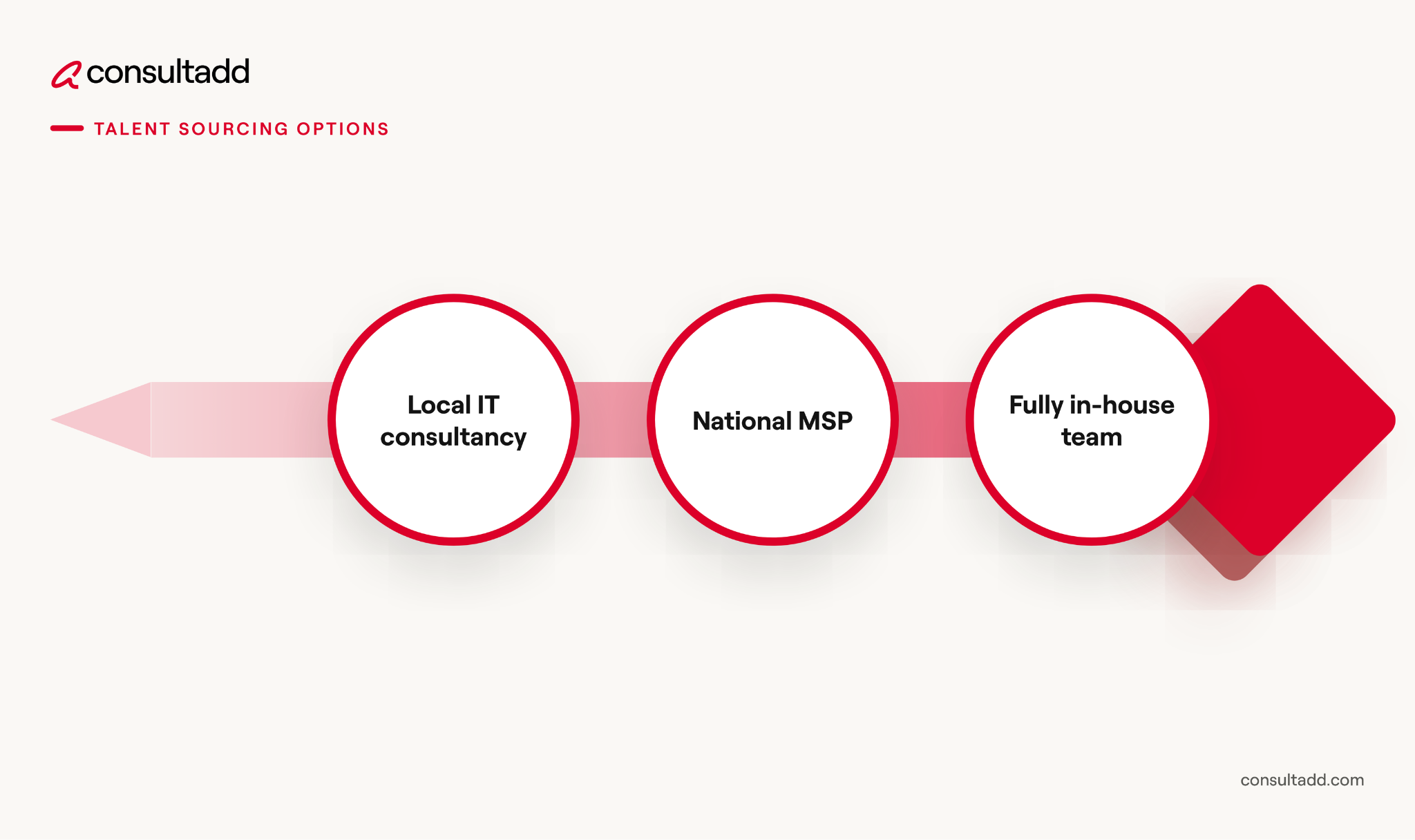
None of these is automatically "correct." A fast-growing company that needs to scale across states might genuinely be better served by a national MSP.
A company that just needs someone reliable and closely tied to their day-to-day operations is usually better off with a local IT consulting firm.
Green flags and Red Flags when you're vetting options
Choosing an IT Staffing Agency: What Actually Matters?
Finding an IT staffing agency is easy.
Finding one that consistently delivers qualified talent, understands your business, and becomes a long term hiring partner is much harder. Almost every staffing firm promises access to top talent, faster hiring, lower recruitment costs, and industry expertise.
The comparison below highlights some of the most common green flags and red flags to look for when evaluating IT staffing agencies. While no single factor should determine your decision, these indicators can help you separate experienced recruitment partners from firms that rely more on persuasive sales conversations than proven hiring expertise.
If a firm hesitates on the SLA question, that's worth paying attention to. It's usually not an oversight.
Questions worth asking before you sign anything
Before signing a contract, take the time to evaluate how a consulting firm actually operates, not just what it promises. The conversations you have before the agreement is signed often reveal more about a provider than the proposal itself.
Here are some questions worth asking:
- How quickly do you respond to critical IT issues, and are those response times guaranteed in a service-level agreement (SLA)?
- Have you worked with businesses in our industry or of a similar size, and can you provide client references?
- What does your onboarding process look like, and how long does it typically take before you're fully operational?
- How do you handle changes in scope if our technology needs grow or our business expands?
- Who will be our primary point of contact, and how is communication handled during ongoing projects?
- What cybersecurity measures and compliance standards do you follow to protect client data?
- How do you document our systems, and will we retain access to that documentation throughout the engagement?
- What reporting, performance metrics, and review meetings can we expect?
- What services are included in the quoted price, and what would incur additional charges?
- If we decide to end the partnership, what does the transition process look like, and how will knowledge and access be handed over?
If you're specifically hiring for a technical role rather than a full consulting engagement, it's worth reading what to actually look for in a candidate before you post the job.
Start Strong With Consultadd
With 15 years in business and 5,000+ successful staffing engagements, we don't just fill roles, we build reliability into your process. We've supported 65 staffing companies in the past year alone and maintain MSAs with industry leaders like Robert Half and TEKsystems.
Here's what working with Consultadd looks like:
- Talent sourced in under 24 hours
- Ready-to-deploy candidates, vetted for experience and compliance
- Lower turnover risk: we match long-term goals, not just short-term needs
- Seamless compliance: visa, documentation, onboarding? Handled.
- Dedicated 1:1 account managers for responsive, personalized support
- Top 100 candidate matches delivered in the past year
- Strong partnerships with universities to tap into fresh, committed talent
- Post-placement support so your investment grows beyond day one
For candidates, your next opportunity is more than just a job title, it's a chance to build skills, gain experience, and move your career forward. At Consultadd, we connect technology professionals with projects and employers that align with their goals, whether they're looking for contract, contract-to-hire, or long-term opportunities.
The tech job market moves fast, but the right guidance can make all the difference. Ready to take the next step in your career journey? Explore Opportunities >>
Key takeaways
- A local IT consultancy typically costs a fraction of a full-time in-house hire while covering more ground, from security to cloud to networking.
- The US IT consulting market has grown to $821.2 billion and 502,000 businesses in 2026, giving you more real local options than a few years ago.
- Local providers win on response time and regulatory familiarity, while national MSPs can win on scale, so the right choice depends on your size and growth plans.
- The clearest red flag in any vendor conversation is reluctance to commit to a response-time SLA in writing.
- Ask about onboarding, references in your industry, and exit flexibility before you sign, not after.
FAQs
How do I find a reliable IT consultancy near me?
Start with referrals from other local businesses in your industry, then check for a written SLA, relevant case studies, and clear pricing before comparing quotes.
Is a local IT consulting firm more expensive than a national provider?
Not usually. Pricing depends more on scope and contract length than on geography. Local firms are often more flexible with smaller engagements.
What's the difference between IT consulting and managed IT services?
IT consulting is typically project-based and strategic, like planning a cloud migration. Managed IT services are ongoing and operational, covering day-to-day monitoring and support.
How much does it cost to hire an IT consultant for a small business?
Costs vary widely, but a small company can often get a full outsourced IT team for $24,000–$48,000 a year, compared to $120,000 or more for a single in-house hire
When should a small business consider outsourcing IT instead of hiring in-house?
As soon as IT needs outpace what one generalist can reasonably cover, or when hiring cycles (currently averaging 66 days for technical roles) are slowing down other projects.

Are Staffing Agencies Worth It?
Introduction
Are staffing agencies worth it? If you have ever watched a job request sit open for two months while your team quietly picks up the slack, you have probably asked yourself exactly that.
The honest answer is that it depends on the role, your timeline, and what the delay is actually costing you.
Sometimes an agency is the smartest money you will spend all quarter. Other times you are better off hiring in-house and keeping the fee in your pocket.
This guide skips the sales pitch. We will walk through what agencies really charge, what a slow or bad hire costs you, and how to tell which of those two situations you are actually in, with real numbers behind every claim. By the end, you should be able to make the call for your own team instead of guessing.
TL;DR
- Agencies charge a real fee, roughly 15% to 30% of first-year salary for a direct hire or a 25% to 75% markup on contract pay. The whole question is whether that fee buys enough speed and quality to pay for itself.
- For hard-to-fill tech roles, it usually does. More than 1.2 million tech jobs sit unfilled in the U.S., and the average technical role takes around 66 days to fill on your own.
- A bad hire is the cost nobody budgets for. The U.S. Department of Labor puts it at about 30% of first-year pay, and SHRM says replacing someone can run one-half to two times their salary.
- Most of a contract markup is not agency profit. Payroll taxes, insurance, and benefits eat up 60% to 85% of the bill rate; the agency's net margin usually lands around 3% to 8%.
- Agencies earn their fee when speed, niche skills, or flexible headcount matter. They are harder to justify for stable, easy-to-fill roles you can source yourself.
What does a staffing agency actually do?
A staffing agency finds qualified candidates, screens them, and presents the best talent for your hiring needs. For contract and temporary roles, it also acts as the legal employer of record, handling payroll, tax withholding, workers' compensation, and compliance, reducing the administrative burden on employers.
Key benefits include:
- Finding and screening qualified candidates
- Managing payroll and compliance for contract workers
- Reducing hiring time and administrative effort
The U.S. staffing industry generated around $184 billion in 2024, connecting 11 million people with work, with nearly 2.2 million temporary and contract workers on assignment in an average week. Hiring through a staffing agency means tapping into an established talent pipeline that operates at national scale.
If you want to see how a well-run engagement should look on your side of the table, our guide to IT staffing done right breaks down the practices that separate good partners from bad ones.
The real question behind "are staffing agencies worth it?
Here is the trap most hiring managers fall into. The agency fee is a big, visible number sitting on an invoice, so it feels like the cost.
The far larger cost, the one that never shows up on any invoice, is the role staying empty or getting filled by the wrong person. Nobody sends you a bill for a missed product deadline or a project that stalled because a seat sat empty for a quarter.
So the question is not really "is the fee expensive?"
It obviously is, in absolute terms. The better question is whether the fee is smaller than what the vacancy or the mis-hire would have cost you. To answer that, you need both numbers on the table. Let's put them there.
What staffing agencies actually cost
There are three fee structures you will run into, and they behave very differently. A direct-hire fee is a one-time charge when the person starts. A contract markup is an ongoing rate added to every hour worked. A conversion fee applies when you decide to bring a contractor on permanently.
Cost is often one of the first factors businesses consider when deciding whether to work with a staffing agency, but there isn't a single pricing model that fits every hiring scenario.
The amount you pay depends largely on the type of role you're filling and the hiring arrangement that best suits your business needs.
Whether you're recruiting a permanent employee, hiring contract talent for a short-term project, or evaluating a candidate through a temp-to-hire arrangement, each model has its own fee structure, advantages, and trade-offs.
Understanding how these pricing models work can help you compare agencies more effectively, budget accurately, and choose a solution that delivers the best return on your hiring investment rather than simply the lowest upfront cost.
Here is roughly what each one looks like:
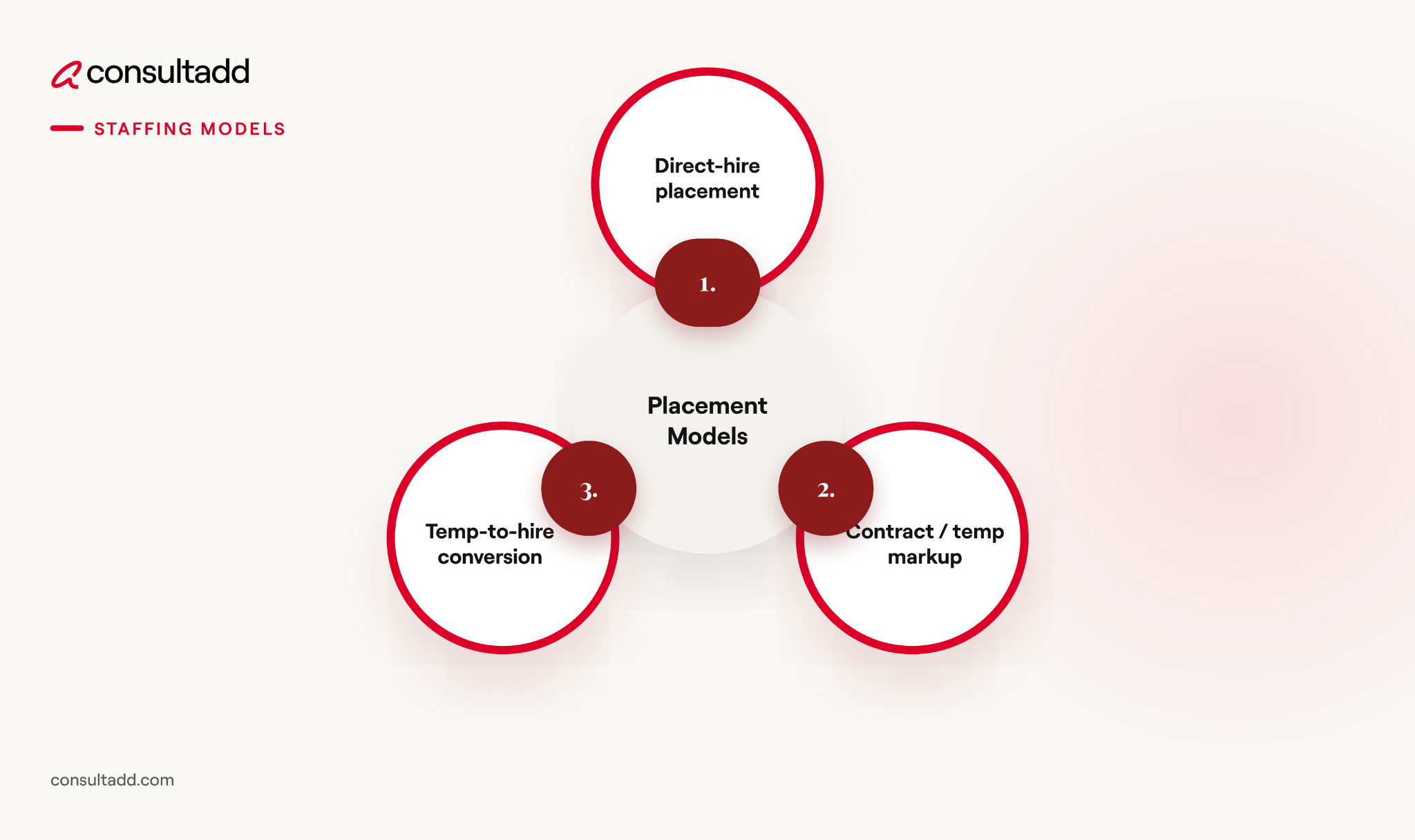
One thing worth clearing up, because it is where a lot of the "agencies are a rip-off" feeling comes from. When you see a $50/hour contractor billed to you at $80/hour, that $30 gap is not profit.
According to KORE1's breakdown, the employer costs you would pay anyway, things like FICA, unemployment tax, workers' comp, and benefits, make up 60% to 85% of the bill rate.
After recruiting, screening, and account management come out, the agency's actual net margin usually sits around 3% to 8%. You are mostly paying the true cost of employing someone, plus a modest fee for finding and carrying them.
The cost of getting the hire wrong
It is easy to focus on staffing fees because they are visible and appear directly in your hiring budget. The costs of a poor hiring decision, however, are often much larger and far less obvious.
Every vacant role can slow projects, reduce team productivity, and place additional pressure on existing employees, while a bad hire can lead to onboarding expenses, lost time, lower morale, and the need to restart the recruitment process.
When viewed from this broader perspective, hiring becomes less about minimizing recruitment costs and more about minimizing business risk. The benchmarks below highlight why making the right hiring decision the first time is often far more valuable than simply choosing the least expensive hiring option.
Why the tech talent shortage changes the math
For general or high-volume roles, you can often self-source and skip the fee. Tech is a different animal, and this is where the case for an agency gets much stronger. The talent simply is not sitting there waiting for your job post.
Globally, ManpowerGroup's 2026 survey found that 72% of employers are struggling to fill open roles, with technology and cybersecurity among the hardest-hit fields (the cybersecurity workforce gap alone is around 4.8 million people). In the U.S. specifically, 87% of tech leaders report trouble finding skilled workers and 95% say it is harder now than three years ago.
Those open roles do not fill themselves quickly. Technical positions take roughly 66 days to fill, about 50% longer than non-technical jobs, and the U.S. Bureau of Labor Statistics projects around 1.4 million unfilled computing jobs by 2027.
Every one of those 66 days is a day your roadmap slips. A good tech-focused agency already has vetted specialists in its network, which is the whole point: you are buying back weeks you would otherwise lose to sourcing. If you want the full picture of why this shortage keeps getting worse, we dug into the key drivers of the tech talent shortage separately.
In-house hiring vs a staffing agency
Neither option wins every time. It comes down to how urgent, specialized, and permanent the role is, plus how much recruiting muscle you already have in-house. Here is a side-by-side to make the trade-offs concrete.
If you are hiring for one stable, easy-to-source role and you have a recruiter with time on their hands, doing it yourself often makes sense. If you need three engineers for a six-month migration, or a security specialist you cannot find on your own, the agency route usually wins.
For the roles you do choose to run internally, our checklist on what to look for when hiring software developers will help you avoid the expensive mistakes.
So, are staffing agencies worth it?
The answer is yes in many situations, but not in every one. Whether an IT staffing agency is worth the investment depends on the type of role you're hiring for, how quickly you need to fill it, and the resources your organization already has.
Looking only at the placement fee can make staffing services seem expensive. However, when you consider the hidden costs of prolonged vacancies, missed project deadlines, lost productivity, and poor hiring decisions, the equation often changes dramatically.
For most technology roles today, the challenge is not simply finding candidates but finding the right candidates before your competitors do. Skilled software developers, cloud engineers, cybersecurity professionals, data scientists, DevOps specialists, and AI experts are in high demand, and many are off the market within days of beginning their job search.
Every additional week spent sourcing resumes, coordinating interviews, and restarting unsuccessful hiring cycles represents time your business cannot recover. In these situations, the value of an experienced staffing partner extends well beyond introducing resumes. They bring established talent networks, market insights, technical screening expertise, and the ability to significantly reduce hiring timelines.
Staffing agencies are particularly valuable when hiring for specialized or difficult-to-fill positions, when project deadlines leave little room for lengthy recruitment cycles, or when your workforce needs to scale quickly to meet changing business demands.
They also provide flexibility during periods of rapid growth, seasonal hiring, product launches, digital transformation initiatives, or contract-based projects where permanent hiring may not be the best solution.
In these scenarios, the placement fee is often outweighed by the savings generated through faster hiring, stronger candidate quality, and reduced business disruption.
That said, staffing agencies are not the right solution for every hiring need. If you're recruiting for roles that consistently attract a large number of qualified applicants, have well-established internal recruiting capabilities, and can comfortably manage sourcing, screening, and interviewing without delaying business operations, the additional cost of an external staffing partner may not provide enough incremental value.
In those cases, your internal recruitment team may be fully capable of delivering successful hires while keeping costs lower.
The key is to view staffing agencies as a strategic business tool rather than a default hiring expense. Like any business investment, their value depends on how and when they are used.
Choosing to partner with an agency simply because one is available can lead to unnecessary spending. Choosing one because it solves a genuine hiring challenge can significantly improve recruitment outcomes, strengthen your workforce, and accelerate business growth.
Ultimately, the benefits of working with an IT staffing agency are real, but they should be valuated in the context of your hiring goals, budget, timeline, and internal capabilities. When the cost of leaving a position vacant or making the wrong hire exceeds the agency's fee, partnering with the right staffing firm is often one of the smartest investments an organization can make.
The most successful companies are not necessarily the ones that always hire internally or always outsource recruitment. They are the ones that understand when each approach makes the most business sense and choose the strategy that delivers the greatest long-term value.
Start Strong With Consultadd
With 15 years in business and 5,000+ successful staffing engagements, we don't just fill roles, we build reliability into your process. We've supported 65 staffing companies in the past year alone and maintain MSAs with industry leaders like Robert Half and TEKsystems.
Here's what working with Consultadd looks like:
- Talent sourced in under 24 hours
- Ready-to-deploy candidates, vetted for experience and compliance
- Lower turnover risk: we match long-term goals, not just short-term needs
- Seamless compliance: visa, documentation, onboarding? Handled.
- Dedicated 1:1 account managers for responsive, personalized support
- Top 100 candidate matches delivered in the past year
- Strong partnerships with universities to tap into fresh, committed talent
- Post-placement support so your investment grows beyond day one
For candidates, your next opportunity is more than just a job title, it's a chance to build skills, gain experience, and move your career forward. At Consultadd, we connect technology professionals with projects and employers that align with their goals, whether they're looking for contract, contract-to-hire, or long-term opportunities.
The tech job market moves fast, but the right guidance can make all the difference. Ready to take the next step in your career journey? Explore Opportunities >>
Key takeaways
- The fee is not the real cost. Compare it against the cost of an empty seat or a bad hire, not against zero.
- A bad hire runs at least 30% of first-year pay, and replacement can hit two times salary, which often dwarfs a placement fee.
- Most of a contract markup covers real employer costs; the agency's net margin is usually just 3% to 8%.
- In tech, speed is everything. With 1.2 million-plus unfilled roles and ~66-day fill times, an agency's ready pipeline buys back weeks.
- Use an agency for specialized, urgent, or flexible roles. Handle stable, easy-to-source roles in-house when you have the capacity.
FAQs
How much does a staffing agency cost?
For a permanent placement, expect 15% to 30% of the hire's first-year salary. For contract workers, expect a 25% to 75% markup on their hourly pay, which in IT usually lands between 35% and 50%. Converting a contractor to a full-time employee typically adds an 11% to 21% conversion fee.
Isn't the markup just pure profit for the agency?
No, and this is the biggest misconception. Employer costs like payroll taxes, insurance, and benefits account for 60% to 85% of the bill rate. After recruiting and overhead, the agency's net margin is usually only 3% to 8%.
Are staffing agencies worth it for small businesses?
Often yes, because a small team feels a bad hire harder. With SHRM pegging replacement cost at half to two times salary, a smaller company has less margin to absorb the mistake, so the vetting an agency provides can be more valuable, not less.
How much faster is hiring through an agency?
It varies, but the gap is real. Technical roles take around 66 days to fill on your own, and a good agency shortens that by starting with candidates it has already sourced and screened, rather than building a pipeline from scratch after you post the job.
When is a staffing agency not worth it?
When the role is permanent, easy to fill, and central to your operations, and you have the internal recruiting capacity to source well. In that case a one-time markup buys you work you could have done yourself, so hiring in-house is usually the cheaper long-term call.

The Best IT Staffing Firms in 2026 and How to Pick the Right One for Your Actual Problem
Introduction
Here is the frustrating reality with most IT staffing firm comparisons: they tell you who is biggest, not who is right for you.
A Fortune 500 company with 200 open IT roles across 15 states has a completely different staffing problem than a mid-market technology company trying to find two cleared cloud security engineers in 90 days.
The firms that solve one of those problems well are not necessarily the ones that solve the other.
The IT staffing market is substantial. According to Staffing Industry Analysts, the 57 largest IT staffing firms in the United States collectively generated $27.2 billion in revenue in 2025, with the top five firms alone holding about 29% market share.
The market as a whole is projected to return to growth in 2026, the first expansion year after three consecutive years of contraction.
This guide is organized differently. Instead of ranking firms by size, it organizes the best IT staffing firms by what kind of hiring problem they solve best, then gives you a framework for choosing between them.
TL;DR:
- Don't choose an IT staffing firm based solely on size or brand recognition.
- The best staffing partner depends on your specific hiring needs, industry, and role requirements.
- Different firms specialize in different areas, such as contract staffing, executive search, niche tech talent, or large-scale hiring.
- Evaluating firms by their strengths and expertise leads to faster hiring and better-quality candidates.
- Match your hiring challenge with the right IT staffing firm, rather than simply picking the biggest name.
What Makes an IT Staffing Firm Actually Good
Before getting into specific firms, it helps to know what criteria actually predict a good outcome. Size and brand recognition are poor proxies for performance. The metrics that matter more:
Placement speed for your role type. Top-performing IT staffing firms deliver qualified candidates within 7 to 14 days for contract roles and 3 to 5 weeks for direct hires, according to SIA benchmarks. If a firm cannot tell you their average time to first qualified submittal broken down by role type, that is a gap worth noting.
Candidate sourcing diversity. Strong staffing firms combine internal databases, professional networks, referrals, and active community engagement to source candidates. Firms that rely primarily on job boards tend to surface the same over-applied candidates every other company is already reviewing.
Screening rigor beyond the resume. In a market where AI-generated resumes are increasingly common and skills misalignment is one of the top complaints among hiring managers, technical assessment quality matters. What a firm does after it finds a resume tells you more than how fast it finds one.
Contract flexibility. Some searches need pure contract talent. Others need contract-to-hire. Others need direct placement. A firm that only does one model well will push you toward that model even when it is not the best fit for your situation.
Candidate experience. Staffing firms represent your company to candidates. Poor communication, disorganized processes, and inconsistent follow-through by a staffing partner damages your employer brand, even when you never interact directly with the candidate.
The Best IT Staffing Firms in 2026 (by Use Case)
1. TEKsystems: For Enterprise-Scale IT Staffing
TEKsystems has topped the SIA revenue rankings for IT staffing in the US for consecutive years, generating $3.92 billion in IT staffing revenue in 2025. For large enterprises running complex, multi-year technology programs, that scale is genuinely relevant. TEKsystems maintains deep benches across most modern technology stacks, including cloud (AWS, Azure, GCP), DevOps, cybersecurity, data engineering, and enterprise platforms like Salesforce and SAP.
Their "Modernization-as-a-Service" model has evolved beyond traditional staffing into full-scale digital services, offering managed teams and statement-of-work delivery for organizations that want to outsource an entire function rather than just add headcount.
Fortune has consistently named TEKsystems one of the best companies to work for, which tends to translate into better candidate quality and lower turnover for their clients.
Best for: Large enterprises with high-volume, multi-year IT hiring programs. Less differentiated for specialized or niche roles.
2. Insight Global: For High-Volume Speed and Scale
Insight Global ranked second in the SIA 2026 list with $3.28 billion in IT staffing revenue in 2025. Their "Compass" division focuses specifically on high-level IT leadership, and the firm has a track record of building entire technical departments from scratch quickly.
If you need to stand up a technology team fast and have the internal structure to absorb a large influx of contract talent, Insight Global's scale and deployment speed are genuine advantages.
Best for: Rapid team builds, high-volume hiring, IT leadership search. Relationship-driven organizations may find the large-firm process impersonal.
3. Robert Half Technology: For Finance-Adjacent IT and ERP Roles
Robert Half has been in professional staffing since 1948 and their technology division covers software development, systems administration, networking, ERP implementations, and project management. Forbes ranked them the top professional recruiting firm for seven consecutive years through 2025.
Their specific strength is the overlap between finance and technology. For organizations in financial services, companies implementing ERP upgrades, or IT roles that require finance domain knowledge.
Robert Half has a depth of candidate relationships that generalist competitors typically lack. They also publish widely-used annual salary guides that help both companies and candidates benchmark compensation.
Best for: Finance-industry IT roles, ERP and financial systems implementations, enterprise procurement teams that need a nationally recognized and publicly traded vendor.
4. Apex Systems: For Government and Cleared IT Talent
Apex Systems, part of Everforth, formerly ASGN Incorporated, is one of the largest IT staffing firms in the US and has built particular depth in government contracting. Federal agencies, defense contractors, and companies supporting government programs consistently cite Apex as one of the better options for cleared candidates.
Their placement timelines for cleared roles, Secret and Top Secret clearances specifically, tend to be faster than most firms because cleared recruiting requires dedicated expertise and ongoing relationship maintenance with cleared talent pools that generalist firms cannot replicate.
Best for: Federal IT contracts, cleared candidate requirements, government-adjacent commercial work.
5. Experis (ManpowerGroup): For Multinational and Global IT Programs
Experis is ManpowerGroup's technology-focused staffing brand. ManpowerGroup is one of the three largest staffing firms globally, and Experis channels that infrastructure into IT and digital transformation roles specifically.
For organizations that need consistent IT staffing across multiple countries, Experis eliminates the complexity of managing 10 to 15 separate agency relationships across different geographies.
The tradeoff is the usual one with large-firm global providers: responsiveness and customization are harder to get, and the process can feel slow compared to a more focused partner.
Best for: Multinationals, organizations with IT hiring needs across multiple countries, companies that want a single account relationship for global tech talent.
6. Beacon Hill Technologies: For Mid-Market, Niche, and Relationship-Driven Searches
Beacon Hill consistently ranks in the SIA top 10 for IT staffing firms and has won ClearlyRated's Best of Staffing Diamond award, which requires five or more consecutive years of client satisfaction recognition.
Their specialized practice teams in applications, data, QA, and DevOps provide more technical depth than a generalist large firm.
Their sweet spot is mid-market IT placements where candidates need to hit the ground running and clients want dedicated attention rather than a high-volume account management approach.
Best for: Mid-market companies, specialized IT disciplines, organizations that want a firm large enough to deliver at scale but focused enough to stay close to the account.
7. Motion Recruitment: For Niche Tech Stacks and Software Engineering Specialization
Motion Recruitment has built a reputation for niche tech talent in software engineering, product management, and data analytics. Unlike larger generalist firms, they maintain deep specialization in specific technology stacks and role types, which translates into better candidate quality for harder-to-fill engineering searches.
Their local market expertise also benefits startups and mid-sized companies that need someone who knows the talent landscape in a specific city or region rather than pulling from a national database.
Best for: Software engineering searches, niche technology stacks, startups and growth-stage companies.
8. Kforce: For Finance and IT Experience Combined
Kforce, which moved from sixth to third on the SIA 2026 IT staffing list with $1.22 billion in revenue, brings over 60 years of experience and maintains more than 50 offices across the US and Europe. Their particular strength is the combination of technology and finance domain knowledge, making them a strong choice for organizations that need IT talent with relevant industry context.
Best for: Mid-sized organizations blending technology and finance talent needs, hybrid programs that mix short-term contracts with direct-hire placements.
Consultadd: The Specialist Partner for Contract Tech Talent
Here is where the list gets more specific, because Consultadd fills a role that the large generalist firms genuinely do not.
Most of the firms listed above are built to serve end-client companies directly. Consultadd's model is different and worth understanding, because it addresses a problem that is both common and surprisingly underserved.
Who Consultadd Serves?
Consultadd has been in business since 2011, working specifically with US staffing firms, including some of the biggest names in the industry: TEKsystems and Robert Half have both worked with Consultadd.
Consultadd has earned its reputation through 15 years of trust, commitment, and consistent delivery in technology staffing. Instead of taking a broad approach, the firm has built deep expertise in a focused set of technical domains, allowing clients and staffing partners to hire with confidence.
Its contract hiring practice spans:
- Full Stack development (Python, Java, .NET, JavaScript frameworks such as React and Angular)
- Cloud technologies (AWS, Microsoft Azure, and Google Cloud Platform)
- DevOps and Site Reliability Engineering (Kubernetes, Docker, Terraform, Jenkins, CI/CD)
- Data Engineering, AI/ML Engineering, Generative AI, Large Language Model (LLM) Engineers, AI Solution Architects, Prompt Engineers, MLOps Engineers, Computer Vision Engineers, NLP Engineers, and Data Scientists
Consultadd doesn't simply fill open positions, it works as a long-term partner for staffing agencies, extending their recruiting capabilities with access to highly vetted technology professionals.
Whether an agency needs niche AI talent, experienced cloud consultants, or contract software engineers on short notice, Consultadd becomes an extension of their team, helping them deliver faster while maintaining the trust they've built with their own clients.
That commitment to reliability, transparency, and lasting partnerships is what has become part of Consultadd's legacy.
THE CORE PROBLEM WE SOLVE -
A client needs a qualified contract tech professional. The recruiter reaches out on LinkedIn, sends 100 messages, and either gets no responses or gets candidates who look right on paper but don't hold up under technical review, or who disappear when they find out the role is a contract position. That cycle is expensive, slow, and damaging to client relationships.
Consultadd sits between the staffing firm and the talent market, maintaining a pre-vetted pool of verified tech professionals who are genuinely open to contract engagements.
We use a thorough vetting process, including technical assessments, reference checks, and interviews, before a candidate reaches a staffing firm's desk.
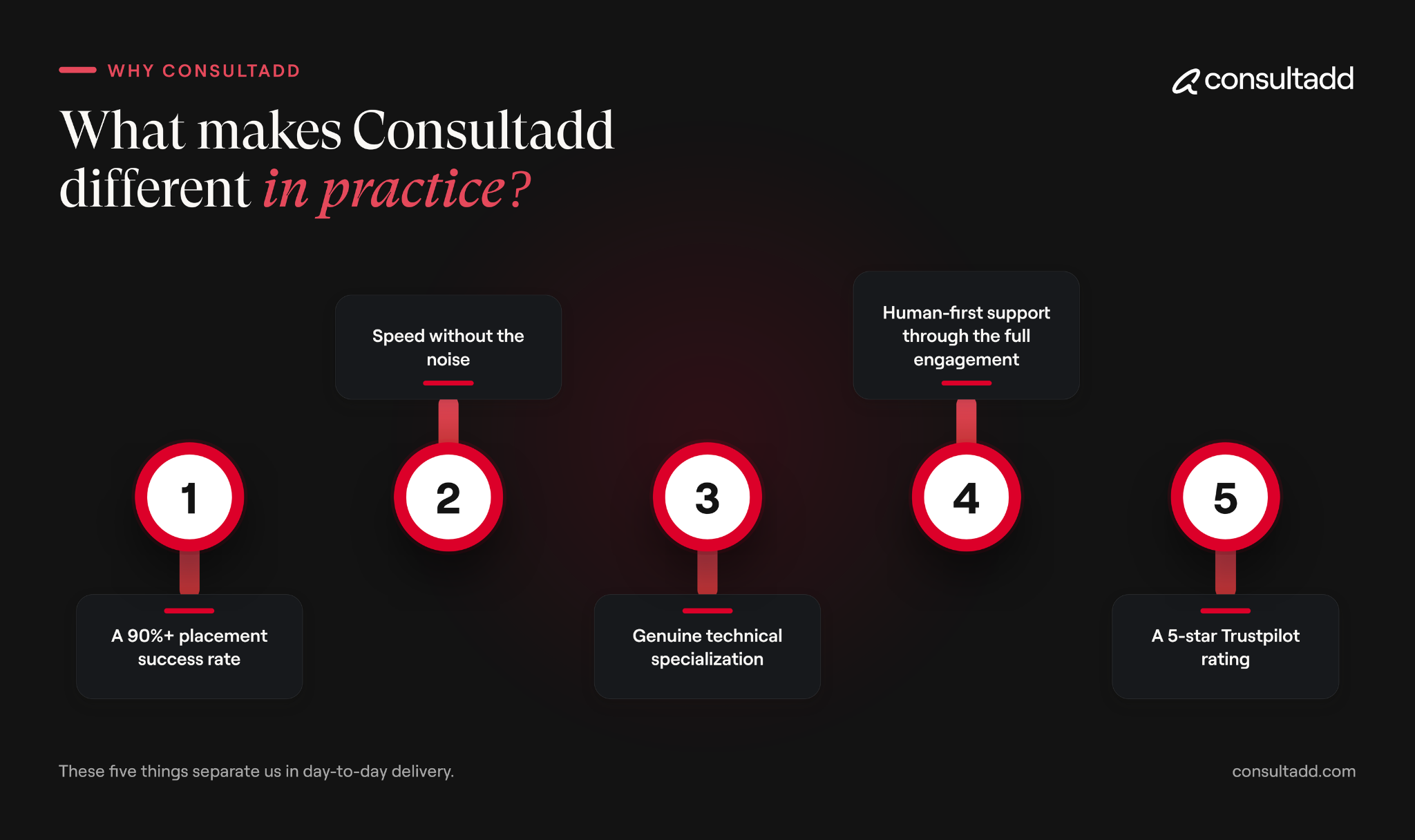
What Makes Consultadd Different in Practice?
A 90% plus placement success rate
Most candidates placed by Consultadd complete their full contract terms, which matters enormously for staffing firms whose client relationships depend on performance continuity.
Speed without the noise
The firm's model cuts recruiter sourcing time significantly. One client described it as cutting their time to find and recruit the right candidate by half. That is not a small efficiency gain in a market where contract roles need to be filled in days, not weeks.
Genuine technical specialization
Thirteen years of focus on a defined set of tech disciplines means Consultadd understands the actual skill requirements for Full Stack, Cloud, and DevOps roles rather than running keyword-matched searches.
The difference between a recruiter who knows what an AWS Solutions Architect actually does and one who is matching job descriptions to resumes shows up immediately in candidate quality.
Human-first support through the full engagement
Consultadd offers one-on-one support from brief through onboarding. Account managers understand individual client needs rather than routing everything through a centralized intake process.
A 5-star TrustPilot rating
That kind of sustained satisfaction across a large volume of placements with demanding staffing firm clients is harder to maintain than most firms acknowledge.
What Consultadd Is Built For?
Consultadd is not trying to be a TEKsystems or an Insight Global.
The firm does not cover 30 technology disciplines or operate 200 offices. What it does, it does with a level of focus that the generalist giants structurally cannot match.
For staffing firms that need a reliable tech talent partner for contract placements in Full Stack, Cloud, and DevOps, Consultadd is worth a conversation before you spend another week on a cold LinkedIn outreach campaign that is not working.
How to Choose the Right IT Staffing Firm for Your Situation
The firm that is right for you depends on a few specific factors. Here is a framework that cuts through the noise:
Start with your actual problem. Are you a company hiring directly for internal roles, or are you a staffing firm looking for a talent partner? Are you filling one specialized contract role or building an entire department? Do you need cleared candidates, global coverage, or deep specialization in a specific technology? Your answer to these questions should determine which type of firm you talk to first.
Match the firm's model to the nature of the work. Contract roles benefit from firms with pre-vetted talent pools. Permanent senior leadership searches benefit from firms with relationship networks and retained search capability. Niche technology roles benefit from firms with specialists, not generalists who cover everything.
Ask about hit rates, not submittal volume. The most useful question you can ask a staffing partner is: what percentage of the candidates you submit result in a hire? High submittal volume with low conversion rates means you are filtering noise on your own time. A firm that submits fewer but better-matched candidates is almost always more valuable.
Check candidate experience track record. Ask how they communicate with candidates during the process, what their average time-to-first-submittal looks like for your role type, and whether they have any candidate satisfaction data. Staffing firms that treat candidates poorly create problems you eventually have to manage.
Do not over-weight brand recognition for specialized roles. The largest firms win on scale, brand recognition, and breadth. They do not always win on depth. For a niche cybersecurity role or a specialized cloud engineering search, a focused firm with a defined practice area often outperforms a large firm running the same sourcing playbook they use for every role.

Start Strong With Consultadd
With 15 years in business and 5,000+ successful staffing engagements, we don't just fill roles, we build reliability into your process. We've supported 65 staffing companies in the past year alone and maintain MSAs with industry leaders like Robert Half and TEKsystems.
Here's what working with Consultadd looks like:
- Talent sourced in under 24 hours
- Ready-to-deploy candidates, vetted for experience and compliance
- Lower turnover risk: we match long-term goals, not just short-term needs
- Seamless compliance: visa, documentation, onboarding? Handled.
- Dedicated 1:1 account managers for responsive, personalized support
- Top 100 candidate matches delivered in the past year
- Strong partnerships with universities to tap into fresh, committed talent
- Post-placement support so your investment grows beyond day one
For candidates, your next opportunity is more than just a job title, it's a chance to build skills, gain experience, and move your career forward. At Consultadd, we connect technology professionals with projects and employers that align with their goals, whether they're looking for contract, contract-to-hire, or long-term opportunities.
The tech job market moves fast, but the right guidance can make all the difference. Ready to take the next step in your career journey? Explore Opportunities >>
Key Takeaways
- Choosing an IT staffing firm by size or brand recognition is a poor proxy for fit.
- Large generalist firms like TEKsystems and Insight Global excel at enterprise-scale, high-volume programs.
- Consultadd fills a distinct position as a specialist tech talent partner for staffing firms, with 13+ years of focus on contract placements in Full Stack, Cloud, and DevOps,
- It has a 90% plus placement success rate, and a track record of working alongside major firms including TEKsystems and Robert Half.
- Enterprise buyers are cutting staffing vendor rosters. Companies going from 10+ vendors to 3 to 4 are consistently finding better outcomes and lower costs.
FAQs
What is the difference between an IT staffing firm and a tech talent partner?
An IT staffing firm typically works directly with companies to fill their internal roles. A tech talent partner, like Consultadd, works with staffing firms themselves, supplying pre-vetted candidates that recruiters can place with their end clients. Both solve a talent gap, but at different points in the hiring chain.
Are larger IT staffing firms always better?
No. Larger firms have scale advantages for high-volume and multi-geography programs. For specialized or niche roles, they frequently lose to smaller firms with dedicated practice areas and deeper candidate relationships in specific technology disciplines.
What should I ask an IT staffing firm before hiring them?
Ask for their average time-to-first-qualified-submittal for your role type, their candidate hit rate over the past 12 months, how they screen technical skills, what their contract flexibility looks like, and how they handle communication with candidates during the process. The answers reveal more than any sales presentation will.
How do IT staffing firms charge for their services?
Contract staffing is typically priced as a markup on the candidate's hourly rate, often 25 to 70% depending on role and market. Direct hire placements are typically charged as a percentage of first-year salary, generally 15 to 30%. Retained search for senior or executive roles often involves an upfront fee. Always get fee structures in writing before starting a search.
Why does Consultadd focus only on contract roles in Full Stack, Cloud, and DevOps?
Specialization is a deliberate choice. A firm that focuses on a defined set of technology disciplines can build and maintain a genuinely vetted talent pool in those areas, rather than covering every IT function at a surface level. For staffing firms placing contract tech talent in these specific disciplines, that depth produces better candidates faster and with fewer mis-hires.

IT Contract Staffing Is Not a Backup Plan. It's a Business Strategy.
Introduction
Here is a framing problem that shows up constantly in conversations about IT contract staffing: companies treat it as what you do when the real plan falls through.
The real plan, in this framing, is hiring a full-time employee. Contract staffing is the consolation prize you use when that takes too long, when budget is uncertain, or when you need someone tomorrow and cannot afford to wait three months for an offer to clear.
That framing is not just wrong. It is expensive.
The companies winning in tech hiring right now are the ones that have stopped treating contract staffing as a fallback and started treating it as a design decision.
- They ask, before a role is even posted, whether this work calls for a permanent headcount addition or a contract engagement.
- They maintain relationships with contract talent pools the same way they maintain relationships with permanent candidates.
- They use the flexibility of contract staffing not because they have to, but because it gives them something permanent hiring cannot: the ability to get the right person into a role in days
This blog is about that mindset shift, and the practical questions that follow from it.
TL;DR:
- IT contract staffing is no longer a backup plan,it's a strategic workforce model that helps companies hire faster, scale efficiently, and reduce hiring risk.
- Choose contract staffing for project-based work, specialized skills, and rapid hiring needs
- The true cost comparison goes beyond salary, as full-time employees include benefits, taxes, onboarding and long-term expenses.
- Many organizations now use a hybrid workforce, combining permanent employees with contract professionals to balance flexibility and business continuity.
- Success depends on planning ahead, partnering with the right staffing firm, and treating contract talent as a long-term workforce asset.
The State of IT Contract Staffing in 2026
Contract and contingent hiring has been growing quietly for years. After three consecutive years of modest contraction in the broader staffing market, 2026 looks like a genuine inflection point.
The American Staffing Association's Staffing Index rose steadily through late 2025, with staffing employment running roughly 4.7% above the same period in 2024.
The Staffing Industry Analysts forecast for 2026 projects the first meaningful growth year since 2022, with the professional services and technology segments expected to outperform the overall market.
More telling than the growth numbers is the shift in how companies are using contract staffing. Analysis from KORE1 covering Q4 2025 through Q1 2026 found that contract-to-hire has become the new default for senior IT roles, with direct hire losing market share in that segment every quarter.
This is not driven by cost alone. It is driven by the reality that permanent hiring cycles are too slow and the penalty for a wrong hire in a senior technical role is too high.
IT staffing searches hit a five-year high in late 2025, consistent with a broader shift from passive to active hiring intent across technology companies. Organizations that had been cautious about headcount through 2024 started moving again, but differently than before. They are prioritizing contract and project-based arrangements over permanent roles, especially for work tied to specific transformation initiatives.
Why the "Backup Plan" Framing Hurts Companies
There is a concrete cost to treating IT contract staffing reactively rather than strategically, and it shows up in a few predictable places.
Slower time-to-fill
- When companies only turn to contract staffing after a permanent search has stalled, they have already lost weeks.
- Specialized IT contract talent, especially in areas like cloud security, AI implementation, and DevSecOps, is in short supply.
- Getting ahead of that curve means maintaining relationships with contract talent pools before you need them, not starting a search from scratch when a project deadline is three weeks out.
Worse candidate quality:
- The best contract IT professionals have options. They gravitate toward companies that treat contract engagements professionally, communicate clearly about scope and duration, and pay on time without friction.
- Companies that only engage contract staffing in crisis mode often end up with whoever is available that week rather than who they actually need.
Missed evaluation opportunity:
- One of the genuine advantages of contract staffing is that it lets companies evaluate someone's work before making a permanent offer.
- Contract-to-hire arrangements reduce hiring risk significantly. But this only works if the engagement is structured thoughtfully from the start, not cobbled together in a rush.
The Real Cost Math
The cost comparison between contract and permanent IT hiring is more nuanced than most people realize. Here is what the numbers actually show.
The visible cost of a contractor is higher on an hourly basis. Contract IT professionals typically bill at rates that can look 2 to 3 times higher than equivalent permanent salary if you only compare base compensation. That comparison is misleading.
Full-time employees carry significant costs beyond salary. Benefits packages, healthcare contributions, paid leave, payroll taxes, and onboarding expenses typically add 25 to 40 percent to the stated salary. That means a $100,000 salaried engineer actually costs $125,000 to $140,000 or more per year, before accounting for the time and internal resources spent recruiting them.
That said, contract staffing is not always the cheaper option. For roles that need to stay in place for two or more years, require deep institutional knowledge, or carry strategic leadership responsibility, the math often flips.
The cost of continuous contract renewal, combined with the loss of retention and cultural integration that comes with permanent employment, can make permanent hiring more economical at longer time horizons.
The right framework is not "which model is cheaper" in the abstract. It is "which model fits the actual nature and duration of this work."
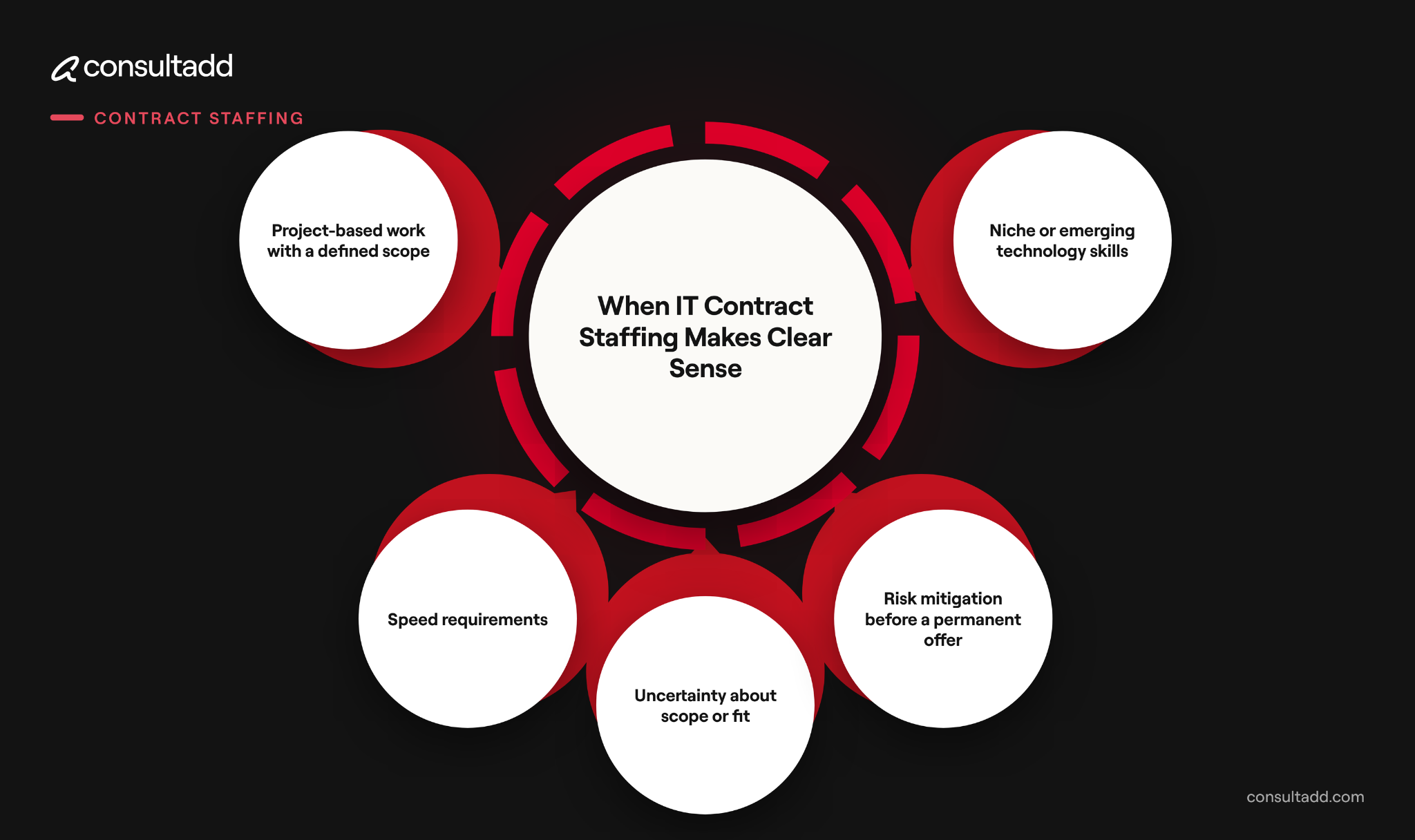
When IT Contract Staffing Makes Clear Sense
There are specific situations where contract staffing is not just a reasonable option but the obviously correct one. Here are the patterns that show up most often:
Project-based work with a defined scope:
- Cloud migrations, system overhauls, security audits, platform builds, and similar initiatives have start and end points.
- Hiring permanent employees for work that has a clear conclusion creates a retention and offboarding problem that does not need to exist. Contract staffing aligns the workforce with the work.
Niche or emerging technology skills:
- AI engineering, cloud security, and advanced data science roles require specialization that may not need to live permanently in your organization.
- A 12-month contract with a specialist who has done this exact thing at three other companies often produces better results than trying to upskill a generalist or hiring someone into a permanent role whose peak value is front-loaded.
Speed requirements:
- Specialized contract staffing firms maintain pre-vetted talent pools. Getting a qualified engineer onboard in days rather than months is genuinely possible with the right partner.
- For projects where time-to-productivity matters, this is a meaningful operational advantage.
Uncertainty about scope or fit:
- When a company is not sure yet whether a function needs to be permanent, or when the skills required are likely to shift as a project evolves, contract staffing provides room to learn before committing.
- This is especially valuable in organizations going through significant technology change.
Risk mitigation before a permanent offer:
- Contract-to-hire arrangements give both sides time to evaluate fit before making a long-term commitment.
- Research consistently shows that early-stage mis-hires are expensive, disruptive, and hard to reverse quickly.
- Starting with a contract period reduces that exposure.
When IT Contract Staffing Is the Wrong Tool
Being clear about when contract staffing does not fit is just as important.
Core long-term roles:
- Functions that require deep institutional knowledge, leadership continuity, or strong cultural alignment are generally better served by permanent hires.
- The cost of losing that institutional knowledge when a contract ends can outweigh the flexibility benefits.
Roles requiring long-term investment:
- Some positions justify years of onboarding, training, and development.
- If you are building a leadership pipeline or investing in someone whose value compounds over time, contract staffing is not the right vehicle.
When team cohesion is a priority:
- Research consistently finds that permanent employees show higher organizational citizenship behaviors: they mentor colleagues, suggest improvements, and contribute to team culture in ways that contract workers typically do not.
- If team cohesion is a strategic priority, over-relying on contract staffing can erode it.
When the math does not work at longer durations:
- As noted above, the cost advantage of contract staffing narrows and eventually reverses at longer time horizons.
- If a role is genuinely permanent and the skills are not especially scarce, building that headcount into a permanent hire often makes more financial sense.
Read more about IT staffing done right.
The Hybrid Workforce Model: Where Most Companies Are Landing
The companies doing this well are not choosing between contract and permanent. They are building workforce architectures that deliberately combine both.
A typical model looks like this: a permanent core team handles long-term operations, institutional knowledge, leadership, and culture. Contract professionals provide surge capacity for defined projects, fill specialized roles during peak demand, and plug gaps while permanent searches are underway.
This blended approach is increasingly embedded in workforce planning rather than treated as an exception. Organizations exploring flexible workforce models are assessing how contract IT staffing supports both immediate needs and long-term digital roadmaps, not just how it covers short-term gaps.
The shift that matters is from reactive to proactive. The organizations that get the most out of IT contract staffing maintain warm relationships with contract talent before they need them, track their vendor relationships actively, and plan contract engagements with the same rigor they apply to permanent hires.
Contract Hiring vs Permanent Hiring
What the IT Contract Talent Market Looks Like Right Now
A few specific dynamics are shaping the contract talent market in 2026 that are worth understanding before you start a search.
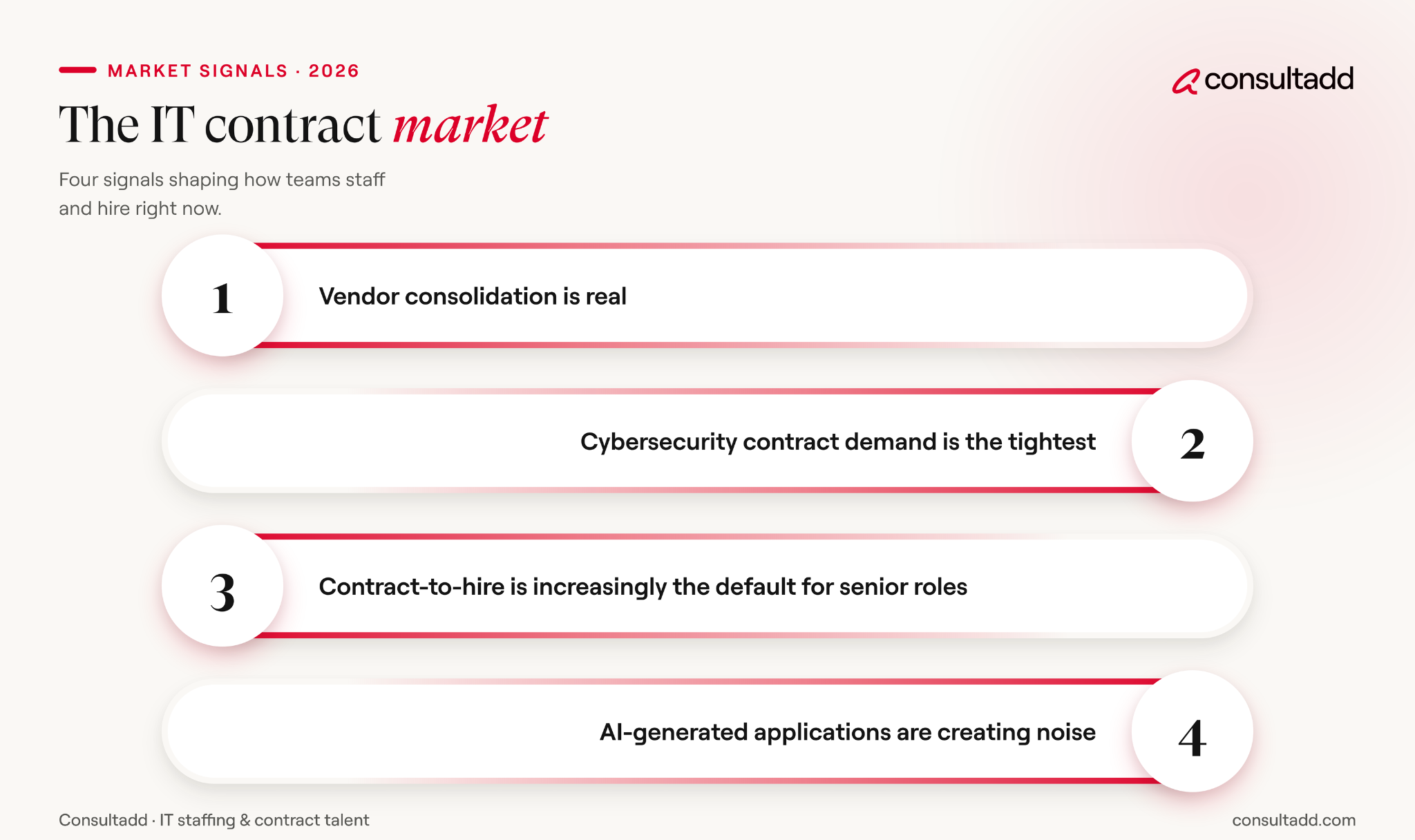
Vendor consolidation is real:
- Enterprise buyers are cutting their staffing vendor rosters significantly. A financial services company tracked by KORE1 cut from eleven active IT vendors to four at the start of Q1 2026 and saved 22 percent on staffing costs while actually improving time-to-fill.
- The lesson: working with fewer, higher-performing partners often produces better results than spreading searches across a long vendor list.
Cybersecurity contract demand is the tightest:
- In the KORE1 data, a federal contractor searching for four cleared cloud security engineers across six weeks and four agencies surfaced exactly three qualified candidates.
- If cybersecurity contract roles are on your roadmap, start the search earlier than you think you need to.
Contract-to-hire is increasingly the default for senior roles:
- For senior IT positions, both companies and candidates have started to prefer contract engagements as an evaluation period before permanent employment.
- The mutual risk reduction is appealing on both sides.
AI-generated applications are creating noise:
- The volume problem in permanent hiring is spilling into contract staffing as well.
- Pre-vetted talent pools maintained by specialized staffing firms are worth more than they used to be, because they filter out the volume problem before it hits your desk.
How to Get More Out of IT Contract Staffing
A few practical points that consistently separate companies that use contract staffing well from those that do not:
Treat contract professionals like professionals:
- Onboarding processes, clear scope documentation, timely payments, and genuine communication about project status affect contractor experience and, by extension, contractor performance.
- Word travels in specialized talent communities.
Define scope before you search:
- The more specific you can be about what success looks like, the duration of the engagement, the technologies involved, and the deliverables expected, the better the match you will get from a staffing partner.
Invest in a real onboarding process:
- Contract professionals typically require minimal training on their technical specialty.
- But they do need context: how the team works, where the relevant documentation lives, who the stakeholders are, what the communication norms are.
Maintain relationships between engagements:
- If a contractor performed well, stay in contact.
- The IT contract talent market is small enough that re-engaging a known quantity is almost always faster and lower-risk than starting a fresh search.
Use data to evaluate your staffing vendors:
- Track which partners are submitting candidates that actually land. The KORE1 data on enterprise vendor consolidation found that most agencies on a typical roster were submitting resumes without landing hires.
- Measuring hit rates over 24 months of actuals produces a very different picture than the one agencies present in their sales conversations.
Start Strong With Consultadd
With 15 years in business and 5,000+ successful staffing engagements, we don't just fill roles, we build reliability into your process. We've supported 65 staffing companies in the past year alone and maintain MSAs with industry leaders like Robert Half and TEKsystems.
Here's what working with Consultadd looks like:
- Talent sourced in under 24 hours
- Ready-to-deploy candidates, vetted for experience and compliance
- Lower turnover risk: we match long-term goals, not just short-term needs
- Seamless compliance: visa, documentation, onboarding? Handled.
- Dedicated 1:1 account managers for responsive, personalized support
- Top 100 candidate matches delivered in the past year
- Strong partnerships with universities to tap into fresh, committed talent
- Post-placement support so your investment grows beyond day one
For candidates, your next opportunity is more than just a job title, it's a chance to build skills, gain experience, and move your career forward. At Consultadd, we connect technology professionals with projects and employers that align with their goals, whether they're looking for contract, contract-to-hire, or long-term opportunities.
The tech job market moves fast, but the right guidance can make all the difference. Ready to take the next step in your career journey? Explore Opportunities >>
Key Takeaways
- IT contract staffing works best when it is treated as a deliberate design decision rather than a fallback when permanent hiring stalls.
- The cost comparison between contract and permanent hiring requires including total employment costs. Benefits, payroll taxes, and onboarding expenses add 25 to 40 percent to salary, making contract arrangements more cost-competitive than headline hourly rates suggest.
- Contract-to-hire has become the default for senior IT roles, with both companies and candidates using it as a lower-risk evaluation period before permanent employment.
- Cybersecurity and cloud security contract talent is the tightest segment in the current market, requiring longer lead times than most other IT roles.
FAQs
What is IT contract staffing?
IT contract staffing involves hiring technology professionals for a defined period or specific project rather than as permanent employees. The staffing agency typically manages payroll, compliance, and benefits for the contract worker, while the client company directs the day-to-day work.
How is IT contract staffing different from staff augmentation?
They are closely related and the terms are often used interchangeably. Staff augmentation typically refers to extending an existing in-house team with external contract professionals who work as part of your team. In practice, the distinction matters less than the specifics of how the engagement is structured.
Is IT contract staffing more expensive than permanent hiring?
On an hourly basis, contract rates are typically higher than equivalent salary. But total employment costs for permanent employees, including benefits, payroll taxes, paid leave, and onboarding, typically add 25 to 40 percent to the stated salary. For project-based or short-duration work, contract staffing is often more cost-effective.
What IT roles are best suited for contract staffing?
Project-based roles with defined scopes and timelines are the clearest fit. Specialized areas where niche expertise is needed for a limited period, such as cloud migration, cybersecurity assessments, AI implementation, or platform builds, are also strong candidates.
What is a contract-to-hire arrangement?
Contract-to-hire means a professional starts in a contract role with an explicit or implicit understanding that the company may offer permanent employment after an evaluation period, typically three to six months. Both sides benefit from the arrangement.
How do we evaluate whether a staffing partner is performing?
Track hit rates over time, meaning what percentage of candidates a vendor submits actually results in a hire, not just what volume they are submitting. Also track time-to-fill, quality of first-round candidates, and retention of placed contractors past the 90-day mark.
What should we watch out for in IT contract staffing?
Worker misclassification is the most significant legal risk. If a contract arrangement effectively makes someone a de facto employee, including directing their work closely, providing equipment, and controlling their schedule, classification rules may require treating them as an employee.
.png)
IT Staffing Done Right: Best Practices
Introduction
IT staffing today is more competitive than ever. Many candidates receive multiple offers within days, understand their value, and expect more than just a paycheck. Hiring someone who is merely “good enough” can lead to missed deadlines, budget overruns, and low team morale.
That’s why IT staffing requires careful planning and a thoughtful approach, not rushed decisions or one-size-fits-all solutions.
In this blog, we share the best practices for IT staffing in 2025, what actually works, what mistakes you may be making as hiring managers, and how to solve real-world challenges with smarter strategies. Keep reading!
TL;DR
- Align hiring with business goals. Define your technical requirements and project objectives before starting the hiring process.
- Focus on skills, not just qualifications. Prioritize hands-on experience, certifications, and practical abilities over degrees alone.
- Make hiring faster and more flexible. Use agile hiring practices, remote talent, and specialized IT staffing partners to secure top candidates quickly.
- Invest in people after hiring. Upskilling, regular feedback, and an inclusive workplace improve employee performance and retention.
- Use data to improve hiring decisions. Track hiring metrics and stay updated on technology trends to build stronger teams over time.
What is IT Staffing?
IT staffing is the process of hiring skilled tech professionals, either temporarily or permanently, to support your company’s technology needs. It includes roles like developers, system admins, data analysts, cybersecurity experts, and IT support specialists.
If your team is overloaded or lacks key technical skills, IT staffing fills the gaps fast. It’s ideal for:
- Meeting tight project deadlines
- Filling skill-specific roles
- Avoiding long recruitment cycles
No long-term contracts. No unnecessary payroll costs. You only pay for what you need.
IT staffing also helps prevent burnout and delays, keeping your projects on track and your team focused.
Now, let’s look at the 11 best practices for IT staffing that make it truly effective.
11 Best Practices for Successful IT Staffing
Hiring in tech is no longer just about filling vacant positions in your team. It’s about building adaptable, skilled teams that support real business growth. If you’re scaling fast or modernizing systems, getting IT staffing right can make or break your progress. These are the best practices for IT staffing that will help you stay focused on results, not just resumes.
1. Understand Your Business Goals and Technical Needs
A common mistake in IT staffing is hiring without clearly defined goals. Even top candidates can underperform if their skills don’t match your needs.
Start by outlining your business objectives, like launching a digital product, migrating to the cloud, or improving cybersecurity. Then define the project scope:
- Timeline and key milestones
- Expected deliverables
- Tools and frameworks involved
- Cross-team collaboration needs
For instance, expanding a data team calls for candidates skilled in Snowflake or Python, not outdated platforms. Hiring for both technical fit and strategic goals helps lower long-term costs and strengthens team performance.
When working with experienced IT staffing partners like Consultadd, these discussions are baked into the process. We start with business priorities and build candidate pipelines accordingly.
2. Prioritize Skills Over Degrees
In today's rapidly evolving tech world, practical skills matter more than academic degrees. Traditional education often lags behind modern technologies like cloud-native systems or container orchestration.
Focus on what candidates can do, not just what they’ve studied. A self-taught engineer with DevOps experience may outperform a graduate with no deployment history. Roles in data science, cybersecurity, and machine learning now demand hands-on expertise.
Look for:
- Certifications (AWS, Azure, GCP)
- GitHub/GitLab contributions
- Project portfolios
- Technical assessment performance
This approach widens your talent pool, improves diversity, and boosts team efficiency from day one.
3. Work with Specialized IT Staffing Partners
Hiring in tech is not a cakewalk. The right talent is scarce, and top candidates rarely stay on the market for long. That’s why working with a dedicated IT staffing partner isn’t just helpful, it’s often essential.
With the right IT staffing partner, you gain instant access to:
- Pre-screened and vetted candidates
- Talent matched to your tech stack and project needs
- Candidates ready for interviews, not just resume reviews
One of the best practices for IT staffing today is simply this: Don’t do it alone when you don’t have to.
4. Embrace Remote and Hybrid Talent Models
Remote work didn’t just shift where people work; it changed how companies hire. Limiting searches to your local area narrows your talent pool and expertise.
With cloud tools and async workflows, distributed teams perform as well as on-site ones. A 2024 Gallup report shows that 52% of U.S. full-time employees now prefer a hybrid setup. Another 27% want fully remote roles. Ignoring this trend can lead to more rejections and slower hiring.
Remote models offer:
- Access to niche skills nationwide or globally
- Reduced overhead
- More diverse, inclusive teams
These models aren’t just flexible but strategic as well. And when done right, they reduce overhead without affecting productivity.
5. Build a Strong Employer Brand
IT professionals want more than a job; they want to join a culture. That’s why a strong employer brand is key. Candidates today look for growth, flexibility, real challenges, and transparency. Salary matters, but so do team dynamics and learning opportunities.
To stand out:
- Share updates on LinkedIn about culture and tech projects
- Respond to reviews on Glassdoor, good or bad
- Highlight upskilling and project ownership opportunities
- Make job descriptions more human and project-focused
6. Implement Agile Hiring Processes
Speed is everything in tech hiring. You may lose your best-fit candidate not because someone else pays more, but because they acted faster.
The best practices for IT staffing emphasize agility. Long, clunky processes increase dropout rates. Candidates expect quick feedback and clear timelines.
Agile hiring doesn’t mean you skip steps; it means you run them better. Here’s how:
- Use tech tools to streamline each stage. Applicant tracking systems (ATS) organize resumes and schedule interviews faster.
- Add structured video interviews for early-stage screening. They reduce delays and save time for both sides.
- Use automated coding assessments for developer roles. These filter strong candidates early and reduce reliance on manual screening.
Want to hire faster and onboard reliable tech talent at the earliest? Do it the best way with Consultadd! Contact Us Now>>
7. Focus on Diversity and Inclusion
Diverse tech teams solve problems faster and create better user experiences. That’s why inclusion matters in IT staffing.
Diversity goes beyond gender or ethnicity; it includes education, age, geography, and experience. Inclusive teams challenge groupthink and drive innovation.
Diverse executive teams were 39% more likely to outperform their peers in profitability. That’s not just a stat, it’s proof that diversity directly impacts business outcomes.
Here’s how you can support it:
- Simplify job descriptions to welcome non-traditional candidates
- Use blind resume tools to reduce bias
- Source talent from multiple, diverse platforms
- Train interviewers to use structured, fair evaluations
Building inclusive hiring habits leads to stronger, more future-ready teams.
8. Invest in Upskilling and Training
One of the best practices for IT staffing is to treat talent as a long-term investment, not a short-term fix. IT talent is a long-term investment. Without growth, even top performers lose motivation or leave.
Upskilling reduces hiring pressure by allowing you to train the best candidates instead of waiting for a perfect fit.
What helps:
- Offer structured paths like certifications and project mentoring
- Promote cross-functional learning across roles
- Tie training to promotions or high-impact projects
This speeds up productivity and strengthens retention by showing employees that their growth matters.
9. Monitor Performance and Cultural Fit
Hiring the right talent is only the first step. The real success shows up once your new team member starts working. That’s why regular check-ins matter.
Start with a structured feedback loop in the first 30, 60, and 90 days. This helps you spot early signs of mismatch, whether it’s in technical performance or team alignment.
Here’s what you can track:
- Task completion timelines
- Code quality or QA metrics (for dev roles)
- Collaboration with cross-functional teams
- Feedback from team meetings or one-on-ones
One of the best practices for IT staffing is keeping an eye on both performance and cultural fit. If someone writes perfect code but disrupts teamwork, that’s a hiring issue, just delayed.
Build a feedback culture from day one. It saves you from long-term issues and helps new hires feel supported and accountable.
10. Stay Updated with Market Trends and Tech Shifts
Programming languages, cloud computing platforms, and AI tools keep changing. You need to hire for today and prepare for tomorrow.
For instance, Python, TypeScript, and Go are gaining traction in AI and cloud-native applications. Companies investing in multi-cloud strategies now look for DevOps engineers familiar with both AWS and GCP.
If your hiring strategy doesn’t evolve with these changes, you’ll always be behind. You’ll struggle to find skilled candidates or end up hiring for roles that are becoming irrelevant.
Here’s how to keep up:
- Subscribe to credible tech news sources.
- Follow developers and engineers on LinkedIn.
- Review job trends quarterly.
- Ask your internal teams what tools they want to explore next.
11. Use Data-Driven Decision Making in Hiring
Good hiring is measurable. When you use data to guide decisions, you improve your hiring process over time and reduce waste.
Start by tracking key metrics:
- Time-to-hire: How long does it take from posting to offer
- Cost-per-hire: Total recruitment spend per candidate
- Quality-of-hire: Performance and retention after onboarding
These numbers give you clarity. They show where delays happen, which channels bring the best candidates, and what quality looks like over time.
Data also helps you reduce turnover. For example, if certain roles see high exits in the first six months, dig into why.
Staffing partners like Consultadd use hiring intelligence tools to support clients with these insights. These systems track applicant behavior, skill benchmarks, and interview conversions, helping you hire smarter, not harder. Explore how>>
Benefits of Partnering With the Right IT Staffing Agency
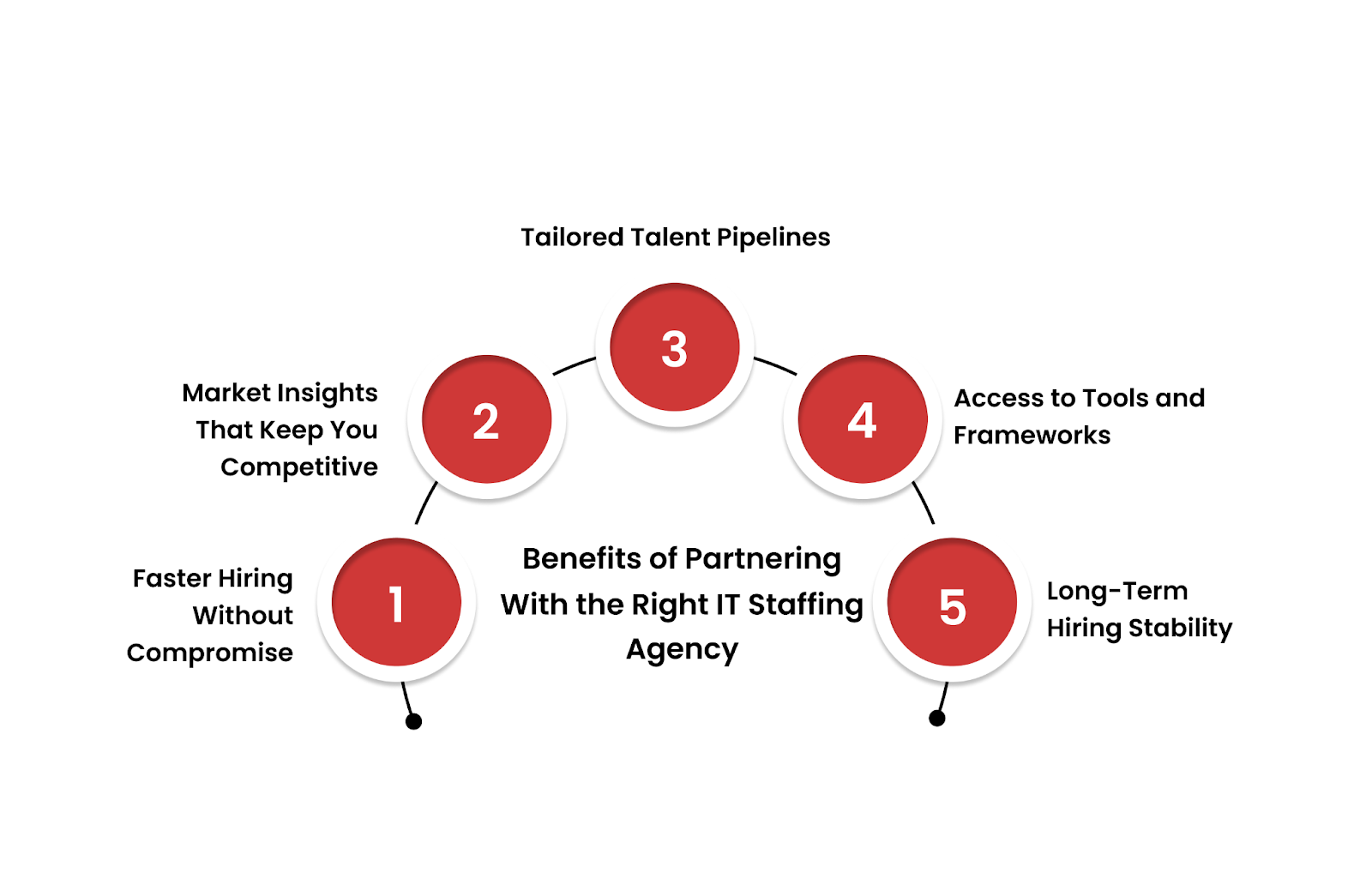
Working with a specialized IT staffing agency offers more than just help filling roles. It gives you access to targeted hiring strategies built around your needs. Here’s how it benefits:
- Faster Hiring Without Compromise
Top agencies reduce the time you spend screening resumes and scheduling interviews. They present qualified candidates who align with your technical and business goals.
- Market Insights That Keep You Competitive
Staffing experts understand current salary expectations, in-demand skills, and hiring trends. This helps you avoid overpaying or underpaying top talent.
- Tailored Talent Pipelines
One of the best things about IT staffing is getting access to customized candidate pools. A reliable agency maintains active pipelines tailored to your project scope and technical stack.
- Access to Tools and Frameworks
Agencies often use proven assessment methods, structured interviews, and technical evaluations. These support the best practices for IT staffing by improving hiring quality at every step.
- Long-Term Hiring Stability
Instead of reacting to talent shortages, you build a steady system for acquiring and retaining skilled professionals.
The best practices for IT staffing help you move beyond guesswork. They consistently hire in alignment with business goals, team dynamics, and future demands. Whether you're hiring one developer or scaling an entire team, success starts with clarity, not speed. We hope this blog helps you get it done the right way.
Start Strong With Consultadd
Working with an experienced partner like Consultadd ensures you hire smarter. From structured processes to real-time market insights, we help you avoid costly missteps and build teams that deliver from day one.
In a market where great tech talent is hard to find and harder to keep, your approach to staffing makes all the difference. Looking to build a future-ready tech team? Contact Us>>
Key Takeaways
- Define your hiring goals first so you bring in people with the right technical skills for your business needs.
- Hire based on skills and experience, not just degrees, and partner with IT staffing experts to find quality talent faster.
- Offer remote or hybrid work, build a strong employer brand, and keep your hiring process fast to attract top candidates.
- Invest in employee growth, encourage diversity, and regularly check performance and team fit to improve retention.
- Track hiring metrics, stay updated on tech trends, and use data to make smarter hiring decisions over time.
FAQs
What is IT staffing?
IT staffing is the process of hiring technology professionals on a temporary, contract, or permanent basis to meet an organization's technical needs.
Why is IT staffing important?
It helps businesses quickly fill skill gaps, complete projects on time, reduce hiring costs, and access specialized technical expertise.
What are the best practices for IT staffing?
Some of the most effective practices include defining hiring goals, prioritizing skills over degrees, speeding up the hiring process, investing in employee development, and using hiring data to make better decisions.
How can an IT staffing agency help?
An IT staffing agency provides access to pre-screened candidates, industry expertise, faster hiring processes, and market insights to help companies find the right talent efficiently.
How do companies improve IT hiring success?
Companies can improve hiring success by offering flexible work options, building a strong employer brand, creating an inclusive hiring process, and continuously monitoring hiring performance and market trends.