
.avif)

Introduction
If you searched for h1b visa jobs this month, here's the first thing worth knowing: the FY2027 cap is closed. USCIS confirmed in July 2026 that it had received enough petitions to hit the congressional limit, and there was no second lottery.
Anyone starting a cap-subject job hunt today is aiming at the March 2027 registration window and an October 2027 start date.
That's the calendar. The rules also changed underneath it. The random lottery is gone, replaced by a wage-weighted draw where your offered salary determines how many entries you get.
Filing costs have been in and out of court all year. If you're using advice from 2023, throw it out.
This is a practical read for candidates. What counts as an h1b visa job, where sponsorship actually exists, what your odds look like at each wage level, and what to do between now and next March.
TL;DR
- The FY2027 cap closed in mid-2026. Cap-subject registration for FY2028 opens around early March 2027, with start dates no earlier than October 1, 2027.
- The lottery is now weighted by wage level. Level IV offers get four entries, Level III three, Level II two, Level I one.
- Cap-exempt employers, universities, affiliated nonprofits, and qualifying research organizations can file year-round with no lottery at all.
- H1B transfers and extensions for people already in status are not subject to the cap, so job-hopping mid-status is a different and easier process.
- The $100,000 entry fee from the September 2025 proclamation is not currently enforceable, but the policy environment is unstable enough that timing matters more than usual.
What counts as an H1B visa job
Not every job posting that says "visa sponsorship available" is an H1B job. The category is narrower than it looks.
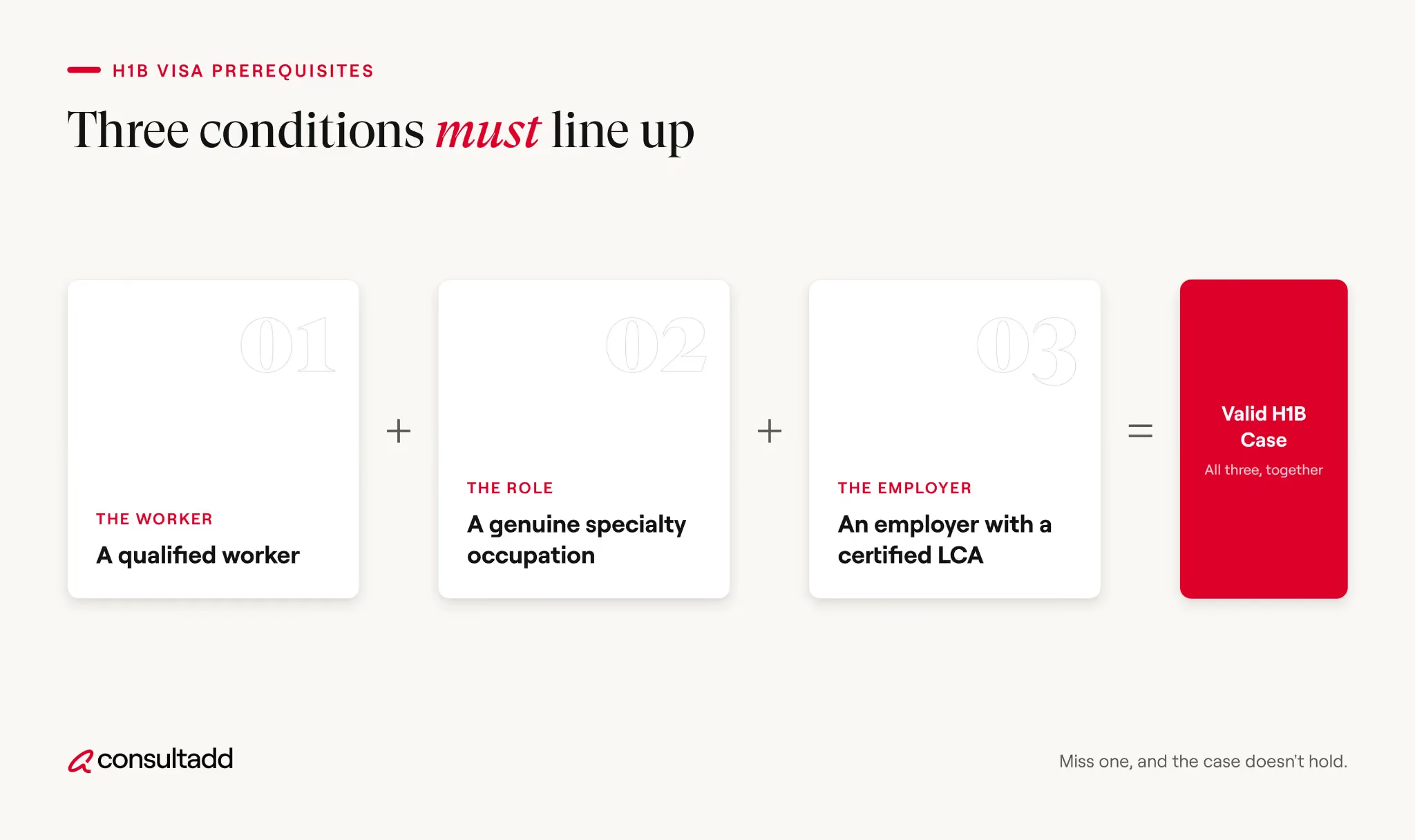
1. It has to be a specialty occupation
USCIS defines the H1B as a nonimmigrant classification for specialty occupations, which means the role needs at minimum a bachelor's degree or the equivalent in a field directly related to the duties.
Software engineering, data science, actuarial work, accounting, architecture, and most clinical and research roles qualify. Generalist operations and support roles usually don't.
The initial grant runs up to three years, with one extension available for a six-year total. Longer stays are possible in specific situations, generally tied to a pending green card case.
USCIS keeps the current requirements and active alerts on its H-1B specialty occupations page.
2. You can't apply for one yourself
The employer files the petition.
There is no self-petition route on an H1B, which means your entire search is really a search for a sponsoring employer, not for a visa.
It also means anyone offering to sell you sponsorship is offering something illegal.
3. Cap-subject and cap-exempt are two different job markets
This distinction does more work than almost anything else in an H1B job search, and most candidates never get told about it.
That last row deserves emphasis. Cap-exempt status doesn't carry over.
If you take a university role and then get an offer from a private company, you generally go into the March lottery as a new applicant. Plan the second move before you make the first.
What changed in 2026, and why it affects your search
Three things shifted, and they pull in different directions.
1. The lottery is now weighted by wage
DHS published its final rule on weighted selection on December 29, 2025, effective February 27, 2026. FY2027 was the first cap season run entirely under it.
Registrants now have to submit the SOC occupation code, the area of intended employment, and the highest Department of Labor wage level the offered salary meets.
Entries are then allocated by tier.
Two mechanics matter for candidates:
- First, each beneficiary is still counted once no matter how many employers register you, so multiple registrations don't multiply your odds.
- Second, USCIS assigns you the lowest applicable wage level across all registrations filed on your behalf. One low-balled registration can drag down an otherwise strong position.
The full rule, including DHS's own responses to public comments, is on the Federal Register.
The practical read: an entry-level offer at Level I is now the hardest H1B path there is. A mid-career offer at Level III or IV is meaningfully better positioned than it was under the old coin flip.
2. The $100,000 fee is off, for now
Proclamation 10973, signed September 19, 2025, required a $100,000 payment on certain new H1B petitions for beneficiaries outside the United States.
It never applied to change of status, extension, or amendment filings for people already in the US.
A federal district court in Massachusetts vacated the implementing policy on June 8, 2026, holding it functioned as a tax the executive branch lacked authority to impose.
The First Circuit declined to reinstate it on July 24, 2026, so the fee is not currently enforceable. The proclamation expires by its own terms on September 20, 2026 unless extended, and DHS has separately opened a rulemaking on a proposed $103,265 charge.
None of this is settled. If your offer involves consular processing from abroad, ask your employer's immigration counsel what the status is the week they file, not the month before.
3. Prevailing wages may be going up
DOL issued a proposed rule in late March 2026 that would raise all four wage levels by shifting their OEWS percentile thresholds.
Level I would move from roughly the 17th percentile to the 34th, Level II from the 34th to the 52nd, Level III from the 50th to the 70th, and Level IV from the 67th to the 88th.
Nothing is final, but combined with the weighted lottery it points the same way: sponsorship is getting more expensive and more concentrated at higher salary bands.
DOL publishes the current wage framework at flag.dol.gov.
Also worth knowing if you're joining a consulting firm: a DHS final rule effective September 9, 2026 extends the 9-11 biometric fee to all H1B and L petitions filed by covered employers, meaning companies with 50 or more US employees where more than half hold H1B or L status. That's a real cost line for some sponsors.
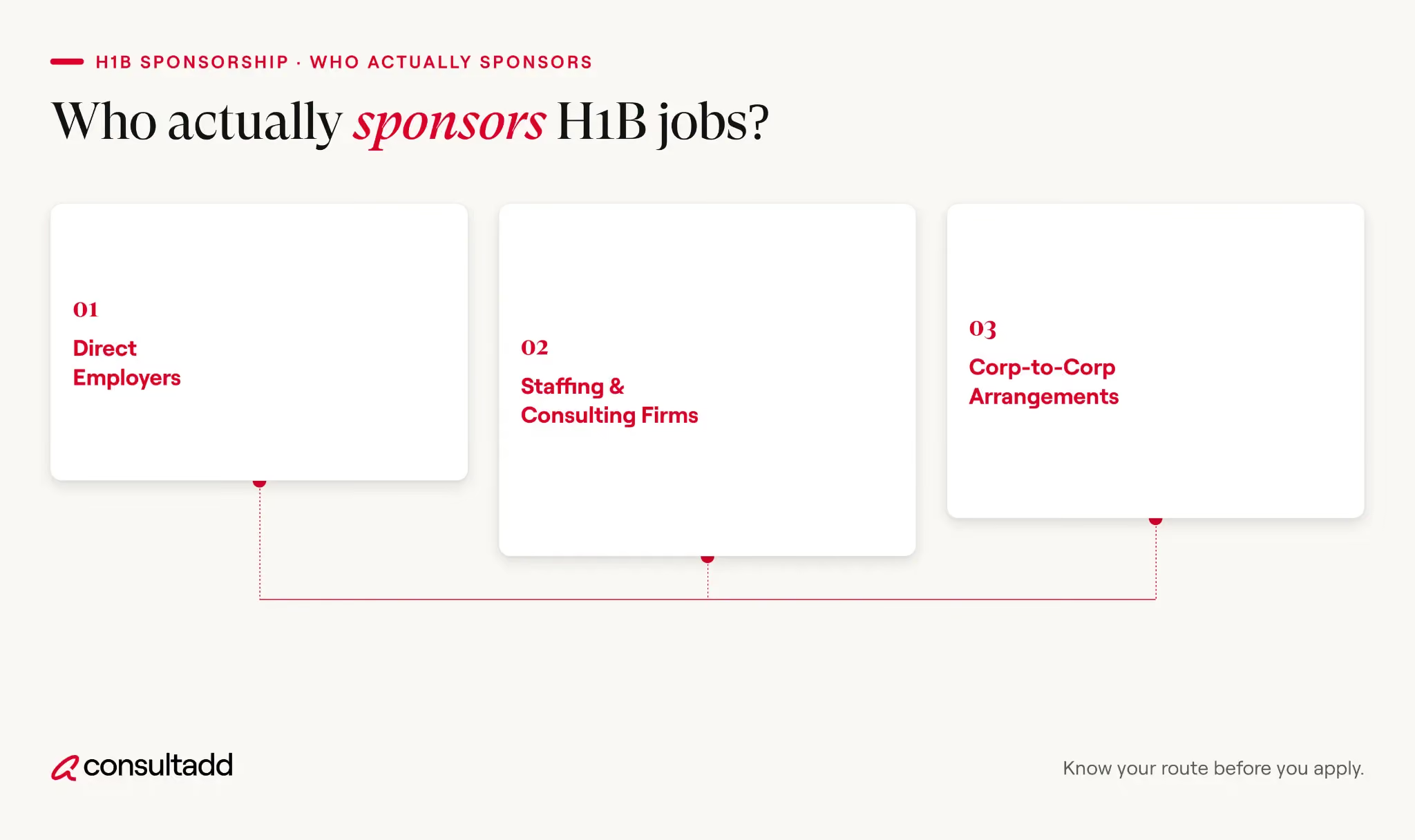
Where H1B visa jobs actually are
Sponsorship clusters. It isn't spread evenly across the economy, and knowing where it sits saves months:
1. Large tech and product companies. Established immigration teams, high wage levels, but the most competitive interview loops.
2. IT staffing and consulting firms. This is where a large share of H1B volume has always lived. The upside is infrastructure: in-house immigration support, experience with cap-gap and transfers, and in some cases access to cap-exempt client placements.
Consultadd's guide to sponsoring an H1B visa walks through how that works in practice.
3. Healthcare systems and research hospitals. Many are cap-exempt or affiliated with cap-exempt institutions.
4. Universities and nonprofit research. No cap, no lottery, year-round filing. Salaries tend to be lower.
5. Financial services and insurance. Steady sponsorship in quant, risk, and engineering roles.
Two ways to verify a company sponsors before you spend time applying:
- Check public LCA filing data, and look at whether the job posting names a specific wage or wage level.
- Postings that dodge compensation entirely are harder to evaluate under a wage-weighted system.
If you're weighing employer types, the comparison of top IT staffing companies in the USA covers which firms run active visa programs.
The timeline you're working against
FY2026 gives a reliable template for what FY2027 will look like.
Work backwards from March. That means interviewing in the autumn and having an offer in hand by January or February. Starting a sponsorship-dependent search in February is starting late.
How to improve your position, not just your resume
Under the old lottery, all you could do was get an offer. Now the offer's structure matters.
- Negotiate on wage level, not just salary. Ask which DOL wage level the offered salary meets for that SOC code and metro area. The answer literally sets your number of lottery entries.
- Don't spread registrations thin. Extra employers don't add entries, and the lowest wage level among them is the one that counts.
- Target roles a tier above entry. An additional year of experience that moves an offer from Level I to Level II doubles your entries.
- Keep cap-exempt options open. No lottery, year-round filing. Worth a parallel track even if it isn't your first choice.
- Ask about the transfer path. If you're already in H1B status, changing employers is a transfer, not a new lottery entry. That's a much shorter conversation.
- Get the compliance details straight. Job title, duties, wage, and worksite have to stay consistent across the LCA, the petition, and reality. Inconsistency draws RFEs.
For candidates working through staffing firms, the mechanics of who employs you and who sponsors you can get confusing. Corp to corp visa sponsorship for H1B jobs breaks down that structure.
Red flags in H1B visa job listings
Some of these are common enough to be worth naming plainly.
- Anyone asking you to pay for sponsorship, the registration fee, or a "processing charge." Employer-paid fees are a legal requirement, not a courtesy.
- A promise of guaranteed selection. Nobody controls the draw.
- A posting with no wage information and a recruiter who won't say the wage level.
- Pressure to accept a lower salary "just for the petition," with a raise promised after approval. That creates a compliance problem and lowers your lottery entries.
- Vague job duties. The petition has to describe a specialty occupation specifically.
If you're on OPT or STEM OPT
Your position is better than most, because you're already in the US and a change of status filing avoids consular processing entirely. That also kept you outside the scope of the $100,000 proclamation while it was in force.
The thing to watch is the gap. If your OPT expires while a timely-filed H1B petition is pending, cap-gap relief can bridge it, but the timing is tight and depends on filing early in the cycle. Line up an employer who has done this before rather than one learning on your case.
The weighted lottery cuts against new graduates specifically, since entry-level offers usually sit at Level I.
That's the strongest argument for taking a role with a higher wage level even if it's less exciting on paper, or for going the cap-exempt route while you build experience.
Where to start
Searching for H1B visa jobs in 2026 is less about volume of applications and more about picking the right lane.
Cap-subject roles need an offer locked in months before March. Cap-exempt roles are open year-round but pay differently. Transfers are the easiest path of all if you already hold status.
The one shift worth internalizing: your salary is now part of your immigration strategy, not just your compensation. A conversation about wage level during negotiation does more for your odds than fifty more applications.
If you're comparing engagement models before you commit, the IT staffing services models guide lays out how contract, contract-to-hire, and direct sponsorship differ.
Start Strong With Consultadd
With 15 years in business and 5,000+ successful staffing engagements, we don't just fill roles, we build reliability into your process. We've supported 65 staffing companies in the past year alone and maintain MSAs with industry leaders like Robert Half and TEKsystems.
Here's what working with Consultadd looks like:
- Talent sourced in under 24 hours
- Ready-to-deploy candidates, vetted for experience and compliance
- Lower turnover risk: we match long-term goals, not just short-term needs
- Seamless compliance: visa, documentation, onboarding? Handled.
- Dedicated 1:1 account managers for responsive, personalized support
- Top 100 candidate matches delivered in the past year
- Strong partnerships with universities to tap into fresh, committed talent
- Post-placement support so your investment grows beyond day one
For candidates, your next opportunity is more than just a job title, it's a chance to build skills, gain experience, and move your career forward. At Consultadd, we connect technology professionals with projects and employers that align with their goals, whether they're looking for contract, contract-to-hire, or long-term opportunities.
The tech job market moves fast, but the right guidance can make all the difference. Ready to take the next step in your career journey? Explore Opportunities >>
Key takeaways
- The FY2027 cap closed in July 2026 with no second lottery, so cap-subject candidates are now targeting the March 2027 registration window.
- Selection is weighted by DOL wage level: Level IV gets four entries and a projected 61% plus chance, Level I gets one entry and the worst odds in the system.
- USCIS uses the lowest wage level across all registrations filed for you, so extra sponsors can hurt rather than help.
- Cap-exempt employers file year-round with no lottery, but moving from cap-exempt to a private employer puts you back in the draw.
- The $100,000 entry fee is currently unenforceable and the proclamation lapses September 20, 2026 unless extended, while a proposed $103,265 replacement is in rulemaking.
FAQs
Which companies sponsor H1B visas?
Sponsorship concentrates in large tech firms, IT staffing and consulting companies, healthcare systems, universities and nonprofit research organizations, and financial services. Public LCA filing data is the most reliable way to confirm a specific employer has sponsored before, since past filings predict future willingness better than a job posting does.
Can I apply for an H1B visa without a job offer?
No. The H1B is employer-sponsored and there is no self-petition option. A US employer has to register you during the cap season and file the petition. Your search is for a sponsoring employer, not for the visa itself.
How many H1B visas are available each year?
The statutory cap is 85,000: 65,000 in the regular pool plus 20,000 reserved for beneficiaries with a US master's degree or higher. Cap-exempt employers and petitions for workers already in H1B status, including transfers and extensions, fall outside that limit.
Do I have a better chance with a higher salary now?
Yes, and it's built into the rule. Registrations are entered once for Level I, twice for Level II, three times for Level III, and four times for Level IV, based on the DOL wage level your offered salary meets for that occupation and location. Ask about the wage level before you accept an offer.
Can I change jobs while on an H1B visa?
Yes. Moving to a new employer is an H1B transfer, which is not cap-subject and does not require going back into the lottery. The new employer files a petition, and portability rules generally let you begin work once it's properly filed. Confirm the specifics with immigration counsel before giving notice.
Is the $100,000 H1B fee still in effect?
Not as of this writing. A federal court vacated the implementing policy in June 2026 and the First Circuit declined to reinstate it in July 2026, so the fee is unenforceable while the appeal continues. The underlying proclamation is set to expire September 20, 2026 unless extended, and DHS has proposed a separate $103,265 charge through rulemaking. Verify the current status before any filing that involves consular processing.
.webp)


.png)
.webp)