

Introduction
Most hiring problems don't start with interviews. They start with the job description.
A vague or bloated job post attracts the wrong people, slows down screening, and burns recruiter hours on candidates who were never going to work out.
According to the U.S. Department of Labor, a single bad hire can cost up to 30% of that employee's first-year salary. For a $100,000 role, that's $30,000 gone before you factor in lost productivity and team disruption.
Job description hiring process optimization is the practice of tightening the link between what a job post says and what the hiring process actually needs. When the description is precise, every downstream step, from sourcing to offer, gets faster and more accurate.
This guide covers how to do that without overcomplicating things.
TL;DR
- A well-written job description directly reduces screening time, interview rounds, and bad hires.
- Most job descriptions fail because they list too many requirements, use vague language, or don't reflect the actual role.
- Structured descriptions with clear must-haves, realistic qualifications, and defined outcomes produce better applicant pools.
- Optimizing job descriptions is one of the cheapest ways to cut time-to-hire and improve quality of hire.
- Partnering with experienced staffing providers adds speed and vetting rigor that internal teams often can't match alone.
Why most job descriptions hurt the hiring process
The typical job description is written once, copied for years, and edited by three people who each add requirements without removing any. The result is a post that reads like a wish list rather than a real role.
Here's what goes wrong:
A SHRM Talent 2026 preview session noted that quality-of-hire misalignment often starts at the job profile and description stage. If the description is off, the entire hiring funnel inherits that error.
For a deeper look at where hiring stalls and why, Consultadd's guide on why hiring processes take so long breaks down the ten most common bottlenecks.
What job description hiring process optimization actually looks like
Optimization here isn't about adding more keywords or formatting tricks. It's about making the description do real work: filtering the right candidates in, filtering the wrong ones out, and giving recruiters a clear brief to screen against.
1. Start with the hiring manager, not an old template
The single biggest lever is a proper intake meeting between the recruiter and the hiring manager before the description gets written.
Consultadd's IT recruitment playbook calls this the intake stage and recommends spending 45 focused minutes producing a written must-have list, an agreed pay range, and a scorecard.
That scorecard becomes the backbone of the job description.
Without this step, recruiters end up guessing. And guessing produces vague posts.
2. Separate must-haves from nice-to-haves
One of the fastest ways to improve an applicant pool is to cut the requirements list in half and label what remains.
Most job descriptions list 12 to 15 requirements and treat them all equally. Research from LinkedIn and multiple hiring studies consistently shows that women and underrepresented candidates tend to apply only when they meet all listed qualifications.
Men are more likely to apply when they meet roughly 60%. A bloated list doesn't just slow hiring. It narrows the pool in ways most teams don't intend.
3. Write for the candidate, not for compliance
Job descriptions serve two audiences: the applicant and the recruiter. Most are written for neither. They're written for legal review or internal documentation.
A few practical fixes:
- Use "you" and "your" instead of "the ideal candidate" or "the successful applicant."
- Lead with what the person will do in the first 90 days, not a five-paragraph company overview.
- Keep sentences short. Eight to thirteen words per sentence is a good target for scanning.
- Replace jargon with plain descriptions. If the role involves "cross-functional stakeholder alignment," say "you'll work with engineering, product, and sales to agree on priorities."
Consultadd's guide on filling niche job roles goes deeper on writing descriptions for specialized positions where precision matters even more.
The connection between job descriptions and time-to-hire
SHRM's 2026 benchmarking data reports a median time-to-fill of 39 days for non-executive roles and 45 days for executive roles. Contract roles through staffing agencies can close in one to two weeks.
A well-optimized job description affects time-to-hire at multiple stages:
Time-to-hire doesn't just affect recruiting costs. It directly affects candidate quality.
According to Consultadd's analysis of hiring process timelines, the gap after the final interview is often the longest wait, and it's where top candidates take competing offers.
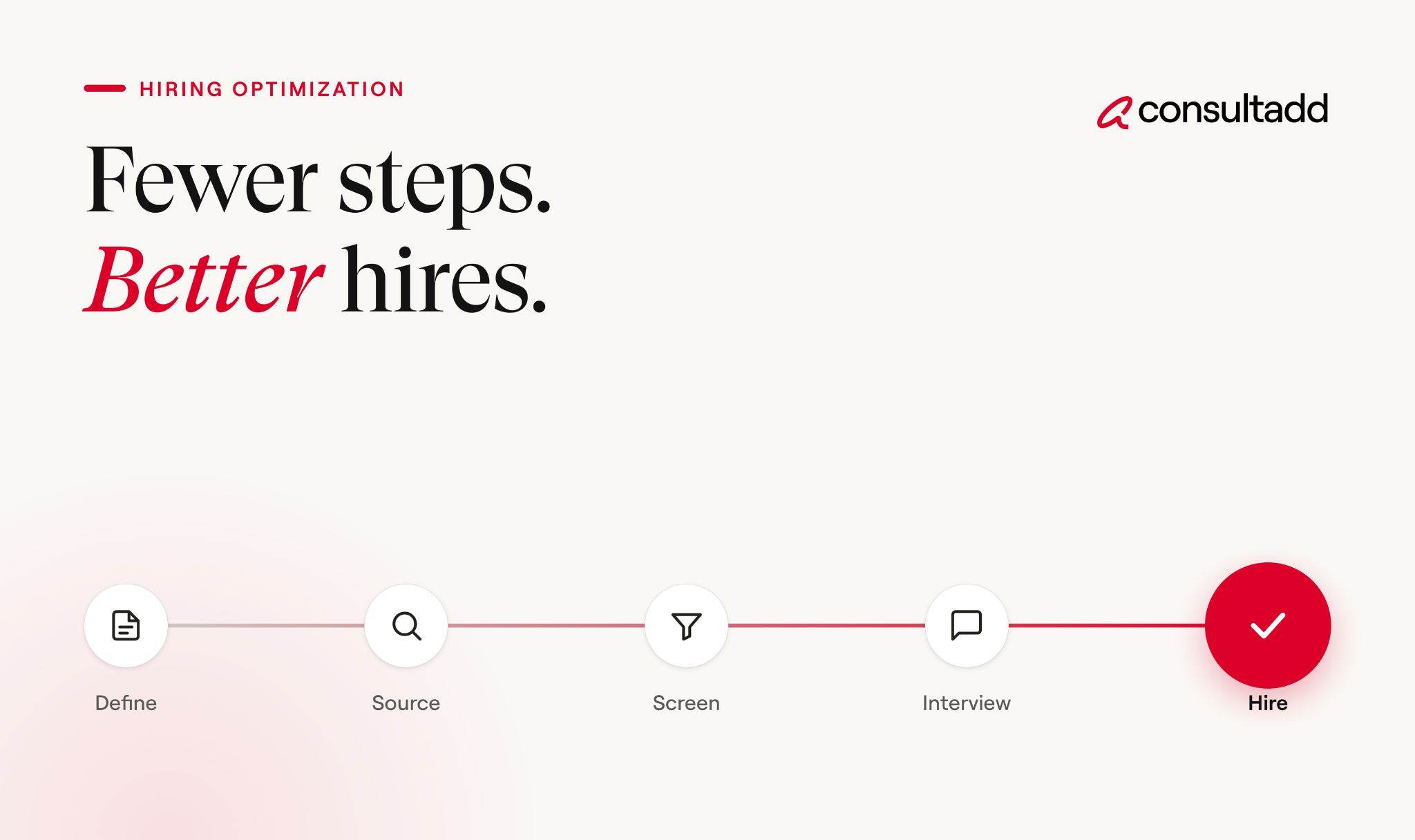
A step-by-step process for optimizing job descriptions
Here's a practical workflow that works whether you're a recruiter, hiring manager, or staffing partner.
1. Run an intake meeting. Sit down with the hiring manager. Document the actual work, the team, the tools, the budget, and what "good" looks like in six months. If you skip this, everything downstream gets harder.
2. Audit the existing description. Pull the last version used. Highlight anything vague, outdated, or duplicated. Remove requirements that don't predict job performance.
3. Write the first draft using the scorecard. Structure it as: what you'll do, what you'll need, what success looks like, what we offer. Keep it under 700 words. Job posts between 300 and 700 words tend to get the strongest application rates.
4. Test it against real candidates. Show the draft to one or two people already in the role or a similar one. Ask: does this sound like the actual job? If not, revise.
5. Add structured data for job boards. Use clear titles (no internal codes), include location, compensation range, and employment type. Google's job posting structured data guidelines specify exactly what fields help your listing appear in Google for Jobs.
6. Review after every hire. Track which description versions produced the best shortlists. Keep a running log of what worked and what attracted the wrong candidates.
Common mistakes to avoid
Even teams that understand the basics of job description hiring process optimization make predictable errors. A few to watch for:
- Copy-pasting between roles. Two different engineering roles shouldn't share the same description. Candidates notice, and it signals that the company doesn't know what it needs.
- Listing every technology ever used. A description for a backend engineer that lists 20 tools tells candidates that the team has no clear tech stack, or that the post was written by someone who doesn't understand the role.
- Ignoring the candidate's perspective. The description should answer: why should a good candidate want this job? If the only answer is "competitive salary and benefits," the post is doing no selling.
- Skipping the review cycle. Descriptions go stale. A post written in 2024 for a cloud engineer role might reference technologies or team structures that no longer apply. Quarterly reviews take 30 minutes and can prevent months of misaligned hiring.
How staffing partners improve the process
Internal teams can optimize their own descriptions. But staffing partners bring something most internal recruiters can't: volume pattern recognition.
A firm like Consultadd, which has completed over 5,000 staffing engagements and works with 65+ staffing companies, sees what works across hundreds of similar roles. That pattern recognition translates into faster shortlists, more accurate candidate matches, and fewer late-stage dropouts.
Here's where the partnership adds the most value:
- Pre-vetted candidates. A staffing partner with a ready pipeline can bypass the sourcing and initial screening stages entirely.
- Compliance handling. Visa documentation, onboarding paperwork, and regulatory checks are handled by the partner, not your hiring manager.
- Description feedback. Good partners push back on job descriptions that won't produce results. That feedback loop is worth more than most teams realize.
For organizations evaluating whether to involve a staffing agency, Consultadd's breakdown of the pros and cons of working with staffing companies covers the honest trade-offs.
Start Strong With Consultadd
With 15 years in business and 5,000+ successful staffing engagements, we don't just fill roles, we build reliability into your process. We've supported 65 staffing companies in the past year alone and maintain MSAs with industry leaders like Robert Half and TEKsystems.
Here's what working with Consultadd looks like:
- Talent sourced in under 24 hours
- Ready-to-deploy candidates, vetted for experience and compliance
- Lower turnover risk: we match long-term goals, not just short-term needs
- Seamless compliance: visa, documentation, onboarding? Handled.
- Dedicated 1:1 account managers for responsive, personalized support
- Top 100 candidate matches delivered in the past year
- Strong partnerships with universities to tap into fresh, committed talent
- Post-placement support so your investment grows beyond day one
For candidates, your next opportunity is more than just a job title, it's a chance to build skills, gain experience, and move your career forward. At Consultadd, we connect technology professionals with projects and employers that align with their goals, whether they're looking for contract, contract-to-hire, or long-term opportunities.
The tech job market moves fast, but the right guidance can make all the difference. Ready to take the next step in your career journey? Explore Opportunities >>
Key takeaways
- Job description hiring process optimization starts with a proper intake meeting between recruiters and hiring managers, not with a template.
- Cutting requirements to true must-haves and labeling nice-to-haves increases both the size and quality of your applicant pool.
- Descriptions written for candidates, not for internal documentation, convert better and reduce screening time.
- Tracking which descriptions produce the best hires creates a feedback loop that compounds over time.
- Staffing partners with high-volume pattern recognition can accelerate every stage from description to placement.
FAQs
How does a job description affect the hiring process?
The job description sets expectations for candidates, gives recruiters screening criteria, and provides interviewers a framework. A vague or inflated description leads to mismatched applicants, longer screening cycles, and higher rejection rates at every stage.
What is the ideal length for a job description?
Between 300 and 700 words. Posts in this range tend to get more qualified applications than either very short listings (which lack detail) or very long ones (which candidates abandon before finishing).
How often should job descriptions be updated?
At minimum, review them quarterly and always after a completed hire. Track which versions attracted the strongest candidates and use that data to refine future posts.
What's the difference between a job description and a job posting?
A job description is the internal document that defines a role's responsibilities, requirements, and reporting structure. A job posting is the external-facing version, written to attract candidates. The posting should be shorter, more engaging, and focused on what the candidate gets, not just what the company needs.
Can optimizing job descriptions reduce time-to-hire?
Yes. Clearer descriptions produce better-matched applicants, which means less time spent on screening, fewer unnecessary interview rounds, and faster offers. Teams that run a structured intake meeting and write against a scorecard typically see measurable reductions in time-to-fill.
Should staffing agencies write job descriptions for clients?
The best results come from collaboration. The hiring manager provides the context, the staffing partner provides market intelligence, and the description is written jointly. Agencies that simply post what the client sends tend to reproduce the same problems the client already had.