%20(1)%20(2).avif)

Introduction
You get an offer, read the details, and stop at one line: "contract for hire." Nobody explains it in the job post, and the recruiter uses three different names for it on the same call.
So, what is contract for hire?
It's a hiring arrangement where you work a role for a fixed period, usually through a staffing agency, with the option for the client company to bring you on permanently at the end. You do the actual job from day one. The paperwork just sits somewhere else for a while.
Most people searching this term have already been offered one of these roles and want to know whether it's a real job or a stalling tactic.
Short answer: it's a real job, and roughly one in five conversions falls apart for reasons that have nothing to do with performance. The rest of this covers how the model works, what it costs each side, and the questions worth asking before you sign.
TL;DR
- Contract for hire (also called contract-to-hire, temp-to-hire, or C2H) means a fixed-term assignment with a built-in option to convert to a permanent role.
- During the contract, the staffing agency is your legal employer. It runs payroll, withholds taxes, and issues your W-2.
- Typical contract length runs three to twelve months. Six months is the most common in tech.
- Conversion is an option, not a guarantee. Budget freezes and reorgs kill more conversions than bad performance does.
- Hourly pay is often higher than the equivalent permanent salary, because benefits and job security usually start only after conversion.
What contract for hire actually means
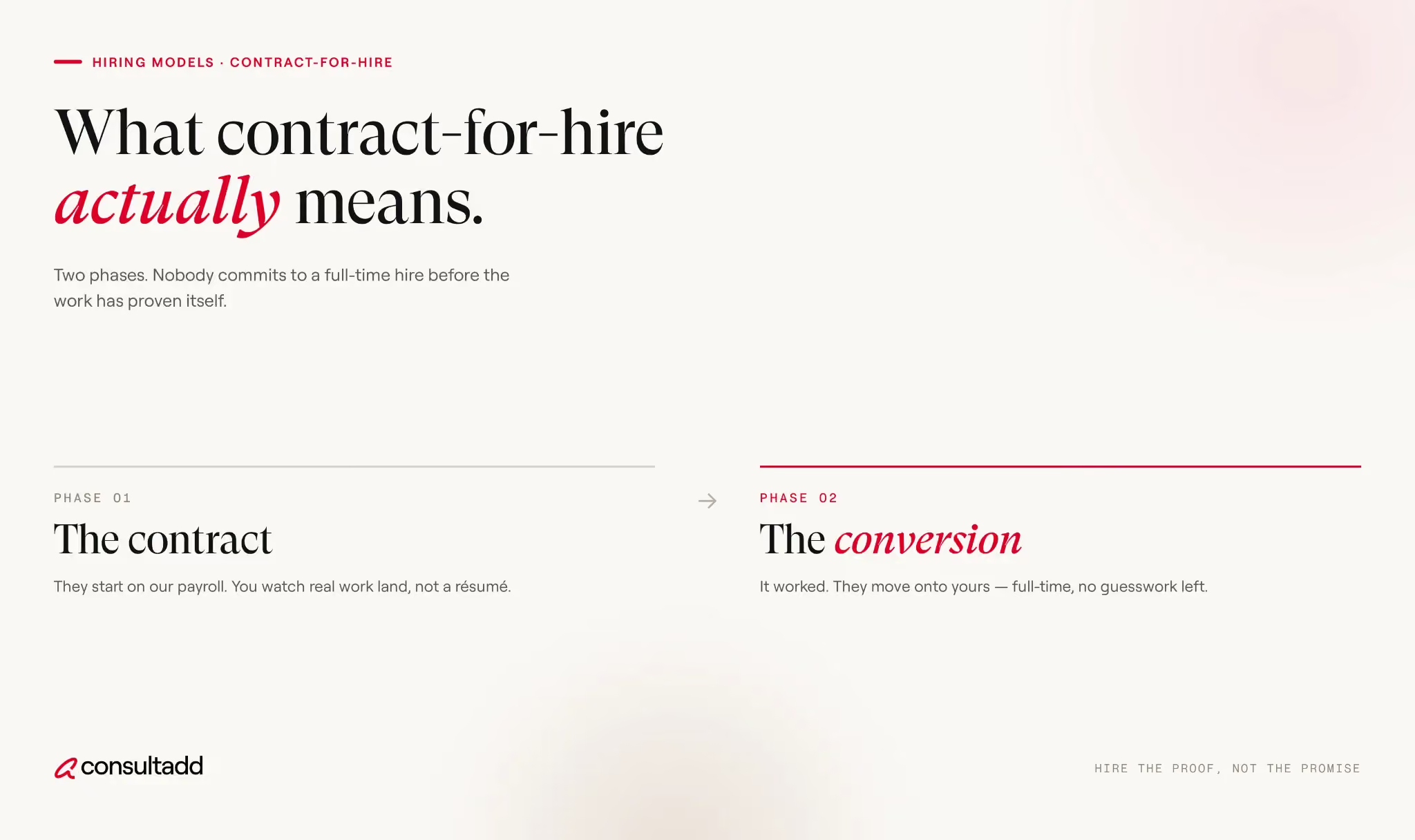
A contract for hire role has two phases.
Phase one is the contract.
- A staffing agency hires you, places you at a client company, and you work there on a defined assignment.
- Your manager, your standup, your tickets, your laptop: all of that comes from the client.
- Your paycheck comes from the agency.
Phase two is conversion.
- At the end of the contract term, the client decides whether to move you onto its own payroll as a permanent employee.
- If it does, the agency steps out.
- If it doesn't, the assignment ends and the agency looks for your next placement.
The naming is a mess and that's not your fault. Recruiters use "contract-to-hire," "temp-to-hire," "temp-to-perm," and "C2H" for the same thing.
"Contract for hire" is the phrasing a lot of candidates land on when they're typing it into Google. Same model.
Don't confuse it with "work made for hire" -
If your search turned up copyright pages, that's a different concept entirely. Under Section 101 of the Copyright Act, a "work made for hire" is about who owns the copyright in something an employee or commissioned contractor creates.
When a work is made for hire, the party that hired the individual counts as the author and copyright owner, not the person who actually created it. The U.S. Copyright Office covers this in Circular 30. It has nothing to do with staffing.
It's also not independent contracting -
This one trips up a lot of people.
A contract for hire worker is a W-2 employee of the staffing agency.
An independent contractor is self-employed, invoices on a 1099, and pays self-employment tax.
The distinction isn't cosmetic. The IRS states that misclassifying an employee as an independent contractor means the employer's share of taxes goes unpaid and the employee's share goes unwithheld, and a business that gets this wrong can be held liable for those employment taxes. You can read the agency's own summary in Worker Classification 101.
If a recruiter offers you a "contract for hire" role but wants you on a 1099, ask why.
Sometimes there's a legitimate corp-to-corp structure behind it, which we cover in the guide to C2C contract-to-hire opportunities. Sometimes it's just someone avoiding payroll taxes.
How the arrangement works, step by step
The mechanics are more predictable than the terminology suggests.
- The client company tells the staffing agency what it needs, including the contract length and the conversion intent.
- The agency sources and screens candidates, then submits a shortlist.
- The client interviews. This is usually shorter than a permanent loop, often one or two rounds.
- You accept an hourly rate and sign with the agency, not the client.
- The agency handles onboarding, background checks, work authorization, and payroll setup.
- You work the assignment. The agency invoices the client at a bill rate that covers your pay plus its employment costs and margin.
- Near the end of the term, the client decides on conversion. Sometimes it happens early.
Who employs you during the contract
- The staffing agency does.
BLS research on the temporary help services industry calls this the defining feature of the model: the contractual employment relationship sits with the employment services firm, not with the firm requesting the worker.
Practically, that means the agency owns your W-2, your timesheet approvals, your workers' comp, and whatever benefits it offers contractors.
Health coverage varies a lot between agencies. Ask before you sign, not after.
What happens at conversion
- Most client agreements include a conversion clause.
- It usually works one of two ways: the client pays a flat conversion fee to hire you directly, or the fee drops to zero once you've worked a set number of billable hours.
- That second structure is why a six-month contract often converts on month seven instead of month five.
- The fee schedule is doing the talking, not your review.
Contract for hire vs contract vs direct hire
These three sit next to each other on job boards and get confused constantly.
If you want the wider map of engagement models, including staff augmentation and managed services, the IT staffing services models guide lays them out side by side.
Why employers use it
Three reasons come up over and over in staffing conversations.
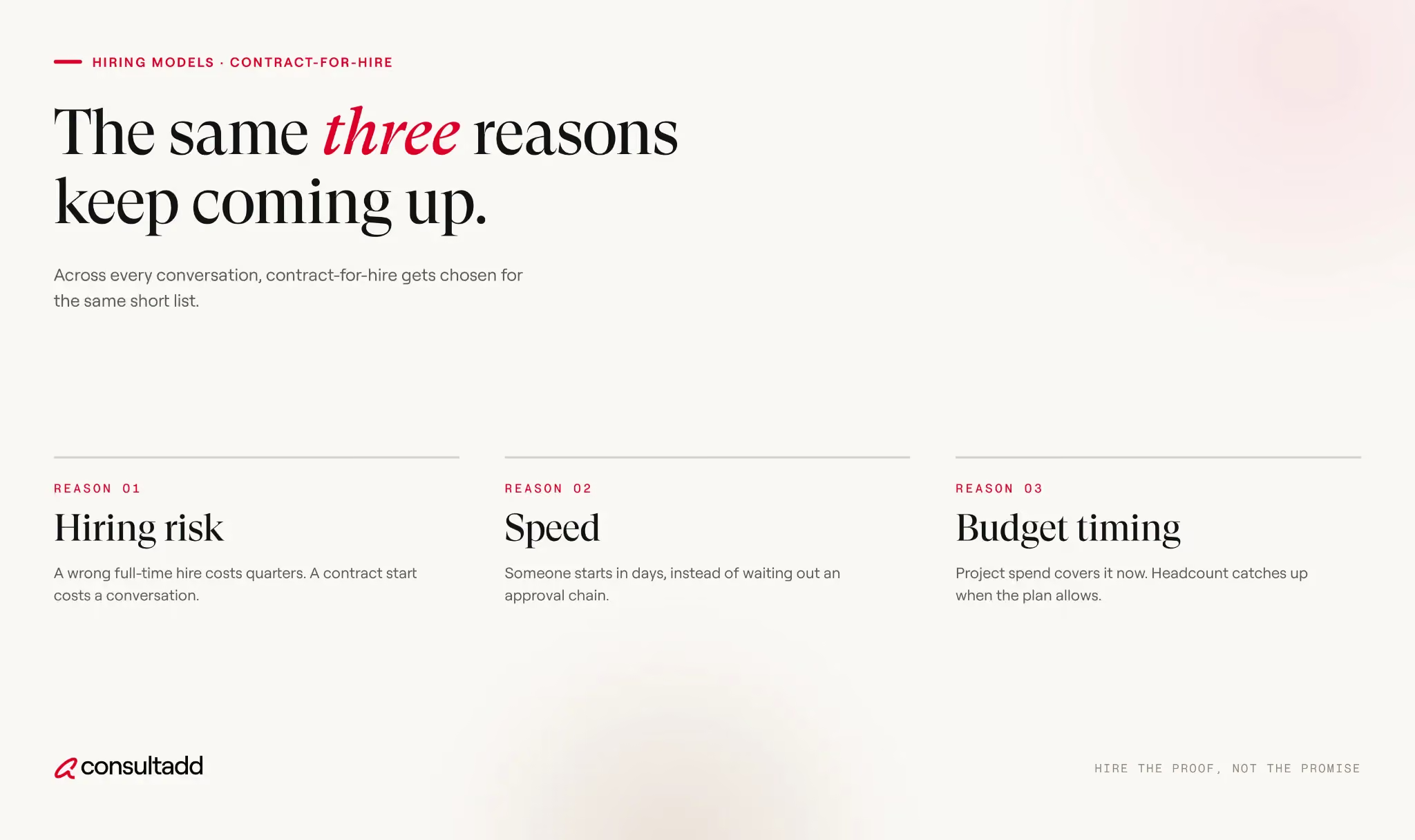
Hiring risk. A permanent hire commits a company to a salary, a benefits load, and months of ramp time based on a few hours of interviews. A contract for hire replaces some of that guesswork with observed work.
Speed. Permanent requisitions can sit for weeks waiting on headcount approval. Contract budgets often move faster because they come out of a different line. Agencies with active benches can submit candidates in days.
Budget timing. A team may know the work exists but not yet have approved a headcount. Contract for hire fills the seat now and converts once the budget lands.
This isn't a fringe pattern anymore. Analysis from KORE1 covering Q4 2025 through Q1 2026 found that contract-to-hire had become the default path for senior IT roles, with direct hire losing share in that segment quarter after quarter.
Consultadd's take on that shift is in IT contract staffing as a business strategy.
The volume shows up in federal data too. Staffing Industry Analysts, reading the June 2026 BLS Employment Situation, reported that temporary help services employment rose by 9,300 jobs and the temporary agency penetration rate held at 1.57%.
What it means for you as a candidate
The honest version, with both columns filled in.
One thing that isn't negotiable: a legitimate agency never charges you a fee. The client pays. If someone asks you for money to secure a placement, walk.
There's a longer read on the tradeoffs in contract to hire meaning, how it works, and who it's for.
Questions worth asking before you sign
Use this as a checklist. Ask the recruiter, and ask the hiring manager separately if you get the chance. If the answers don't match, that's information.
Where the model goes wrong
Two failure patterns are worth naming.
The first is the perpetual contract. The term ends, the extension arrives, conversion keeps sliding one quarter to the right. Set a personal deadline before you start and hold it.
The second is the phantom conversion. Some companies use contract for hire as cheap flexible labor and convert almost nobody. The role is honest work, but the permanent job at the end was never funded.
Both are avoidable with one conversation upfront. Neither is avoidable if you skip it.
So, what is contract for hire, in one line?
It's a fixed-term job with a permanent option attached, where a staffing agency employs you until the client takes over.
Used well, it gets you into a company faster than a permanent process would and lets you check the fit before you commit. Used badly, it's an extension treadmill.
The difference usually comes down to whether the permanent headcount is funded and whether anyone told you the truth about it. Ask early.
If the answer is straight, contract for hire is one of the more sensible ways to change jobs right now.
A closer look at both sides of that judgment call is in contract-to-hire benefits, pros, and cons.
Start Strong With Consultadd
With 15 years in business and 5,000+ successful staffing engagements, we don't just fill roles, we build reliability into your process. We've supported 65 staffing companies in the past year alone and maintain MSAs with industry leaders like Robert Half and TEKsystems.
Here's what working with Consultadd looks like:
- Talent sourced in under 24 hours
- Ready-to-deploy candidates, vetted for experience and compliance
- Lower turnover risk: we match long-term goals, not just short-term needs
- Seamless compliance: visa, documentation, onboarding? Handled.
- Dedicated 1:1 account managers for responsive, personalized support
- Top 100 candidate matches delivered in the past year
- Strong partnerships with universities to tap into fresh, committed talent
- Post-placement support so your investment grows beyond day one
For candidates, your next opportunity is more than just a job title, it's a chance to build skills, gain experience, and move your career forward. At Consultadd, we connect technology professionals with projects and employers that align with their goals, whether they're looking for contract, contract-to-hire, or long-term opportunities.
The tech job market moves fast, but the right guidance can make all the difference. Ready to take the next step in your career journey? Explore Opportunities >>
Key takeaways
- Contract for hire means a fixed-term assignment through a staffing agency with an option to convert to permanent employment at the end.
- You're a W-2 employee of the agency during the contract, not an independent contractor, and the IRS treats that distinction as a matter of substance rather than labels.
- Terms usually run three to twelve months, and conversion timing is often driven by the agency's fee schedule rather than your performance.
- Hourly pay tends to beat the equivalent permanent salary, while benefits and job security typically start at conversion.
- Ask about approved headcount and the client's real conversion rate before you sign. Those two answers predict the outcome better than anything else.
FAQs
Is contract for hire the same as contract-to-hire?
Yes. Contract for hire, contract-to-hire, temp-to-hire, temp-to-perm, and C2H all describe the same arrangement. The phrasing shifts between recruiters and job boards, but the structure is identical: a fixed term with a conversion option.
Do contract for hire employees get benefits?
During the contract, benefits come from the staffing agency, and coverage varies widely between agencies. Some offer full medical, dental, and 401(k) access. Others offer very little. Once you convert, you move onto the client's plan like any other employee.
How long does a contract for hire position last?
Most run three to twelve months, with six months being the most common in technology roles. Extensions are normal. If a client extends more than once without discussing conversion, treat that as a signal worth raising directly.
Can I turn down the permanent offer at the end?
Yes. Conversion is a decision both sides make. If the team, the work, or the salary isn't what you expected, you can decline and let the agency place you elsewhere. Declining doesn't usually damage your standing with a good agency.
Is contract for hire a bad sign about the company?
Not on its own. Plenty of well-run companies use it to move faster than their permanent hiring process allows or to fill a seat while headcount clears approval. It becomes a bad sign when nobody can tell you whether the permanent role is actually funded.
Do I pay the staffing agency anything?
No. The client company pays the agency, and the agency pays you. Reputable firms never charge candidates a placement fee. Any request for payment to secure a role is a reason to end the conversation.
.webp)

.webp)