

Introduction
Post a generative AI engineer role today and you'll get resumes fast. That's the trap. Everyone lists "LLM" and "RAG" now, because job postings reward it, but the gap between someone who's shipped a production RAG pipeline to real users and someone who finished a weekend tutorial has never been wider.
To hire generative AI engineers well in 2026, the job isn't finding candidates. It's telling those two apart before an offer goes out, not two quarters later when a hallucinated response lands in a customer's inbox.
The numbers explain why this role gets mis-hired so often. Demand for LLM-specific freelance work grew roughly 304% year over year, while the supply of engineers with real production LLM experience grew only around 85%.
That mismatch inflates resumes and rates in equal measure. And the title itself has splintered: "generative AI engineer" now covers at least five genuinely different jobs, and hiring for the wrong one is the single most common reason these searches stall past ninety days.
This guide breaks down what the role actually involves, the five working profiles you're choosing between, 2026 compensation, and how to run a loop that filters signal from resume-padding.
TL;DR
- "Generative AI engineer" isn't one job. Pick one of five lanes before writing the req: LLM application, RAG/retrieval, fine-tuning, eval/safety, or production GenAI/MLOps.
- Nearly all of this work is integration, not model training. Almost nobody trains foundation models from scratch; the job is building on top of OpenAI, Claude, or open-weight models.
- 2026 US compensation runs roughly $145,000 - $215,000 mid-level and $230,000-$340,000+ senior for full-time roles, with freelance/contract rates from $75 to $200+ per hour.
- RAG architecture now appears in a majority of applied LLM job listings, making retrieval-pipeline competence close to a baseline requirement, not a specialty.
- Run a real technical loop: RAG system design, failure-mode analysis, and eval discipline predict production performance far better than a "tell me about transformers" conversation.
What a generative AI engineer actually does
Set expectations correctly from the start: a generative AI engineer builds applications on top of pre-trained foundation models. They are not training GPT-class models from scratch, virtually nobody outside a handful of labs does that, the computer cost alone runs into the millions.
The job is integration and orchestration: taking a raw model behind an API and turning it into a working product feature that's reliable, fast enough, and affordable to run at scale.
That distinguishes it clearly from a traditional machine learning engineer, who more often builds models from structured data for classification or prediction tasks. It also distinguishes it from a research scientist, whose work sits closer to advancing model capability than shipping product.
The generative AI engineer sits between those roles and product engineering: fluent enough in the models to reason about their failure modes, and fluent enough in software engineering to ship something dependable around them.
The five profiles hiding under one job title
This is the section that saves the most wasted interview cycles. "Generative AI engineer" as a title covers at least five distinct working profiles, and searches that try to hire for two or three of them in one person routinely stall for months:
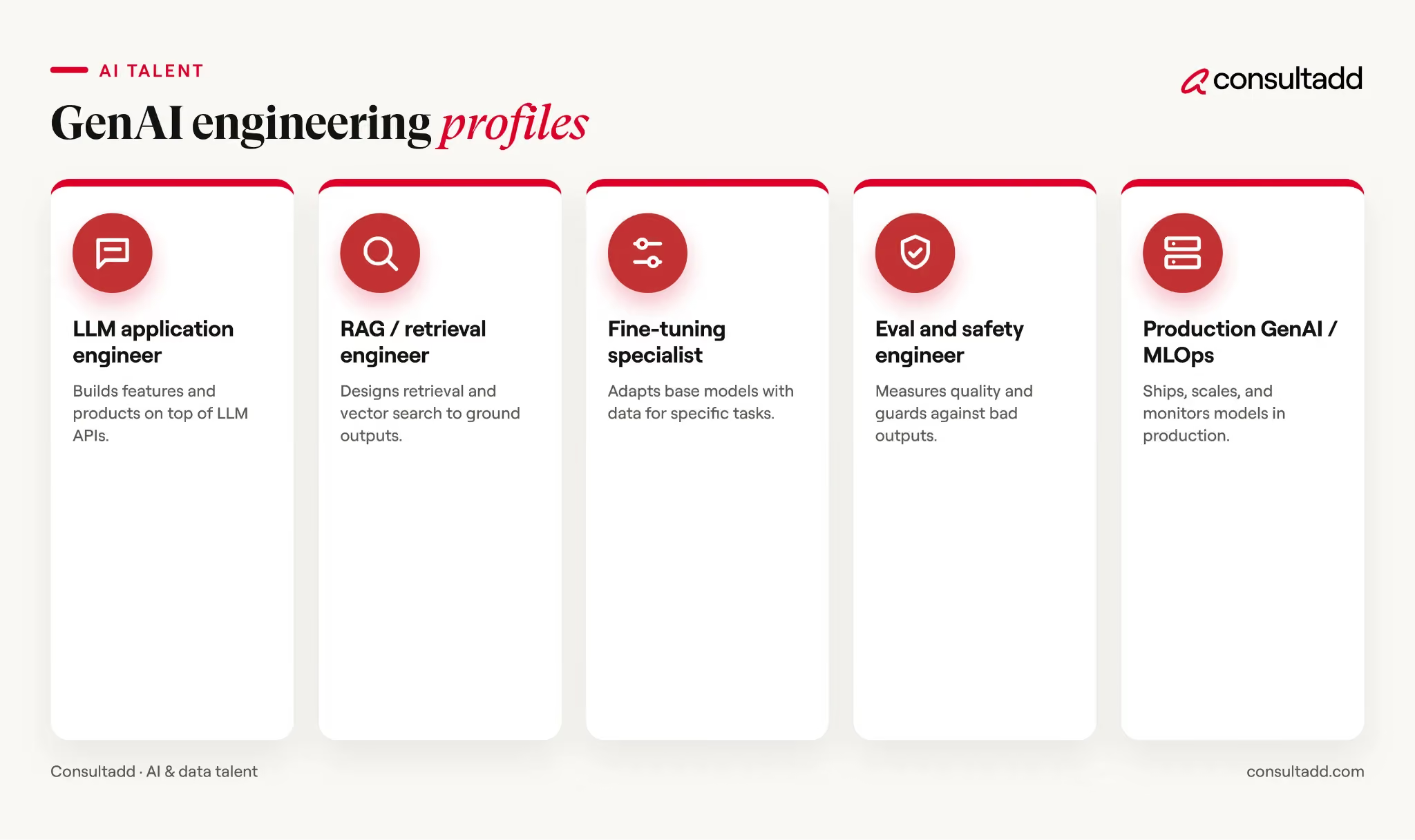
At most early-stage companies, one person covers two or three of these out of necessity. LLM application work paired with a credible RAG lean is the most common combination that actually gets hired successfully; fine-tuning paired with eval skews toward a more research-leaning hire. Asking for all five in one req is asking for a unicorn, and searches built that way are the ones still open ninety days later.
Decide your primary lane before the job post goes live, the same discipline that matters across technical hiring generally, and something we cover in more general terms in our guide to hiring and recruiting strategies.
Skills that separate real builders from resume padding
Within whichever lane you're hiring for, these are the concrete signals that correlate with real, shipped experience rather than tutorial-level familiarity:
This mirrors the same "explain a real system you built" test that works well in broader technical interviews, something we cover for adjacent roles in our guide to interview questions for a full stack developer.
2026 compensation: salary and contract rates
Compensation for this role moves fast and varies more by specialization than almost any other engineering hire. Here's where the market sits:
- First, generalists are losing ground: engineers without a clear specialization increasingly compete against domain experts commanding 30-50% more for equivalent experience, so a vague "AI engineer" req attracts a weaker slate than a lane-specific one.
- Second, this is consistently one of the hardest categories to close: median time from role-open to accepted offer at competitive companies runs into the tens of days, meaningfully longer than most engineering hires, and the most common reason a strong candidate walks is a competing offer from a company with deeper AI-team budgets.
- Building slack into your process, and moving fast once you find the right person, matters more here than in almost any other technical search.
Our breakdown of time to hire vs time to fill covers how to diagnose where a slow-moving process is bleeding candidates.
How to run a hiring loop that actually filters
A four-round structure, scoped to your chosen lane, consistently outperforms an improvised conversation-heavy process:
1. Recruiter screen (30 min)
Confirm the lane match and get one concrete example of shipped GenAI work before investing further time. "Walk me through a generative AI feature you built, from idea to production" is the single best filter question at this stage.
2. Technical deep dive (60-90 min)
Review a take-home or portfolio piece in detail, then move into live problem-solving: RAG system design for a realistic scenario, plus failure-mode analysis. Ask what happens when retrieval returns irrelevant context, or when the model confidently states something false, and how they'd catch it before a user sees it.
3. Architecture and judgment discussion (45-60 min)
Present a system with real constraints, a cost ceiling, a latency requirement, a compliance concern, and have the candidate reason through trade-offs aloud. This is where the difference between someone who's read about RAG and someone who's debugged one in production becomes obvious.
4. Team and mission fit (30-45 min)
How does generative AI solve your company's specific problem, and what would they build in the first ninety days. Vague enthusiasm here is a weaker signal than a candidate who's already thought concretely about your use case.
Close fast once you've found the right person. Strong generative AI candidates evaporate off the market within days, not weeks, and moving to offer within 48 hours of the final round is standard practice among teams that close successfully without a compensation arms race.
If your search is bigger than one hire, or the timeline is tight, pairing internal recruiting with a specialist staffing partner can meaningfully compress the search.
Our review of the best IT staffing firms covers what to look for when vetting one.
Common mistakes companies make
The same failure patterns show up across most stalled or regretted generative AI hires:
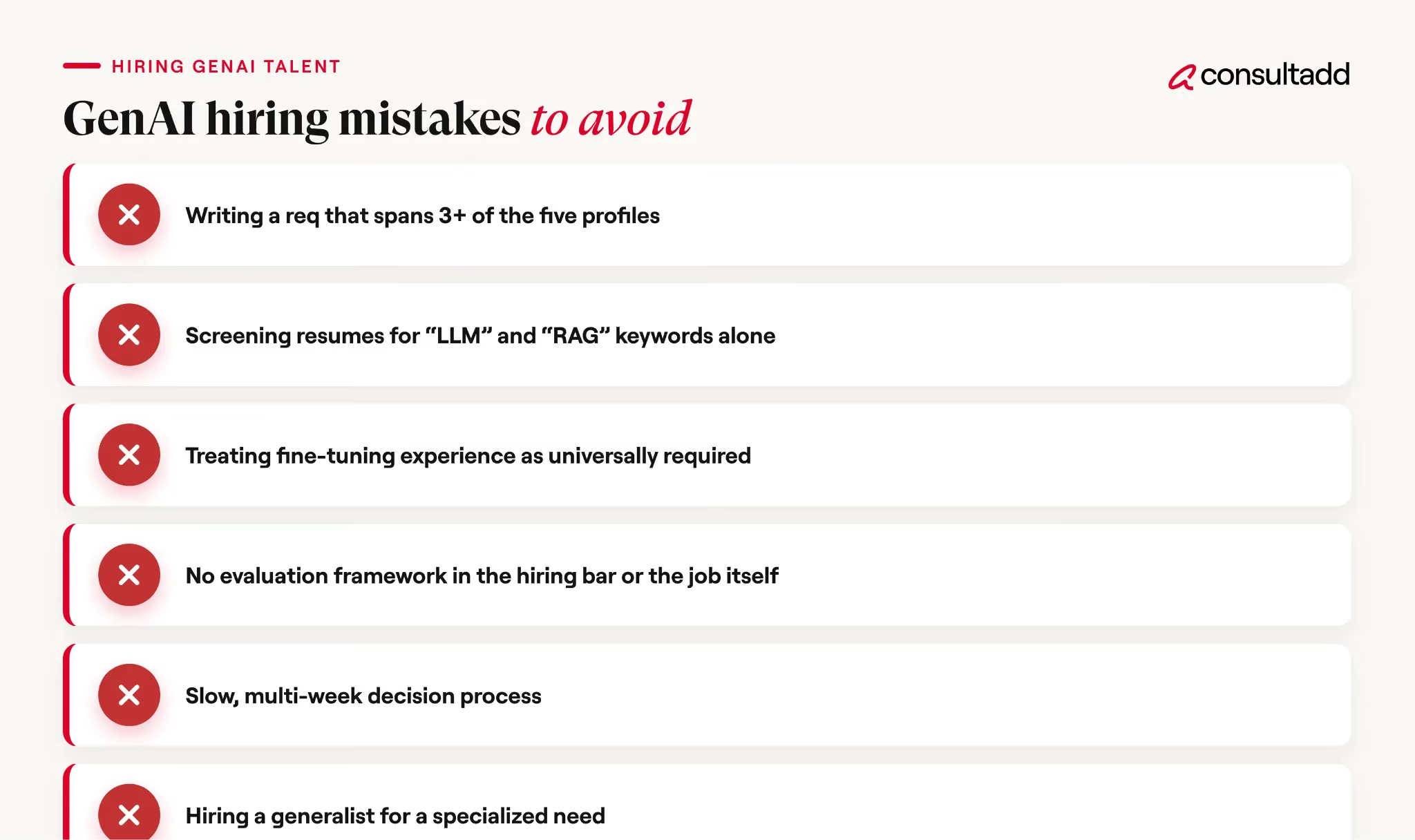
The pattern underneath all of these: this role rewards precision in how you hire, not just speed or budget. Scope the lane, test for shipped experience and evaluation discipline, and move fast once the right person is in front of you.
Start Strong With Consultadd
With 15 years in business and 5,000+ successful staffing engagements, we don't just fill roles, we build reliability into your process. We've supported 65 staffing companies in the past year alone and maintain MSAs with industry leaders like Robert Half and TEKsystems.
Here's what working with Consultadd looks like:
- Talent sourced in under 24 hours
- Ready-to-deploy candidates, vetted for experience and compliance
- Lower turnover risk: we match long-term goals, not just short-term needs
- Seamless compliance: visa, documentation, onboarding? Handled.
- Dedicated 1:1 account managers for responsive, personalized support
- Top 100 candidate matches delivered in the past year
- Strong partnerships with universities to tap into fresh, committed talent
- Post-placement support so your investment grows beyond day one
For candidates, your next opportunity is more than just a job title, it's a chance to build skills, gain experience, and move your career forward. At Consultadd, we connect technology professionals with projects and employers that align with their goals, whether they're looking for contract, contract-to-hire, or long-term opportunities.
The tech job market moves fast, but the right guidance can make all the difference. Ready to take the next step in your career journey? Explore Opportunities >>
Key takeaways
- "Generative AI engineer" splits into five distinct profiles, LLM application, RAG/retrieval, fine-tuning, eval/safety, and production GenAI/MLOps, and scoping one lane before hiring is the single biggest predictor of a clean search.
- The role is overwhelmingly about integration on top of foundation models, not training them; screen for shipped product experience, not theoretical model knowledge.
- 2026 US compensation runs roughly $145K-$215K mid-level and $230K-$340K+ senior full-time, with freelance rates from $75 to $200+ per hour depending on proven experience.
- RAG competence has become close to a baseline expectation, appearing in most applied LLM job listings, while fine-tuning matters most for specialized domains rather than every hire.
- Run a scoped, four-round loop testing RAG design, failure-mode reasoning, and evaluation discipline, and move to offer within 48 hours of the final round once you've decided, since strong candidates don't stay available long.
FAQs
What does a generative AI engineer actually do?
They build applications on top of pre-trained foundation models like GPT or Claude rather than training models from scratch. The work centers on integration and orchestration: prompting, chaining tools, building retrieval pipelines, and sometimes fine-tuning a model, all aimed at turning a raw API into a reliable product feature.
What's the difference between hiring a generative AI engineer and a machine learning engineer?
A traditional machine learning engineer typically builds models from structured data for tasks like classification or prediction. A generative AI engineer works on top of existing large language models, focused on integration, retrieval, prompting, and evaluation rather than building models from the ground up. The skill sets overlap but the day-to-day work differs substantially.
How much does it cost to hire generative AI engineers in 2026?
Full-time US compensation typically runs $145,000-$215,000 for mid-level roles and $230,000-$340,000+ for senior specialists, with the top end driven by fine-tuning, evaluation, and infrastructure expertise. Freelance and contract rates range from about $75 to $200+ per hour depending on demonstrated production experience.
What questions should I ask to interview a generative AI engineer?
Start with "walk me through a generative AI feature you shipped, including a failure it produced and what you changed." Follow with RAG system design for a realistic scenario, how they'd handle irrelevant retrieval results or confident-but-false model output, and how they measure whether a prompt or architecture change actually improved quality.
Do I need to hire someone who can fine-tune models?
Only if your use case genuinely requires it. Most product applications, chat features, internal copilots, customer-facing assistants, are served well by LLM application and RAG skills without any fine-tuning. Fine-tuning matters most in specialized domains like legal, healthcare, or finance where off-the-shelf prompting underperforms.
Why is it hard to hire generative AI engineers right now?
Demand for LLM-specific work has grown far faster than the supply of engineers with real production experience, which inflates both resumes and rates. The title also covers at least five distinct working profiles, so companies that don't scope a specific lane end up interviewing mismatched candidates and stalling well past a normal hiring timeline.
.webp)


.webp)