
Hiring & Recruitment

How Do Executive Search Firms Find Candidates? Explained
Introduction
The best CFO your company could hire is probably not reading job boards. She's busy running finance somewhere else, reasonably happy, and not applying to anything.
So how do executive search firms find candidates like her? Not through job postings. They find them through systematic market research, deep industry networks, and direct, confidential outreach to people who weren't looking.
That's the short answer, and it explains why executive search exists as a separate discipline from regular recruiting. Roughly 70 to 80% of executive-level candidates are passive.
The talent pool for a VP or C-suite role isn't a stack of applications; it's a map of who currently holds comparable roles across an industry, and someone has to build that map, then start conversations.
This guide walks through exactly how search firms do it: the sourcing methods, the step-by-step process, how long it takes, and what it costs.
TL;DR
- Executive search firms find candidates proactively through talent mapping, industry networks, referrals, and direct outreach, not through job ads or inbound applications.
- Most executive candidates (roughly 70 to 80%) are passive, meaning they're employed and not job hunting, so trust-based, confidential outreach is the core skill.
- The typical retained search runs six to seven stages, from intake brief to offer negotiation, and takes about 8 to 16 weeks end to end.
- Retained firms charge an upfront fee, usually 25 to 35% of the hire's first-year compensation, and most include a replacement guarantee.
- AI sourcing tools now compress the research phase dramatically, but the shortlist quality still comes from human judgment, relationships, and assessment rigor.
What executive search firms actually do
Executive search (you'll also hear "retained search" or, informally, "headhunting") is a specialized recruitment model for senior leadership roles: C-suite, VP, board, and other positions where a bad hire is expensive enough to justify a rigorous process. The urgency is real. CEO succession rates hit 12.5% in 2025, up from 9.8% the year before, according to Harvard Business Review reporting on Conference Board and Egon Zehnder data. Leadership seats are turning over faster, and boards want disciplined ways to fill them.
The structure of the engagement shapes how candidates get found, so it's worth separating the two dominant models:

The retained model matters for one simple reason: because the firm is paid regardless of speed, it can afford to research the entire market rather than racing to submit whoever responds first. That research is where candidate discovery actually happens.
If you're weighing search firms against other options for senior roles, our breakdown of the best IT staffing firms in 2026 explains how to match the partner model to the problem you're solving.
How do executive search firms find candidates? The core methods
No single channel produces an executive shortlist. Firms layer four methods, and the blend is the craft.
Talent mapping and market research
This is the foundation, and it's the part outsiders rarely see. Researchers identify target companies (competitors, adjacent industries, companies one size up or down), then reverse-engineer their org charts to figure out who holds the comparable roles today. A single mandate might involve mapping and ranking 100+ leaders before anyone gets a call.
The output is a literal map of the talent market: names, titles, career trajectories, compensation estimates, and likely openness to a move. Done well, it surfaces strong candidates from non-obvious backgrounds, which referral-only sourcing systematically misses.
Industry networks and referrals
Search consultants spend years building relationships with executives, board members, and former placements across their specialty. When a mandate opens, those relationships become a referral engine: "who's the best supply chain leader you've worked with?" is a question that produces names no database contains, along with built-in credibility from the person making the introduction.
Firms also track rising leaders continuously, not just when a search is live. Consultants follow who's speaking at conferences, publishing in trade press, and getting promoted. By the time a role opens, a good consultant already knows a dozen plausible candidates personally.
Direct outreach to passive candidates
Once the map exists, the work becomes persuasion. Since most targets aren't looking, outreach can't read like a recruiter blast.
Consultants approach discreetly, often without naming the client at first, and position the conversation around career trajectory rather than a job description. Multi-channel sequences (calls, email, professional networks) run over weeks, and confidentiality cuts both ways: candidates need certainty their current employer won't hear about the conversation.
This is also where "off-limits" agreements shape the pool. Reputable retained firms won't poach from their own clients, which is a question worth asking before you hire one.
Databases, LinkedIn, and AI sourcing
The modern layer. Firms maintain proprietary candidate databases built over decades, and they use LinkedIn's advanced search alongside newer AI sourcing tools that scan professional profiles, publications, patents, and public code repositories.
The gain is coverage and speed: research that once took weeks can compress to days, and industry reporting in early 2026 credits AI-assisted research with pulling average C-suite search timelines down meaningfully.
The honest caveat: AI extends the map; it doesn't make the hire. The judgment about who can actually lead your company still comes from humans doing structured assessment. Firms that lean on automation without domain expertise produce fast, mediocre shortlists.
Here's how the channels compare:
The executive search process, step by step
Candidate discovery sits inside a larger structured process. Most retained searches follow a version of these stages, and the full cycle typically runs 8 to 16 weeks, stretching to 20+ for board and CEO roles:
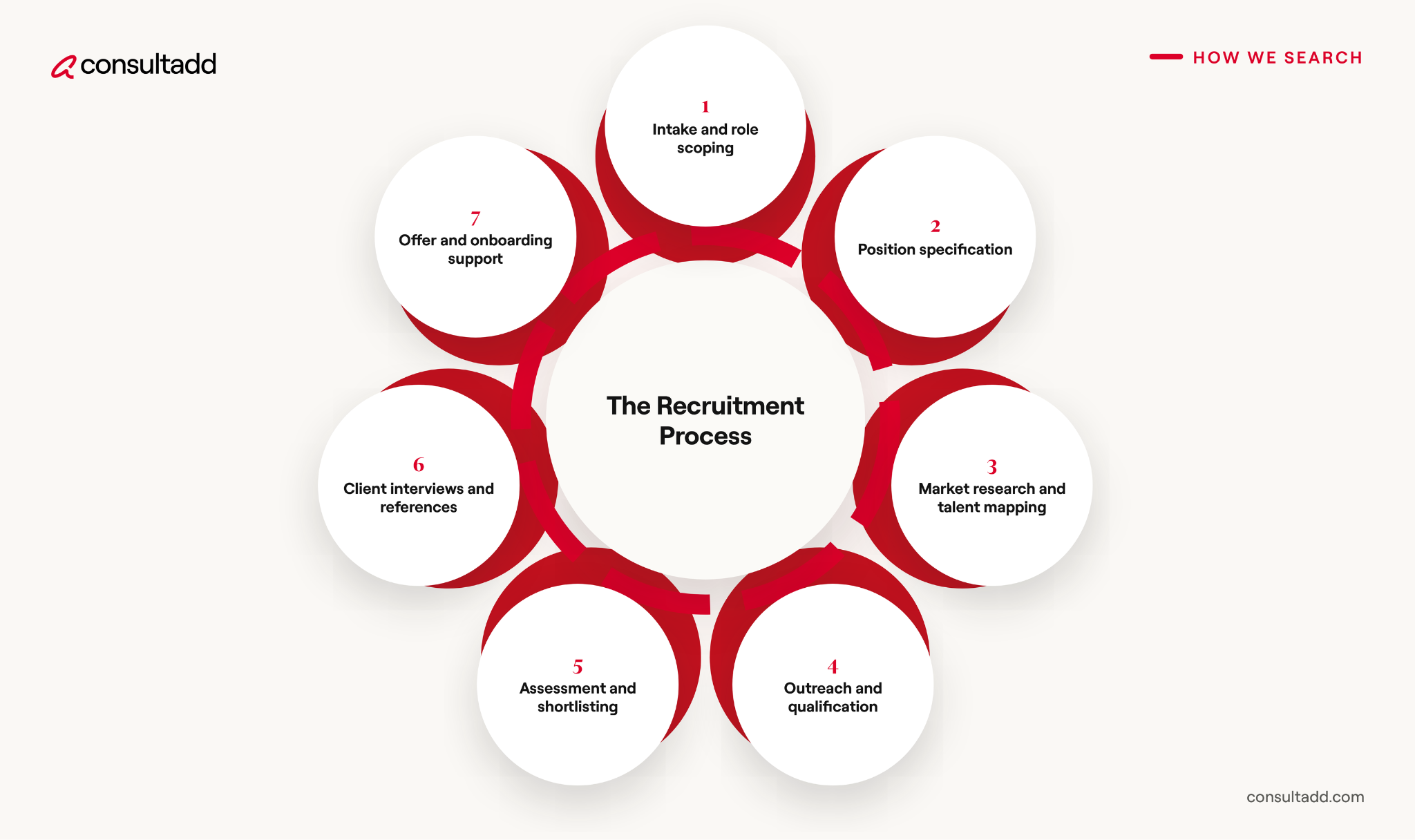
Two things about this table are worth underlining -
First, sourcing and assessment overlap; firms run outreach in parallel with early evaluation rather than sequentially, which is how a market of 100+ names becomes a shortlist of four without taking six months.
Second, the early stages determine the outcome. A vague position spec produces a vague shortlist, no matter how good the research is.
That's the same discipline gap we see in hiring generally, and it's a core theme in our review of the hiring strategies companies are actually using successfully.
How firms assess the candidates they find
Finding names is half the job. The other half is deciding which of them can actually do the work, and this is where search firms earn their fee or don't.
Structured evaluation has largely replaced gut feel at reputable firms. That means competency-based interviews scored against the position spec, and often formal leadership assessments layered on top; several large firms run candidates through proprietary frameworks or scoring models.
The reason is blunt: executive hires rarely fail on technical ability. They fail on misaligned expectations, cultural mismatch, and weak stakeholder management, so the assessment has to probe those directly.
Reference checking at this level is also a different animal from calling two listed references. Consultants work their networks to find people who worked with the candidate but weren't hand-picked by them, building a rounded picture of how the person leads under pressure.
For companies, this rigor is most of what you're paying for. For senior candidates on the other side of the table, it means preparation matters: expect evidence-based questions about outcomes you owned, not a friendly chat about your resume.
The preparation principles in our coding interview playbook scale up surprisingly well; structured processes reward structured answers at every level.
What this means for companies and candidates
So, how do executive search firms find candidates? By treating the talent market as something you research rather than something you advertise to: mapping who holds the relevant roles today, working networks built over decades, approaching passive leaders with discretion, and using technology to widen and speed up the search without outsourcing the judgment.
For companies, the practical takeaway is to engage a search firm when the role is senior enough, confidential enough, or specialized enough that the best candidates won't apply on their own.
Vet the firm on research methodology, who personally runs your search, off-limits policy, and guarantee terms rather than brand name alone.
For candidates, the lesson is that executive opportunities find you through visibility and relationships. Do excellent work, make it legible (speak, publish, lead things people can see), and treat every recruiter conversation as a long-term relationship rather than a transaction.
The consultant who calls you about the wrong role this year often calls about the right one in three.
And for the many leadership-adjacent and senior technical roles that don't need a retained search, faster models exist.
We covered when contract and contract-to-hire approaches beat traditional recruiting in IT contract staffing is a business strategy, not a backup plan.
Start Strong With Consultadd
With 15 years in business and 5,000+ successful staffing engagements, we don't just fill roles, we build reliability into your process. We've supported 65 staffing companies in the past year alone and maintain MSAs with industry leaders like Robert Half and TEKsystems.
Here's what working with Consultadd looks like:
- Talent sourced in under 24 hours
- Ready-to-deploy candidates, vetted for experience and compliance
- Lower turnover risk: we match long-term goals, not just short-term needs
- Seamless compliance: visa, documentation, onboarding? Handled.
- Dedicated 1:1 account managers for responsive, personalized support
- Top 100 candidate matches delivered in the past year
- Strong partnerships with universities to tap into fresh, committed talent
- Post-placement support so your investment grows beyond day one
For candidates, your next opportunity is more than just a job title, it's a chance to build skills, gain experience, and move your career forward. At Consultadd, we connect technology professionals with projects and employers that align with their goals, whether they're looking for contract, contract-to-hire, or long-term opportunities.
The tech job market moves fast, but the right guidance can make all the difference. Ready to take the next step in your career journey? Explore Opportunities >>
Key takeaways
- Executive search firms find candidates through original market research and talent mapping, industry networks and referrals, confidential outreach to passive leaders, and database/AI-assisted sourcing, layered together rather than used alone.
- Because 70 to 80% of executive candidates aren't job hunting, discretion and relationship-building matter more than any job posting ever could.
- A retained search follows six to seven structured stages and typically takes 8 to 16 weeks, with fees of 25 to 35% of first-year compensation and usually a replacement guarantee.
- AI tools now compress the research phase from weeks to days, but shortlist quality still depends on human assessment, structured interviews, and off-list reference checks.
- Companies should vet firms on methodology, off-limits policy, and who personally leads the search; candidates should invest in visibility and long-term recruiter relationships.
FAQs
How do executive search firms find candidates?
They research the market rather than advertise to it. Firms map target companies and their org charts to identify who holds comparable roles, tap industry networks and referrals for trusted names, and approach passive candidates directly and confidentially. Proprietary databases and AI sourcing tools extend the reach, but the shortlist comes from human judgment.
What is the difference between an executive search firm and a recruitment agency?
Executive search firms work on a retained, exclusive basis for senior leadership roles, conducting original research to reach passive candidates, and are paid upfront. Recruitment agencies typically work on contingency, competing to place mostly active job seekers in mid-level roles, and are paid only on a successful hire.
How much do executive search firms charge?
Retained firms typically charge 25 to 35% of the hire's first-year total compensation, billed in installments starting at engagement. Most include a replacement guarantee, commonly 12 months, meaning they'll redo the search if the placement leaves early. Contingency recruiters charge a success fee only, usually at lower percentages.
How long does an executive search take?
Most retained searches run 8 to 16 weeks from intake brief to accepted offer. Board and CEO searches can extend to 20 weeks or more. Firms using AI-assisted research have shortened the mapping phase considerably, but client interview scheduling and offer negotiation still set the pace at the end.
Do executive search firms work with candidates directly?
Yes, but the client company hires and pays them, so they place people into the searches they're running rather than shopping candidates around. Senior professionals should still build relationships with search consultants in their industry, keep their accomplishments visible, and respond thoughtfully to outreach, since that's how you end up on the map for future mandates.
What is talent mapping in executive search?
Talent mapping is the research process of identifying every relevant leader in a target market: which companies employ them, what roles they hold, their career trajectories, and their likely openness to a move. Firms often map and rank more than 100 executives per search before outreach begins, which is how strong but non-obvious candidates get found.

Time to Hire vs Time to Fill: What Each Metric Tells You
Introduction
Ask five recruiting teams how long it takes them to hire someone and you'll get five numbers measured five different ways.
That's the whole problem with the time to hire vs time to fill debate: the two metrics get used interchangeably, and they measure genuinely different things.
Time to fill tracks how long a role sits open, starting the day the requisition opens.
Time to hire tracks how fast a specific candidate moves through your pipeline, starting the day they apply or get sourced.
Mix them up and every benchmark comparison you make is meaningless. Worse, you'll fix the wrong bottleneck. A company can have a lightning-fast interview process and still leave roles open for two months because nobody's sourcing.
This guide defines both metrics precisely, shows the formulas, gives you current benchmarks, and explains how to use the gap between the two numbers as a diagnostic tool.
TL;DR
- Time to fill measures requisition open date to offer acceptance. Time to hire measures the candidate's entry into your pipeline to offer acceptance. Time to fill is always the equal or larger number.
- The widely cited SHRM benchmark puts average time to fill around 44 days, though it varies heavily by industry and role seniority.
- The gap between the two numbers is diagnostic: a big gap points to sourcing or approval delays, while two similarly high numbers point to a slow interview process.
- Speed has real stakes. Robert Half research shows top candidates leave the market within about 10 days, and SHRM estimates vacant roles cost $4,000 to $9,000 per month in lost productivity.
- Measure both in calendar days, segment by role type, and track your own trend over quarters rather than obsessing over national averages.
Time to Hire vs Time to Fill: The Core Difference
Both metrics end at the same moment: the day a candidate accepts your offer. Everything that separates them happens at the start line.
Time to fill starts its clock when the job requisition is formally opened or approved. It captures the entire business timeline: approval delays, writing the job post, sourcing, screening, interviews, decision-making, and the offer itself. It answers the question leadership actually asks, which is "how long is this seat empty?"
Time to hire starts its clock when a specific candidate enters your pipeline, either by applying or by being sourced. It captures only the candidate's journey and answers a narrower question: "once we find someone, how fast do we move?"
The distinction sounds academic until you see it in numbers. A company can post a 50-day time to fill with a 15-day time to hire, meaning 35 of those days were spent before the eventual hire ever appeared. Nothing about the interview process was slow. The sourcing was.
One is a process-level metric, the other is a funnel-level metric. You need both, and you need everyone in the company calculating them the same way, because if one recruiter starts the clock at requisition request and another at job posting, your data is useless for comparison.
How to calculate each metric
The formulas are simple. Consistency is the hard part.
The formulas
Three measurement rules that save you from garbage data:
- Use calendar days, not business days. Candidates don't pause their job search on weekends, and neither do your competitors.
- Record dates when events happen, not from memory at quarter's end. Any modern ATS does this automatically.
- Track quarterly or rolling averages. One 90-day executive search can skew a monthly number badly.
A Worked Example
Say a requisition for a marketing manager opens March 1. The recruiter spends three weeks on approvals and sourcing. The eventual hire applies March 22, interviews through mid-April, and accepts on April 20.
- Time to fill: March 1 to April 20 = 50 days
- Time to hire: March 22 to April 20 = 29 days
Same hire, two very different stories. The 29-day funnel looks healthy. The 21-day gap before any candidate is engaged is where the improvement opportunity lives.
Benchmarks: What "Normal" Looks Like in 2026
The most widely cited figure comes from SHRM's talent acquisition benchmarking research, which puts the average time to fill at roughly 44 days across industries. Around that average, sector differences are large:
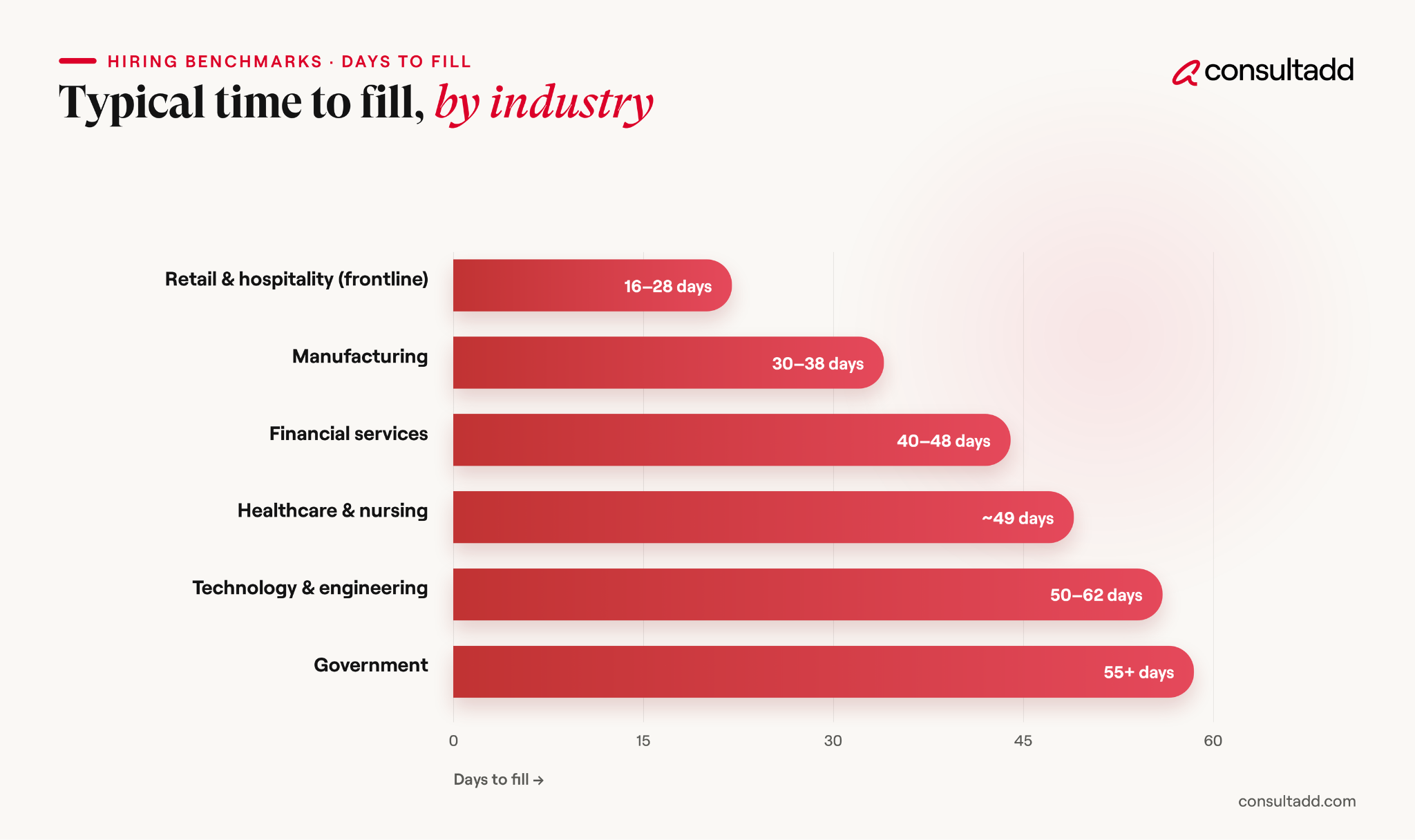
Two caveats before you pin these to a dashboard.
First, benchmarks are directional, not targets. A 25-day fill on a senior engineering role sounds great until you learn the team skipped reference checks to get there.
Second, your own trend matters more than any national average. Dropping from 52 days to 38 over three quarters is a bigger win than beating a median compiled from companies nothing like yours.
The labor market context shifts these numbers too. When openings outnumber available candidates in a sector, fill times stretch regardless of how efficient your process is.
The stakes behind the benchmarks are concrete. SHRM estimates an open position costs $4,000 to $9,000 per month in lost productivity, overtime, and delayed revenue. And Robert Half's research has long shown that top candidates are off the market within about 10 days. A 60-day process isn't just slow. It's selecting for whoever's left.
Using the gap as a diagnostic tool
Here's where tracking both metrics pays off. Neither number alone tells you what's broken. The relationship between them does.
That second pattern deserves a closer look, because interview bloat is the quiet culprit in most of the slow funnels I've seen. Hiring teams keep adding rounds "just to be sure," and each added stage brings scheduling delays, feedback loops, and candidate drop-off.
In a 2024 Greenhouse survey, 67% of recruiters named hiring manager delays as their top bottleneck. The candidates feel it too: SHRM research found 57% of job seekers lose interest in a role when the process drags.
Segmentation is the other non-negotiable. A company-wide 40-day average can hide an engineering pipeline running at 62 days while admin roles close in 18. Averages comfort; segments inform.
How to reduce both metrics without hurting quality
Speed and quality aren't opposites. Most hiring delay is dead time, not evaluation time: candidates waiting for feedback, interviews waiting for calendars, offers waiting for signatures. Cutting dead time costs you nothing in rigor.
Fix The Upstream (Improves Time to Fill)
- Set internal SLAs: hiring managers review shortlists within two working days, interview feedback lands within 24 hours. Boring, unglamorous, and consistently one of the highest-impact fixes.
- Build proactive pipelines for roles you hire repeatedly. Entering a new requisition with warm, partially assessed candidates changes the math entirely.
- Write the job post and align on must-have criteria before the requisition opens, not two weeks after.
- For hard-to-fill technical roles, a staffing partner with an existing bench can compress sourcing from weeks to days.
Our comparison of the best IT staffing firms in 2026 covers how to evaluate that option honestly.
Fix The Funnel (Improves Time to Hire)
- Cap interview rounds. Two well-structured stages, a competency-based screen plus a panel, are enough for most roles. Every round you remove typically saves five to ten days.
- Run stages in parallel where possible instead of strictly sequentially.
- Automate scheduling. It sounds trivial; it reliably saves days per hire.
- Use structured, criteria-based scorecards. SHRM's guidance is clear that structured screening improves 90-day performance and reduces early attrition, so speed achieved through structure upgrades quality rather than trading it away.
Contract and contract-to-hire models are another lever worth naming, since they decouple "seat filled" from "permanent hire decided."
We made the fuller case in IT contract staffing is a business strategy, not a backup plan.
Which metric should you report to leadership?
Both, but for different audiences and decisions. That's the practical resolution to the time to hire vs time to fill question.
Report time to fill to executives and finance. It maps directly to cost of vacancy, workforce planning, and project timelines. If your average is 45 days, requisitions need to open 45 days before the business needs the headcount, and leadership can plan around that.
Use time to hire inside the recruiting team. It isolates the funnel you actually control and shows whether process changes, fewer rounds, faster feedback, better scheduling, are working.
And whichever number you're presenting, pair it with quality of hire, offer acceptance rate, and early retention. A fast process that produces mis-hires isn't fast. It's just failing quickly.
Start Strong With Consultadd
With 15 years in business and 5,000+ successful staffing engagements, we don't just fill roles, we build reliability into your process. We've supported 65 staffing companies in the past year alone and maintain MSAs with industry leaders like Robert Half and TEKsystems.
Here's what working with Consultadd looks like:
- Talent sourced in under 24 hours
- Ready-to-deploy candidates, vetted for experience and compliance
- Lower turnover risk: we match long-term goals, not just short-term needs
- Seamless compliance: visa, documentation, onboarding? Handled.
- Dedicated 1:1 account managers for responsive, personalized support
- Top 100 candidate matches delivered in the past year
- Strong partnerships with universities to tap into fresh, committed talent
- Post-placement support so your investment grows beyond day one
For candidates, your next opportunity is more than just a job title, it's a chance to build skills, gain experience, and move your career forward. At Consultadd, we connect technology professionals with projects and employers that align with their goals, whether they're looking for contract, contract-to-hire, or long-term opportunities.
The tech job market moves fast, but the right guidance can make all the difference. Ready to take the next step in your career journey? Explore Opportunities >>
Key takeaways
- Time to fill starts when the requisition opens; time to hire starts when the candidate enters the pipeline. Both end at offer acceptance, and time to fill is always the equal or larger number.
- The SHRM benchmark of roughly 44 days average time to fill is a reference point, not a target. Segment by role type and track your own quarterly trend instead.
- Read the two metrics together: a large gap between them means an upstream sourcing or approval problem, while two high numbers mean a slow interview funnel.
- Most delay is dead time. Internal SLAs, fewer interview rounds, parallel stages, and automated scheduling cut days without cutting rigor.
- Report time to fill to leadership for planning and cost of vacancy; use time to hire internally to measure funnel improvements, and always pair speed metrics with quality of hire.
FAQs
What is the difference between time to hire and time to fill?
Time to fill measures the total days from when a job requisition opens to when a candidate accepts the offer. Time to hire measures only the days from when the eventual hire entered your pipeline to their offer acceptance. Time to fill covers the whole process; time to hire covers one candidate's journey through it.
Which is longer, time to hire or time to fill?
Time to fill is always equal to or longer than time to hire, because it includes everything that happens before any candidate engages: requisition approval, posting the job, and sourcing. The same hire might show a 50-day time to fill and a 29-day time to hire.
What is a good time to fill in 2026?
SHRM benchmarking puts the cross-industry average around 44 days, with frontline retail roles closing in under 3 weeks and technical roles often taking 50 to 62 days. A reasonable target for standard professional roles is 30 to 45 days. Anything consistently above 60 days for non-executive positions deserves a process audit.
How do you calculate time to fill?
Subtract the requisition open date from the offer acceptance date, in calendar days. For a company average, add up the time-to-fill values for all hires in a period and divide by the number of hires. The critical part is consistency: everyone must use the same start event, and SHRM recommends the requisition approval date because it captures internal delays.
Why is time to fill important?
It quantifies how long the business goes without needed capacity. SHRM estimates each vacant role costs $4,000 to $9,000 per month in lost productivity and overtime, and for revenue-generating roles the losses run higher. Finance and operations teams also use average time to fill to plan headcount, budgets, and project timelines.
How can I reduce time to hire?
Attack dead time first: set 24-hour SLAs for interview feedback, cap the process at two or three structured rounds, run stages in parallel, and automate scheduling. Removing a single interview stage typically saves five to ten days. Structured scorecards keep quality intact while decisions speed up.

The Best Hiring Strategies That Companies Are Actually Using
Introduction
The global median time to hire sits at 38 days as of 2025, and for specialized or hard-to-fill roles it runs considerably longer. Meanwhile, according to LinkedIn's talent research, roughly 70% of the global workforce is passive, meaning they are not applying to job boards and are unlikely to see your listing at all.
If your hiring strategy depends primarily on inbound applications, you are already fishing in a shrinking pond. That gap between traditional hiring assumptions and the actual talent market is where most hiring problems live.
Companies assume the process is working because they are getting applications. What they are not always measuring is how many strong candidates never applied, how many dropped out mid-process because of a poor experience, or how many accepted elsewhere because the decision took too long.
The best hiring strategies in 2026 are built around a different assumption: that top talent has options, moves fast, and will make decisions about your company long before they walk into an interview. Everything that follows flows from that reality.
TL;DR:
- Skills-based hiring outperforms degree-based screening, helping companies access a wider and more qualified talent pool.
- Building talent pipelines before roles open significantly reduces time-to-hire for critical positions.
- Candidate experience directly impacts hiring success, with slow communication and lengthy processes causing candidates to reject offers.
- AI should automate repetitive recruiting tasks, while recruiters focus on relationship-building and hiring decisions.
- Strong employer branding, structured interviews, and employee referrals consistently lead to better quality hires and lower hiring costs.
Strategy 1: Skills-Based Hiring Over Credential Screening
The most widely adopted shift in talent acquisition right now is the move from credential-based filtering to skills-based evaluation. Over 85% of employers are now using some form of skills-based hiring, according to TestGorilla's 2025 State of Skills-Based Hiring report, and more than 80% of leaders say it is actively contributing to better hiring outcomes and organizational growth.
The logic is straightforward. A degree tells you that someone completed an academic program. It does not tell you whether they can do the specific work your role requires. Skills-based hiring replaces that proxy with direct assessment: coding challenges, portfolio reviews, work samples, competency-based interview questions, and scenario-based tasks that evaluate demonstrated capability.
The practical effect is a wider candidate pool, fewer mis-hires, and better first-year performance. When candidates are evaluated on what they can actually do rather than what institution they attended, companies access talent they would otherwise filter out entirely. Nearly 47% of technology hires in recent surveys came through non-traditional paths.
Requiring a four-year degree for those roles would have eliminated almost half of the people who turned out to be the best fits. For a detailed breakdown of how skills-based assessment works in practice, AIHR's guide to recruiting strategies covers the implementation side in depth.
Strategy 2: Build Talent Pipelines Before Roles Open
The companies that consistently hire fast and well are not starting from scratch every time a role opens. They are maintaining active pipelines of qualified candidates who have already been engaged, assessed, and kept warm.
Proactive pipeline building means identifying likely future skill needs, reaching out to candidates before positions are posted, revisiting strong finalists from past searches (the people who came second in a previous hire are often excellent fits for the next one), and staying connected with high-potential professionals even when there is no immediate opening. The difference this makes in practice is substantial.
When a role opens, teams with existing pipelines can move to first interviews within days rather than restarting the sourcing cycle from zero. For specialized roles where the qualified candidate pool is small, that head start is the difference between making the hire and watching the candidate be accepted elsewhere.
Strategy 3: Fix the Candidate Experience First
Here is a number worth sitting with: 26% of job seekers declined offers in 2026 because of a poor hiring experience, according to CareerPlug data, not because the compensation was wrong or the role was unappealing but because the process itself left a bad impression.
Seventy-two percent of candidates who have a bad experience share it, either online or through professional networks, amplifying the damage well beyond the individual hire. On the other side, employers who improved their Glassdoor rating by even 0.5 points saw 20% more job clicks and 16% more applications.
The fixes are usually not complicated:
- Publish clear timelines and stick to them.
- Communicate at every stage, including when the answer is "we're still deciding."
- Audit your application process to make sure it takes less than 10 minutes to complete.
- Cut interview rounds that are not doing real filtering work.
- Give feedback within 48 hours of each stage.
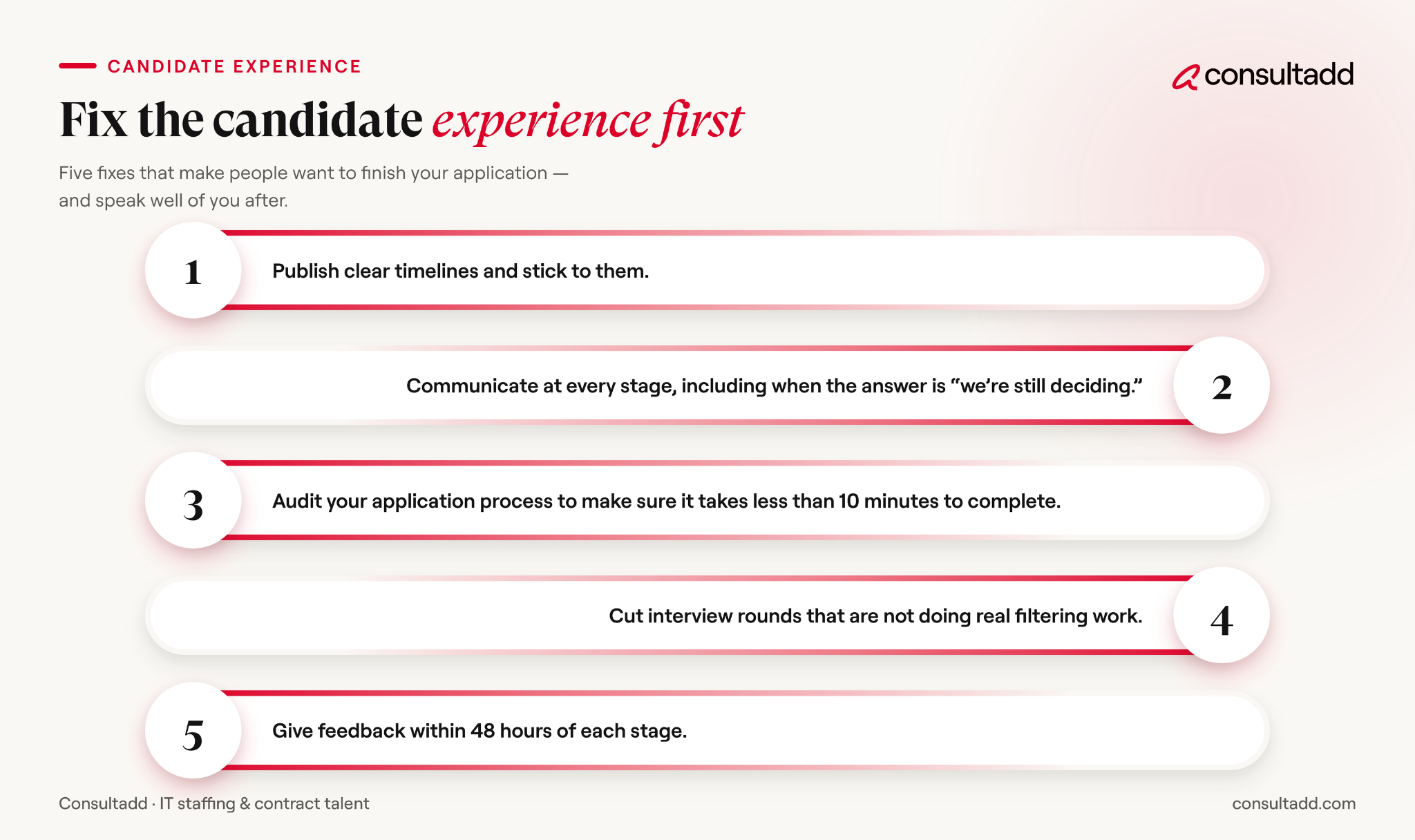
These things feel like table stakes, but most companies are not doing them consistently. Seventy-eight percent of job seekers say they expect a clear timeline for the hiring process.
Fast-track your hiring process without cutting corners. Consultadd handles technical assessments, background checks, visa support, and payroll management so you get fully trained, ready-to-deploy developers faster. Explore our immediately available core talent pool now.
Strategy 4: Use Structured Interviews Consistently
Unstructured interviews are one of the most reliable ways to introduce bias and noise into hiring decisions. Structured interviews standardize the process. Every candidate for the same role answers the same questions, which are designed to assess the specific competencies the role requires.
Evaluators use defined scoring rubrics rather than gut reactions. Interviewers from different functions rotate through the process to reduce the "feels familiar" bias that homogeneous panels produce.
The outcomes are measurable. Structured interviews reduce bias, improve the consistency of candidate evaluations, and make it significantly easier to compare candidates fairly.
They also make hiring managers better at interviewing, because preparation and criteria-setting forces clarity about what success in the role actually looks like. Combining structured interviews with skills-based assessments is where the real lift comes. The assessment tells you whether someone can do the technical work.
The structured interview tells you how they think, communicate, handle ambiguity, and operate under pressure.
Strategy 5: Invest in Employer Brand as a Recruiting Tool
Eighty-eight percent of candidates say employer branding influences their decision to apply, according to MSH data. Companies with a strong employer brand experience a 50% reduction in cost-per-hire.
The practical implication is that your careers page, Glassdoor profile, LinkedIn presence, and the stories your current employees tell publicly all function as recruiting infrastructure, whether you manage them or not.
Candidates research companies before applying. Eighty-three percent check company reviews and ratings when deciding where to send an application, and 87% say reputation directly influenced the decision to take their current role. Strong employer branding is not the same as good marketing copy on a careers page.
What candidates actually respond to is specific and honest: what does the day-to-day work feel like, how does leadership behave, do people grow in their careers here, and does the company follow through on what it says it values.
Employee testimonials, culture content, and transparent job descriptions that include pay ranges and growth paths consistently outperform polished generic messaging. For a thorough look at how employer branding statistics are shifting hiring outcomes in 2026, Vouch's employer branding data roundup pulls together the most relevant numbers.
Strategy 6: Use AI for Efficiency, Not as a Substitute for Judgment
AI has become embedded in hiring workflows at most technology-forward companies. According to Workday data, HR leaders rank recruitment and onboarding among the top three areas where they are realizing value from AI tools.
AI-powered screening tools can reduce time-to-hire by as much as 75% in high-volume scenarios, and AI-assisted sourcing dramatically expands the reach of a search beyond the candidates who happen to be using the right keywords on a given job board.
The important nuance is where AI creates value versus where it creates problems. AI is genuinely good at high-volume screening, interview scheduling, automated follow-up communication, sourcing across multiple channels simultaneously, and flagging potential skills matches that a human reviewer might miss.
It is less reliable at assessing cultural fit, evaluating soft skills, interpreting context in work histories, or making the kinds of judgment calls that experienced recruiters make instinctively. Application volumes have increased roughly 40% year-over-year at many organizations as candidates use AI tools to generate and submit applications at scale.
This creates a screening challenge that AI tools can help manage, but it also increases the value of experienced human judgment in separating strong candidates from well-optimized applications that do not reflect actual ability.
The teams getting the most out of AI in hiring are using it to remove administrative friction and handle volume, not to replace the recruiters who build candidate relationships and make final calls.
Strategy 7: Make Referral Programs Work Actually
Employee referral programs are one of the most consistently effective sourcing channels in hiring. Forty-eight percent of companies say their best hires come through referrals.
Referred candidates tend to accept offers more often, ramp faster, and stay longer, partly because they already have a realistic picture of the culture and role from someone they trust before they even apply. Most referral programs underperform because they are either poorly structured or not promoted.
The fixes are not complicated. Incentives should be meaningful, whether cash, extra time off, or other perks employees actually value. The process for submitting a referral should take less than five minutes.
Hiring teams should respond to referrals faster than they respond to inbound applications, both because the candidates are typically stronger and because failing to do so signals to the referring employee that their effort was not taken seriously.
Updates on referred candidates should flow back to the person who referred them. Referral programs also serve as retention tools. When employees are bringing in people from their professional networks, they become more invested in the team's composition and more connected to colleagues. People are significantly more likely to stay in roles where they like the people around them.
Strategy 8: Build Diversity Into the Process, Not Onto It
Diverse teams make better decisions, understand broader customer bases more effectively, and show measurably lower turnover rates. Companies with inclusive cultures report 22% lower turnover and 22% higher productivity scores, according to research cited by Wandify.
The business case is solid. The implementation question is whether diversity is built into how you hire or added as an afterthought.
Built-in means: job descriptions reviewed for exclusionary language before posting, structured interviews and standardized scoring to reduce the "feels familiar" effect, diverse hiring panels across function and seniority, sourcing through channels that reach candidates outside your usual networks, and skills-based criteria that do not filter by proxies for access to education.
Added on means: a diversity section in the job description, a commitment statement on the careers page, and no changes to the actual process. The latter does not move the needle.
Fifty-seven percent of candidates actively consider a company's diversity and inclusion initiatives when deciding whether to accept an offer, according to Deloitte data. What they are looking at is whether the evidence matches the messaging.
Start Strong With Consultadd
With 15 years in business and 5,000+ successful staffing engagements, we don't just fill roles, we build reliability into your process. We've supported 65 staffing companies in the past year alone and maintain MSAs with industry leaders like Robert Half and TEKsystems.
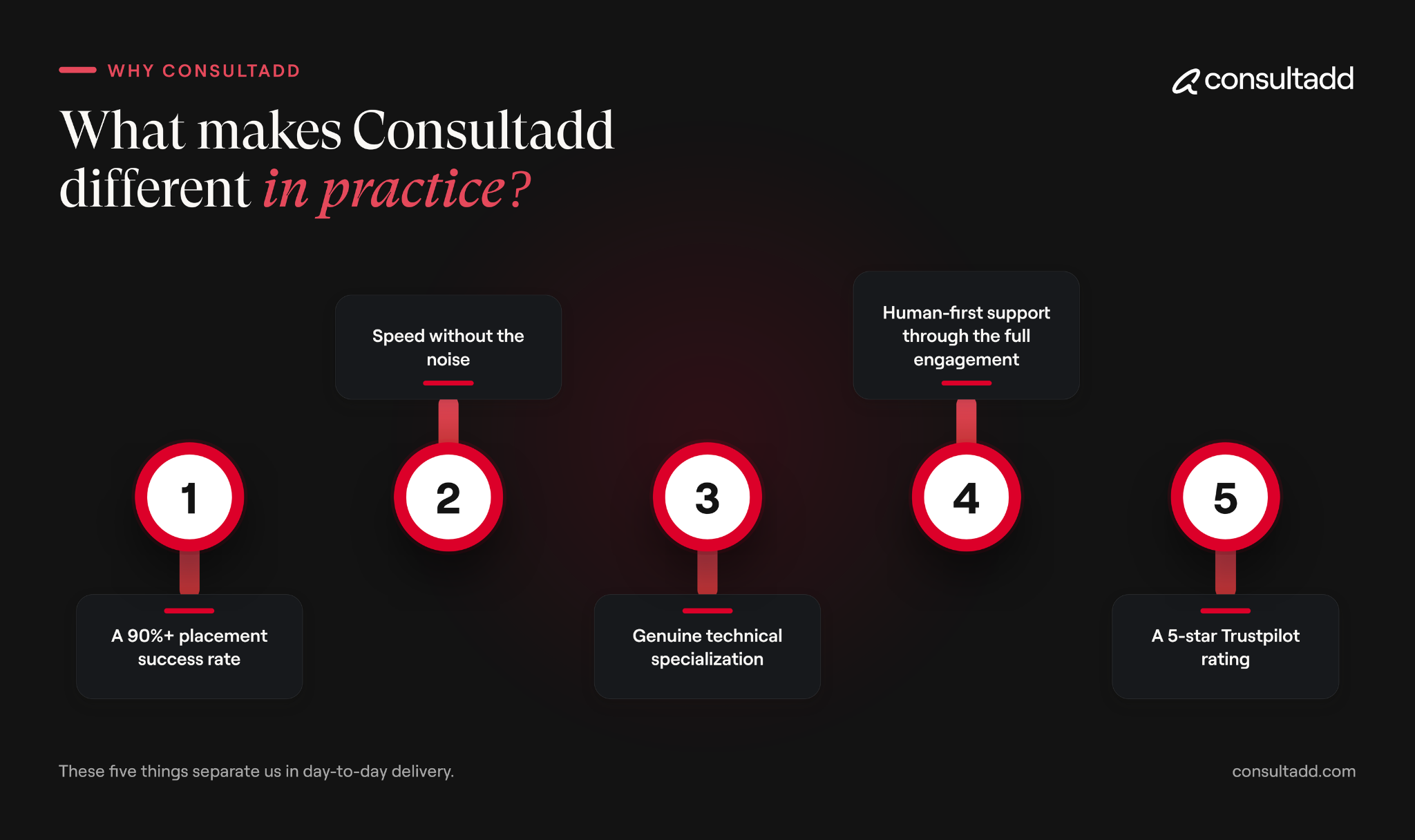
Here's what working with Consultadd looks like:
- Talent sourced in under 24 hours
- Ready-to-deploy candidates, vetted for experience and compliance
- Lower turnover risk: we match long-term goals, not just short-term needs
- Seamless compliance: visa, documentation, onboarding? Handled.
- Dedicated 1:1 account managers for responsive, personalized support
- Top 100 candidate matches delivered in the past year
- Strong partnerships with universities to tap into fresh, committed talent
- Post-placement support so your investment grows beyond day one
For candidates, your next opportunity is more than just a job title, it's a chance to build skills, gain experience, and move your career forward. At Consultadd, we connect technology professionals with projects and employers that align with their goals, whether they're looking for contract, contract-to-hire, or long-term opportunities.
The tech job market moves fast, but the right guidance can make all the difference. Ready to take the next step in your career journey? Explore Opportunities >>
Key Takeaways
- Focus on skills, not credentials, to improve quality of hire and reduce hiring bias.
- Create and nurture proactive talent pipelines instead of recruiting only after vacancies arise.
- Optimize the candidate experience with faster communication, fewer interview rounds, and clear timelines.
- Combine AI with human expertise. Use AI for screening and scheduling, but leave final hiring decisions to recruiters.
- Invest in employer branding, structured interviews, and referral programs to attract, evaluate, and retain top talent more effectively.
FAQs
What is a hiring strategy?
A hiring strategy is a structured plan that defines how an organization will attract, evaluate, and hire candidates for open roles. It covers sourcing channels, assessment methods, the candidate experience, and the metrics used to measure whether the process is working.
What is the most effective hiring strategy in 2026?
No single strategy works in isolation. The companies seeing the best results are combining skills-based evaluation, proactive talent pipeline building, structured interviews, and strong employer branding into a coherent process. Each element reinforces the others.
How does skills-based hiring work in practice?
Instead of filtering candidates by degree or job title, skills-based hiring evaluates what candidates can demonstrate they can do. This typically means using technical assessments, work samples, coding challenges, portfolio reviews, and competency-based interview questions designed to assess the specific capabilities the role requires.
Why do so many job seekers decline offers?
In 2026, the most commonly cited reason candidates decline offers is a poor hiring experience, including slow communication, unclear timelines, too many interview rounds, and a general sense of being left in the dark.
How important is employer branding for hiring?
Very. Eighty-eight percent of candidates say employer branding influences their decision to apply. Fifty percent reduction in cost-per-hire is the commonly cited advantage for companies with strong employer brands.

IT Recruitment in 2026: What's Broken, What's Working and How to Fix Your Hiring Strategy
Introduction
Let's be honest: IT recruitment in 2026 is not a simple task. You post a job, get flooded with applications, many of them AI-generated and somehow still struggle to find someone who can actually do the work.
The best candidates are off the market in days. Hiring processes stretch for weeks. And by the time an offer goes out, the candidate has already accepted something else.
This is not a rare frustration. It is the industry norm right now. Seventy-six percent of employers faced talent shortages in 2025, with IT roles at the top of that list.
At the same time, technology hiring teams only met about 50% of their hiring goals in 2025, a number that has been stuck flat for two consecutive years despite widespread investment in AI tools and recruitment software. The problem is not a lack of effort. It is a structural one.
This blog breaks down what is actually happening in IT recruitment right now, what the data says about where hiring teams are losing ground, and what strategies are making a measurable difference.
TL;DR:
- IT recruitment in 2026 is more competitive than ever, with talent shortages, longer hiring cycles, and increasing competition for specialized tech skills.
- Skills-based hiring has become the most effective recruitment strategy, enabling companies to identify capable candidates beyond traditional resumes and degrees.
- Building proactive talent pipelines and streamlining interviews helps organizations reduce time-to-hire and secure top candidates before competitors do.
- Strong employer branding and a positive candidate experience significantly improve application quality, offer acceptance rates, and overall hiring success.
- Partnering with specialized IT staffing firms provides faster access to pre-vetted tech talent and helps fill difficult roles in AI, cybersecurity, cloud, and data science.
The State of IT Recruitment: What the Numbers Tell Us
Before jumping into solutions, it helps to understand the scale of the problem.
The demand for tech talent is not slowing. U.S. employers posted nearly 1.1 million technology and IT jobs in 2025. AI, ML, and data science roles grew 163% year over year. Cybersecurity postings jumped 124%.
And yet, 71% of technology leaders say skills shortages have caused project delays with nearly half reporting that projects have been cancelled entirely because they could not staff the right people.
The tech sector's unemployment rate remains near historic lows, which means hiring is not slow because demand has dropped.
It is slow because the talent pool is genuinely thin for specialized roles, candidates hold multiple offers simultaneously, and hiring processes have not adapted quickly enough to keep pace with how fast the market moves.
Why Traditional IT Recruitment Is Falling Short
A few specific patterns keep coming up when you look at why hiring teams struggle:
Outdated screening processes. Relying on resumes and degree requirements alone filters out a huge portion of qualified talent. Nearly half of all technology job postings no longer require a four-year degree, and 47% of recent technology hires came from non-traditional paths. If your screening still defaults to credentials over capability, you are cutting yourself off from a large share of the talent pool.
Slow hiring cycles. The average time-to-hire in tech has been creeping upward, not down. Interview scheduling delays, unclear ownership between hiring managers and recruiters, and slow feedback loops all compound the problem. A clear majority of technology leaders report longer hiring timelines over the past year, with only a small fraction managing to move faster.
Skills misalignment. Resumes, especially in an era of AI-generated applications, are a poor signal of actual ability. Hiring teams report that candidate skills increasingly fail to match what resumes suggest, forcing additional evaluation steps that slow things down further.
Reactive hiring. Most organizations only start recruiting when a role opens. By that point, the talent pipeline is cold, the timeline is tight, and the team is already under pressure. That is a losing position to hire from.

What Is Actually Working in IT Recruitment Right Now
The good news is that some teams are pulling ahead, and the approaches they are using are not complicated
1. Skills-Based Hiring
This is the single biggest shift happening in IT recruitment right now. Instead of filtering by degree or job title history, leading companies are evaluating what candidates can actually do.
More than 80% of leaders using skills-based hiring say it is helping their organizations drive better outcomes. Candidates respond well to it too. 78% of job seekers report a positive experience when employers focus on skills rather than credentials.
Practically, this means using technical assessments, portfolio reviews, GitHub activity, pair-programming tasks, and scenario-based interviews in place of (or alongside) traditional screening.
A LinkedIn study projected that by 2025, nearly half of all recruitment decisions would shift toward skills over credentials. That projection has held up.
2. Proactive Talent Pipeline Building
The organizations that consistently hire well in 2026 are not waiting for roles to open before they engage talent. They are building relationships with candidates months in advance, mapping likely future skill needs, and maintaining warm pipelines of vetted professionals.
This shift from reactive to proactive recruiting can cut time-to-fill in half. When a role opens, the shortlist is already partially built. That advantage is hard to overstate in a market where top candidates disappear in days.
3. Streamlined Interview Processes
Companies that have reduced candidate drop-off rates share a common pattern: their interview process is shorter, more structured, and clearer in expectations. One-day interview sprints, pre-scheduled panel interviews, and defined decision timelines all help.
Some companies have adopted what amounts to a repeatable "rinse and repeat" interview structure; defining the role, selling the company, evaluating technical ability, checking values alignment that is applied consistently from junior to executive levels.
4. Employer Brand Investment
Candidates in 2026 research companies before they apply. They look at culture, leadership, growth opportunities, work flexibility, and whether the company's stated values match what employees actually say.
A weak employer brand, or no brand at all, is a real drag on applications from strong candidates.
Sharing specific, honest content about what it is like to work at your company (not just polished press releases) makes a measurable difference in both application volume and quality.
5. Partnering with Specialized Recruitment Firms
Seventy percent of technology leaders say the AI hiring landscape alone has made them more likely to work with a staffing or consulting firm, primarily to find candidates with specialized skills and manage the increased noise from AI-generated applications.
And 93% of tech and IT leaders say staffing firms have been effective at helping with AI-related hiring challenges.
This makes sense. Specialized IT recruitment partners maintain pre-vetted talent pipelines, understand niche skill requirements, and can dramatically reduce time-to-hire for roles that would otherwise sit open for months.
Traditional IT Recruitment vs Modern IT Recruitment
The Skills That Are Hardest to Hire For Right Now
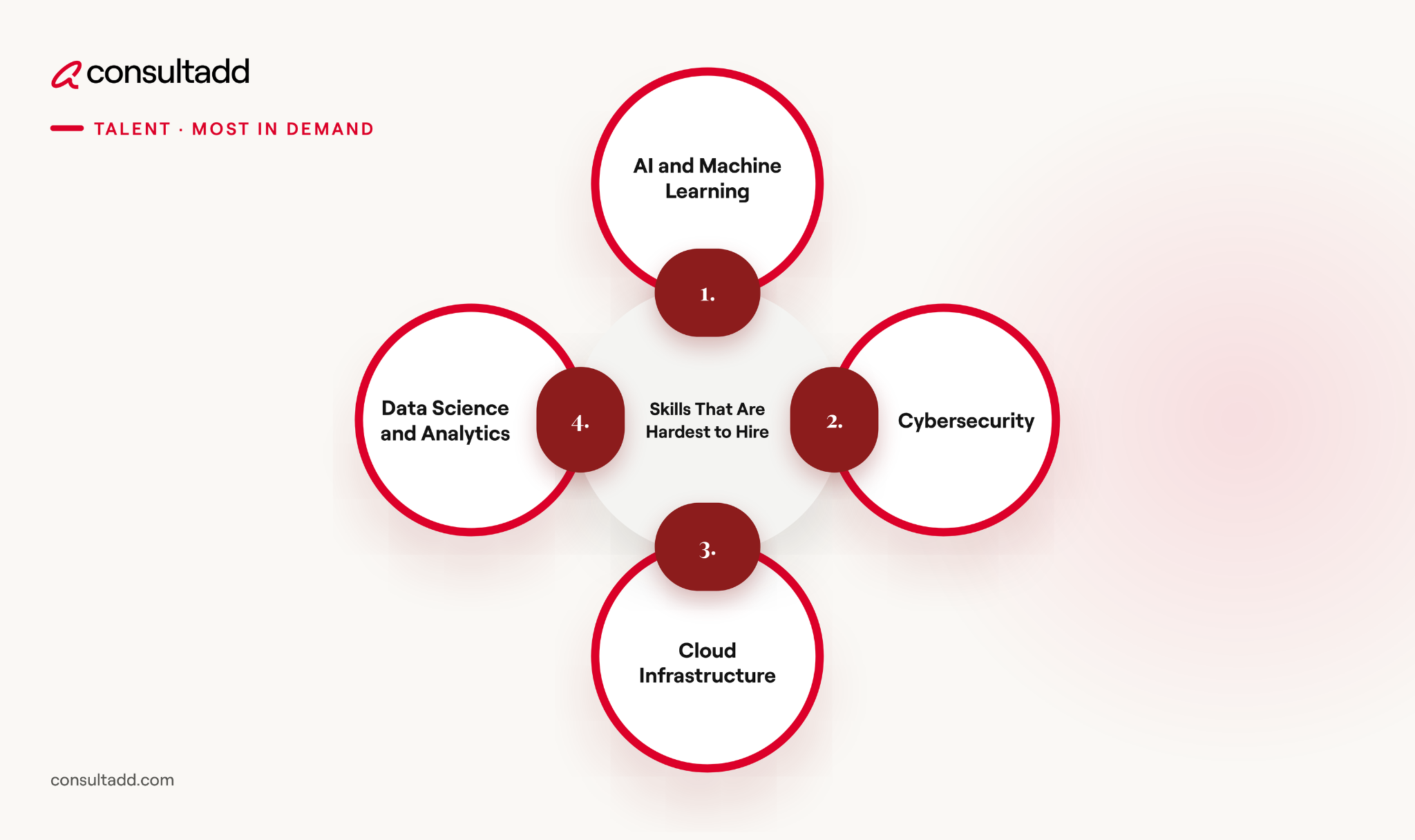
Knowing where the talent crunch is sharpest helps prioritize hiring strategy. Based on current job posting data and hiring trends, these are the roles where competition is most intense:
AI and Machine Learning: AI/ML roles grew 163% in job postings from 2024 to 2025. The demand for candidates who can build, fine-tune, and deploy AI systems far exceeds the current supply. McKinsey reports that nearly 46% of technology leaders say missing AI skills are blocking their highest-priority initiatives.
Cybersecurity: There are an estimated 4.7 million unfilled cybersecurity roles globally, with more than 457,000 open in the US alone. Cybersecurity engineers saw a 124% jump in job postings year over year. This shortage is not going away.
Cloud Infrastructure: As companies continue migrating workloads and building cloud-native applications, demand for cloud architects, engineers, and DevOps specialists remains consistently high.
Data Science and Analytics: Organizations are generating more data than ever and struggling to find people who can turn that data into decisions. Data roles remain among the most difficult to fill across industries.
Struggling to find developers who check all these boxes? Tap into Consultadd's pre-vetted talent pool of 200+ verified developers skilled in AI/ML Full-Stack, Cloud, and DevOps. Start hiring smarter today! Schedule a free talent discovery call with our team.
Common Mistakes That Slow Down IT Recruitment
A few patterns consistently show up on the wrong side of hiring outcomes:
Writing job descriptions that scare people off. Padding requirements with every conceivable desired attribute discourages otherwise qualified candidates from applying. The research is clear: list the skills that are genuinely mandatory, and separate them from nice-to-haves.
Homogeneous interview panels. Panels that always include the same people tend to hire people who "feel familiar." Rotating panelists from different functions and training interviewers to evaluate skills and thinking patterns, not likability, produces better hiring outcomes and stronger teams.
Ignoring candidate experience. Nearly half of job seekers decline offers because of a negative hiring experience. A slow, opaque, or disorganized process is not just annoying, it costs you candidates. The hiring process is a first impression of what it is like to work somewhere.
Hiring in isolation. IT recruitment that operates separately from workforce planning, business goals, and skills gap analysis tends to produce reactive, misaligned hires. The organizations getting this right treat talent acquisition as a strategic function, not an administrative one.
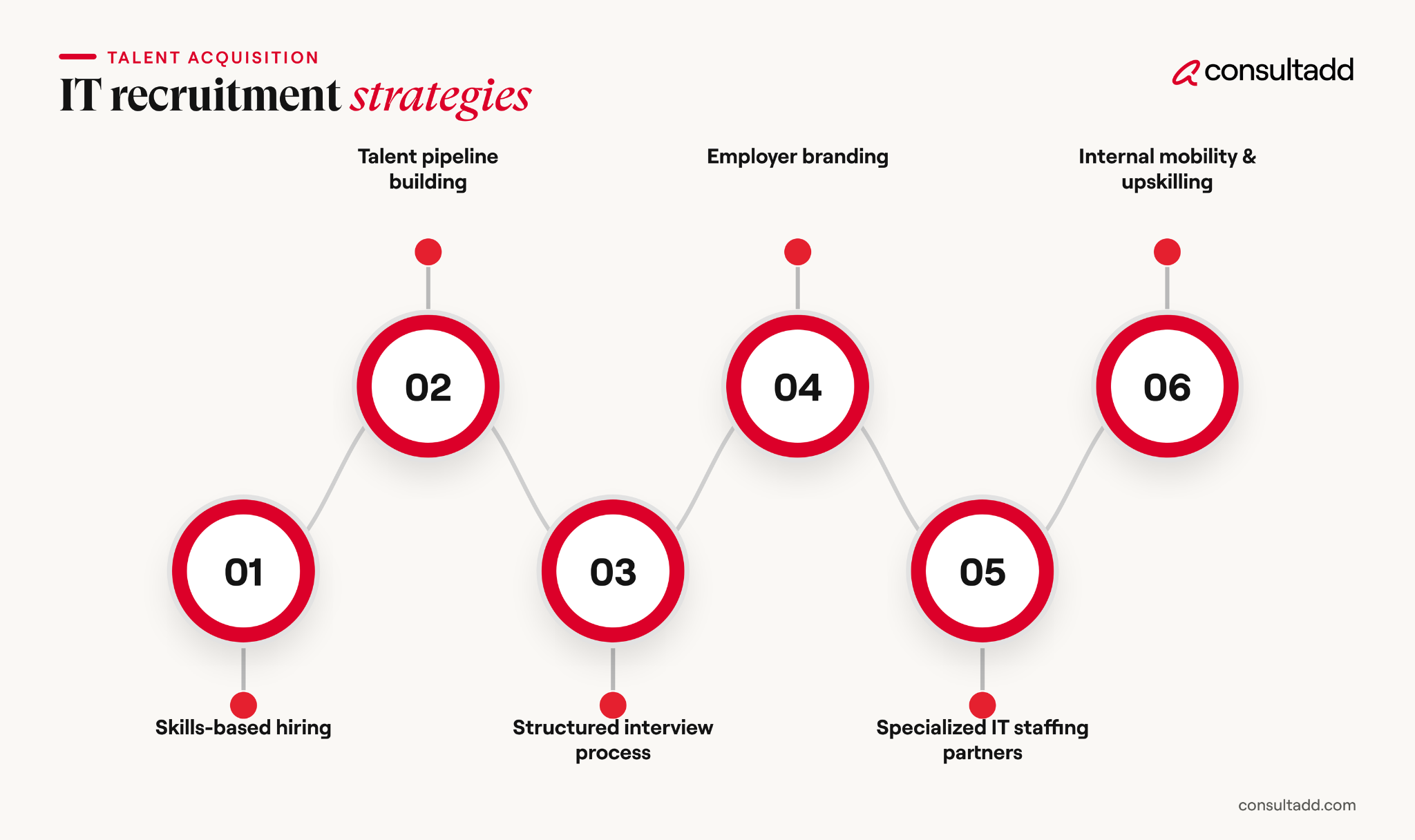
IT Recruitment Strategies and Their Business Impact
What Candidates Are Looking For in 2026
IT recruitment is a two-way street. Understanding what motivates tech professionals right now matters just as much as knowing how to screen them.
The research is consistent on this: tech talent is looking for more than salary. Flexible and remote work arrangements are now standard expectations, not perks. A significant majority of tech job seekers prefer fully remote or hybrid roles. Compensation that keeps pace with inflation matters, but so do benefits, equity participation, wellness programs, and increasingly clear career development paths.
Companies that can show candidates a realistic 2-5 year growth roadmap during the hiring process have a meaningful edge. The half-life of technical skills in some fields is under three years, so professionals are actively evaluating whether a company will invest in keeping their skills current.
Internal Mobility: The Hire You Already Have
One underused lever in IT recruitment is internal mobility. Forward-thinking organizations are increasingly finding that the best next hire might already be on the payroll.
Structured upskilling programs, clear technical career paths, and deliberate internal job posting practices can surface talent that hiring teams would otherwise spend months looking for externally. In 2023, 48% of tech organizations said they were prioritizing upskilling and cross-skilling over new hires. The numbers have continued to move in that direction.
This is not just a cost play. Internal mobility improves retention, signals to employees that growth is real, and gives the organization more control over building the specialized skill sets it needs rather than trying to buy them in a competitive market.
Start Strong With Consultadd
With 15 years in business and 5,000+ successful staffing engagements, we don’t just fill roles, we build reliability into your process. We’ve supported 65 staffing companies in the past year alone and maintain MSAs with industry leaders like Robert Half and TEKsystems.
Here’s what working with Consultadd looks like:
- Talent sourced in under 24 hours
- Ready-to-deploy candidates, vetted for experience and compliance
- Lower turnover risk: we match long-term goals, not just short-term needs
- Seamless compliance: visa, documentation, onboarding? Handled.
- Dedicated 1:1 account managers for responsive, personalized support
- Top 100 candidate matches delivered in the past year
- Strong partnerships with universities to tap into fresh, committed talent
- Post-placement support so your investment grows beyond day one
For candidates, your next opportunity is more than just a job title, it's a chance to build skills, gain experience, and move your career forward. At Consultadd, we connect technology professionals with projects and employers that align with their goals, whether they're looking for contract, contract-to-hire, or long-term opportunities.
The tech job market moves fast, but the right guidance can make all the difference. Ready to take the next step in your career journey? Explore Opportunities >>
Key Takeaways
- IT recruitment is operating in one of the tightest talent markets in recent history, with shortages hitting AI, cybersecurity, and cloud roles hardest.
- Skills-based hiring is the most impactful shift companies can make right now, replacing degree-filtered screening with real capability assessment.
- Proactive pipeline building consistently cuts time-to-fill and improves candidate quality compared to reactive, post-vacancy recruiting.
- Internal mobility and upskilling are underused options that can reduce external hiring pressure while strengthening retention.
- Specialized IT recruitment partners reduce time-to-hire significantly and provide access to pre-vetted talent pools that general job boards cannot match.
FAQs
What is IT recruitment and how is it different from general recruitment?
IT recruitment focuses specifically on sourcing, screening, and hiring technology professionals like software engineers, cybersecurity specialists, data scientists, cloud architects, and related roles.
Why is IT recruitment so difficult in 2026?
Demand for specialized tech talent has outpaced supply for several years. Near-zero unemployment in key IT disciplines, intense competition from companies of all sizes, faster candidate decision timelines, and the explosion of AI-generated applications have all made IT recruitment more challenging.
What is skills-based hiring and why does it matter for IT recruitment?
Skills-based hiring evaluates candidates based on demonstrated capability rather than credentials like degrees or specific job titles. For IT recruitment, this means using technical assessments, coding challenges, portfolio reviews, and scenario-based interviews.
Should we build an internal IT recruitment team or work with a staffing partner?
Both approaches have a place. Internal teams are valuable for ongoing, high-volume hiring and cultural continuity. Specialized IT staffing partners add value for hard-to-fill roles, niche skill sets, and faster time-to-hire through pre-built talent networks. Most companies doing this well use a hybrid approach.
What are the most in-demand IT roles right now?
As of mid-2026, the highest-demand roles include AI and ML engineers, cybersecurity professionals (especially engineers and analysts), cloud architects, DevOps specialists, and data scientists. These are also the hardest roles to fill.

What Does Vetting A Candidate Mean?
Introduction
You read a resume. It looks great. The interview goes well. Then you make the offer, and three months later you realize the person can't actually do half of what the resume claimed. That gap, between what a candidate says and what's true, is exactly what vetting closes.
So what does vetting a candidate mean? It's the process of checking a candidate's background, skills, and claims before you hire them, so you know they can do the job and are who they say they are. It pulls resume checks, skills tests, references, and background checks into one decision instead of a gut call.
Vetting isn't the same as a quick resume scan. It's the difference between hoping someone works out and having real reasons to believe they will. This guide breaks down what vetting covers, the steps involved, and how to do it well without dragging out your hiring process.
TL;DR
- Vetting a candidate means verifying their skills, background, and claims before an offer, not just reading a resume.
- It's broader than a background check. A background check is one piece of vetting, alongside skills tests, references, and identity checks.
- The core steps are resume screening, phone screen, skills assessment, structured interview, reference checks, and background checks.
- Around 70% of U.S. workers admit to lying on a resume, so verifying claims matters more than trusting them.
- The final call stays with a human. Automation gathers and structures the evidence, but a person makes the decision.
What vetting a candidate actually means
Vetting is verification. When you vet someone, you're confirming that the person in front of you matches the person on paper, and that they meet your bar for both skill and trust.
The word comes from the idea of examining something carefully before you accept it. In hiring, that means looking past the polished resume and the confident interview to the facts underneath.
A good way to think about it: a resume is a claim, not proof. Vetting is how you turn claims into evidence. Did they hold that title? Can they write the code? Will a former manager vouch for how they actually worked?
None of this means treating candidates as suspects. Most people are honest. But a structured process protects you from the small percentage who aren't, and it protects candidates too, because everyone gets judged by the same standard instead of a hiring manager's mood that day.
Vetting vs screening vs background check
People use these three words as if they mean the same thing. They don't, and the difference matters when you're building a process.
Screening is the early filter. It's the first pass on applications, where you narrow a big pile down to people worth talking to.
A background check is the records pulled on a finalist. It covers criminal history, employment dates, education, and similar facts.
Vetting is the whole thing. It's the full evaluation that includes screening and the background check, plus skills tests, references, and identity verification.
The takeaway is simple. Every background check is part of vetting, but not all vetting is a background check.
Why vetting candidates matters
The honest reason is money and risk. A bad hire is expensive, and vetting is cheap next to one.
There's a trust side too. Resumes are not proof, and about 70% of U.S. workers admit they have lied on one at some point. Verifying claims rather than trusting them is the whole point.
Then there's scale. U.S. employers made 5.2 million hires in a single month in mid-2026, per the Bureau of Labor Statistics. Ad hoc, do-it-by-feel checks don't hold up at that volume. A consistent process does.
One warning worth stating plainly. Over-vetting is a real failure mode. Pile ten checks onto a junior role and strong candidates will drop out before you finish. Match the depth of vetting to the stakes of the role.
The candidate vetting process, step by step
Vetting works best as a sequence, with the cheapest, fastest checks first and the deeper ones reserved for people who make it through. Here's a practical order.
- Resume and application screening. Match experience and qualifications against the role. Software can help surface the right resumes and support a blind review that reduces bias.
- Phone screen. A short call, usually around 30 minutes, to confirm basics, gauge interest, and check that the candidate meets the minimum requirements.
- Skills assessment. A test or practical exercise that measures the actual abilities the job needs. This is where inflated resumes get exposed.
- Structured interview. The same core questions for every candidate, scored consistently, so you compare people fairly instead of on rapport.
- Reference checks. Conversations with former managers or colleagues to confirm how the person actually worked, not just that they were employed.
- Background check. The records pull on your finalist, run with the candidate's consent.

Run what you can in parallel to keep things fast, but keep the order of depth. There's no reason to run a background check on someone who failed the skills test.
ConsultAdd covers the digital side of this in more detail in its guide on the online job candidate vetting process and tips, which is worth a read if your hiring runs remote.
Common vetting checks and what they catch
Not every check does the same job. Some confirm identity, some measure ability, and some surface risk. Here's how the main ones line up.
The mix you choose depends on the role. A safety-sensitive or finance position earns deeper checks. A high-volume entry-level role needs a lighter, faster touch so you don't lose good people to a slow process.
Staying fair and compliant while you vet
Vetting isn't a free-for-all. In the U.S., background checks fall under the Fair Credit Reporting Act, and hiring decisions are governed by EEOC anti-discrimination rules. That means you need candidate consent for background checks and a consistent, job-related process.
A few habits keep you on the right side of the line. Apply the same steps to every candidate for a given role. Base decisions on job-related factors, not hunches. Collect only the information you actually need, and store it securely.
Social media checks are a gray area. You can look, but review only public information, tell candidates you're doing it, and stay within the law so you don't invite bias or a privacy complaint. When in doubt, involve someone who knows your local employment rules.
The goal isn't just to avoid lawsuits. A fair process produces better hires, because you're judging people on what the job requires instead of on noise.
How staffing partners handle vetting
If your team is small or your hiring volume spikes, vetting well for every role gets hard fast. This is where a staffing partner earns its keep.
A specialized agency runs the sourcing, screening, and verification, then hands you a short list of people who already cleared the checks. Instead of sifting through hundreds of resumes for a full-stack developer, you might see five candidates who match your exact requirements.
Good partners also treat vetting as more than a checkbox. They screen for skills, availability, and long-term fit, which cuts down on the early dropouts that quietly wreck a hiring plan.
If you're weighing a trial period before committing, ConsultAdd's breakdown of the contract-to-hire model explains how a "try before you buy" approach reduces the risk of a bad permanent hire.
The thread running through all of it: vetting is how you turn a hopeful hire into a confident one.
Start Strong With Consultadd
With 15 years in business and 5,000+ successful staffing engagements, we don't just fill roles, we build reliability into your process. We've supported 65 staffing companies in the past year alone and maintain MSAs with industry leaders like Robert Half and TEKsystems.
Here's what working with Consultadd looks like:
- Talent sourced in under 24 hours
- Ready-to-deploy candidates, vetted for experience and compliance
- Lower turnover risk: we match long-term goals, not just short-term needs
- Seamless compliance: visa, documentation, onboarding? Handled.
- Dedicated 1:1 account managers for responsive, personalized support
- Top 100 candidate matches delivered in the past year
- Strong partnerships with universities to tap into fresh, committed talent
- Post-placement support so your investment grows beyond day one
For candidates, your next opportunity is more than just a job title, it's a chance to build skills, gain experience, and move your career forward. At Consultadd, we connect technology professionals with projects and employers that align with their goals, whether they're looking for contract, contract-to-hire, or long-term opportunities.
The tech job market moves fast, but the right guidance can make all the difference. Ready to take the next step in your career journey? Explore Opportunities >>
Key takeaways
- Vetting a candidate means verifying their skills, background, and claims before you hire, so the decision rests on evidence instead of a good first impression.
- Vetting is the whole evaluation. Screening is the early filter, and a background check is one late-stage piece of it.
- A structured, consistent process cuts the cost and risk of a bad hire, which can run one to two times the salary.
- Match the depth of vetting to the role, since over-vetting a junior position drives strong candidates away.
- Keep the process fair and compliant with FCRA and EEOC rules, and keep the final hiring decision with a human.
FAQs
What does it mean to vet a candidate?
Vetting a candidate means checking their background, skills, and claims before you make an offer. It confirms they can do the job and are who they say they are. The process usually combines resume screening, skills tests, references, and a background check into one decision.
Is vetting the same as a background check?
No. A background check is one part of vetting, focused on records like criminal history and employment verification. Vetting is the full evaluation, which also includes skills assessments, reference checks, and identity verification. Every background check is vetting, but not all vetting is a background check.
How long does it take to vet a candidate?
It depends on the role and how many checks you run. A light process for an entry-level job can wrap up in days, while a high-trust role with deep background checks may take a few weeks. Running checks in parallel speeds things up without cutting corners.
What are the main steps in candidate vetting?
A typical process moves from resume screening to a phone screen, then a skills assessment, a structured interview, reference checks, and finally a background check. The cheap, fast checks come first, and the deeper ones are saved for finalists. This keeps the process efficient and fair.
Can you check a candidate's social media when vetting?
Yes, but carefully. Review only public information, let candidates know you're doing it, and follow laws like the FCRA to avoid bias and privacy problems. Social media should support a decision, not drive it, and it should never replace job-related checks.
Why is vetting candidates important?
Vetting reduces the risk and cost of a bad hire, which can run one to two times the person's salary once you add rehiring and lost productivity. It also protects your reputation and helps you meet compliance requirements for regulated roles. Done consistently, it leads to better hires and lower turnover.

What to Look For When Hiring Software Developers: Your Hiring Guide
Introduction
The difference between a great software developer and an average one can make or break your project timeline. Companies with strong engineering teams are more likely to achieve their business goals, while poor hiring decisions cost organizations an average of $240,000 per bad hire in the tech sector.
Understanding what to look for when hiring a software developer isn't just about technical skills anymore. The present hiring landscape demands a strategic approach that balances technical expertise, cultural alignment, and long-term growth potential.
This blog discusses the essential elements you need to evaluate, from core competencies to interview strategies, helping you build a development team that drives real business results.
TL;DR
- Define clear hiring requirements. Know your tech stack, system requirements, and business objectives before you begin.
- Focus on five key traits: technical expertise, problem-solving ability, scalable code quality, communication, and adaptability.
- Prioritize real-world, practical assessments, such as system design discussions, debugging sessions, and code reviews.
- Value hands-on experience over credentials. Review portfolio projects, Git history, and previous system ownership.
- Spot red flags early, including weak communication, poor code practices, and resistance to feedback or learning.
Start with Clear Hiring Requirements
Success begins with knowing exactly what you need. Vague job descriptions attract the wrong candidates and waste everyone's time.
Define Your Technical DNA
Before you interview a single candidate, map your exact technical needs:
Core Stack Requirements:
- Primary languages (Python, JavaScript, Go, Rust)
- Frameworks and libraries (React, Vue, Django, FastAPI)
- Database technologies (PostgreSQL, MongoDB, Redis)
- Cloud infrastructure (AWS, GCP, Azure)
Architecture Expertise:
- Microservices vs. monolithic systems
- API design and integration patterns
- DevOps and CI/CD pipeline experience
- Scalability and performance optimization
Early-stage companies need versatile generalists while established enterprises require deep knowledge specialists. Know what you need before you start looking.
Align with Business Impact
The best developers don't just write code; they also solve business problems. Identify whether you need someone to:
- Build MVP products that attract investors
- Scale existing systems for 10x growth
- Modernize legacy infrastructure
- Lead technical architecture decisions
The 5 Critical Areas: What to Look for When Hiring a Software Developer
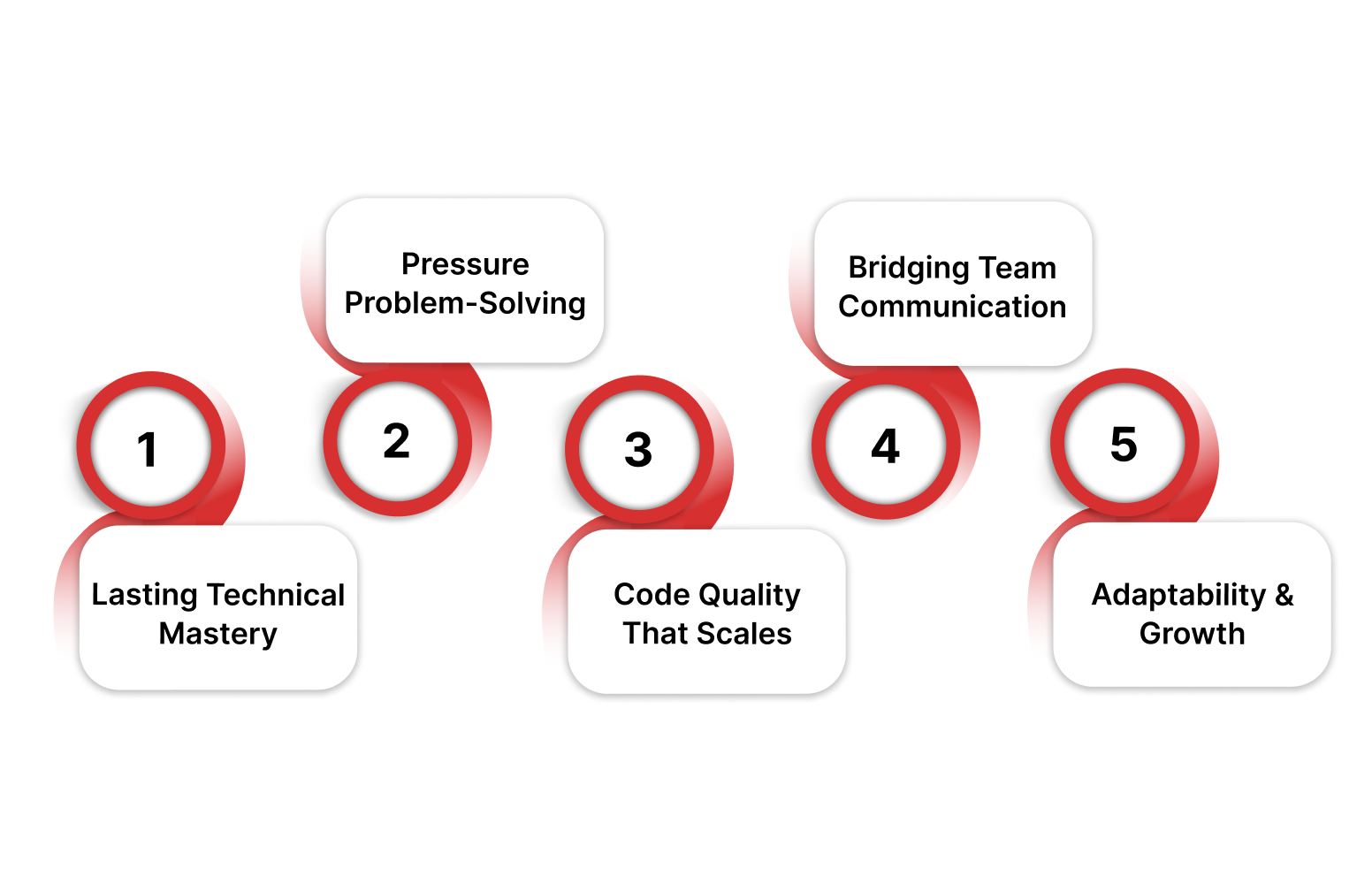
These five areas separate exceptional developers from average ones. Evaluate your candidates based on these, and you'll never make a bad hire again.
1. Technical Mastery That Goes a Long Way
Test candidates beyond surface knowledge. Anyone can list programming languages on their resume. Elite developers demonstrate their skills:
Proficiency in Core Programming Languages
Evaluate hands-on experience and language-specific best practices. Prioritize candidates with demonstrable knowledge in:
- Frontend: JavaScript, TypeScript, React, Angular, Vue.js
- Backend: Python, Java, Go, C#, Ruby, Rust
- Mobile: Kotlin, Swift, React Native
- Data & AI: Python (for data analysis, AI/ML), R, SQL
This range ensures your team can build full-stack, scalable applications while adapting to evolving project needs.
System Design and Architecture Fundamentals
Top developers think in terms of systems, not isolated features. Ensure they understand:
- Database design and optimization
- Caching strategies (Redis, Memcached)
- Load balancing, fault tolerance, and distributed systems patterns
- API design, versioning, and backward compatibility
Familiarity with Software Development Methodologies
Hands-on experience with Agile, Scrum, and Kanban methodologies is crucial. Developers should:
- Understand iterative development and continuous delivery principles
- Know how to work within sprints, manage backlogs, and participate in standups and retrospectives
This ensures seamless collaboration and predictable delivery timelines.
Problem-Solving and Analytical Abilities
Exceptional developers break down complex issues into manageable parts, applying logical, structured approaches like:
- Root cause analysis
- Decomposition techniques
- Trade-off analysis and impact assessments
Test this by presenting candidates with real production bugs or architecture challenges during interviews.
Proficiency with Version Control and Collaboration Tools
Experience with Git and platforms like GitHub or GitLab is non-negotiable. Developers should demonstrate:
- Clear branching strategies
- Clean commit hygiene
- Code review participation and collaborative debugging workflows
Knowledge of Modern Development Workflows
Expect them to be familiar with:
- Test-Driven Development (TDD) and Behavior-Driven Development (BDD)
- CI/CD pipelines
- Containerization tools (Docker, Kubernetes)
- Infrastructure as Code (Terraform, CloudFormation)
- Observability and monitoring tools (Prometheus, Grafana)
2. Problem-Solving Under Pressure
Present real scenarios from your codebase to the candidates. Exceptional developers will:
- Ask clarifying questions before coding
- Break complex problems into logical components
- Propose multiple solutions with trade-off analysis
- Debug systematically rather than randomly
Red Flag: Candidates who jump straight to coding without understanding requirements.
3. Code Quality That Scales
Review their GitHub repositories and portfolio projects. Here's what you should look for:
- Clean Code: Meaningful names, single responsibility functions, clear documentation
- Testing Coverage: Unit tests, integration tests, end-to-end testing
- Git Hygiene: Atomic commits, clear messages, proper branching strategies
- Performance Awareness: Optimized algorithms, efficient database queries
Struggling to find developers who check all these boxes? Tap into Consultadd's pre-vetted talent pool of 200+ verified developers skilled in AI/ML Full-Stack, Cloud, and DevOps. Start hiring smarter today! Schedule a free talent discovery call with our team.
4. Communication That Bridges Teams
Technical brilliance means nothing if software developers can't collaborate effectively. Strong candidates will:
- Explain complex concepts in simple terms
- Write clear technical documentation
- Participate constructively in code reviews
- Handle feedback without defensiveness
5. Growth Mindset and Adaptability
Technology evolves rapidly. You need a team that is ready to work in changing environments. The best developers:
- Learn new frameworks and languages quickly
- Contribute to open-source projects
- Stay current with industry trends
- Embrace changing requirements as opportunities
Your Interview Process: Beyond the Whiteboard
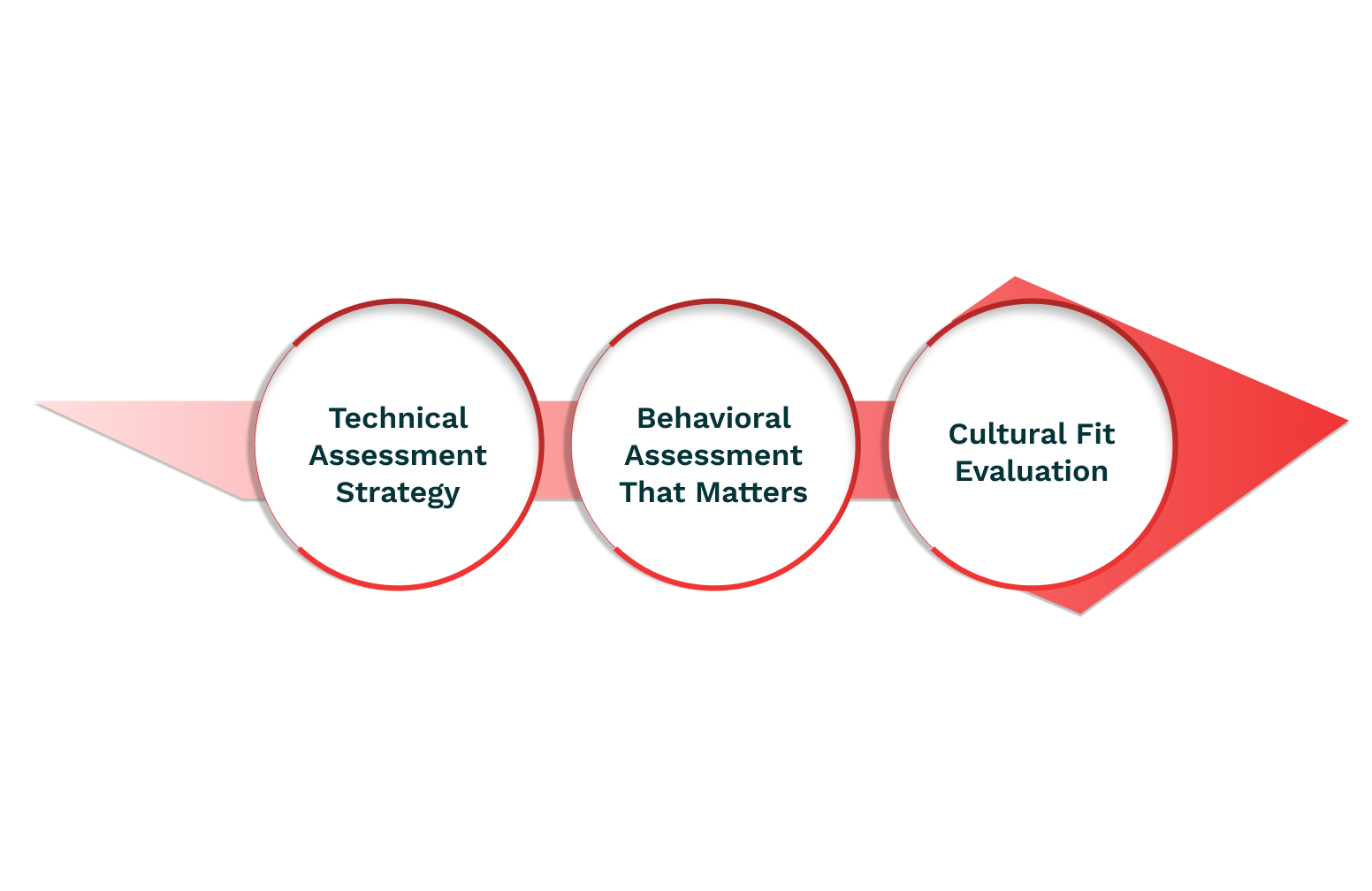
Traditional coding interviews fail to predict real-world performance. Here's how to assess candidates in terms of how they'll work.
Technical Assessment Strategy
Skip the puzzles, focus on reality. Instead of abstract algorithms, use scenarios from your actual codebase to test the candidates:
- Code review exercises with real pull requests
- Architecture discussions about scaling challenges
- Debugging sessions with production issues
- Pair programming on feature implementations
System design requirements for all levels. Even junior developers should understand basic system concepts:
- How does a web request travel through your stack?
- What happens when your database becomes a bottleneck?
- How would you handle a 5x traffic spike?
Behavioral Assessment That Matters
Use the STAR method to explore:
- Situation: "Tell me about a time you disagreed with a technical decision."
- Task: "What was your role in resolving it?"
- Action: "What specific steps did you take?"
- Result: "What was the outcome and what did you learn?"
Cultural Fit Evaluation
Understanding what to look for when hiring a software developer includes cultural alignment. Ask questions that clarify the following:
- Do they share your company's values?
- Are they excited about your problem domain?
- How do they handle stress and tight deadlines?
- Do they mentor others and share knowledge?
Fast-track your hiring process without cutting corners. Consultadd handles technical assessments, background checks, visa support, and payroll management so you get fully trained, ready-to-deploy developers faster. Explore our immediately available core talent pool now.
Developer Red Flags That May Cost You Later
These warning signs predict future problems. Recognizing them early saves months of frustration and expensive turnover.
Technical Red Flags:
- Can't explain their code from GitHub
- Defensiveness about code quality feedback
- Inability to discuss trade-offs in technical decisions
- Overengineering simple solutions
Cultural Red Flags:
- Blames others for project failures
- Shows no curiosity about your business
- Poor communication during technical discussions
- Unwillingness to learn new technologies
Choosing Your Hiring Strategy
Different situations require different approaches. Match your hiring model to your specific needs and timeline constraints.
Moreover, connecting with specialized recruitment partners can streamline this decision-making process, offering access to pre-vetted talent pools without the overhead of traditional recruitment cycles.
Avoid These Costly Hiring Mistakes
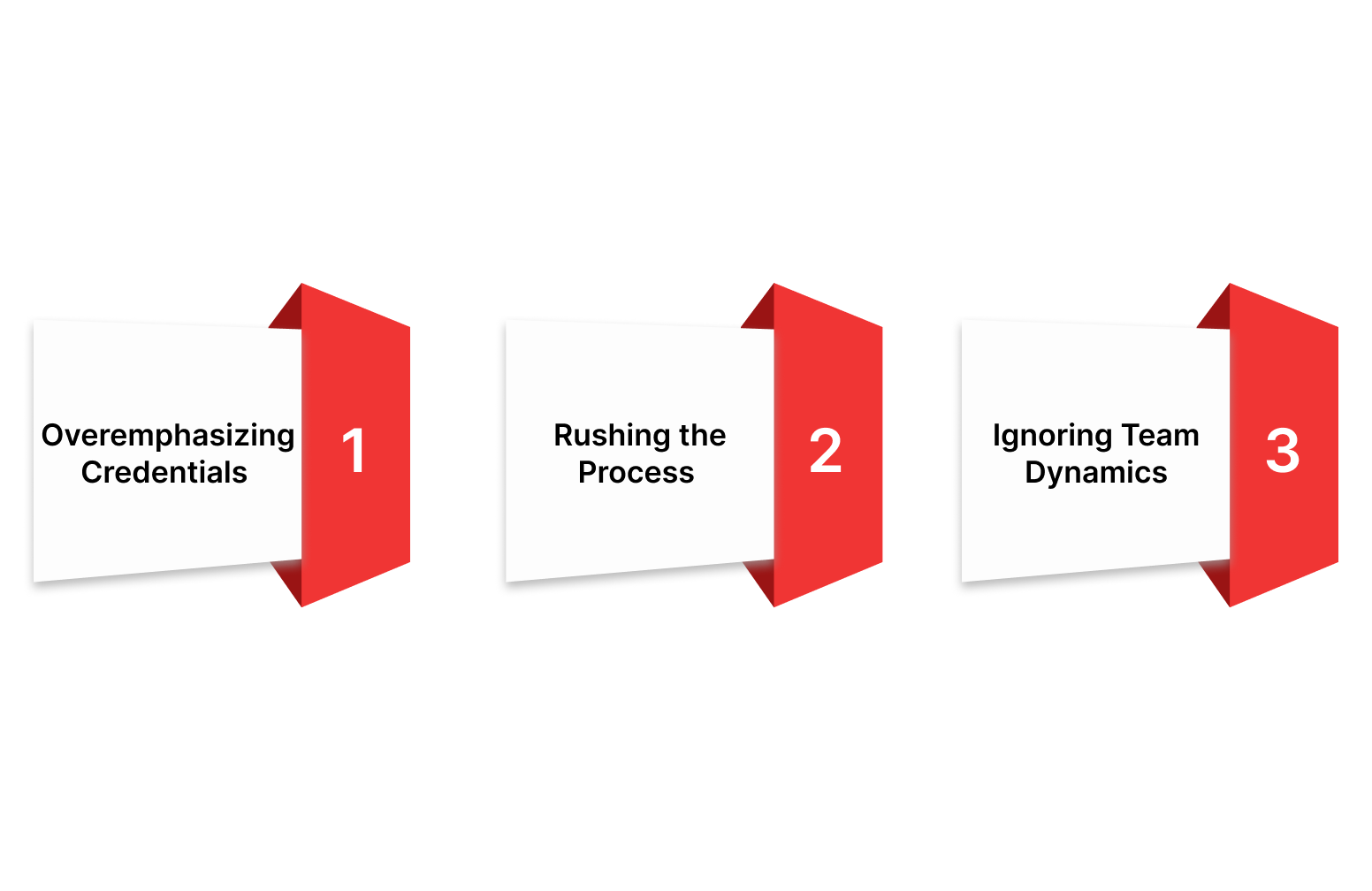
Even experienced hiring managers fall into these traps. Learn from others' expensive errors instead of making them yourself.
- Overemphasizing Credentials
A computer science degree doesn't guarantee coding ability. Focus on demonstrated skills through portfolio review and practical assessments.
- Rushing the Process
Taking shortcuts in evaluation leads to expensive turnover. Invest time upfront to avoid 6-month disasters.
- Ignoring Team Dynamics
Technical skills matter, but team chemistry determines long-term success. Involve your existing developers in the interview process.
Companies that excel at what to look for when hiring a software developer share standard practices:
- They assess practical skills over theoretical knowledge
- They evaluate cultural fit alongside technical ability
- They invest in thorough, multi-stage interview processes
- They prioritize problem-solving ability over resume keywords
The difference between good and great developers isn't just technical; it's their ability to understand business context, collaborate effectively, and adapt to changing requirements.
The best companies avoid mistakes and follow proven hiring practices that deliver long-term business value.
Start Strong With Consultadd
Working with an experienced partner like Consultadd ensures you hire smarter. From structured processes to real-time market insights, we help you avoid costly missteps and build teams that deliver from day one.
In a market where great tech talent is hard to find and harder to keep, your approach to staffing makes all the difference. Looking to build a future-ready tech team? Contact Us>>
Key Takeaways
Knowing what to look for when hiring a software developer requires balancing technical expertise, problem-solving abilities, and cultural alignment. The most successful hires combine deep technical skills, strong communication abilities, and growth mindsets, contributing to long-term team success.
Your hiring process should be structured, comprehensive, and aligned with your business objectives. Take time to define precise requirements, use practical assessment methods, and avoid common pitfalls that lead to costly mis-hires.
Finding the right software developers requires expertise, time, and access to quality talent pools that many companies struggle to maintain internally. With 15 years of experience and over 5,000 successful engagements, Consultadd becomes your behind-the-scenes tech talent partner, specializing in Full-Stack Development, Cloud Technology, and DevOps hiring.
FAQs
What are the most in-demand programming languages for software developers in 2025?
In 2025, the most sought-after programming languages include Python, JavaScript, TypeScript, Go, Rust, and Java. For frontend development, React, Angular, and Vue.js lead the market, while Python dominates roles in AI, data science, and the backend. Kotlin and Swift remain top choices for mobile development.
How can I effectively assess a software developer's problem-solving skills during an interview?
Present candidates with real production issues or architecture challenges from your codebase. Ask them to explain their approach, reasoning, trade-offs, and debugging process before writing code.
Why is cultural fit important when hiring software developers?
Cultural fit ensures developers align with your company's values, communication style, and work culture. It directly impacts team collaboration, retention, and long-term project success.
What technical assessment methods work better than coding puzzles?
Replace abstract puzzles with code review exercises, system design discussions, real debugging sessions, and pair programming challenges using your actual tech stack.
Should I prioritize full-time developers, contractors, or staffing partners for my project?
It depends on your project timeline, technical complexity, and budget. Full-time hires suit core product development, contractors handle short-term specialist work, and staffing partners help you scale quickly with pre-vetted talent.
What are common red flags to watch for when hiring developers?
Be cautious of candidates who can't explain their past code, resist feedback, overengineer simple solutions, blame others for issues, or show no curiosity about your business.