
Hiring & Recruitment

How to Hire AWS Developers: Skills, Costs & Process
Introduction
AWS still runs roughly 30% of the world's cloud infrastructure, more than Azure and Google Cloud combined at some measurements, which means the demand to hire AWS developers hasn't cooled even as the broader tech hiring market has.
What's changed is the bar. In 2026, "knows EC2 and S3" doesn't clear it anymore. Companies now need engineers who can architect for cost and scale, secure what they build, and increasingly, work fluently with AWS's AI services like Bedrock and SageMaker.
That raised bar is exactly why hiring AWS developers has gotten harder to do well, even though the talent pool is objectively large. Titles are inconsistent, certifications get treated as proof of competence when they're really proof of studying, and the best candidates rarely stay on the market long enough for a slow process to catch them.
This guide covers what to actually look for, what the role costs in 2026, how to structure the hiring process, and which engagement model fits your situation.
TL;DR
- Look past the title. Evaluate compute, storage, networking, IaC (Terraform or CloudFormation), and security fundamentals, not just years of "AWS experience."
- AWS certifications correlate with roughly a 26% salary premium and reliably indicate structured knowledge, but they're a signal to verify, not a substitute for a technical assessment.
- US salaries for AWS developers commonly run $110,000 to $195,000+ depending on seniority and location; contract and freelance rates in North America typically fall between $90 and $180+ per hour.
- AI-service fluency (Bedrock, SageMaker, Amazon Q) is now a real differentiator, not a nice-to-have, especially for roles touching product development.
- Match the engagement model to the need: full-time for core infrastructure ownership, contract or contract-to-hire for defined projects, migrations, and fluctuating capacity.
What an AWS developer actually does
"AWS developer" covers a wider range of work than the title suggests, and the range is exactly why hiring for it goes wrong when the job description is vague. In practice, the role usually blends three things: building application code that runs on AWS services, provisioning and managing the infrastructure that supports it, and making ongoing decisions about cost, scale, and security as the system grows.
That's different from a pure cloud engineer or DevOps hire, who typically owns infrastructure and pipelines without writing much application code, and different from a solutions architect, who designs systems at a higher level without necessarily implementing them day to day.
Job posts often blur these, which is the single biggest reason companies interview five "AWS developers" and get five wildly different skill profiles. Decide which of the three you actually need before writing the req.
The skills that separate strong candidates from average ones
Years of "AWS experience" on a resume tells you almost nothing; plenty of engineers have spent three years clicking around the console without developing real judgment. Here's what actually predicts performance:

The single best interview signal across all of these: ask a candidate to walk through a system they actually built, end to end, including a decision they'd make differently now. Depth and honesty here separate real builders from resume padding faster than any trivia question.
For teams building out a broader technical interview loop around this role, our guide to interview questions for a full stack developer covers the adjacent frontend/backend rigor that pairs well with AWS-specific technical rounds.
Do certifications matter?
Yes, with a caveat. AWS certifications correlate with a real salary premium, industry salary reports put the average uplift around 26%, and the Solutions Architect Associate remains the most commonly required credential, appearing in a large majority of cloud job postings.
Certifications also give recruiters a fast, standardized signal: a certified candidate has demonstrably studied AWS's own best practices rather than picked up habits from whatever their last employer happened to do.
The caveat is real too. A certification proves someone can pass a structured exam, not that they can debug a production incident under pressure or make a sound cost trade-off on a live system. Treat certifications the way you'd treat a degree: a credible signal worth weighting, never a substitute for a hands-on technical assessment.
The strongest candidates typically pair a relevant certification (Developer Associate for coding-heavy roles, Solutions Architect for design-heavy ones, Security or Machine Learning specialties for those niches) with a portfolio or work history that shows the certification in action.
What it costs to hire AWS developers in 2026
Budget conversations go smoother with real numbers on the table. Here's the 2026 landscape across engagement models:
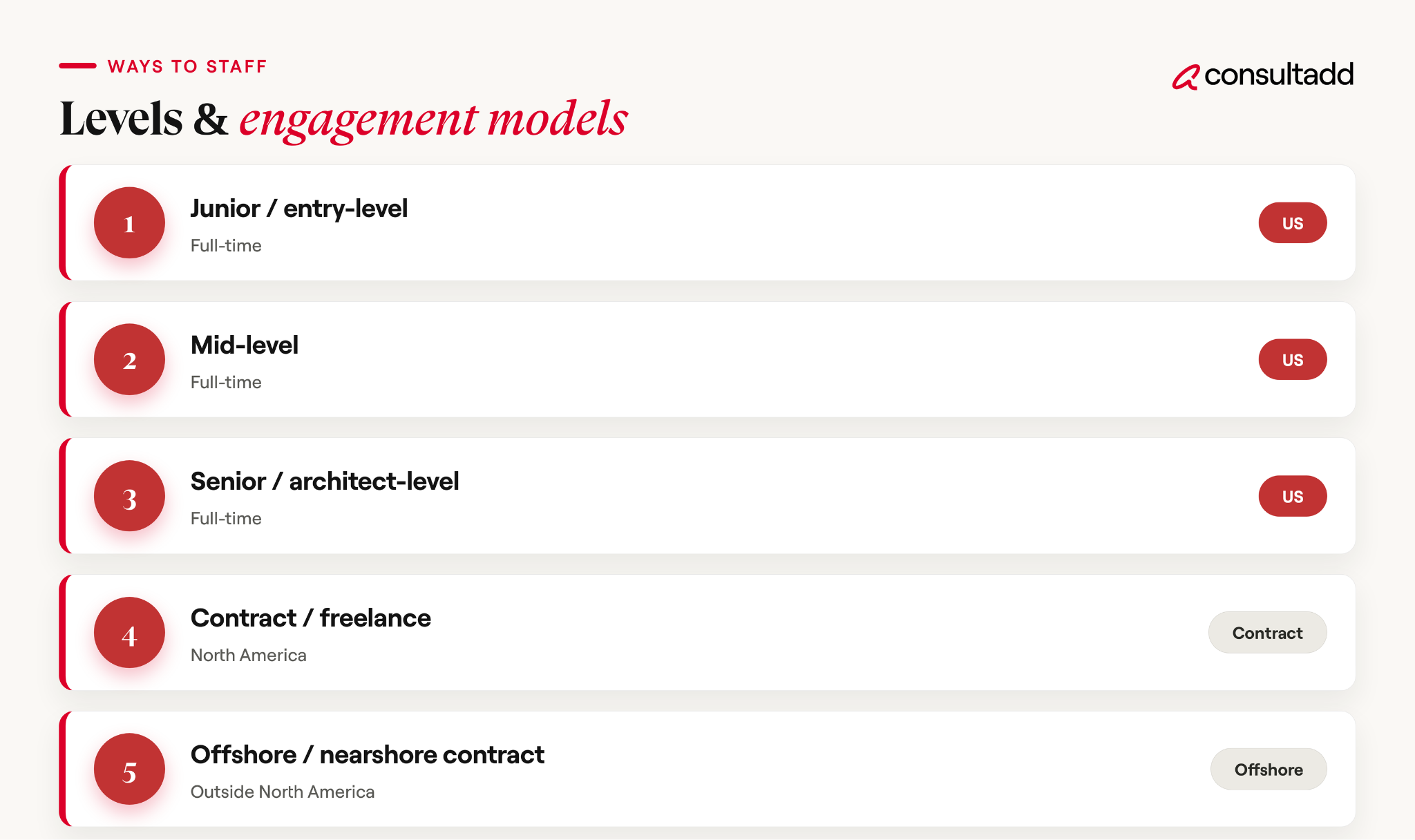
Two budgeting notes worth internalizing.
- First, the sticker salary isn't the full cost: recruiting fees, onboarding time, and tooling commonly add another 20-30% on top, and companies that budget only the base salary consistently get surprised.
- Second, speed has a price tag of its own. Top AWS talent doesn't sit on the market long, and a slow offer process is one of the most common, most avoidable reasons companies lose candidates they'd already won over.
Our breakdown of time to hire vs time to fill covers how to diagnose exactly where that speed leaks out of your process.
Full-time, contract, or contract-to-hire?
The right engagement model depends on the shape of the need, not just the budget:
How to vet candidates: questions and process
A structured loop beats an improvised one, both for accuracy and for speed. A solid AWS developer process runs three stages:
1. Technical screen (30-45 minutes):
Verify fundamentals conversationally before investing in a longer assessment:
- "Walk me through the architecture of a system you built on AWS, end to end."
- "How would you design for a service that needs to handle a 10x traffic spike?"
- "Explain the difference between an IAM role and an IAM user, and when you'd use each."
- "Tell me about a time your AWS bill surprised you. What did you do?"
2. Hands-on assessment (60-90 minutes):
A live or take-home exercise scoped to the actual role: provisioning infrastructure with Terraform or CloudFormation, debugging a broken deployment, or designing a solution to a realistic scenario (a service outgrowing its current architecture, a security misconfiguration to find and fix). Watch for how they reason, not just whether they land the exact right answer.
3. Architecture and judgment discussion (45-60 minutes):
For anything above junior level, this is where separation actually happens. Present a system with real constraints (cost ceiling, compliance requirement, legacy dependency) and have the candidate reason through trade-offs out loud.
The candidates worth hiring will ask clarifying questions before proposing a design, the same discipline that matters in any serious system design interview.
Find our guide to hiring and recruiting strategies useful for the surrounding process, sourcing, structure, and speed together.
The bottom line: hiring AWS developers well in 2026 comes down to clarity on what you actually need, a real technical bar instead of a certification checklist, honest budgeting for the full cost of a hire, and a process fast enough to close candidates before someone else does.
Start Strong With Consultadd
With 15 years in business and 5,000+ successful staffing engagements, we don't just fill roles, we build reliability into your process. We've supported 65 staffing companies in the past year alone and maintain MSAs with industry leaders like Robert Half and TEKsystems.
Here's what working with Consultadd looks like:
- Talent sourced in under 24 hours
- Ready-to-deploy candidates, vetted for experience and compliance
- Lower turnover risk: we match long-term goals, not just short-term needs
- Seamless compliance: visa, documentation, onboarding? Handled.
- Dedicated 1:1 account managers for responsive, personalized support
- Top 100 candidate matches delivered in the past year
- Strong partnerships with universities to tap into fresh, committed talent
- Post-placement support so your investment grows beyond day one
For candidates, your next opportunity is more than just a job title, it's a chance to build skills, gain experience, and move your career forward. At Consultadd, we connect technology professionals with projects and employers that align with their goals, whether they're looking for contract, contract-to-hire, or long-term opportunities.
The tech job market moves fast, but the right guidance can make all the difference. Ready to take the next step in your career journey? Explore Opportunities >>
Key Takeaways
- Define which role you actually need, developer, cloud engineer, or architect, before writing the job post; the titles get used interchangeably but the skill profiles differ.
- Evaluate compute, IaC, networking/security, cost awareness, and increasingly AI-service fluency, not just years of AWS exposure.
- Certifications carry a real ~26% salary premium and are a credible signal, but pair them with a hands-on technical assessment rather than treating them as sufficient proof.
- US salaries commonly run $110K-$195K+ by seniority, with contract rates in North America typically $90-$180+ per hour; budget an extra 20-30% for recruiting, onboarding, and tooling costs.
- Match the engagement model to the need: full-time for core ownership, contract or contract-to-hire for migrations and defined projects, and a vetted staffing partner when speed matters most.
FAQs
What skills should I look for when I hire AWS developers?
Prioritize core compute and storage fluency (EC2, Lambda, S3, RDS/DynamoDB), Infrastructure as Code experience with Terraform or CloudFormation, networking and IAM security judgment, CI/CD experience, and demonstrated cost awareness. In 2026, working familiarity with AWS's AI services like Bedrock and SageMaker is an increasingly important differentiator for roles touching product development.
How much does it cost to hire an AWS developer in 2026?
Full-time US salaries typically run $85,000-$110,000 for junior roles, $110,000-$165,000 for mid-level, and $165,000-$200,000+ for senior and architect-level positions. Contract and freelance rates in North America generally fall between $90 and $180+ per hour depending on seniority and specialty. Budget an additional 20-30% beyond salary for recruiting, onboarding, and tooling.
Are AWS certifications worth requiring for candidates?
They're a credible, worth-weighting signal: certified professionals earn roughly a 26% premium on average, and certifications like Solutions Architect Associate appear in most cloud job postings. But a certification proves exam knowledge, not production judgment, so pair it with a hands-on technical assessment rather than treating it as sufficient on its own.
Should I hire a full-time AWS developer or use a contractor?
Choose full-time for core infrastructure ownership and long-term architectural responsibility. Choose contract or contract-to-hire for defined projects like cloud migrations, modernization efforts, or temporary capacity spikes where a permanent headcount line isn't justified once the work completes. A vetted staffing partner can support either model with faster, pre-screened access to talent.
What interview questions best reveal a strong AWS developer?
The single highest-signal question: have the candidate walk through a real system they built end to end, including a decision they'd revisit today. Follow with a scaling scenario ("design for a 10x traffic spike"), an IAM/security question, and a story about an unexpected AWS bill. For senior roles, an open-ended architecture discussion with real constraints reveals judgment better than any trivia round.
What's the difference between an AWS developer, cloud engineer, and solutions architect?
An AWS developer typically builds application code that runs on AWS services and manages the supporting infrastructure. A cloud engineer or DevOps hire usually owns infrastructure and deployment pipelines with less application-code responsibility. A solutions architect designs systems at a higher level, often across teams, without necessarily implementing them directly. Job posts frequently blur these, so clarify which one you need before hiring.

How to Hire Generative AI Engineers in 2026
Introduction
Post a generative AI engineer role today and you'll get resumes fast. That's the trap. Everyone lists "LLM" and "RAG" now, because job postings reward it, but the gap between someone who's shipped a production RAG pipeline to real users and someone who finished a weekend tutorial has never been wider.
To hire generative AI engineers well in 2026, the job isn't finding candidates. It's telling those two apart before an offer goes out, not two quarters later when a hallucinated response lands in a customer's inbox.
The numbers explain why this role gets mis-hired so often. Demand for LLM-specific freelance work grew roughly 304% year over year, while the supply of engineers with real production LLM experience grew only around 85%.
That mismatch inflates resumes and rates in equal measure. And the title itself has splintered: "generative AI engineer" now covers at least five genuinely different jobs, and hiring for the wrong one is the single most common reason these searches stall past ninety days.
This guide breaks down what the role actually involves, the five working profiles you're choosing between, 2026 compensation, and how to run a loop that filters signal from resume-padding.
TL;DR
- "Generative AI engineer" isn't one job. Pick one of five lanes before writing the req: LLM application, RAG/retrieval, fine-tuning, eval/safety, or production GenAI/MLOps.
- Nearly all of this work is integration, not model training. Almost nobody trains foundation models from scratch; the job is building on top of OpenAI, Claude, or open-weight models.
- 2026 US compensation runs roughly $145,000 - $215,000 mid-level and $230,000-$340,000+ senior for full-time roles, with freelance/contract rates from $75 to $200+ per hour.
- RAG architecture now appears in a majority of applied LLM job listings, making retrieval-pipeline competence close to a baseline requirement, not a specialty.
- Run a real technical loop: RAG system design, failure-mode analysis, and eval discipline predict production performance far better than a "tell me about transformers" conversation.
What a generative AI engineer actually does
Set expectations correctly from the start: a generative AI engineer builds applications on top of pre-trained foundation models. They are not training GPT-class models from scratch, virtually nobody outside a handful of labs does that, the computer cost alone runs into the millions.
The job is integration and orchestration: taking a raw model behind an API and turning it into a working product feature that's reliable, fast enough, and affordable to run at scale.
That distinguishes it clearly from a traditional machine learning engineer, who more often builds models from structured data for classification or prediction tasks. It also distinguishes it from a research scientist, whose work sits closer to advancing model capability than shipping product.
The generative AI engineer sits between those roles and product engineering: fluent enough in the models to reason about their failure modes, and fluent enough in software engineering to ship something dependable around them.
The five profiles hiding under one job title
This is the section that saves the most wasted interview cycles. "Generative AI engineer" as a title covers at least five distinct working profiles, and searches that try to hire for two or three of them in one person routinely stall for months:

At most early-stage companies, one person covers two or three of these out of necessity. LLM application work paired with a credible RAG lean is the most common combination that actually gets hired successfully; fine-tuning paired with eval skews toward a more research-leaning hire. Asking for all five in one req is asking for a unicorn, and searches built that way are the ones still open ninety days later.
Decide your primary lane before the job post goes live, the same discipline that matters across technical hiring generally, and something we cover in more general terms in our guide to hiring and recruiting strategies.
Skills that separate real builders from resume padding
Within whichever lane you're hiring for, these are the concrete signals that correlate with real, shipped experience rather than tutorial-level familiarity:
This mirrors the same "explain a real system you built" test that works well in broader technical interviews, something we cover for adjacent roles in our guide to interview questions for a full stack developer.
2026 compensation: salary and contract rates
Compensation for this role moves fast and varies more by specialization than almost any other engineering hire. Here's where the market sits:
- First, generalists are losing ground: engineers without a clear specialization increasingly compete against domain experts commanding 30-50% more for equivalent experience, so a vague "AI engineer" req attracts a weaker slate than a lane-specific one.
- Second, this is consistently one of the hardest categories to close: median time from role-open to accepted offer at competitive companies runs into the tens of days, meaningfully longer than most engineering hires, and the most common reason a strong candidate walks is a competing offer from a company with deeper AI-team budgets.
- Building slack into your process, and moving fast once you find the right person, matters more here than in almost any other technical search.
Our breakdown of time to hire vs time to fill covers how to diagnose where a slow-moving process is bleeding candidates.
How to run a hiring loop that actually filters
A four-round structure, scoped to your chosen lane, consistently outperforms an improvised conversation-heavy process:
1. Recruiter screen (30 min)
Confirm the lane match and get one concrete example of shipped GenAI work before investing further time. "Walk me through a generative AI feature you built, from idea to production" is the single best filter question at this stage.
2. Technical deep dive (60-90 min)
Review a take-home or portfolio piece in detail, then move into live problem-solving: RAG system design for a realistic scenario, plus failure-mode analysis. Ask what happens when retrieval returns irrelevant context, or when the model confidently states something false, and how they'd catch it before a user sees it.
3. Architecture and judgment discussion (45-60 min)
Present a system with real constraints, a cost ceiling, a latency requirement, a compliance concern, and have the candidate reason through trade-offs aloud. This is where the difference between someone who's read about RAG and someone who's debugged one in production becomes obvious.
4. Team and mission fit (30-45 min)
How does generative AI solve your company's specific problem, and what would they build in the first ninety days. Vague enthusiasm here is a weaker signal than a candidate who's already thought concretely about your use case.
Close fast once you've found the right person. Strong generative AI candidates evaporate off the market within days, not weeks, and moving to offer within 48 hours of the final round is standard practice among teams that close successfully without a compensation arms race.
If your search is bigger than one hire, or the timeline is tight, pairing internal recruiting with a specialist staffing partner can meaningfully compress the search.
Our review of the best IT staffing firms covers what to look for when vetting one.
Common mistakes companies make
The same failure patterns show up across most stalled or regretted generative AI hires:
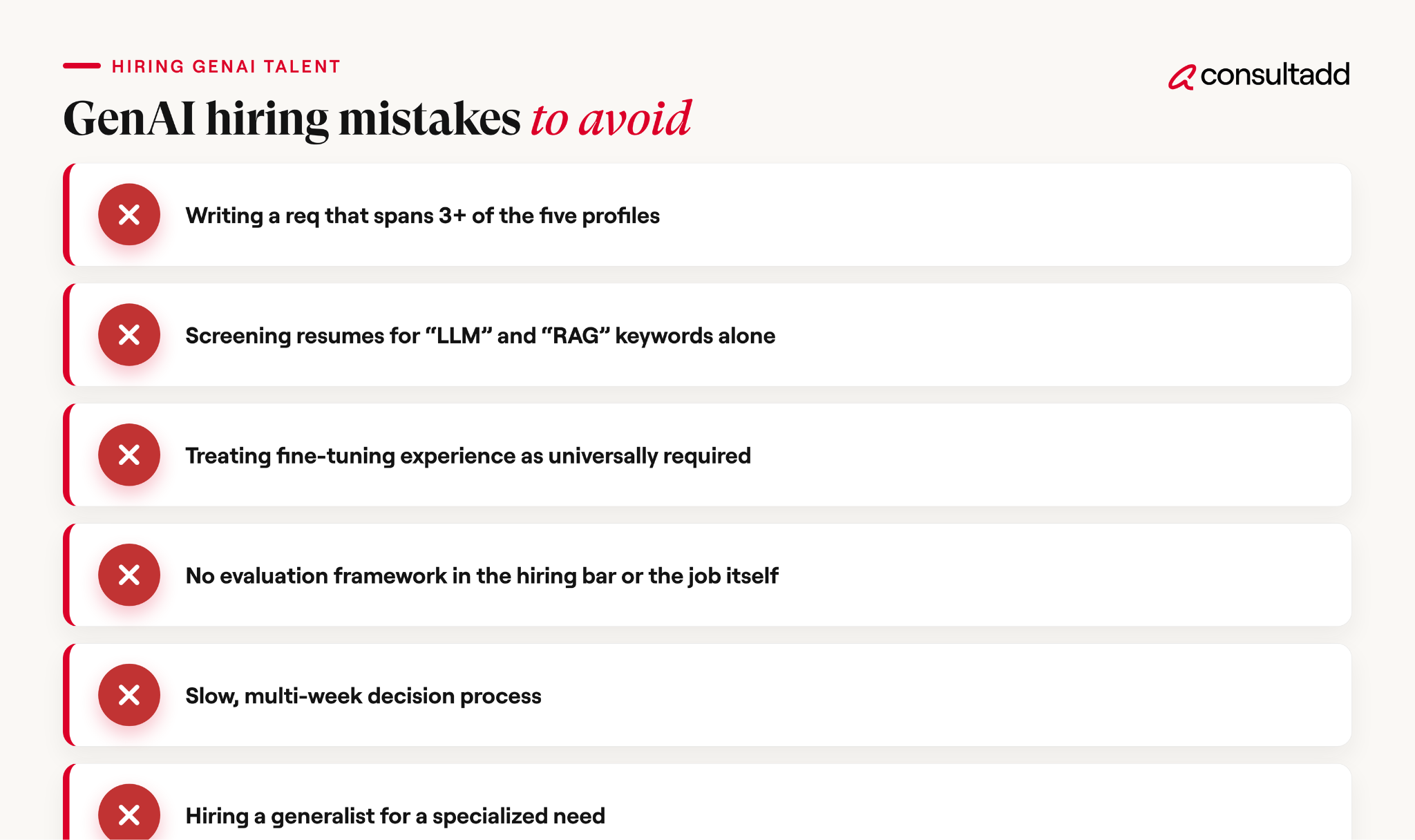
The pattern underneath all of these: this role rewards precision in how you hire, not just speed or budget. Scope the lane, test for shipped experience and evaluation discipline, and move fast once the right person is in front of you.
Start Strong With Consultadd
With 15 years in business and 5,000+ successful staffing engagements, we don't just fill roles, we build reliability into your process. We've supported 65 staffing companies in the past year alone and maintain MSAs with industry leaders like Robert Half and TEKsystems.
Here's what working with Consultadd looks like:
- Talent sourced in under 24 hours
- Ready-to-deploy candidates, vetted for experience and compliance
- Lower turnover risk: we match long-term goals, not just short-term needs
- Seamless compliance: visa, documentation, onboarding? Handled.
- Dedicated 1:1 account managers for responsive, personalized support
- Top 100 candidate matches delivered in the past year
- Strong partnerships with universities to tap into fresh, committed talent
- Post-placement support so your investment grows beyond day one
For candidates, your next opportunity is more than just a job title, it's a chance to build skills, gain experience, and move your career forward. At Consultadd, we connect technology professionals with projects and employers that align with their goals, whether they're looking for contract, contract-to-hire, or long-term opportunities.
The tech job market moves fast, but the right guidance can make all the difference. Ready to take the next step in your career journey? Explore Opportunities >>
Key takeaways
- "Generative AI engineer" splits into five distinct profiles, LLM application, RAG/retrieval, fine-tuning, eval/safety, and production GenAI/MLOps, and scoping one lane before hiring is the single biggest predictor of a clean search.
- The role is overwhelmingly about integration on top of foundation models, not training them; screen for shipped product experience, not theoretical model knowledge.
- 2026 US compensation runs roughly $145K-$215K mid-level and $230K-$340K+ senior full-time, with freelance rates from $75 to $200+ per hour depending on proven experience.
- RAG competence has become close to a baseline expectation, appearing in most applied LLM job listings, while fine-tuning matters most for specialized domains rather than every hire.
- Run a scoped, four-round loop testing RAG design, failure-mode reasoning, and evaluation discipline, and move to offer within 48 hours of the final round once you've decided, since strong candidates don't stay available long.
FAQs
What does a generative AI engineer actually do?
They build applications on top of pre-trained foundation models like GPT or Claude rather than training models from scratch. The work centers on integration and orchestration: prompting, chaining tools, building retrieval pipelines, and sometimes fine-tuning a model, all aimed at turning a raw API into a reliable product feature.
What's the difference between hiring a generative AI engineer and a machine learning engineer?
A traditional machine learning engineer typically builds models from structured data for tasks like classification or prediction. A generative AI engineer works on top of existing large language models, focused on integration, retrieval, prompting, and evaluation rather than building models from the ground up. The skill sets overlap but the day-to-day work differs substantially.
How much does it cost to hire generative AI engineers in 2026?
Full-time US compensation typically runs $145,000-$215,000 for mid-level roles and $230,000-$340,000+ for senior specialists, with the top end driven by fine-tuning, evaluation, and infrastructure expertise. Freelance and contract rates range from about $75 to $200+ per hour depending on demonstrated production experience.
What questions should I ask to interview a generative AI engineer?
Start with "walk me through a generative AI feature you shipped, including a failure it produced and what you changed." Follow with RAG system design for a realistic scenario, how they'd handle irrelevant retrieval results or confident-but-false model output, and how they measure whether a prompt or architecture change actually improved quality.
Do I need to hire someone who can fine-tune models?
Only if your use case genuinely requires it. Most product applications, chat features, internal copilots, customer-facing assistants, are served well by LLM application and RAG skills without any fine-tuning. Fine-tuning matters most in specialized domains like legal, healthcare, or finance where off-the-shelf prompting underperforms.
Why is it hard to hire generative AI engineers right now?
Demand for LLM-specific work has grown far faster than the supply of engineers with real production experience, which inflates both resumes and rates. The title also covers at least five distinct working profiles, so companies that don't scope a specific lane end up interviewing mismatched candidates and stalling well past a normal hiring timeline.

Retaining Top Talent: Why Your Best People Leave And How To Keep Them
Introduction
Your best engineer just gave two weeks' notice. Again. If you're reading this, retaining top talent probably keeps you up at night more than sourcing new hires does.
Recruiting is a known, budgeted cost. Losing someone you already trained, someone your team already relies on, costs more than most hiring managers want to admit.
This guide breaks down why skilled employees actually leave, what it costs when they do, and which retention strategies hold up once you test them against a real team instead of a slide deck.
TL;DR
- Replacing an employee costs between 50% and 200% of their annual salary, and the U.S. quits rate has stayed near 1.9% through mid-2026.
- Most resignations trace back to management and growth, not just pay. Compensation still matters, but it rarely stands alone.
- Career paths, manager training, and pay audits do more for retention than perks or one-time bonuses.
- Tracking flight risk early, through workload, engagement, and manager check-ins, catches problems before someone starts interviewing elsewhere.
- A staffing partner can absorb hiring pressure so your team has room to fix retention instead of just reacting to it.
Why retaining top talent matters right now
The labor market has cooled since the mass resignations of 2021 and 2022, but people are still leaving jobs at a meaningful rate. The quits rate stood at 1.9% in May 2026, according to the Bureau of Labor Statistics. That works out to millions of voluntary departures every month, spread across every industry, including yours.
A lower quit rate compared to a few years ago doesn't mean retention got easier. It means the people who leave now are more selective about it.
When your top performer walks, it's rarely impulsive. They've usually thought about it for months, and by the time they hand in their notice, a counteroffer won't fix it.
This matters more in tech and specialized roles, where a single departure can stall a project for weeks.
We've watched this play out inside the ongoing tech talent shortage, where open roles already outnumber qualified candidates.
Losing a skilled employee in that environment doesn't just create a vacancy. It creates a bidding war for their replacement.
What losing a top performer really costs
Most leadership teams underestimate turnover cost because they only count the obvious line items: job ads, recruiter fees, a new laptop. The real number runs much higher.
Costs you can put a number on
- SHRM estimates that replacing an employee costs between 50% and 200% of their annual salary, depending on the role and seniority.
- For a mid-level specialist earning $90,000, that's anywhere from $45,000 to $180,000 per departure.
- For a senior architect or team lead, the upper end of that range is closer to the norm than the exception.
Costs that don't show up on a spreadsheet
The harder costs to quantify are often the ones that hurt more:
- A departure resets institutional knowledge. Whoever takes over inherits half-documented systems and client relationships built over years, not weeks.
- Remaining team members pick up the slack during the vacancy, which is exactly the kind of overload that pushes the next person toward the exit.
- There's also a trust cost. When a strong performer leaves, their teammates start asking why. If the answer points to leadership, that question spreads fast.
Why skilled employees actually quit
Pay matters, but it's rarely the whole story. Most exits come down to a handful of recurring patterns.
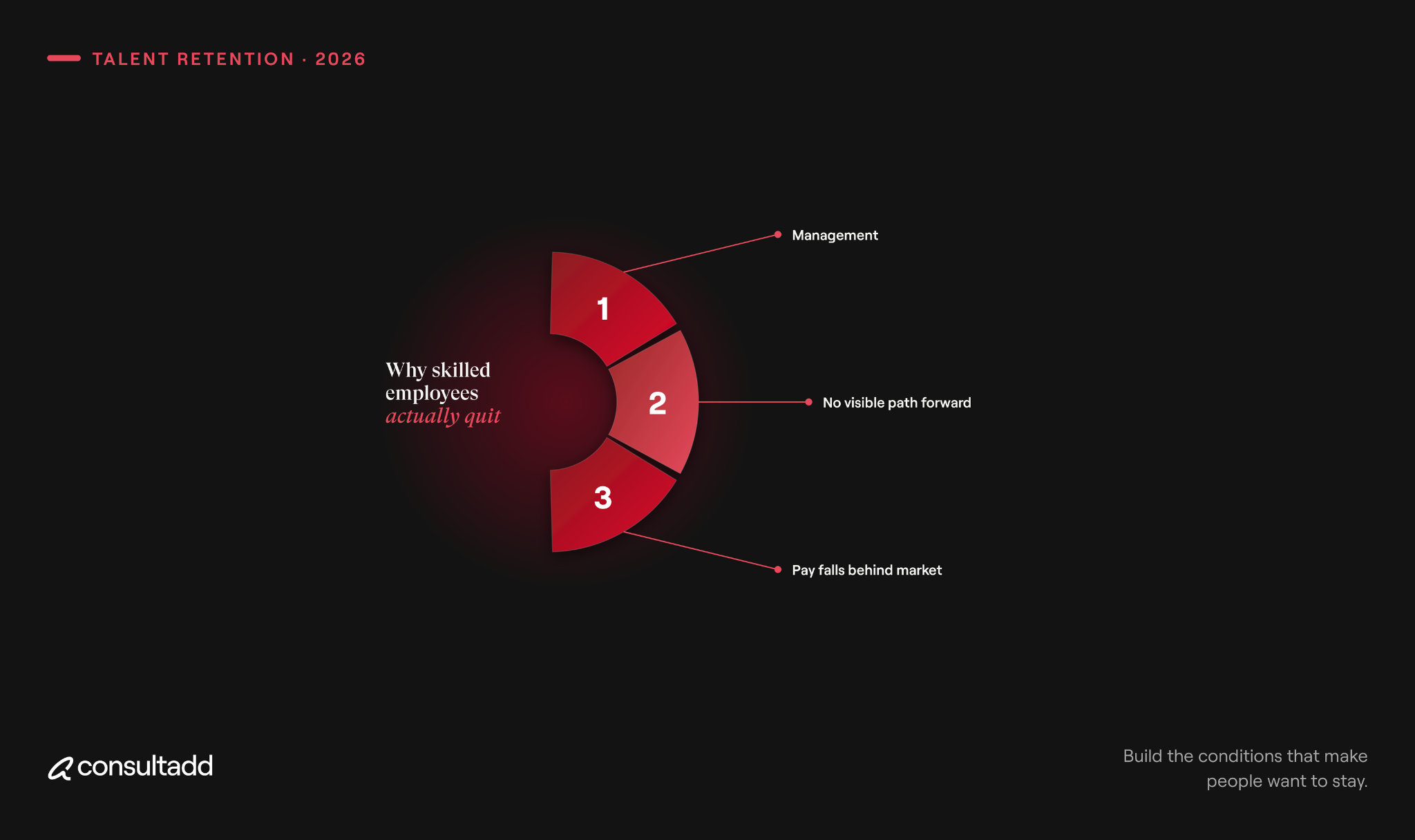
1. Management, not money, is usually the trigger
- People often leave managers before they leave companies.
- A manager who never checks in beyond deadlines, who takes credit quietly and assigns blame loudly, wears people down long before a competing offer shows up.
- This shows up constantly in the recruiter challenges we see across staffing teams: candidates cite their current manager as the reason they're job hunting far more often than they cite salary.
2. No visible path forward
- Skilled employees want to know what's next.
- If the only way up is waiting for someone above them to leave, ambitious people will look elsewhere for that path instead of waiting around for it.
- A role with no growth story attached becomes a layover, not a destination.
3. Pay that falls behind the market
- Compensation reviews that happen once a year can't keep pace with a market where a competitor is actively recruiting your team.
- Gartner's research on 2026 talent trends points to compensation and career pathways as the top attrition drivers organizations need to address directly.
- If someone finds out a new hire on their team is earning more than they are, that gap becomes the story they tell themselves about their entire tenure.
Retention strategies that hold up in practice
None of this requires a reinvented HR department. It requires consistency on the basics that actually move the needle.
1. Build career paths people can see
- Write down what the next role actually looks like, what skills it requires, and roughly how long it takes to get there.
- Review it with each person at least twice a year.
- Vague promises about "growth opportunities" don't retain anyone. A documented path does.
2. Fix pay gaps before your competitor does
- Run a compensation review against current market data at least once a year, not just at hiring time.
- If the budget doesn't allow a raise across the board, prioritize your highest-impact people first.
- Losing them costs more than the raise would have.
3. Train managers like it's a real skill
- Most managers get promoted for technical skill, not people skill, and then get no training on how to lead.
- A short, recurring program on feedback, delegation, and recognition changes how their teams experience the job day to day.
4. Track flight risk before people quit
- Watch for the early signals: declining engagement in one-on-ones, missed optional meetings, a sudden drop in Slack or GitHub activity.
- None of these guarantee someone is leaving, but together they're worth a direct, honest conversation before it's too late to have one.
For teams that want a structured starting point, a 90-day retention audit is a practical way to move from noticing a problem to acting on it.
How a staffing partner supports retention
Retention and hiring aren't separate problems.
Teams stretched thin from constant vacancies rarely have the bandwidth to fix the culture issues driving people out in the first place. That's often where a specialized staffing partner earns its keep, by absorbing the hiring pressure so your internal team can focus on the people already on staff.
This is also where the contract-to-hire hiring model becomes relevant. It gives both sides a real trial period to confirm fit before committing long-term, which naturally screens out the mismatches that turn into six-month resignations.
Combined with proven best practices for IT staffing, it becomes far easier to bring in people who are more likely to stay in the first place.
Start Strong With Consultadd
With 15 years in business and 5,000+ successful staffing engagements, we don't just fill roles, we build reliability into your process. We've supported 65 staffing companies in the past year alone and maintain MSAs with industry leaders like Robert Half and TEKsystems.
Here's what working with Consultadd looks like:
- Talent sourced in under 24 hours
- Ready-to-deploy candidates, vetted for experience and compliance
- Lower turnover risk: we match long-term goals, not just short-term needs
- Seamless compliance: visa, documentation, onboarding? Handled.
- Dedicated 1:1 account managers for responsive, personalized support
- Top 100 candidate matches delivered in the past year
- Strong partnerships with universities to tap into fresh, committed talent
- Post-placement support so your investment grows beyond day one
For candidates, your next opportunity is more than just a job title, it's a chance to build skills, gain experience, and move your career forward. At Consultadd, we connect technology professionals with projects and employers that align with their goals, whether they're looking for contract, contract-to-hire, or long-term opportunities.
The tech job market moves fast, but the right guidance can make all the difference. Ready to take the next step in your career journey? Explore Opportunities >>
Key takeaways
- Turnover is expensive in ways that go beyond the recruiting bill, from lost knowledge to team burnout during the vacancy.
- Management quality and visible career growth drive more exits than compensation alone, though pay gaps still matter.
- A documented career path and an annual pay benchmark are two of the highest-return retention moves available.
- Manager training takes longer to pay off but changes retention at the root instead of patching symptoms.
- Retaining top talent works best as an ongoing practice, not a reaction to someone already halfway out the door.
FAQs
What is the best way to retain top talent?
There's no single fix. The combination that works most consistently is a visible career path, compensation that stays current with the market, and managers trained to give real feedback. Skip any one of these and the others carry more weight than they should.
Why do top performers leave good companies?
Even strong companies lose people when growth stalls or a manager mismanages day-to-day work. Skilled employees have options, so they leave the moment the current role stops teaching them something or stops feeling fair.
How much does it cost to replace an employee?
Replacement costs typically run from 50% to 200% of the departing employee's annual salary, according to SHRM, with the higher end applying to senior or highly specialized roles. That figure includes recruiting, onboarding, and lost productivity during ramp-up.
What is a good employee retention rate?
It depends heavily on industry and role type, so there's no universal benchmark. A more useful approach is tracking your own trend over time and comparing regretted departures, the ones you actually wanted to keep, against total exits.
How can small businesses retain top talent without big budgets?
Budget helps, but consistency matters more. Clear growth conversations, honest feedback, and flexibility on schedule or location cost little and address the same drivers that push people toward larger competitors.
Does a staffing partner help with employee retention?
Yes, indirectly but meaningfully. A partner that sources vetted, well-matched candidates reduces early-stage turnover, and by handling hiring volume, it frees your internal team to focus on developing the people already there.

Hire Scala Developers: A Practical Guide for 2026
Introduction
If you're trying to hire Scala developers right now, you've probably already noticed the pool is small and the resumes that do land in your inbox rarely match the job description. That's normal.
Scala sits in a strange spot: it's not a beginner language, it's not the most popular one, and most companies only need it for a handful of high-stakes systems like data pipelines, streaming platforms, or fintech backends.
Below, we'll walk through why hiring for this skill is tougher than hiring for, say, Python or JavaScript, what to actually test for in an interview, where to source candidates, and when it makes sense to bring in a staffing partner instead of running the search yourself.
TL;DR
- Scala developers are scarce because only a small slice of engineers use the language as their primary tool, even though it commands some of the highest pay in the industry.
- Most Scala hiring needs trace back to a handful of use cases: big data pipelines, streaming systems, and fintech backends where type safety and JVM performance matter.
- Test for functional programming fluency, not just Scala syntax. Plenty of candidates write Scala like it's Java with extra symbols.
- Contract and contract-to-hire arrangements work well for Scala hiring because they let you validate a scarce, expensive skill set before committing to a full-time salary.
- A specialized IT staffing partner like Consultadd can cut sourcing time significantly, since general recruiters rarely maintain a warm Scala pipeline.
Why hiring Scala developers is harder than most backend roles
Scala has always been a specialist's language. It runs on the JVM, blends functional and object-oriented programming, and shows up almost exclusively in systems where either performance or correctness carries real financial weight.
That combination creates a strange hiring paradox: demand is steady, but the supply of developers who reach for Scala as their primary language is tiny.
JetBrains' 2025 State of Developer Ecosystem survey put a number on this. Scala leads among the top-paid developers, with 38% falling into the top-paid bracket, despite being used by only 2% of developers as a primary language.
That's not a coincidence. When a skill is both hard to find and tied to systems that can't afford to go down, employers pay a premium for it.
What Scala actually gets used for
Understanding where Scala shows up in production makes it a lot easier to write a job description that attracts the right candidates instead of a pile of generalist resumes.
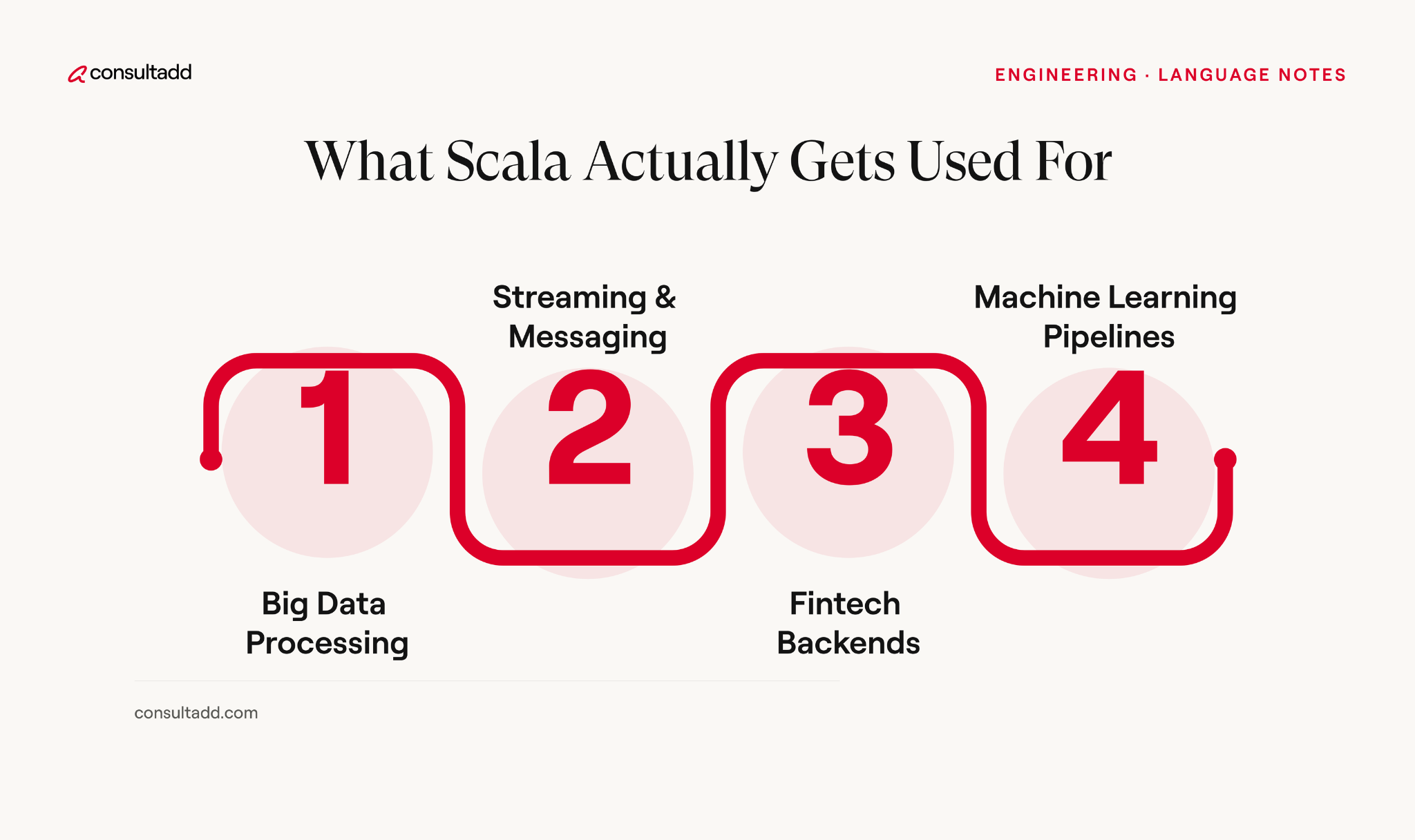
Spark's official documentation notes that it provides high-level APIs in Java, Scala, Python, and R, backed by an optimized engine for general execution graphs, but because Spark's core is written in Scala and both run on the JVM, Scala code tends to execute with less overhead than the Python equivalent.
If your company runs Spark jobs at any real scale, you're probably going to need at least one engineer who's comfortable in Scala, even if the rest of the team works in Python.
Skills to actually test when you hire Scala developers
A Scala resume tells you almost nothing on its own. I've seen plenty of candidates who list Scala as a skill but write it exactly like Java, ignoring the functional features that make the language worth using in the first place.
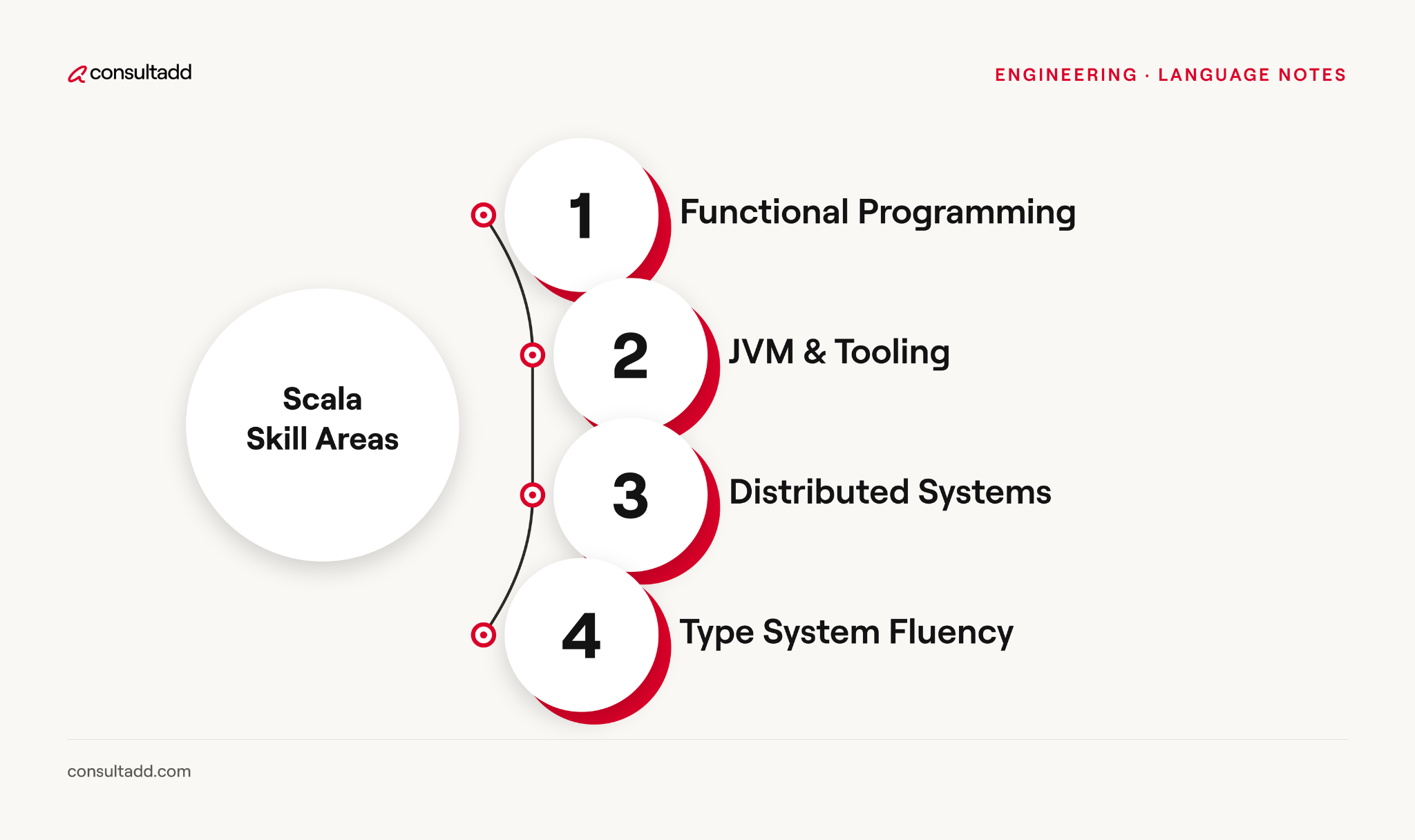
The interview needs to dig past syntax:
If you want a broader framework for evaluating backend candidates, our guide on what to look for when hiring software developers covers the core competencies and interview structure.
Where to source Scala developers
General job boards tend to disappoint here. The candidates who actually write production Scala congregate in a smaller set of places, and it helps to go looking for them there instead of waiting for applications to arrive.
- Scala-specific communities and conferences, like Scala Days and local Scala user groups, are a reliable source since attendees are self-selecting for depth over breadth.
- GitHub and Scaladex (the Scala library index) can surface developers who maintain or contribute to Spark, Akka, or other Scala-heavy projects, which tells you a lot more than a resume bullet point.
- Data engineering and fintech meetups also tend to attract Scala talent, since that's where the language actually gets used day to day.
Our broader guide on how to hire the best software engineers covers sourcing tactics like headhunting on developer platforms and tapping niche, invite-only communities, most of which apply directly to a Scala search.
Contract, contract-to-hire, or full time: picking the right model
Scala hiring is one of the clearer cases where the employment model matters as much as the candidate. Because the skill is scarce and often tied to a specific project, forcing every hire into a full-time offer can slow you down or lock you into a role you don't need permanently.
We've broken down the tradeoffs between these models in more depth in contract to hire vs full time for developers, including how the calculation shifts for specialized roles like Scala where the candidate pool is thin to begin with.
Should you use a staffing agency to hire Scala developers?
Here's the honest tradeoff. Running the search yourself gives you full control over the process, but it also means building a Scala pipeline from scratch, something most internal recruiters have never had to do since the role doesn't come up often.
A specialized staffing partner already has that pipeline warm. There's also a cost angle worth keeping in mind.
The Bureau of Labor Statistics puts the median annual wage for software developers at $133,080, and Scala roles routinely land above that baseline given the scarcity premium the language commands.
A bad hire at that pay level is expensive to unwind, which is exactly the kind of risk a contract-to-hire arrangement through a staffing partner is built to reduce.
Start Strong With Consultadd
With 15 years in business and 5,000+ successful staffing engagements, we don't just fill roles, we build reliability into your process. We've supported 65 staffing companies in the past year alone and maintain MSAs with industry leaders like Robert Half and TEKsystems.
Here's what working with Consultadd looks like:
- Talent sourced in under 24 hours
- Ready-to-deploy candidates, vetted for experience and compliance
- Lower turnover risk: we match long-term goals, not just short-term needs
- Seamless compliance: visa, documentation, onboarding? Handled.
- Dedicated 1:1 account managers for responsive, personalized support
- Top 100 candidate matches delivered in the past year
- Strong partnerships with universities to tap into fresh, committed talent
- Post-placement support so your investment grows beyond day one
For candidates, your next opportunity is more than just a job title, it's a chance to build skills, gain experience, and move your career forward. At Consultadd, we connect technology professionals with projects and employers that align with their goals, whether they're looking for contract, contract-to-hire, or long-term opportunities.
The tech job market moves fast, but the right guidance can make all the difference. Ready to take the next step in your career journey? Explore Opportunities >>
Key takeaways
- Scala talent is scarce because so few developers use it as a primary language, which pushes pay and hiring difficulty higher than most backend roles.
- The language shows up almost exclusively in big data, streaming, and fintech systems, so tailor your job description to those use cases.
- Test for functional programming fluency and distributed systems thinking, not just familiarity with Scala syntax.
- Contract and contract-to-hire arrangements reduce the risk of committing to a full-time salary for a skill set this specialized.
- A staffing partner with an existing Scala pipeline can shorten your time to hire significantly compared to starting a search from scratch.
FAQs
What makes Scala developers harder to hire than other backend engineers?
Only a small share of developers use Scala as their primary language, even though the systems it powers, like Spark pipelines and fintech backends, tend to be high-stakes. That combination of low supply and high responsibility is what drives both the scarcity and the pay premium.
Do I need a Java background to hire a good Scala developer?
Not necessarily, but it helps. Scala runs on the JVM and interoperates closely with Java, so candidates with Java experience often ramp up faster on existing codebases, especially in mixed Scala-Java environments.
How much does it cost to hire Scala developers in the US?
Pay varies widely by seniority and location, but Scala roles typically land above the general software developer median, which the Bureau of Labor Statistics puts at $133,080 a year. Specialized, senior-level Scala roles in finance or data engineering often run well above that baseline.
Should I hire a contract or full-time Scala developer?
Contract works well for a defined project like a Spark migration, while full time makes sense for ongoing platform work. If you're unsure, contract-to-hire lets you evaluate fit before committing to a permanent salary.
What industries use Scala the most?
Financial services, e-commerce infrastructure, and data engineering teams make up most of the demand, largely because of how heavily those industries rely on Apache Spark and Kafka for processing and streaming data.
How can a staffing agency help me hire Scala developers faster?
A specialized agency already maintains relationships with Scala engineers through niche communities and past placements, which cuts out the months an internal team might spend building that pipeline from zero.

Contract To Hire Meaning: How It Works And Who It's For
Introduction
Here's the contract to hire meaning in plain terms: you take a job that starts as a temporary W2 position through a staffing agency, work it for a set stretch, usually three to twelve months, and then either convert to a permanent employee of the client company or the assignment simply ends.
It works as a trial run for both sides. The employer gets to watch you perform before committing to a full-time salary.
You get to see the team, the workload, and the day-to-day culture before you sign anything long-term.
Below, we will walk through how the process plays out, what it means for pay and benefits, and when it beats a straight full-time offer.
TL;DR
- The contract to hire is a W2 arrangement, not 1099 or corp-to-corp. A staffing agency runs your payroll during the trial period.
- The trial period usually runs three to twelve months. At the end, the client decides whether to extend a permanent offer.
- Pay often runs higher than a comparable permanent role, but benefits and job security typically only kick in after conversion.
- Employers use this model to lower hiring risk and confirm skills and fit before committing to a full-time salary and benefits package.
- Staffing partners like Consultadd handle sourcing, compliance, and conversion paperwork, so neither side gets stuck untangling red tape later.
What contract to hire actually means
A contract to hire role, sometimes called temp to hire or temp to perm, starts you off as an employee of a staffing agency rather than the company where you'll actually work. The agency puts you on its payroll, withholds your taxes, and often provides at least some baseline benefits.
You show up at the client's office (or log into their systems remotely) and do the job like any other team member. The only thing missing is a permanent offer letter from that client, at least for now.
If the assignment goes well, the client extends a direct offer near the end of the contract term. Your pay, benefits, and title usually get renegotiated at that point, sometimes to your advantage since the hiring manager already knows exactly what you bring to the table.
If it doesn't go well, or if the project wraps up, the contract simply ends and you move on to the next opportunity. Nobody has to go through a messy termination process, because there was never a permanent commitment to begin with.
How it differs from temp work and direct hire
Straight temporary work has no conversion path built in. You're brought on for a defined project or busy season, and when it's done, it's done.
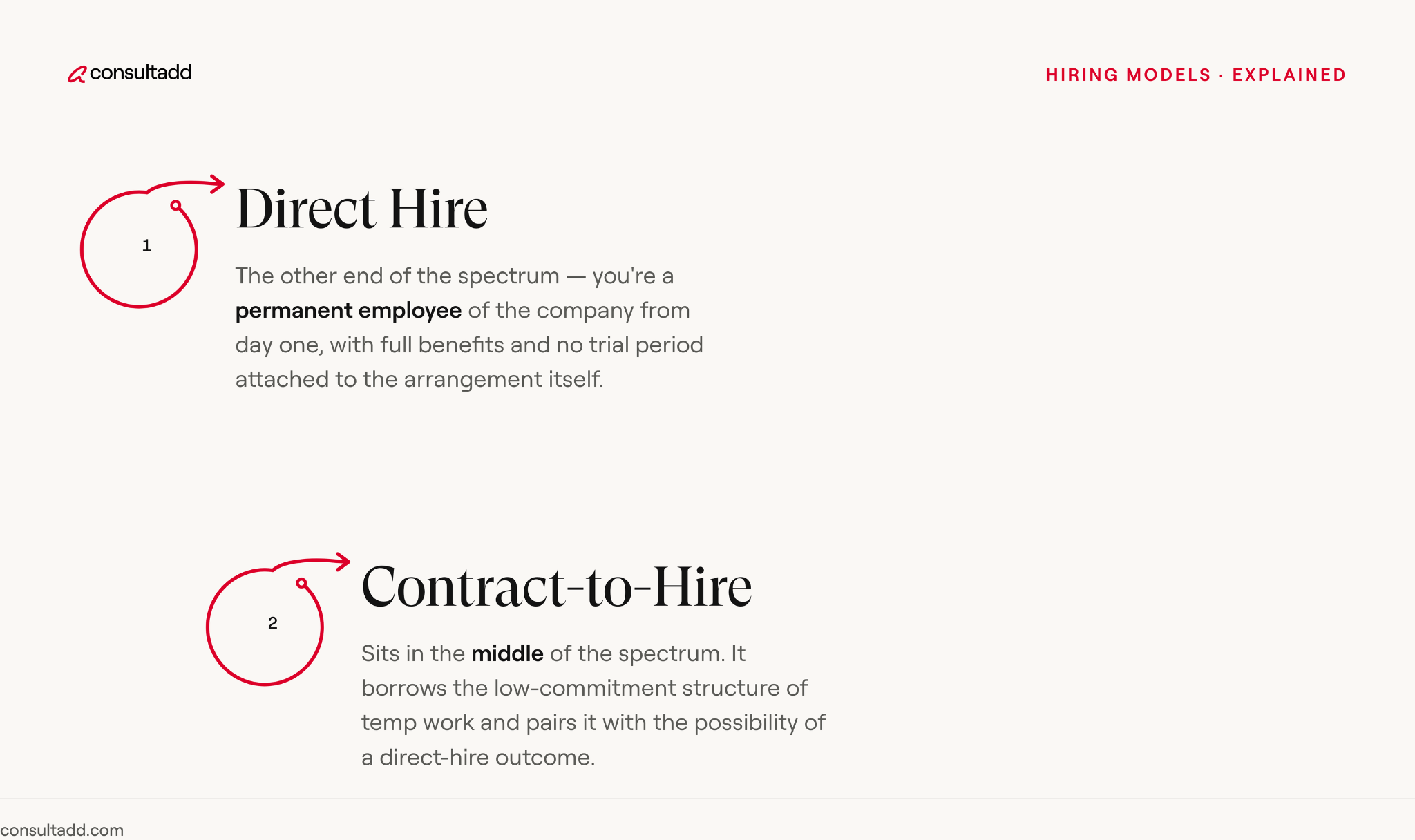
Direct hire sits at the other end of the spectrum: you're a permanent employee of the company from day one, with full benefits and no trial period attached to the arrangement itself (though most jobs still carry an informal probation period).
Contract to hire sits in the middle. It borrows the low-commitment structure of temp work and pairs it with the possibility of a direct-hire outcome.
That's exactly why staffing agencies built the model in the first place: it gives employers a way to de-risk a hiring decision without asking candidates to accept a purely temporary gig.
How the contract to hire process actually works
The mechanics are fairly consistent across the IT staffing industry, even though contract lengths and conversion terms vary by employer.
Typical contract length
Most contract-to-hire assignments in tech run somewhere between three and six months, though specialized roles, like cloud migration work or a niche AI project, sometimes stretch to a year before conversion talks even start.
- Shorter contracts tend to show up when a company needs to fill a role fast and figure out the long-term fit as they go.
- Longer ones are more common when the project itself has a defined end date and permanent headcount depends on whether the work continues past it.
Contract to hire vs full time: what actually changes
This is where most of the confusion around contract to hire meaning actually comes from. On paper, the day-to-day work looks identical to a full-time job.
The differences show up in your paycheck, your benefits, and how quickly you can start.
We've broken down this comparison in more detail, including how it plays out specifically for software engineers, in our guide to contract to hire vs full time for developers.
The short version: contract to hire wins when you want to test a role or a team before committing. Full time wins when you already know you want stability and are willing to trade some flexibility for it.
Contract to hire vs 1099 and corp-to-corp
People often lump contract to hire in with 1099 work or corp-to-corp (C2C) arrangements, but they're built differently, especially when it comes to taxes and who's on the hook for compliance.
If you want the full breakdown of how C2C actually works and who it makes sense for, we cover it in what is C2C employment, explained simply.
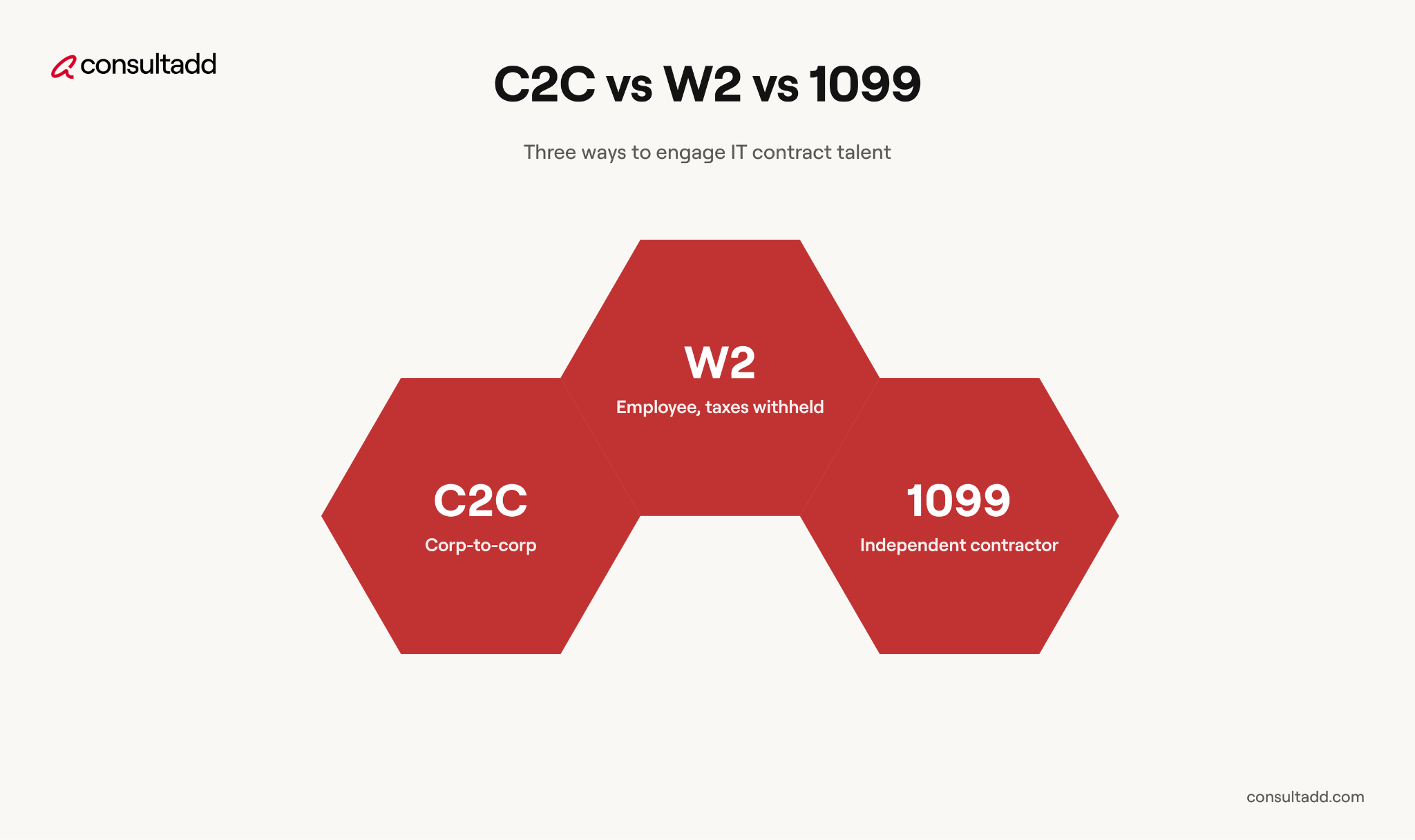
One thing worth knowing: contract to hire is always a W2 relationship.
If a recruiter offers you a "contract to hire" role and then hands you a 1099, that's not actually a contract to hire. It's worth asking directly before you sign anything.
The U.S. Department of Labor's guidance on worker classification under the Fair Labor Standards Act explains why this distinction carries real legal weight, since misclassifying a W2 employee as an independent contractor can strip away minimum wage and overtime protections.
Why employers use contract to hire
Every hiring decision is a bet, and a bad one is expensive.
Contract to hire gives employers a way to hedge that bet. Instead of committing to a full salary and benefits package based on a handful of interviews, they get months of actual, on-the-job evidence before making it permanent.
There's also a practical staffing angle. According to the Bureau of Labor Statistics, contingent and alternative work arrangements have grown steadily, with contingent workers making up 4.3 percent of the U.S. workforce up from 3.8 percent in 2017.
That growth tracks with how many companies now build contract to hire directly into their hiring strategy rather than treating it as a stopgap.
For a deeper look at whether the model fits a given hiring situation, our guide on choosing contract to hire walks through the benefits and the tradeoffs employers should weigh before going this route
What it means for job seekers
If you're the one being offered a contract-to-hire role, a few things are worth knowing going in.
First, the higher hourly rate you're often quoted exists because you're not getting the same benefits package a permanent hire would. Read the offer carefully and ask what happens to your pay and benefits at conversion, not just during the contract.
Second, conversion isn't guaranteed. A client's budget can shift halfway through your contract for reasons that have nothing to do with your performance. That's a real risk, and it's fair to factor it into your decision.
Third, and we'd flag this one especially for anyone new to the staffing world: legitimate agencies never charge job seekers a placement fee. If a recruiter asks you for money to "process" your application, that's a red flag worth walking away from.
Finding the right staffing partner for contract to hire
Not every staffing firm runs contract-to-hire programs the same way.
Placement speed, screening rigor, and how a firm handles compliance during the trial period all vary quite a bit between providers.
We put together a buyer's guide covering what to look for in an IT staffing firm, including benchmarks for how fast a good firm should be able to deliver qualified candidates for contract versus direct-hire roles.
The Society for Human Resource Management also maintains a useful reference on structuring contract and temporary staffing policies if you're building out an internal process rather than working with an outside partner.
Start Strong With Consultadd
With 15 years in business and 5,000+ successful staffing engagements, we don't just fill roles, we build reliability into your process. We've supported 65 staffing companies in the past year alone and maintain MSAs with industry leaders like Robert Half and TEKsystems.
Here's what working with Consultadd looks like:
- Talent sourced in under 24 hours
- Ready-to-deploy candidates, vetted for experience and compliance
- Lower turnover risk: we match long-term goals, not just short-term needs
- Seamless compliance: visa, documentation, onboarding? Handled.
- Dedicated 1:1 account managers for responsive, personalized support
- Top 100 candidate matches delivered in the past year
- Strong partnerships with universities to tap into fresh, committed talent
- Post-placement support so your investment grows beyond day one
For candidates, your next opportunity is more than just a job title, it's a chance to build skills, gain experience, and move your career forward. At Consultadd, we connect technology professionals with projects and employers that align with their goals, whether they're looking for contract, contract-to-hire, or long-term opportunities.
The tech job market moves fast, but the right guidance can make all the difference. Ready to take the next step in your career journey? Explore Opportunities >>
Key takeaways
- Contract to hire is a W2 arrangement run through a staffing agency, not a 1099 or corp-to-corp setup.
- The trial period typically lasts three to twelve months before a permanent offer decision gets made.
- Pay tends to run higher during the contract phase, but benefits and job security usually arrive only after conversion.
- Employers use this model to reduce hiring risk, and job seekers use it to test a role before committing long-term.
- Working with an experienced staffing partner smooths out compliance, onboarding speed, and the conversion process itself.
FAQs
What does contract to hire mean in a job offer?
It means you'll start as a W2 employee of a staffing agency, working at the client's site or remotely, with the possibility of a permanent offer once the contract period ends. It's not a guarantee of permanent employment, just an option built into the arrangement.
Is contract to hire a W2 or 1099 position?
It's always W2. The staffing agency withholds your taxes and handles payroll during the contract period, which is what separates it from 1099 or corp-to-corp arrangements.
How long does a typical contract to hire period last?
Most run between three and six months, though some specialized technical roles extend to a year depending on the project timeline and how quickly the client wants to make a permanent decision.
Can an employer end a contract to hire arrangement early?
Yes. Since you're technically employed by the staffing agency, not the client, the client can end the assignment before the contract term is up, often due to budget changes or shifting project scope rather than performance issues.
Is contract to hire better than a full-time job?
It depends on what you're optimizing for. Contract to hire often pays more hourly and gets you working faster, while full time offers benefits and job security from day one. Neither option is universally better.
Do staffing agencies charge job seekers for contract to hire placements?
No. Reputable agencies get paid by the client company, not the candidate. If anyone asks you for money to secure a contract-to-hire placement, treat it as a warning sign and look elsewhere.

Diversity Hires: What the Term Means and What the Law Allows
Introduction
Diversity hire gets thrown around online as an insult more often than it gets used accurately. It's not a job category, a legal classification, or a box that gets checked on an offer letter.
But the term has real weight behind it, especially now, because the rules governing diversity hires have shifted substantially since early 2025.
This guide explains what the term actually means, what changed at the federal level, and how employers can still build inclusive teams without stepping into legal risk.
TL;DR
- Diversity hire isn't a formal hiring category. It's an informal, often inaccurate label applied to a candidate.
- Since March 2025, the EEOC and DOJ have treated employment decisions based on race, sex, or other protected traits as unlawful, even when the goal is diversity.
- In June 2026, the EEOC rescinded decades-old guidance that supported voluntary affirmative action plans, narrowing what's considered safe.
- Broadening where you recruit is still legal. Making the final hiring decision based on a protected trait is not.
- Consultadd helps clients widen their candidate pools through sourcing, not selection criteria, keeping placements both inclusive and compliant.
What Does "Diversity Hire" Actually Mean?
There's no legal definition for the term. It's typically used, sometimes fairly and often not, to describe a candidate someone assumes was hired partly because of their race, gender, or another protected characteristic rather than purely on qualifications.
That assumption usually says more about the person making it than the candidate in question. A wider candidate pool doesn't lower the bar. It just means more qualified people got a fair look before a decision was made.
Legally, the distinction that matters isn't who applied or who got noticed. It's what actually drove the final hiring decision. Title VII of the Civil Rights Act has long prohibited using race, sex, or other protected traits as a factor in that decision, for any candidate, regardless of intent.
How the Legal Landscape Changed in 2025 and 2026
This is the part that's moved fastest, and it's worth understanding regardless of where you land on the underlying policy debate.
The EEOC has been direct about where it now stands. Its own guidance states that Title VII protects every individual equally, regardless of whether they belong to a minority or majority group, and that intent to promote diversity doesn't exempt an employment decision from that standard.
For a broader look at how this is playing out across HR functions, SHRM's tracking of DEI-related executive actions is a useful ongoing reference, since enforcement priorities are still shifting month to month.
What's Still Legal: Broadening Your Candidate Pool
Here's the distinction that gets lost in a lot of the noise.
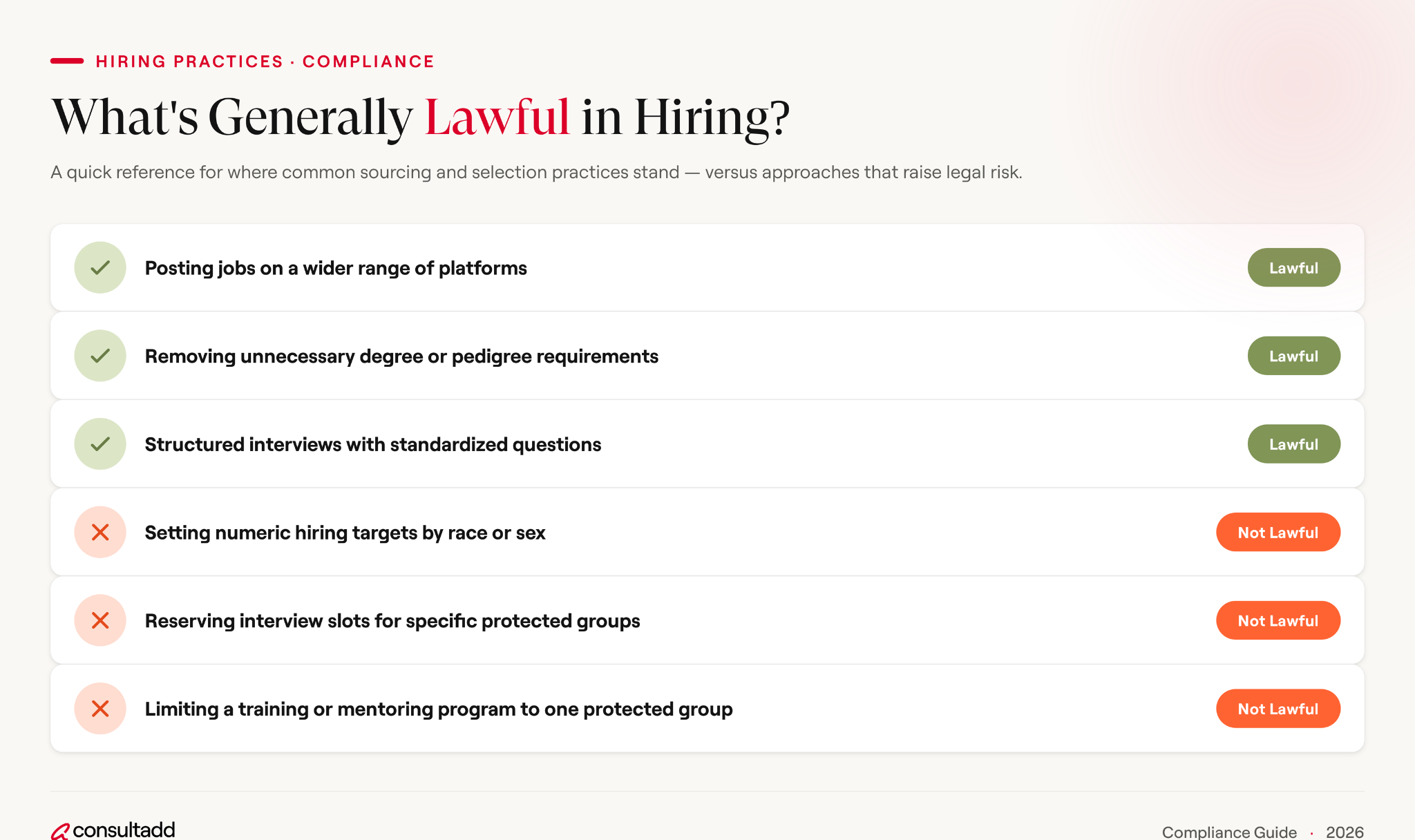
Sourcing and selection are two different stages, and the law treats them differently.
Casting a wider net, posting jobs in more places, removing unnecessary degree requirements, rewriting job ads to be less exclusionary, is about who gets seen.
Nobody's rejected because of it.
Making a final hire based on a candidate's race, sex, or other protected trait, even as one factor among several, is a different matter entirely, and that's where the legal risk actually sits.
Building a Compliant, Merit-Based Hiring Process
None of this means employers have to stop caring about reaching a broad range of candidates. It means the "how" matters more than it used to.
- Widen sourcing channels instead of relying on the same referral networks every time.
- Standardize interview questions and scoring so every candidate is measured against the same criteria.
- Reduce identifying details during early resume screening to limit unconscious bias.
- Base evaluations on skills and job-relevant experience rather than pedigree or where someone previously worked.
- Train hiring managers on where the line between broad sourcing and biased selection actually sits.
If You've Been Called a "Diversity Hire"
If this term has been aimed at you, it's worth remembering it's an assumption, not a fact. Being sourced through a wider outreach effort has nothing to do with whether you were the right candidate for the role.
Employers still have to evaluate every hire against the actual requirements of the job.
Our earlier post on effective strategies for building a diverse talent pool covers sourcing tactics in more depth, and our guide to workplace diversity types breaks down the different dimensions of diversity worth considering beyond the obvious ones.
It's a frustrating label to carry, and it says nothing about your actual qualifications. If it's affecting how you show up at work, that's worth talking through with someone you trust, whether that's a manager, a mentor, or an outside professional.
What This Means for Staffing Partners and Employers
For staffing firms and hiring teams, the practical shift is this: build the widest, most qualified pool you can, then let standardized, job-relevant criteria decide who moves forward.
That combination gets you both a diverse slate and a defensible process, which matters a lot more now than it did two years ago.
Start Strong With Consultadd
With 15 years in business and 5,000+ successful staffing engagements, we don't just fill roles, we build reliability into your process. We've supported 65 staffing companies in the past year alone and maintain MSAs with industry leaders like Robert Half and TEKsystems.
Here's what working with Consultadd looks like:
- Talent sourced in under 24 hours
- Ready-to-deploy candidates, vetted for experience and compliance
- Lower turnover risk: we match long-term goals, not just short-term needs
- Seamless compliance: visa, documentation, onboarding? Handled.
- Dedicated 1:1 account managers for responsive, personalized support
- Top 100 candidate matches delivered in the past year
- Strong partnerships with universities to tap into fresh, committed talent
- Post-placement support so your investment grows beyond day one
For candidates, your next opportunity is more than just a job title, it's a chance to build skills, gain experience, and move your career forward. At Consultadd, we connect technology professionals with projects and employers that align with their goals, whether they're looking for contract, contract-to-hire, or long-term opportunities.
The tech job market moves fast, but the right guidance can make all the difference. Ready to take the next step in your career journey? Explore Opportunities >>
Key Takeaways
- "Diversity hire" is an informal label, not a legal or organizational hiring category.
- Federal guidance since 2025 treats hiring decisions based on protected traits as unlawful, regardless of intent.
- The 2026 EEOC guidance rescission narrowed the safe harbor employers previously relied on for affirmative action plans.
- Broadening where and how you source candidates remains legal. Deciding based on a protected trait does not.
- A standardized, skills-based evaluation process protects both candidates and employers.
FAQs
What does "diversity hire" actually mean?
It's an informal term, not a legal or HR classification, generally used to describe a candidate someone assumes was hired partly because of a protected characteristic rather than qualifications alone.
Is diversity hiring illegal in 2026?
Hiring decisions based on race, sex, or other protected traits are unlawful under Title VII, and recent EEOC guidance has reinforced that standard. Broadening recruitment outreach to reach more candidates is not illegal on its own.
Can a company still recruit for diversity?
Yes, as long as the effort focuses on sourcing and outreach rather than using a protected trait as a factor in the final hiring decision. Widening where you post jobs and who sees them is different from deciding who gets hired based on demographics.
What's the difference between diversity recruiting and diversity quotas?
Diversity recruiting means casting a wider net so more qualified candidates from different backgrounds get considered. Quotas or numeric targets tied to race or sex in the final hiring decision are what current EEOC guidance treats as unlawful.
Are federal contractors affected differently than private employers?
Yes. Federal contractors face additional certification requirements and False Claims Act exposure under the March 2026 executive order, on top of the Title VII standards that apply to all employers.
How can I tell if a hiring process is compliant?
Look for standardized interview questions, evaluation criteria tied to the job itself, and documentation showing every candidate was measured the same way. If protected characteristics factor into the actual decision at any stage, that's the point where risk enters.