
Contracts

Contract Worker vs Employee: The Real Differences
Introduction
The words sound interchangeable in casual conversation, but the contract worker vs employee distinction is one of the most consequential lines in US labor law. It determines who pays your taxes, who covers you if you get hurt on the job, whether you're entitled to overtime, and whether the company can be sued for treating you like an employee while paying you like a contractor.
Get the label wrong, on either side, and the consequences show up at tax time, in a workers' comp claim, or in a federal audit.
The distinction has also become genuinely unstable at the regulatory level. The Department of Labor paused enforcement of its 2024 classification rule, then in February 2026 proposed rescinding it entirely in favor of a simpler, contractor-friendlier test.
Meanwhile states like California, Massachusetts, and New Jersey run their own stricter rules regardless of what Washington decides. Companies and workers operating across state lines are, in practice, complying with the strictest rule that touches them.
This guide lays out what actually separates the two categories, compares taxes, benefits, cost, and legal protections side by side, and walks through where the classification rules stand in 2026.
TL;DR
- The legal test isn't the contract's label; it's control and economic reality. Who directs the work, and is the worker economically dependent on this one company, or running their own business.
- Employees get tax withholding, benefits eligibility, and legal protections (minimum wage, overtime, unemployment, workers' comp); contractors get flexibility and higher gross pay but none of that safety net.
- Employers save roughly 20-30% on top of wages by using contractors correctly, since payroll taxes, benefits, and insurance shift to the contractor.
- Federal rules are in flux: DOL paused 2024's worker-friendly test and proposed a simpler, two-factor standard in February 2026, with a final rule still pending as of mid-2026.
- State law often overrides federal flexibility. California's ABC test, and similar rules in Massachusetts and New Jersey, remain the strictest classification standards in the country regardless of federal changes.
What actually separates a contract worker from an employee
Here's the fact that surprises most people: what your offer letter or contract calls you doesn't determine your legal classification. Courts and agencies look at the actual working relationship, and the analysis boils down to two core questions the DOL's current and proposed frameworks both center on.
Control : Who decides how, when, and where the work gets done?
An employee typically works set hours, follows company procedures, uses company equipment, and reports to a supervisor who directs the day-to-day work. A genuine independent contractor sets their own methods and schedule, subject only to the deliverable and deadline the contract specifies.
Economic reality: Is the worker economically dependent on this one company, or are they in business for themselves?
A contractor with multiple active clients, their own equipment, and their own marketing is running a business. Someone with one client, told when to log in, and given a company laptop looks like an employee regardless of what the contract says.
Everything else, permanency of the relationship, whether the work is central to the company's core business, whether specialized skill is involved, feeds into that same core analysis as supporting evidence, not as an independent trump card.
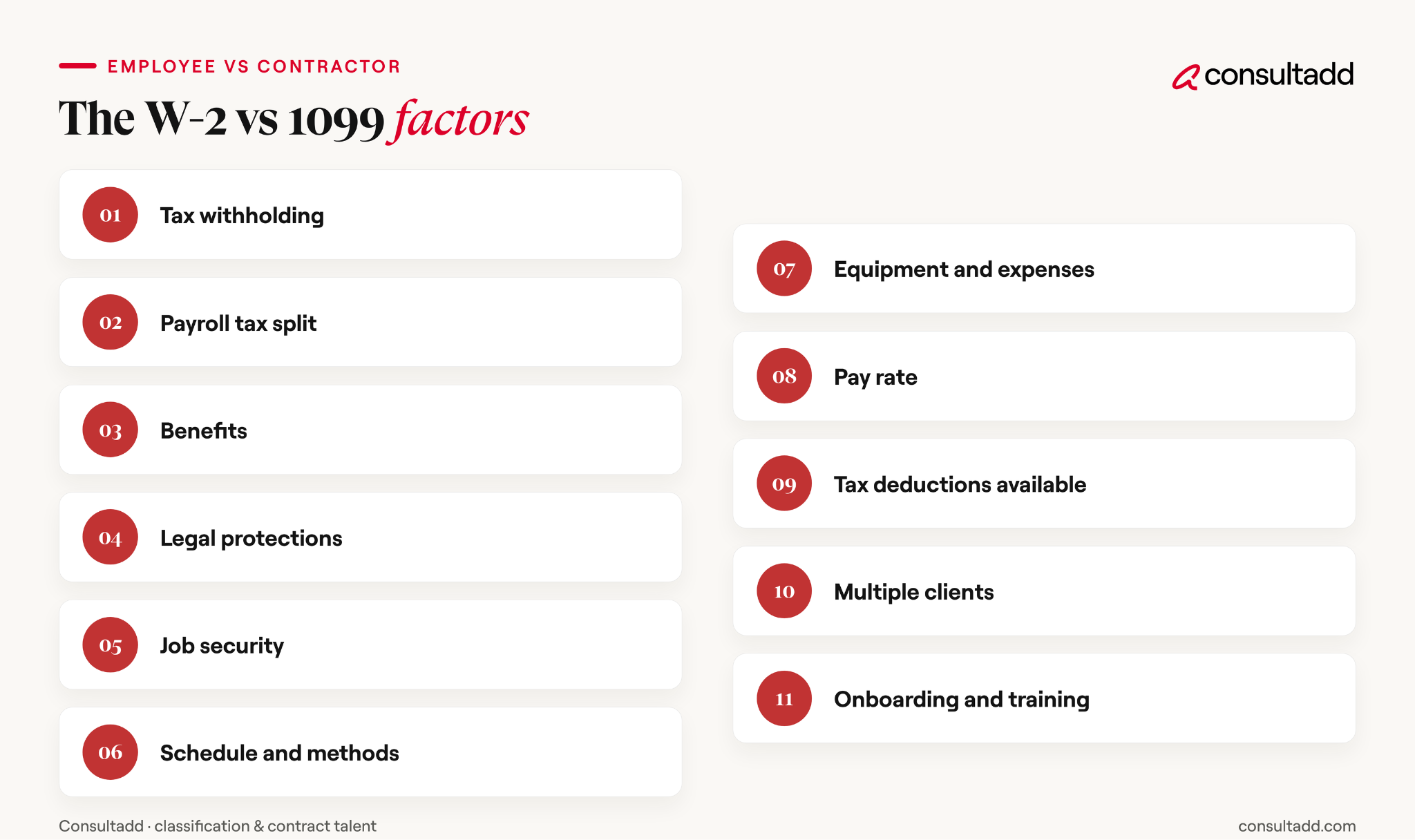
Contract worker vs employee: full comparison
Side by side, here's where the categories genuinely diverge:
Notice how consistently the pattern holds: nearly every employee advantage (protections, benefits, stability) corresponds to an employer obligation, and nearly every contractor advantage (rate, flexibility, deductions) corresponds to something the worker now has to handle themselves. Neither side of the table is free money; it's a transfer of responsibility with real trade-offs on both ends.
What each classification costs an employer
For companies deciding how to structure a role, the honest math looks like this:
Hiring an employee typically adds 20-30% on top of base salary once you count the employer's half of payroll taxes, benefits (health insurance, retirement matching), workers' comp insurance, unemployment insurance contributions, paid time off, and the administrative cost of running payroll and HR compliance.
Hiring a contractor removes most of that overhead, but not the responsibility to structure the relationship correctly. A contractor paid a higher gross rate with no benefits often costs a company less overall than an equivalent-salary employee, precisely because the payroll tax, insurance, and benefits burden shifted to the contractor's side.
The trade-off companies frequently underweight: contractors bring flexibility (scale up for a project, scale down when it ends) that employees structurally can't offer, which is exactly why contract and contract-to-hire models have become a deliberate strategy rather than a stopgap for many companies managing fluctuating technical needs.
We made the fuller case for that approach in IT contract staffing is a business strategy, not a backup plan, and for a closer look at how contractor arrangements get structured through business entities specifically, our guide to what is C2C employment covers the corp-to-corp variant common in IT staffing.
The 2026 regulatory picture
This is where the ground has genuinely shifted, and it's worth understanding regardless of which side of the relationship you're on.
The federal back-and-forth:
In January 2024, the DOL finalized a rule using a broad "totality of the circumstances" test with six factors, widely viewed as making it harder to classify someone as a contractor. That rule faced enforcement pushback and was effectively paused in 2025.
Then, on February 26, 2026, the DOL published a new proposed rule that would rescind the 2024 framework entirely and replace it with a simpler, two-core-factor test centered on control and opportunity for profit or loss, similar to a 2021 approach.
Under the proposal, actual day-to-day practice matters more than contract language, but routine requirements like insurance, safety compliance, and meeting agreed deadlines don't by themselves push a worker toward employee status. Public comments closed April 28, 2026, and as of mid-2026 the rule remains proposed, not final.
State law doesn't wait for federal clarity:
California's ABC test, codified through AB 5 and refined by AB 1514 (effective January 1, 2026, adjusting certain professional exemptions), remains one of the strictest classification standards in the country: a worker is presumed an employee unless the company proves all three prongs, freedom from control, work outside the company's usual business, and an independently established trade.
Massachusetts and New Jersey run comparably strict tests. The practical result for any multi-state employer: comply with the most protective standard touching each worker, because a federal proposal loosening the national floor changes nothing in states that set a higher one.
The takeaway for both sides in 2026:
Treat the classification question as unsettled and audit-worthy, not resolved. A worker or company confident in their classification under last year's rule should re-examine it under both the emerging federal standard and whichever state law applies.

Misclassification: the risk on both sides
Misclassifying an employee as a contractor, deliberately or by accident, exposes a company to back taxes, unpaid overtime, unemployment insurance contributions, and penalties that can multiply quickly across a workforce.
The core exposure hasn't changed even as the federal test evolves: regulators and courts look at the real relationship, not the contract's title, so a company that directs a "contractor's" schedule, provides their equipment, and treats them like staff in every practical sense carries real risk regardless of the paperwork.
For workers, misclassification cuts the other way: lost overtime pay, no unemployment insurance if the relationship ends, no workers' comp coverage if injured on the job, and no employer contribution to payroll taxes that were, legally, owed.
The safest posture for companies, regardless of which federal test ultimately survives: make the classification match the reality. If a role requires set hours, company equipment, exclusive availability, and close supervision, it's an employee role, and structuring it as a 1099 contract doesn't change that underneath the label.
Which one is right for you?
For workers, the choice usually comes down to what you value more. Employment fits if you want predictable income, employer-paid benefits, and legal protections without the administrative load of running a business. Contracting fits if you're experienced enough to manage your own pipeline, comfortable with variable income, and want the higher gross rate and tax flexibility that comes with self-employment.
For companies, the decision should follow the nature of the work, not just the cost comparison. Ongoing, core, closely supervised work belongs in an employee role; project-based, specialized, or fluctuating-capacity work is a legitimate fit for contractors, provided the relationship is actually structured that way in practice, not just on paper.
Getting this right protects both the worker's rights and the company's compliance position, and it's the same judgment call that shapes good hiring strategy generally, something we cover in more depth in our guide to hiring and recruiting strategies.
Whichever side of the relationship you're on, the rule that survives every regulatory change is the same one: the substance of the working relationship, not the label on the contract, is what actually determines your classification.
Start Strong With Consultadd
With 15 years in business and 5,000+ successful staffing engagements, we don't just fill roles, we build reliability into your process. We've supported 65 staffing companies in the past year alone and maintain MSAs with industry leaders like Robert Half and TEKsystems.
Here's what working with Consultadd looks like:
- Talent sourced in under 24 hours
- Ready-to-deploy candidates, vetted for experience and compliance
- Lower turnover risk: we match long-term goals, not just short-term needs
- Seamless compliance: visa, documentation, onboarding? Handled.
- Dedicated 1:1 account managers for responsive, personalized support
- Top 100 candidate matches delivered in the past year
- Strong partnerships with universities to tap into fresh, committed talent
- Post-placement support so your investment grows beyond day one
For candidates, your next opportunity is more than just a job title, it's a chance to build skills, gain experience, and move your career forward. At Consultadd, we connect technology professionals with projects and employers that align with their goals, whether they're looking for contract, contract-to-hire, or long-term opportunities.
The tech job market moves fast, but the right guidance can make all the difference. Ready to take the next step in your career journey? Explore Opportunities >>
Key takeaways
- The contract worker vs employee distinction turns on actual control and economic dependence, not on what the contract or offer letter calls the relationship.
- Employees get withheld taxes, employer-shared payroll tax, benefits, and legal protections; contractors get flexibility, higher gross pay, and business tax deductions, in exchange for handling everything themselves.
- Employers typically pay 20-30% above salary for an employee once taxes, benefits, and insurance are counted, which is why correctly structured contractor relationships save real money.
- Federal classification rules are unsettled in 2026: the DOL proposed rescinding 2024's worker-friendly test in favor of a simpler two-factor standard, with a final rule still pending as of mid-year.
- State law can override federal flexibility entirely; California, Massachusetts, and New Jersey maintain strict tests that apply regardless of what happens in Washington, so multi-state companies must comply with the toughest standard touching each worker.
FAQs
What is the main difference between a contract worker and an employee?
The legal difference comes down to control and economic dependence, not the contract's title. Employees follow company-directed schedules and methods and are economically dependent on one employer; contractors control their own methods and schedule and typically operate as an independent business, often serving multiple clients.
Do contract workers get benefits?
No, not from the hiring company. Contractors are responsible for arranging and paying for their own health insurance, retirement savings, and paid time off. In exchange, they typically command a higher gross pay rate and can deduct legitimate business expenses that employees generally cannot.
Which pays more, contract work or employment?
Gross pay is usually higher for contract work, since the rate has to cover what an employer would otherwise provide: benefits, payroll tax matching, and paid leave. Net income depends heavily on how well a contractor manages the full 15.3% self-employment tax, self-funded benefits, and gaps between contracts, so comparing hourly rates alone is misleading.
What are the legal risks of misclassifying an employee as a contractor?
For companies, misclassification can trigger back taxes, unpaid overtime, unemployment insurance liability, and penalties, especially in strict states like California. For workers, misclassification means losing overtime pay, unemployment insurance, and workers' compensation coverage they were legally entitled to, regardless of what the contract stated.
Are the rules for classifying workers changing in 2026?
Yes. The DOL proposed rescinding its 2024 classification rule in February 2026, replacing it with a simpler test centered on control and profit/loss opportunity. The proposal isn't final as of mid-2026, and regardless of the federal outcome, states like California, Massachusetts, and New Jersey maintain their own stricter classification tests that continue to apply.
Should my business hire employees or contractors?
Match the classification to the actual work. Core, ongoing, closely supervised roles should be employees; project-based, specialized, or fluctuating-capacity work can legitimately use contractors, as long as the relationship is structured, and operated, like a genuine independent engagement rather than employment in disguise.

W2 vs C2C vs 1099: Which Contract Type Fits You Best
Introduction
You get an offer, and the recruiter mentions the role is "W2" or asks if you can go "C2C" or "1099."
Same job, three different labels, and each one changes your taxes, your benefits, and who's legally on the hook if something goes wrong.
This guide lays out w2 vs c2c vs 1099 side by side so you can walk into that conversation knowing exactly what you're agreeing to.
TL;DR
- W2 means an employer withholds your taxes and often provides benefits; C2C and 1099 don't.
- C2C requires a registered business entity on your end. 1099 doesn't.
- Take-home pay looks different across all three, even at the same bill rate, once taxes and benefits are factored in.
- Only W2 employment gives you guaranteed unemployment insurance and overtime protection under federal law.
- Consultadd places contractors under all three models and can walk you through which one actually makes sense for your situation.
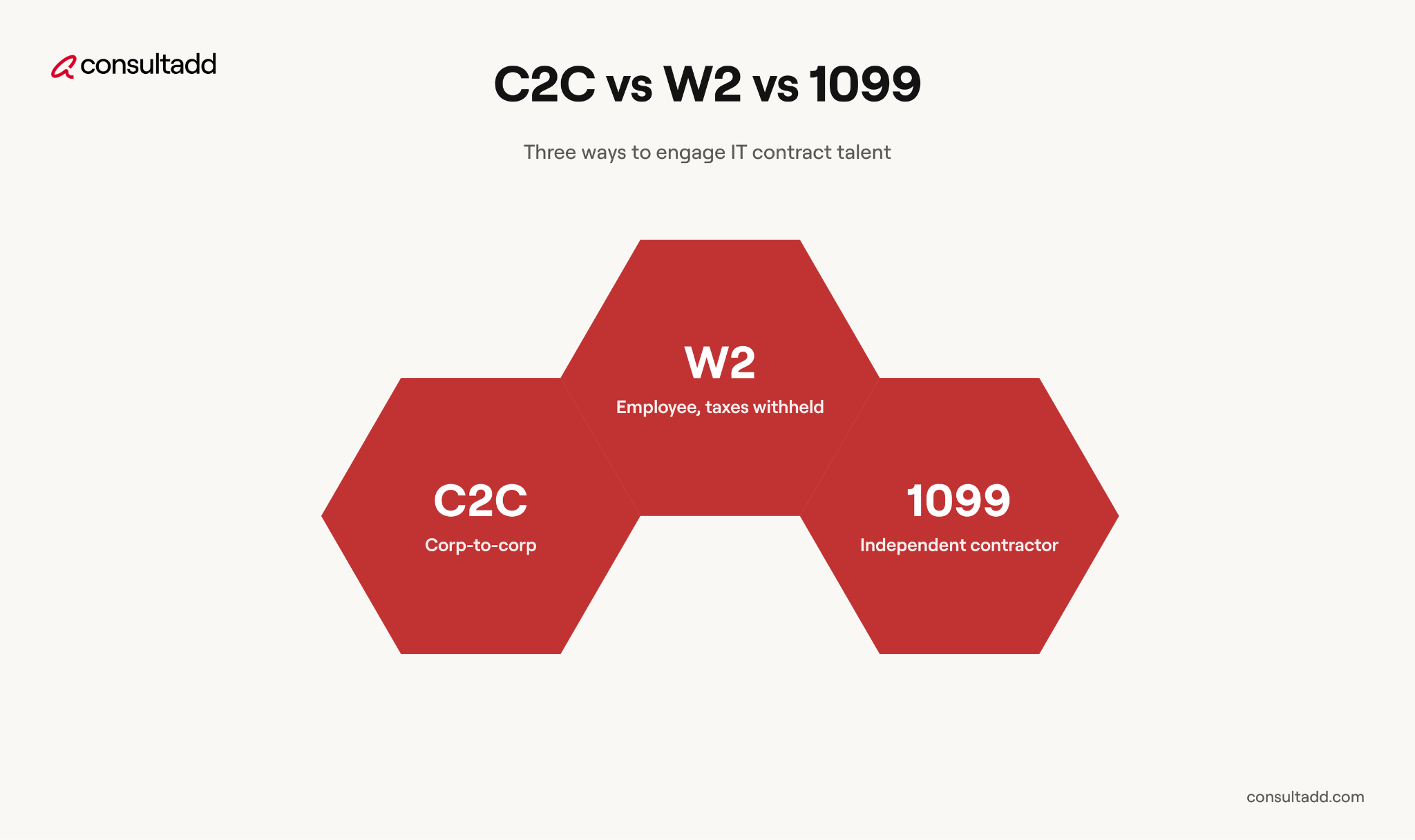
W2, C2C, and 1099 in One Sentence Each
W2 means you're a direct employee, usually of a staffing agency, and taxes come out of your paycheck automatically.
1099 means you're self-employed as an individual. The client reports what they paid you, but nothing gets withheld.
Corp to corp (C2C) means you've set up a registered business, an LLC or S-corp, and the client contracts with that business instead of with you personally.
For a deeper look at how the W2 and C2C sides specifically compare, our guide on W2 vs C2C key differences goes further into visa sponsorship and turnover considerations.
Same Rate, Three Different Paychecks
Here's where the differences actually hit home. Say a role pays an $80 an hour bill rate.
Under W2, the agency withholds income tax, Social Security, and Medicare, and you might get benefits like health insurance or PTO baked in, which lowers the effective rate you'd need to match your take-home goals.
Under 1099, nothing gets withheld up front, but you owe self-employment tax (both halves of Social Security and Medicare) plus income tax, and you're responsible for quarterly estimated payments.
Under C2C, your business invoices the full rate, then your business pays its own taxes and, if you've elected S-corp status, potentially some of that income as a lower-taxed distribution instead of wages.
The math benefits people who understand entity structuring. It works against people who don't.
Our breakdown of what contract work actually means walks through the 1099 side of this math in more detail, including quarterly payment deadlines.
Benefits and Protections Across All Three
W2 employment is the only one of the three that guarantees certain federal protections automatically. The Department of Labor's Fact Sheet 13 on the FLSA employment relationship explains that when a genuine employment relationship exists, the worker is entitled to minimum wage and overtime pay under federal law.
Independent contractors, whether 1099 or C2C, don't get that same guarantee, because the law treats them as running their own business rather than depending on an employer.
Unemployment insurance follows the same split. W2 employees are typically covered because their employer pays into the state unemployment fund. 1099 and C2C workers generally aren't, unless their state has separately opted to extend coverage.
Visa and Work Authorization: Where the Three Diverge
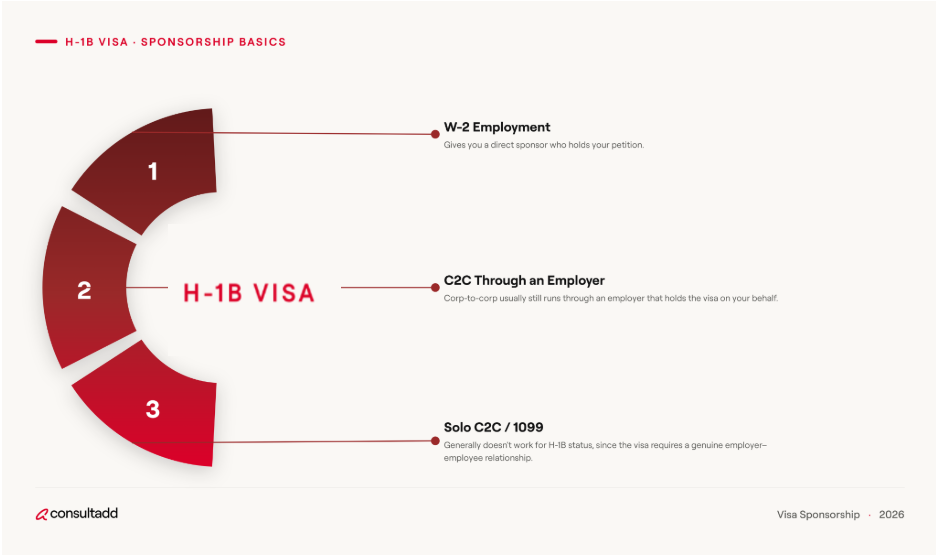
For contractors on a visa, especially H-1B, these categories aren't interchangeable.
- A W2 arrangement gives you a direct sponsor who holds your petition.
- C2C usually still runs through an employer, like a consulting firm, that holds the visa on your behalf.
- A pure solo C2C or 1099 setup generally doesn't work for H-1B status at all, since the visa requires a genuine employer-employee relationship.
USCIS pays particularly close attention to placements at a third-party worksite, and its guidance on H-1B third-party placements requires documentation proving that the relationship holds up for the full length of the petition.
Which One Should You Choose?
W2 tends to fit best if:
- You're newer to contracting and want predictable withholding and possible benefits
- You're on a visa that requires a direct sponsor
- You'd rather not manage quarterly taxes or entity paperwork
1099 tends to fit best if:
- You're doing solo freelance work without wanting to form a business entity
- The engagement is short or part-time
- You're comfortable handling your own taxes and estimated payments
C2C tends to fit best if:
- You already run a registered business and want the tax structuring options it allows
- You're taking on longer or higher-rate contracts where the entity setup pays for itself
- You have (or plan to get) liability insurance in place
If you're still unsure which category applies to your situation, that's usually a conversation worth having with a staffing partner before signing anything, not after.
Start Strong With Consultadd
With 15 years in business and 5,000+ successful staffing engagements, we don't just fill roles, we build reliability into your process. We've supported 65 staffing companies in the past year alone and maintain MSAs with industry leaders like Robert Half and TEKsystems.
Here's what working with Consultadd looks like:
- Talent sourced in under 24 hours
- Ready-to-deploy candidates, vetted for experience and compliance
- Lower turnover risk: we match long-term goals, not just short-term needs
- Seamless compliance: visa, documentation, onboarding? Handled.
- Dedicated 1:1 account managers for responsive, personalized support
- Top 100 candidate matches delivered in the past year
- Strong partnerships with universities to tap into fresh, committed talent
- Post-placement support so your investment grows beyond day one
For candidates, your next opportunity is more than just a job title, it's a chance to build skills, gain experience, and move your career forward. At Consultadd, we connect technology professionals with projects and employers that align with their goals, whether they're looking for contract, contract-to-hire, or long-term opportunities.
The tech job market moves fast, but the right guidance can make all the difference. Ready to take the next step in your career journey? Explore Opportunities >>
Key Takeaways
- W2 gives you withheld taxes and often benefits, but less flexibility and lower headline pay rates.
- 1099 keeps things simple with no entity required, but you carry the full tax burden yourself.
- C2C offers tax structuring advantages for contractors who already run a business, but it demands more setup.
- Only W2 employment guarantees federal minimum wage, overtime, and unemployment insurance protections.
- Visa status often decides this choice for you before pay or tax preferences even enter the picture.
FAQs
Is 1099 the same as corp to corp?
No. A 1099 contractor works as an individual with no business entity involved. A C2C contractor works through a registered LLC or S-corp, and that entity, not the person, is the contracting party.
Which pays more, W2 or C2C?
Neither is automatically higher. C2C bill rates are often quoted higher because the contractor's business now covers taxes and benefits the W2 employer would otherwise handle. Take-home pay depends on how well the rate accounts for those costs.
Can I switch from W2 to C2C mid-contract?
It's possible, but it usually requires setting up a business entity first and renegotiating the contract terms with the agency or client. It isn't a simple mid-stream label change.
Do 1099 or C2C contractors get benefits?
Generally, no. Neither classification includes employer-provided health insurance, PTO, or retirement contributions unless the contractor's own business chooses to provide them.
Is C2C legal on an H-1B visa?
It can be, but typically only when a consulting firm or agency holds the visa sponsorship, not as a fully independent solo arrangement. Documentation requirements are strict for third-party placements.
How do I know which classification a job actually needs?
Check the job posting or ask the recruiter directly, since staffing agencies usually specify W2, C2C, or 1099 requirements upfront. If you're unsure which fits your visa status or business setup, a staffing partner can help you sort it out before you sign anything.

What Is The Visa Number On A US Visa? Where To Find It
Introduction
You're filling out an immigration form, it asks for your "visa number," and your passport page is suddenly a wall of numbers: one on the bio page, two or three on the visa sticker itself, another on some USCIS notice in your email.
Which one is it? Here's the direct answer: the visa number on a US visa is the red number printed in the lower right corner of the visa stamp (also called the visa foil) in your passport. It's usually eight digits, and it's the only number on the stamp printed in red.
That's genuinely most of what you need. But the reason this question gets asked millions of times a year is that US immigration paperwork surrounds you with lookalike identifiers, and entering the wrong one can delay an application.
So this guide covers where the number sits, what it does, how it differs from every other number you're juggling, and the second, completely different meaning of "visa number" that trips up green card applicants.
TL;DR
- The visa number (also called the visa foil number) is the red number in the bottom right of your US visa stamp, typically 8 digits, sometimes one letter followed by seven digits.
- Simple rule: if the number isn't red, it isn't your visa number. The black control number elsewhere on the stamp is a different identifier.
- It's a randomly generated tracking number for that specific visa sticker, not for you personally; a renewed visa gets a brand-new number.
- It's different from your passport number, A-Number, USCIS receipt number, I-94 number, and case ID, and forms occasionally need each of these.
- In green card contexts, "visa number" can instead mean an available immigrant visa slot under the monthly Visa Bulletin, an entirely separate concept.
What is the visa number on a US visa?
Think of it as a serial number for the sticker itself. When a US embassy or consulate approves your visa, it prints a foil (the official term for the sticker) into your passport, and that foil carries a unique identifier: the visa number. Federal agencies use it to pull up the record of that specific visa in their systems, and CBP officers reference it when verifying your authorization at the border.
Three characteristics worth knowing:
- It's random. The digits don't encode your visa type, the consulate, or anything about you. An H-1B visa number looks no different from an F-1 or B-1/B-2 number.
- It belongs to the foil, not to you. Renew your visa and the new foil carries a completely new number; the old one simply remains on the expired stamp as history.
- It exists only on paper. There's no online lookup for it. If you need it, you need the physical passport (or a good scan of the visa page, which is an excellent reason to keep one).
It's also personal data worth guarding. Share it with government agencies, your employer's immigration counsel, or accredited legal representatives, and nobody else.
Reading your visa stamp: where everything sits
A US visa foil packs a lot into a small rectangle. Here's the map:
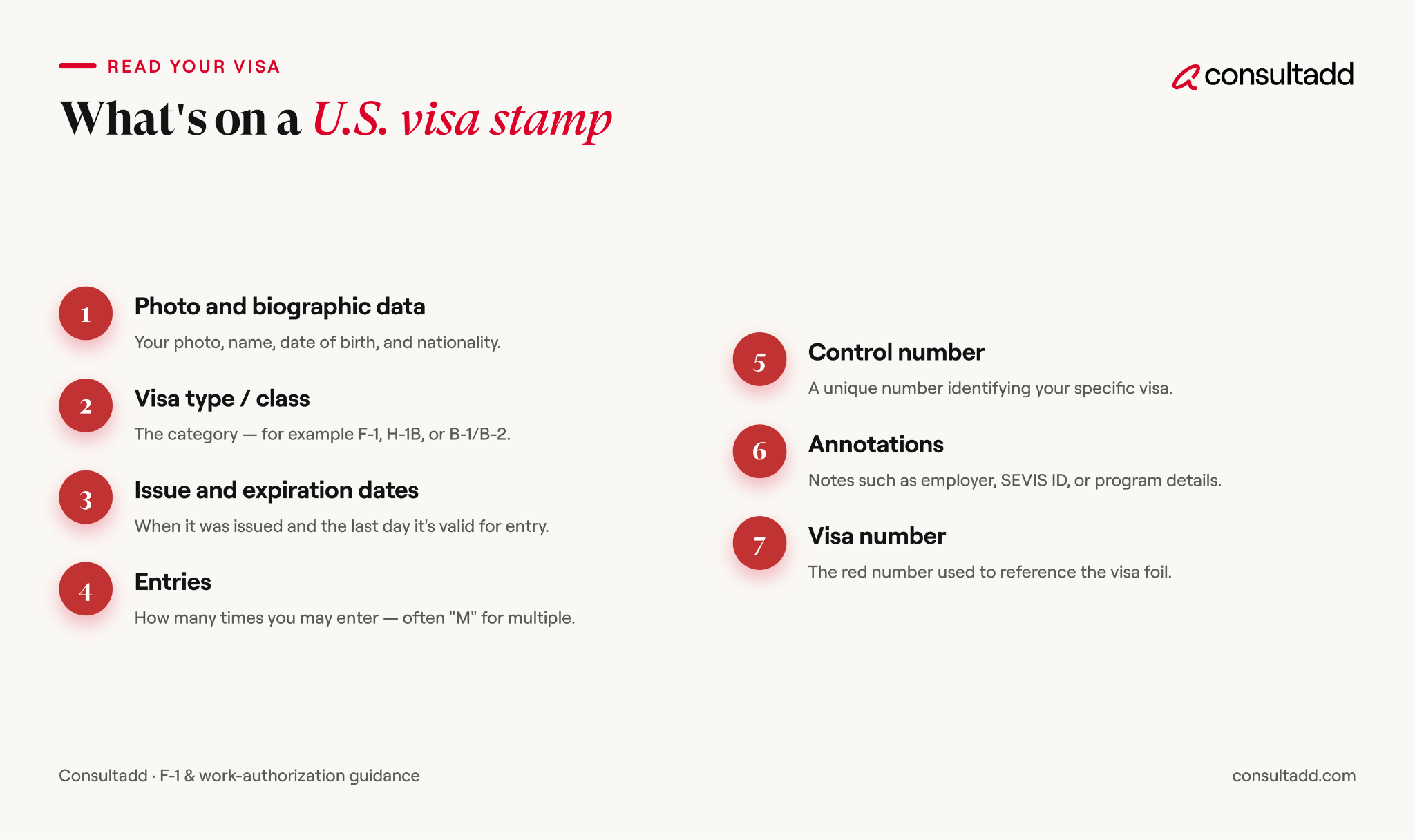
The red ink is deliberate: everything else on the foil prints in black, so the one identifier you'll be asked for most often stands out at a glance. Older visas sometimes show a letter followed by seven digits; the format has been standardized toward eight digits over time.
On immigrant visas, you'll also find your A-Number printed on the foil, labeled as the registration number.
Visa number vs every other number
This table is the part worth bookmarking, because mixing these up is the number-one cause of form errors:
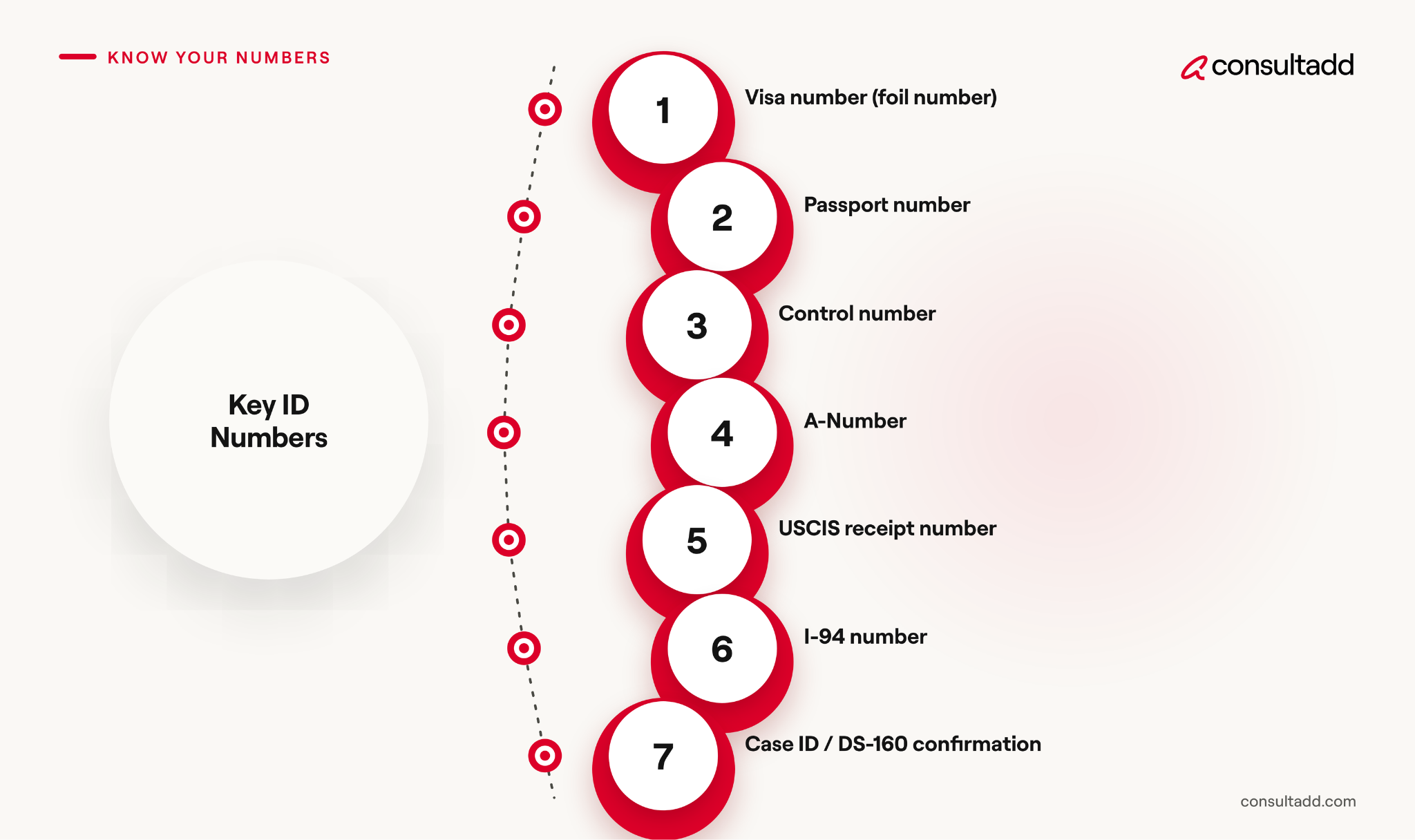
The one-line rules that resolve 95% of confusion: red means visa number. The bio page means passport number. "A" prefix means A-Number. Three letters then ten digits means receipt number.
When you actually need your visa number
Honestly, less often than people expect, which is part of why nobody memorizes it. The situations where it comes up:
- USCIS immigration forms. Applications like the I-485 (adjustment of status) and others ask for the nonimmigrant visa number from your most recent entry. Enter it exactly as printed, red number only.
- Visa renewals and DS-160 applications. The form asks whether you've previously held a US visa and for that visa's number.
- Certain border and consular interactions. Officers reference it to pull your visa record, though they read it off the foil themselves.
What it's not needed for: checking your I-94, applying for a Social Security number, opening a bank account, or proving work authorization day to day.
When a form asks for a number and you're unsure which, match the format: if the field wants 8 digits and you're holding a 13-character receipt number, you've got the wrong identifier.
Lost visas, renewals, and common mistakes
- Lost or stolen passport with a visa inside. Report it to local police and notify the US embassy or consulate (or the State Department) so the visa can be flagged. The visa can't be transferred or reprinted; you'll apply for a new one, which will carry a new number.
- Faded or unreadable number. It happens on older, well-traveled passports. Don't guess. A consulate, your attorney, or in some cases your employer's immigration file will have the number on record from issuance.
- Expired visa, valid stay. A common and legitimate situation: your visa foil (entry document) can expire while your authorized stay (I-94) continues. The old foil's number remains your answer for "most recent visa number" on forms until a new visa is issued.
- The classic mistakes, in descending order of frequency: submitting the black control number instead of the red visa number, submitting the passport number, using an old visa's number after a renewal, and confusing foil numbers with Visa Bulletin availability. Each is avoidable with one glance at the ink color and one check of which foil is current.
The whole topic rewards two minutes of prevention: scan your passport bio page and every visa page, store the scans securely, and note which numbers are which. Future you, filling out a form at 11 pm the night before a deadline, will be grateful.
Start Strong With Consultadd
With 15 years in business and 5,000+ successful staffing engagements, we don't just fill roles, we build reliability into your process. We've supported 65 staffing companies in the past year alone and maintain MSAs with industry leaders like Robert Half and TEKsystems.
Here's what working with Consultadd looks like:
- Talent sourced in under 24 hours
- Ready-to-deploy candidates, vetted for experience and compliance
- Lower turnover risk: we match long-term goals, not just short-term needs
- Seamless compliance: visa, documentation, onboarding? Handled.
- Dedicated 1:1 account managers for responsive, personalized support
- Top 100 candidate matches delivered in the past year
- Strong partnerships with universities to tap into fresh, committed talent
- Post-placement support so your investment grows beyond day one
For candidates, your next opportunity is more than just a job title, it's a chance to build skills, gain experience, and move your career forward. At Consultadd, we connect technology professionals with projects and employers that align with their goals, whether they're looking for contract, contract-to-hire, or long-term opportunities.
The tech job market moves fast, but the right guidance can make all the difference. Ready to take the next step in your career journey? Explore Opportunities >>
Key takeaways
- The visa number on a US visa is the red, usually 8-digit number in the lower right corner of the visa stamp; if the ink isn't red, it's not your visa number.
- It's a randomly generated serial number for that specific foil, carries no encoded meaning, and changes with every renewal.
- Keep it distinct from your passport number, control number, A-Number, USCIS receipt number, and I-94 number; each serves a different system and forms may ask for any of them.
- You'll need it mainly on USCIS forms, visa renewal applications, and employer immigration files; it can't be looked up online, so keep a secure scan of your visa page.
- In green card contexts, "visa number availability" refers to quota slots under the monthly Visa Bulletin, a completely separate concept from the number on your foil.
FAQs
Where is the visa number on a US visa?
It's printed in red ink in the lower right corner of the visa stamp (foil) in your passport. It's typically eight digits, and since everything else on the stamp prints in black, the red ink makes it easy to spot.
Is the visa number the same as the passport number?
No. Your passport number is issued by your home country and appears on your passport's bio page. The visa number is assigned by the US when your visa is issued and appears only on the visa stamp itself. Forms that ask for both want them in separate fields.
Is the control number the same as the visa number?
No. The control number is the longer black number on the visa stamp, used internally by the State Department. When a form asks for your visa number, the control number is always the wrong answer; only the red number qualifies.
Does my visa number change when I renew my visa?
Yes. Each physical foil receives its own unique number, so a renewed visa carries a brand-new one. The old number stays on the expired stamp as a historical record, and forms asking for your most recent visa number want the current foil.
Can I find my visa number online?
No. Unlike your I-94 record, which is retrievable on the CBP website, the visa number exists only on the physical stamp in your passport. That's why keeping a secure scan of your visa page is worth doing the day you receive it.
What does "waiting for a visa number" mean for a green card?
That phrase uses the other meaning of the term: an immigrant visa slot under the annual caps Congress sets. Availability is published monthly in the State Department's Visa Bulletin, and applicants must wait until their priority date becomes current. It has nothing to do with the red number on a visa stamp.

Corp to Corp Staffing Explained: The Complete Guide
Introduction
"C2C only" shows up on so many IT job postings that most people scroll right past it without a second thought. But corp to corp is a specific business arrangement with its own tax rules, contracts, and risks, and getting it wrong can cost real money on both sides.
This guide breaks down what corp to corp actually means, how the paperwork and payments move through the chain, and when this staffing model makes sense for your hiring plans.
TL;DR
- Corp to corp (C2C) means a company pays another business entity, not an individual, for a contractor's work.
- The contractor needs a real registered business, such as an LLC or S-corp. A sole proprietorship doesn't count.
- C2C differs from W2 and 1099 arrangements in who handles taxes, benefits, and legal liability.
- Misclassifying a worker under a C2C label can trigger IRS penalties, back pay, and audits.
- Consultadd handles the vetting, compliance, and paperwork so staffing firms and clients can move fast without taking on the risk themselves.
What Is Corp to Corp (C2C)?
Corp to corp is a contracting arrangement where a business pays another business for a worker's services, instead of paying that worker directly. The contractor sets up a registered entity, usually an LLC or S-corp, and that entity signs the contract, sends the invoice, and collects the payment.
The person still shows up and does the job. What changes is the paper trail. Money moves from company to company instead of company to individual, which is exactly where the name comes from.
This setup is common in IT staffing, where specialized skills are needed for a defined stretch of time and neither side wants the overhead of a permanent hire.
For a closer look at how these agreements typically read, our breakdown of what C2C employment actually involves walks through a sample arrangement piece by piece.
Who's Involved in a Corp to Corp Chain
A typical C2C placement usually has three parties in it:
- The end client, who needs the work done
- A staffing agency or prime vendor, who holds the contract with the client
- The contractor's business entity, which signs the corp-to-corp agreement with the agency
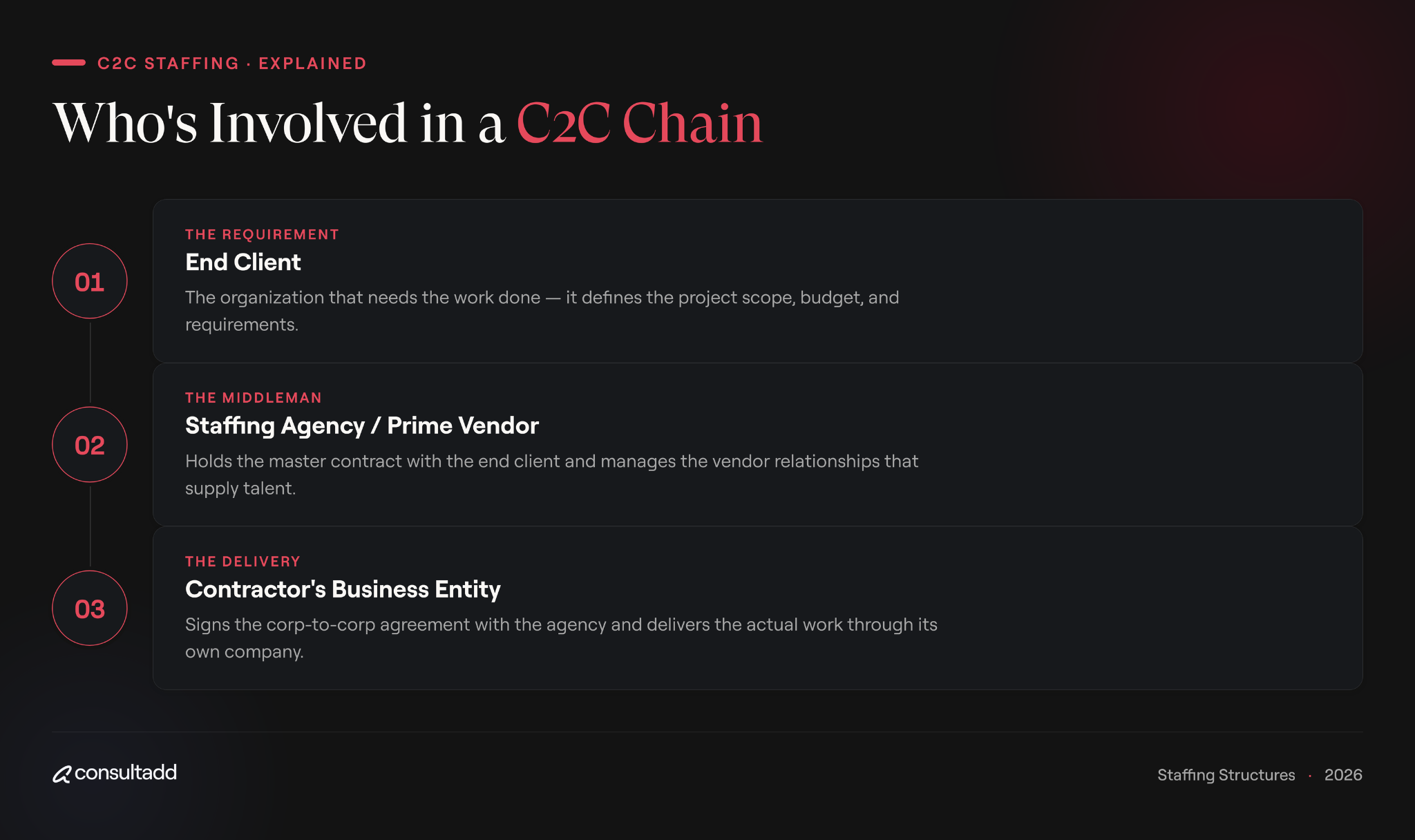
Money and paperwork flow down this chain, and so does risk. If one link in the chain isn't set up correctly, everyone above it can inherit the problem.
How a Corp to Corp Agreement Actually Works
Picture a nine-month software engineering project. The client doesn't want to hire full time for it. A staffing agency finds a contractor who already runs an LLC. The agency signs a C2C agreement with that LLC, not with the person behind it.
The contractor does the work. Their LLC invoices the agency. The agency bills the client. Everyone gets paid, but no one in the chain is technically the "employer" of the person writing the code, at least not in the traditional sense.
For a plain-language comparison of how this stacks up against other contract types, our guide on what contract work actually means covers 1099 and W2 setups side by side.
Corp to Corp vs W2 vs 1099
People mix these three up constantly, and honestly, the confusion isn't surprising. All three describe someone working on a project without a permanent job title, but the tax picture and the liability picture change with each one.
Why Companies and Contractors Choose Corp to Corp
For companies, C2C usually means no payroll taxes, no benefit obligations, and no long-term commitment. The relationship ends when the contract ends. There's no severance conversation to have.
For contractors, running a business entity brings more control over rates, the freedom to work with multiple clients at once, and tax deductions that W2 employees simply don't get.
None of that makes C2C the automatic right answer. It fits short, well-defined projects with niche skills far better than it fits an open-ended role where the company wants ownership over how the day-to-day work gets done.
Our piece on why C2C contract hiring solutions matter for recruitment goes into the scenarios where this model earns its keep.
Compliance Risks in Corp to Corp Staffing
This is where things go wrong for companies that treat C2C as a shortcut around hiring rules.
The IRS doesn't care what label sits on the contract. It looks at who controls the work, who carries the financial risk, and how the relationship actually functions from day to day.
The IRS's own guidance on employee versus independent contractor status lays out the same three factors examiners use in every classification review: behavioral control, financial control, and the type of relationship between the parties.
Get the classification wrong, and the Department of Labor's rules on misclassification can require back pay, overtime, and penalties, even when both sides agreed to the C2C label going in.
Corp to Corp and Visa Sponsorship
C2C gets more complicated once visa sponsorship enters the picture, especially for H-1B roles placed at a client's site instead of the sponsoring employer's own office.
USCIS pays close attention to these placements. Its guidance on third-party worksite requirements requires the petitioning employer to prove the work qualifies as a specialty occupation and that a genuine employer-employee relationship exists for the entire length of the petition.
That means real paperwork: signed contracts, detailed job duties, and a clear chain showing who actually directs the work. Skip this step and an H-1B extension can get denied or flagged for further review.
Our guide to corp to corp visa sponsorship for H1B jobs walks through the documentation USCIS typically asks for.
Is Corp to Corp Right for Your Hiring Needs?
C2C tends to make sense when:
- The project has a defined scope and a clear end date
- You need a specialized skill set you won't need on a permanent basis
- The contractor already runs a registered business with insurance in place
- Speed matters more than long-term retention
It tends to make less sense when:
- The role is genuinely full time and open-ended
- You want direct control over schedules, tools, and daily supervision
- The worker doesn't have, or want, their own business entity
If you land somewhere in the middle, that's usually a sign to bring in a staffing partner rather than guess your way through it.
Start Strong With Consultadd
With 15 years in business and 5,000+ successful staffing engagements, we don't just fill roles, we build reliability into your process. We've supported 65 staffing companies in the past year alone and maintain MSAs with industry leaders like Robert Half and TEKsystems.
Here's what working with Consultadd looks like:
- Talent sourced in under 24 hours
- Ready-to-deploy candidates, vetted for experience and compliance
- Lower turnover risk: we match long-term goals, not just short-term needs
- Seamless compliance: visa, documentation, onboarding? Handled.
- Dedicated 1:1 account managers for responsive, personalized support
- Top 100 candidate matches delivered in the past year
- Strong partnerships with universities to tap into fresh, committed talent
- Post-placement support so your investment grows beyond day one
For candidates, your next opportunity is more than just a job title, it's a chance to build skills, gain experience, and move your career forward. At Consultadd, we connect technology professionals with projects and employers that align with their goals, whether they're looking for contract, contract-to-hire, or long-term opportunities.
The tech job market moves fast, but the right guidance can make all the difference. Ready to take the next step in your career journey? Explore Opportunities >>
Key Takeaways
- Corp to corp means the hiring company pays a contractor's business entity, not the contractor as an individual.
- A real LLC, S-corp, or C-corp is required on the contractor's side. A sole proprietorship won't qualify.
- C2C shifts tax and benefit responsibility to the contractor's business, unlike W2 arrangements.
- Misclassification is the biggest compliance risk, and both the IRS and Department of Labor enforce it.
- H-1B placements under C2C need solid documentation to satisfy USCIS third-party worksite rules.
FAQs
What does corp to corp (C2C) mean in staffing?
Corp to corp means the hiring company or staffing agency pays a contractor's registered business, like an LLC or S-corp, instead of paying the contractor directly. The contractor's business invoices for the work and handles its own taxes.
What's the difference between C2C and 1099?
A 1099 contractor works as an individual and reports income on their own tax return. A C2C contractor works through a registered business entity, and that entity, not the person, is the party named in the contract.
Can a corp to corp contractor be on an H1B visa?
It's possible, but it requires careful documentation. USCIS scrutinizes third-party placements closely and needs proof that a genuine employer-employee relationship exists for the full length of the petition.
Do I need an LLC to work corp to corp?
Yes. A C2C arrangement requires a real registered business entity, typically an LLC, S-corp, or C-corp. Working as a sole proprietor doesn't satisfy the structure.
Who pays taxes in a corp to corp arrangement?
The contractor's business entity handles its own tax obligations. The hiring company doesn't withhold payroll taxes the way it would for a W2 employee.
Is corp to corp the same as being self-employed?
Not quite. Both involve working outside traditional employment, but C2C specifically requires a registered business entity as the contracting party, while general self-employment (like 1099 work) doesn't.

What Is a 1099 Business Opportunity? A Simple Guide
Introduction
You have probably seen it on a job listing or in a recruiter's email: a 1099 role, a 1099 gig, a 1099 opportunity. It sounds official, maybe a little intimidating. So what is a 1099 business opportunity, really?
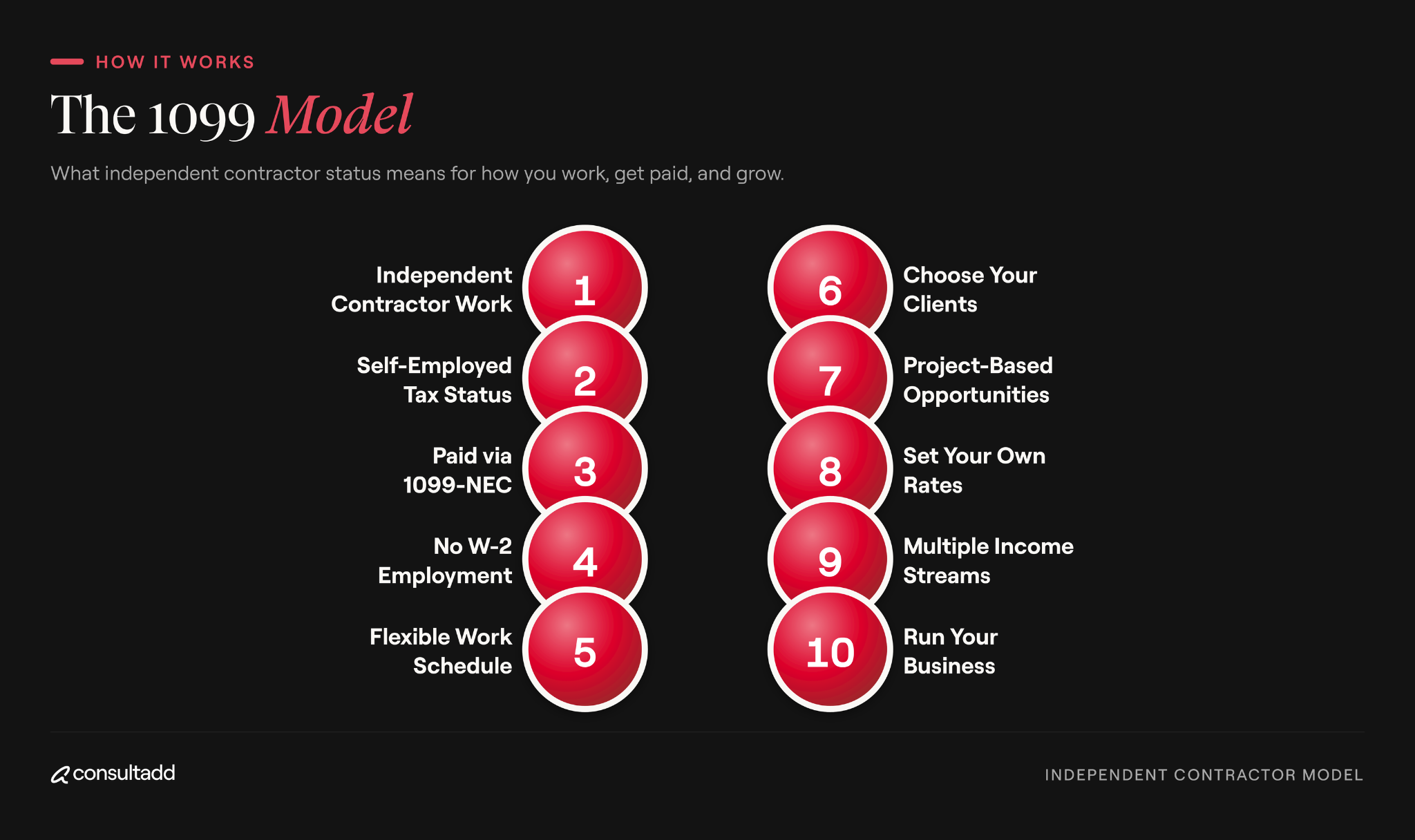
Here is the short version. It is not a product you buy off a shelf or a franchise you sign up for. It is a chance to earn money as an independent contractor instead of a regular employee. You offer your skills or services to a client, they pay you, and at tax time you get a Form 1099-NEC rather than a W-2. That one difference changes how you get paid, how you file taxes, and how much freedom you have over your work.
For a lot of people, that trade is worth it. For others, it is a headache they did not sign up for. Let me walk through how it works so you can decide which camp you fall into.
TL;DR
- A 1099 business opportunity is a chance to earn income as a self-employed independent contractor, not a job you buy or a franchise.
- You get paid without tax withholding, so you handle your own taxes and set aside 25% to 30% of income.
- The 2026 self-employment tax rate is 15.3%, and on $100,000 a 1099 worker pays roughly $7,065 more in employment taxes than a W-2 employee.
- The upside is control, flexibility, higher earning potential, and broad tax deductions.
- Watch for red flags like upfront fees or "recruit others to earn" pitches, which are not real 1099 opportunities.
What is a 1099 business opportunity?
A business opportunity, in plain terms, is a favorable situation you can use to start or grow something of your own. Add "1099" to it and you are talking about doing that as an independent contractor.
The name comes from the IRS form. When a client pays you as a contractor, they report it on a 1099-NEC (short for nonemployee compensation). When an employer pays you as staff, they use a W-2.
The IRS treats anyone who receives a 1099-NEC as self-employed, which is a tax status, not a business structure.
So a 1099 business opportunity usually means one thing: there is a demand for a skill you have, and you can meet it as your own boss.
Maybe a company needs a software developer for a six-month project. Maybe a growing business needs marketing help but does not want a full-time hire. You step in, do the work, and run it like a one-person business.
The best of these opportunities share a few traits. They solve a clear need, they pay well enough to be worth your time, and they can grow as you add clients.
How a 1099 opportunity actually works
The mechanics are simpler than the paperwork makes them look. You agree on a scope and a rate, you do the work, and you invoice for it. No taxes come out of your pay.
That money is yours to manage, which is both the appeal and the catch.
The 1099-NEC form and reporting thresholds
- If a single client pays you enough in a year, they send you a 1099-NEC and file a copy with the IRS.
- For 2026, that reporting threshold rose to $2,000, up from the long-standing $600 figure, under a recent tax law change.
- One thing trips people up here. You owe tax on all your self-employment income whether or not a form shows up in your mailbox.
- The 1099 is a reporting tool, not the thing that creates the tax. Keep your own records and report everything.
1099 versus W-2: who handles what
This is the comparison that matters most. A W-2 employer withholds your income tax, takes out your share of Social Security and Medicare, and pays the employer half on top.
As a 1099 contractor, none of that happens for you. You carry it all.
Neither column is "better" in the abstract. It depends on what you value. If predictability keeps you sane, W-2 has real appeal.
If you want control and can handle the admin, the 1099 side opens up.
The tax side you need to understand
This is where a 1099 opportunity earns its reputation. Not because the taxes are unfair, but because nobody is doing them for you. Go in prepared and it is manageable. Ignore it and April gets ugly.
Self-employment tax and what to set aside
Since no employer is splitting the bill, you pay both halves of Social Security and Medicare.
For 2026 that self-employment tax is 15.3%, made up of 12.4% for Social Security and 2.9% for Medicare, calculated on about 92.35% of your net earnings.
The Social Security portion applies up to a wage base of $184,500.
To put a number on it, a 1099 worker earning $100,000 pays roughly $7,065 more in employment taxes than a W-2 employee at the same income. That gap surprises people who jump to contracting for the higher rate without adjusting for it.
The fix is boring but works: set aside 25% to 30% of every payment for taxes. Pay quarterly estimated taxes if you expect to owe $1,000 or more for the year. Here are the 2026 numbers worth memorizing.
Deductions that lower your bill
Here is the part people forget when they only look at the tax rate. As a 1099 worker, the IRS treats you as a business, so ordinary business expenses reduce what you owe. You can also deduct half of your self-employment tax right off your income.
The qualified business income deduction lets many contractors write off up to 20% of their business income, and it is now permanent.
Add a home office, software, equipment, mileage, and a retirement plan like a SEP-IRA or Solo 401(k), and your effective tax rate can land lower than that 15.3% headline suggests.
For the full mechanics, the IRS self-employment tax page lays out the forms, mainly Schedule C and Schedule SE.
Pros and cons of a 1099 business opportunity
No sugarcoating here. A 1099 business opportunity gives you real freedom and real responsibility in equal measure. Weigh both before you commit.
The honest read: contracting rewards people who are disciplined about money and comfortable with uneven income. If a slow month would put you in a panic, build a cushion first. If you like variety and hate being told when to log on, this setup can fit you well.
How to spot a legitimate 1099 opportunity
Not everything labeled a "1099 business opportunity" is a real one. The term gets borrowed by pitches that are closer to a sales scheme than actual contract work. A little skepticism protects you.
Real contract work has a clear scope, a rate you agree to, and a client who pays you for services. If someone asks you to pay to join, or the money comes mainly from recruiting other people, that is not a 1099 opportunity. That is a warning sign.
There is also a legal angle. Some companies label workers as 1099 contractors when they treat them like employees, which is called misclassification. The IRS uses a test built on behavioral control, financial control, and the type of relationship.
If you think you have been misclassified, the U.S. Department of Labor and IRS Form SS-8 give you a path to a formal determination.
Common types of 1099 opportunities
The label covers a wide range of work. What ties it together is that you serve clients as an independent business rather than clocking in as staff.
Technology leads the list. Software developers, cloud engineers, data specialists, and IT consultants take contract roles constantly, often through a staffing partner that handles the client relationship and paperwork.
If that is your field, our overview of contract-to-hire roles explains how these engagements often convert into permanent offers, and IT staff augmentation covers how companies bring contractors onto their teams.
Beyond tech, you will find consultants advising on business or finance, creative freelancers like writers and designers, tradespeople, and gig platform workers. The tax rules are the same across all of them.
Start Strong With Consultadd
With 15 years in business and 5,000+ successful staffing engagements, we don't just fill roles, we build reliability into your process. We've supported 65 staffing companies in the past year alone and maintain MSAs with industry leaders like Robert Half and TEKsystems.
Here's what working with Consultadd looks like:
- Talent sourced in under 24 hours
- Ready-to-deploy candidates, vetted for experience and compliance
- Lower turnover risk: we match long-term goals, not just short-term needs
- Seamless compliance: visa, documentation, onboarding? Handled.
- Dedicated 1:1 account managers for responsive, personalized support
- Top 100 candidate matches delivered in the past year
- Strong partnerships with universities to tap into fresh, committed talent
- Post-placement support so your investment grows beyond day one
For candidates, your next opportunity is more than just a job title, it's a chance to build skills, gain experience, and move your career forward. At Consultadd, we connect technology professionals with projects and employers that align with their goals, whether they're looking for contract, contract-to-hire, or long-term opportunities.
The tech job market moves fast, but the right guidance can make all the difference. Ready to take the next step in your career journey? Explore Opportunities >>
Key takeaways
- A 1099 business opportunity is simply a chance to earn income as a self-employed independent contractor, reported on Form 1099-NEC instead of a W-2.
- You keep more control and gain wide tax deductions, but you handle your own taxes and give up employer benefits.
- Plan for the 2026 self-employment tax of 15.3% and set aside 25% to 30% of your income.
- Deductions like the 20% qualified business income write-off can pull your effective tax rate below the headline number.
- Vet every offer: real contract work pays you for services, while upfront fees or recruit-to-earn pitches are red flags.
FAQs
Is a 1099 business opportunity the same as a job?
Not exactly. A job usually means W-2 employment with taxes withheld and benefits provided. A 1099 opportunity means you work as an independent contractor, run your own taxes, and serve clients as a business. You gain freedom but take on more responsibility.
Do I need an LLC to take a 1099 opportunity?
No. You can operate as a sole proprietor and still receive 1099-NEC income. Forming an LLC or S Corp can offer liability protection and possible tax savings as your income grows, but it is optional, not a requirement to start.
How much should I set aside for taxes as a 1099 contractor?
A good rule is 25% to 30% of each payment. Since no taxes are withheld, you are responsible for self-employment tax plus income tax. If you expect to owe $1,000 or more for the year, the IRS wants you to pay quarterly estimated taxes.
What is the difference between a 1099-NEC and a 1099-K?
A 1099-NEC reports payments a client made to you directly for services. A 1099-K reports payments processed through platforms like PayPal or Stripe. For 2026, the 1099-K threshold returns to $20,000 and 200 transactions, but you still report all income regardless of which form arrives.
Are 1099 business opportunities legit or a scam?
Most are legitimate contract work. The term gets misused, though. Real opportunities pay you for a service under a clear agreement. If an offer asks for an upfront fee or the income depends on recruiting others, treat it as a warning sign and walk away.
Can a 1099 opportunity turn into a full-time job?
Yes, often. Contract-to-hire arrangements are built for exactly this. Both sides use the contract period to test fit, and many convert into permanent W-2 roles. Working through a staffing partner can make that transition smoother.

What's Work Authorization?
Introduction
You found the perfect candidate. Skills, culture fit, everything lines up. Then someone asks whether they can legally work here, and the hire grinds to a halt. If you have been there, you already know why this matters.
So what's work authorization? In plain terms, it is the legal permission a person needs to work in a country where they are not a citizen.
For employers, it is also a compliance line you cannot cross. Hire someone who is not authorized, and the fines land on you, not them. This guide breaks down what work authorization means, who needs it, the main types, and how you verify it without stepping into legal trouble.
TL;DR
- Work authorization is the legal permission to work in a country you are not a citizen of.
- U.S. citizens and green card holders are already authorized and need no extra document.
- Many non-citizens prove authorization with an Employment Authorization Document (EAD), also called a work permit.
- Every U.S. employer must confirm work authorization using Form I-9 for every new hire, citizens included.
- Getting classification or verification wrong can trigger fines, so process and paperwork matter.
What work authorization actually means
Work authorization is the legal right to hold a job in a country where you are not a citizen or permanent resident. In the United States, that right comes from your immigration status, your circumstances, or a document that proves both.
Some people carry their authorization automatically. A U.S. citizen does not think twice about it. A lawful permanent resident, or green card holder, is authorized to work without applying for anything extra, since the green card itself is the proof.
Everyone else usually needs to show something. That something is often a work permit, which brings us to the different types below.
If you want a staffing-focused primer on the topic, Consultadd has a clear rundown of what a work authorization is and why it matters in hiring.
Who needs work authorization
Citizens do not need to prove work authorization the way non-citizens do, though they still complete the paperwork every employer requires.
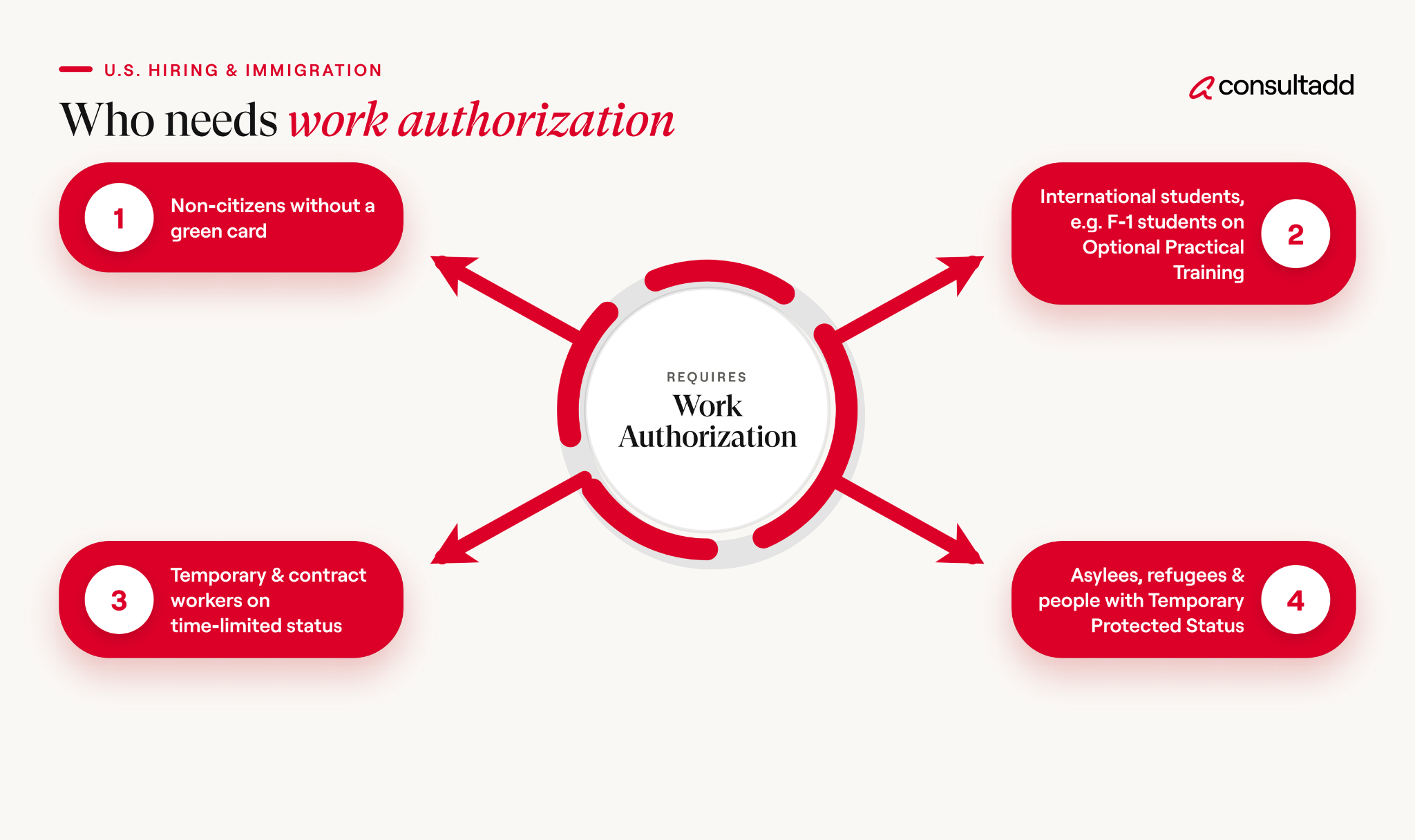
The people who actually need to establish work authorization tend to fall into a few groups:
- Non-citizens without a green card
- International students, such as F-1 students on Optional Practical Training
- Temporary and contract workers on time-limited status
- Asylees, refugees, and people with Temporary Protected Status
If a worker is not a citizen or a permanent resident, assume they need to show valid authorization before their first day. No card in hand usually means no legal start date, even for unpaid roles in some categories.
The main types of work authorization
Here is where people get lost, because "work authorization" is really an umbrella over several very different situations. Some workers are authorized because of who they are. Others are authorized only for a specific employer. And a large group has to apply for a card first.
Citizens and permanent residents
This group is the simplest. Citizens and green card holders can work for any employer, in any role, with no time limit tied to a permit. Their proof is built into documents they already hold.
Employment Authorization Document (EAD)
The EAD, officially Form I-766 and often called a work permit, is a card issued by U.S. Citizenship and Immigration Services. It proves a non-citizen can work legally for a set period. To get one, most applicants file Form I-765, and an approved EAD is usually valid for one or two years before it needs renewing.
The USAGov work permit guide is a good starting point for eligibility and how the card works. One planning note: rules on automatically extending an expiring EAD changed in late 2025, so always check current USCIS guidance before assuming a lapsed card still counts.
Employer-specific work visas
Some nonimmigrants are authorized to work "incident to status," meaning the status itself grants the right, but only for a specific sponsoring employer. H-1B and L-1B workers are common examples. They generally do not carry an EAD, since their approval notice and I-94 do the job. This is also where visa categories overlap and confuse people.
Consultadd's breakdown of the differences between H-1B and OPT visas untangle two of the most common ones.
How employers verify work authorization
Here is the part every employer has to get right. Federal law requires that every employer complete Form I-9 for each new hire, a rule in place since November 6, 1986. It applies to citizens and non-citizens alike.
Form I-9 does two jobs at once: it confirms identity and confirms work authorization. The employee attests to their status and presents documents, and the employer examines them to see that they reasonably appear genuine.
The catch that trips up new hiring managers: the employee picks which acceptable documents to show. You cannot demand a specific one. Doing so can count as discrimination. Workers choose either one document from List A, or one from List B paired with one from List C.
A List B document has to be paired with a List C document to cover both requirements. Keep the completed I-9 on file and make it available if federal officials ask to inspect it.
Work authorization vs a work visa
People use these terms as if they mean the same thing. They do not. A work visa is one route to work authorization, but authorization is the broader idea.
So a work visa can give you work authorization, but you can also have work authorization without a traditional work visa, for example through an EAD tied to asylum or a pending green card.
Common work authorization mistakes to avoid
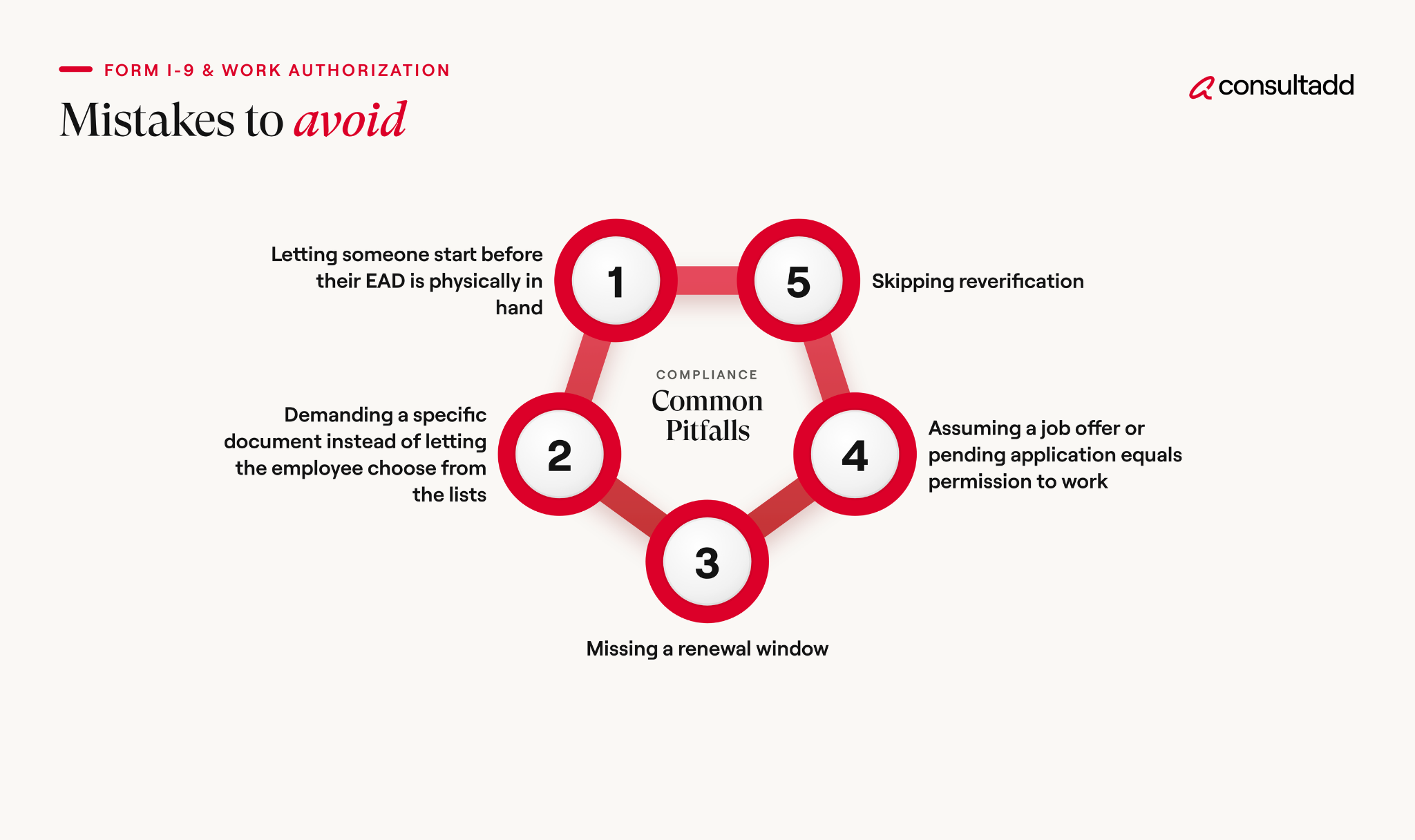
A few errors show up again and again, and each one carries real cost:
- Letting someone start before their EAD is physically in hand.
- Demanding a specific document instead of letting the employee choose from the lists.
- Missing a renewal window and letting authorization lapse mid-employment.
- Assuming a job offer or pending application equals permission to work.
- Skipping reverification when a time-limited authorization expires.
For staffing teams juggling many placements at once, this is where a partner earns its keep. Handling compliance across contract and project roles is a core part of project-based recruiting and staffing, and getting it wrong slows every hire behind it.
The bottom line
So, what's work authorization? It is the legal green light that says a person can work, and the paperwork that proves it.
- For workers, it decides whether they can accept a role.
- For employers, it decides whether a hire is safe or a liability.
Get the status right, verify it properly, and track the expiration dates, and most of the risk takes care of itself.
Start strong with Consultadd
With 15 years in business and 5,000+ successful staffing engagements, we don't just fill roles, we build reliability into your process. We've supported 65 staffing companies in the past year alone and maintain MSAs with industry leaders like Robert Half and TEKsystems.
Here's what working with Consultadd looks like:
- Talent sourced in under 24 hours
- Ready-to-deploy candidates, vetted for experience and compliance
- Lower turnover risk: we match long-term goals, not just short-term needs
- Seamless compliance: visa, documentation, onboarding? Handled.
- Dedicated 1:1 account managers for responsive, personalized support
- Top 100 candidate matches delivered in the past year
- Strong partnerships with universities to tap into fresh, committed talent
- Post-placement support so your investment grows beyond day one
For candidates, your next opportunity is more than just a job title, it's a chance to build skills, gain experience, and move your career forward. At Consultadd, we connect technology professionals with projects and employers that align with their goals, whether they're looking for contract, contract-to-hire, or long-term opportunities.
The tech job market moves fast, but the right guidance can make all the difference. Ready to take the next step in your career journey? Explore Opportunities >>
Key takeaways
- Work authorization is the legal permission to work in a country where you are not a citizen.
- Citizens and green card holders are already authorized, while many non-citizens need an EAD.
- The EAD (Form I-766) is issued by USCIS and usually valid for one to two years.
- Every employer must verify work authorization with Form I-9 and let the employee choose which documents to show.
- Most compliance risk comes from timing and paperwork, so track statuses and renewal dates closely.
FAQs
What's work authorization in simple terms?
It is the legal right to work in a country where you are not a citizen or permanent resident. In the U.S., that right comes from your immigration status, your circumstances, or a document like an EAD that proves it. Employers must confirm it before you start.
What is the difference between work authorization and a work visa?
Work authorization is the broad legal right to work. A work visa is one specific way to get that right, usually tied to a sponsoring employer. You can have work authorization without a traditional work visa, for example through an EAD.
Who needs an Employment Authorization Document (EAD)?
Non-citizens who are not green card holders often need an EAD, including many students on OPT, asylees, TPS holders, and people with a pending green card. Citizens and permanent residents do not need one, since their existing documents already prove authorization.
How do employers verify work authorization?
Employers use Form I-9 for every new hire. The employee presents documents that prove identity and work authorization, and the employer reviews them. The employee chooses which acceptable documents to show, and the employer cannot demand a specific one.
Can someone start working before their EAD arrives?
Generally no. In most categories, a worker cannot legally begin until the EAD card is in hand and any required start date has passed. Starting early can violate their status, so it is worth waiting for the physical card.
How long is work authorization valid?
It depends on the basis for it. An EAD is usually valid for one or two years, then needs renewal. Status-based authorization lasts as long as the underlying status. Citizens and permanent residents have no expiration tied to a permit.